Showing posts with label honeybees. Show all posts

The Show

Monday, May 28, 2012

Wonderful Pomegranate in Full Bloom
It's Memorial Day Monday at the Bird Ranch and the Show is on full display. It happens at this point every year it seems. Some years the show is a little better than others. This happens to be one of "them years." The Show is on.

I am, of course, referring to the show that our pomegranate tree is putting on. Largely hidden from the rest of the world, our four year old Wonderful Pomegranate is erupting with one of the most incredible and brilliant flower displays I've ever seen.

A Colorful Flower Show
Why did I stick this thing in a side yard? Why am I that dumb? While I knew that I wanted a pomegranate tree in the fruit salad Bird Back 40 collection, based upon my enjoyment of them as a child, I had forgotten the rather brilliant display this tree had given me as a child all those years ago in mid-1970's Modesto.

The tree that inspired me all those years ago is still alive and kicking, believe it or not. Located in front of a Norwegian Avenue home near what used to be an old-style A&W drive-in restaurant, it is well manicured and is as productive as ever. Hello old friend. It's good to see you again.

A Native California Pollinator
Given another chance? I would have stuck the Santa Rosa plum tree in the side yard and put the showy pomegranate out front.

This is going to be the heaviest year yet for pomegranate production thanks to some uber-pollination efforts that are currently taking place. A close examination of this tree yields the discovery of multiple pollinators. I spotted several of the Halictus species, aka sweat bees, just going to town on the coral red flowers and bright yellow stamens. The tree is very close to a mason bee home that I received as a gift several years ago, and they were out in abundance as well.

Hummingbird in Flight: Center Right
Honeybees also could not resist the lure and aroma of these tempting flowers, many of which have been transformed into small pomegranates. And just when I thought the show couldn't get any more diverse, in dropped a neighborhood hummingbird for a sweet drink of pomegranate flower nectar. He quickly zoomed away before I could get a proper closeup, but he's clearly visible in the one photo I managed to snap.

Short and sweet? I love the Show. This tree literally hums with life and production during the spring. Lenny, the Giant Maine Coon Kitten, enjoys the shade it provides below. It also serves as a base from where he can conduct a surprise charge and attack against the unsuspecting dog, aka, Ultimate Digging Machine.

Heavy Crop Now Forming
The pomegranates that are now forming will grow and add size and girth through the summer months. When they turn a glossy dark red in the fall, usually late October, it's time to harvest. I've learned, through experience, that harvest season is fairly quick. You can't allow pomegranates to hang on a tree like citrus. If they are not harvested quickly, they will split and spoil easily.

This means lots of gifts for family, friends and neighbors. It also means lots of pomegranate juice, which is a wonderful addition to freshly-squeezed lemonade. Pomegranates are also great for fresh eating, though they can be messy. Even after 40 years, nobody has quite discovered how to take the mess out of pomegranates. It's enough to make any mother of an eight year old pomegranate crazed boy cringe in terror.

It's pomegranate season. The show is on.

It's SWARM Season!

Saturday, April 14, 2012

Hello Kitty Hive Back in Action
Hey Baby? Wanna get stung?

Gentlemen -- it's not the kind of pickup line that is going to win many style points -- if you get my drift. While some ladies might be up to the challenge, a line like this is likely to result in another type of sting, in the form of hand against cheek. That's her hand -- your cheek. So do be careful.

After many fits and starts -- SWARM season is finally underway in Northern California. The queens in wild colonies of bees that span many of our wild areas, including the Sacramento and American Rivers, have spent all winter building up brood populations. And once these numbers get to a certain point, the hive splits. A new queen emerges -- and the old queen leaves -- usually taking about half of the colony with her.

A Wild Swarm for our Neon Pink Hive
This is nature at its finest. This is how many backyard beekeeper hobbyists like myself, acquire new hives. The bees that you see flying about our neon pink Hello Kitty hive pictured above right and to the left are the result of a wild swarm. This was my very first swarm call. It was my very first attempt at capturing a boatload of bees, and bringing them home to the backyard, Hello Kitty Hive.

Whaddya know? It worked!

There are two ways to bring a colony of bees into your backyard: wild swarms and packaged bees. I must admit, I'm a fan of wild swarms over the packaged bees for reasons that I will get into a bit later. But first -- I need to thank someone. Her name is Lauren Scott. Thanks to Lauren, I have a wild swarm that is so large, so healthy and so active, that it will probably produce honey this year rather than next.

That's a nice advantage.

Swarm Catcher on the Loose!
If you're going to get into the swarm catching business, the number one rule of thumb is: BE PREPARED. Bees don't operate by the clock. They generally don't swarm at night, but can swarm in the morning, mid-afternoon or even late afternoon. There is a very short window of time for capturing a swarm like the one pictured above.

To put it short and sweet? There is no time to drive home, get dressed up in swarm catching duds, then return to the scene of the swarm. By that time it could be LONG gone, and you will have missed a golden opportunity. This is why I keep my beekeeping equipment in the back of my truck. Every tool a beekeeper needs to hive a wild swarm is right at my fingertips. You'll never know when a swarm call will happen. But, during the spring months, it will happen.

In the case of Lauren Scott? She noticed the buzzing activity outside her downtown Sacramento home about two weeks ago. Most swarms can be kind of scary to the uninitiated. They're loud. They make quite the racket. Bees will whiz and buzz right by your ears in a frenzied, excited, agitated state. If you have a fear of getting stung, getting caught near a wild swarm is not a nice place to be.

Lauren's Swarm-A FAT ONE!
However, this is often the safest way to approach a colony of bees. They are in an excited state because a queen has left the hive. Remember that bees are insects and react instinctively. The overriding instinct during a swarm is: protect the queen from harm. If you see a large mass of bees -- a swarm -- that has come to rest on a tree branch or a fence -- understand that there is a queen in the center of that mass. The worker bees and drones have come to rest around her.

Bees will react with a stinging party for two reasons: The first reason you may have learned as a child. If you step on a bee, and you're barefoot as I was all those years ago, you're going to feel a nice little jolt at the bottom of your foot. It is not pleasant. The second reason that bees will sting is an instinctual response to "protect the hive." If bees feel threatened by your presence around a hive, believe me, they will let you know it.
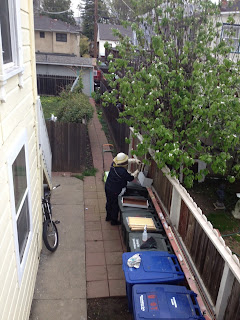
Swarm Collection Underway
But in the case of the wild swarm that Lauren spotted -- there is no hive to protect. Therefore, there is no reason for bees to sting. Indeed, bees are in their most docile state right after they've swarmed. Now, this doesn't mean that you should approach a swarm without protection. There are no guarantees in the world of beekeeping. And I'm not guaranteeing that you won't get stung once or twice if you get too close to a particular, agitated swarm. In the world of beekeeping, the number one rule of thumb is: Never Say Never. Capice?

I had spent the entire winter preparing for this swarm call. I'm still not comfortable enough around bees to approach a hive without protection. There are some beekeepers who will do this job in a t-shirt, shorts and sandals. This is not my approach. This is not for Bill Bird. Bill Bird is a chicken. Bill Bird opts for protection. And protection means a thick suit, gloves, veil, smoker, water bottle and more.

One more thing? The beekeeping community does not produce bee suits in Bill Bird type proportions. They probably do, but it would have to be a special order. I hate special orders. Special orders cost $$$. And if the "special order" suit is two sizes too small once it arrives? Tough luck beekeeper. Time to put on some shorts and sandals.

Preparing for Swarm Collection
So -- in my case? I improvised with a pair of common overalls from Dickies Mens Wear. While I would prefer these overalls to be in a white or light color, Dickies doesn't make anything that large in a white or light color. So -- you purchase the dark blue option and live with it. Working in dark colors around a hive isn't always the smartest option. In my bee suit I resemble a big blue bear. Bees and bears do not mix well. Bees don't like bears for the havoc they often bring when breaking into a hive for honey. A colony of bees can and will react with a stinging party if they are bothered by a particular dark color.

But in my case? I had no choice. It was either dark blue or shorts and sandals.

Swarm Below
The particular colony that Lauren spotted had come to rest against a fence post in a side yard of her downtown Sacramento home. I was lucky. That swarm could have landed on a tree branch 20 feet out of my reach. It could have landed on top of a home. It could have landed on a second story windowsill.

But, instead, this queen chose the temporary perch of a fence post that was about five feet off the ground. The workers settled around her. It was a mass of bees. Early swarms are large swarms. And this was one large swarm that would eventually cover five full frames. For beekeepers? This is like winning the lottery.

As I approached this mass of bees for the first time, I remembered the swarm catching lessons that I had learned from other beekeepers. The number one rule of advice? Stay calm. Stay focused. Bees can smell fear. After placing my swarm catching box on a waste can directly below the mass of bees, I sprayed them with smoke and then started squirting them with a water bottle.

Why I Keep Bees: Honeybee Pollinates Cherry Tree
Why the smoke? There's something about smoke that serves as a calming influence. It also reduces the numbers of bees that will attempt to fly away. The water acts as the same deterrent. Bees can't fly with wet wings. And the weight of the water will eventually cause this mass of bees to fall. This is exactly what I wanted, as I had strategically placed the swarm catching box just below them.

It is a magical sight when large swarms like this fall into a swarm catching box. It looks much like running water as streams of bees gently fall into the box below. Once the stream stops -- it's time to bring out the water bottle for more water treatment on the bees that remain firmly on the fence post. Your goal as a beekeeper is to ensure that the queen gets inside that box. Once she's there, the worker bees and drones will follow, almost like a small army.

The collection effort worked better than I ever could have imagined. When most of the bees had fallen into the box, I gently placed frames inside and closed up the top. I then proceeded to remove a small plug at the side of this swarm collection box. This was the real test of my efforts. If I had captured the queen? Bees would march right through that opening and into the box. If I hadn't captured the queen? There would have been a mad rush to escape.

Imagine the satisfaction that washed over me as I watched the bees march, two-by-two, side-by-side, through that small, dark opening and into the darkened swarm collection box. I had captured the queen. This swarm collection was a success.

Hello Kitty Hive
Despite this successful collection, I wasn't out the woods just yet. The next step was to transport the colony home and then "hive it" into the waiting Hello Kitty hive. Neither step is easy. Bees don't like long car trips. Have you ever taken a cat to the Veterinarian? Bees react in much the same matter. There's always that chance they'll come swarming up out of the swarm collection box and right into your face once the cover to the swarm collection box has been removed.

That's no fun. Trust me.

Luck, however, would once again prevail. The colony was calm. Most of the bees had settled onto the five frames inside the swarm collection box and showed no intention of leaving. The next step was to place each frame inside the Hello Kitty Hive -- shake the remaining bees out of the box and into the hive -- cover it and step away.

Once again -- Lady Luck was with me. As I stepped away from the hive and started to pull off my bee catching gear -- it suddenly struck me how easy this process was. I didn't notice that stray bee on my neck as I was congratulating myself on a job well done. I realized -- proudly -- that I hadn't been stung once during the entire process.

That is until that stray bee flew into my ear and proceeded to insert a well-placed DAGGER.

The joys of beekeeping.

Sumthin Scary in the Bird Back 40...

Tuesday, October 4, 2011

Bird Back 40-Side Yard Test Bed
The photo to your immediate right is the state of just one part of the Bird Back 40. Scary, isn't it? When you see weeds THAT big? How did that little tiny weed reach a height of six feet? Why can't I see the back fence anymore? What is that traversing around and through the citrus trees?

That -- my good friends -- is a series of pumpkin vines that the Wife That Is Venus and I planted earlier this spring in the Back 40 "Test Bed." Keep in mind -- I've grown pumpkins before. But I've never experienced vines like this. They have extended 40-to-50 feet beyond where the seeds were originally planted and are intent upon growing right over the fence and into the neighbor's yard.

I hope the neighbor likes pumpkins.

Pumpkins here-Pumpkins There!
I know what you're thinking. What good are pumpkin vines if you don't have any pumpkins on them? That's a good question. Don't worry. Pumpkins I got. Way, way, way too many pumpkins. In fact, I'm not really sure how many I actually have. When the vines started to take off and grow Every Which Way but Loose during the summer, I sorta lost count.

At first? I thought it was kind of cute to have a pumpkin growing off a stalk of corn. What's that growing on the Caspian Pink Heirloom Tomato bush? A pumpkin! Pumpkins hanging from the Meyer Lemon tree? Grapes the size of pumpkins? Or just pumpkins? Short and sweet: The pumpkins are everywhere.

Note: This is what happens when you plant three different varieties of pumpkin seeds. You tend to get a LOT OF PUMPKINS.

Mass of Pumpkin Vines and PUMPKINS!
Mental note: Do not make the mistake of planting watermelon and cantaloupe seeds in the general vicinity of pumpkin seeds. Pumpkins will overtake them -- cover them  -- and essentially starve them of sunshine and nutrients. If you make the same mistake as I did -- and plant pumpkin seeds near melon seeds -- you will get lots of pumpkins.

And not much else.

Although it's probably now safe to tear out the vines and place the pumpkins in a pile in the Bird Back 40 -- I'm going to leave them in for as long as I can. We will get around to harvesting pumpkins for the all important holiday of Halloween -- and of course of pie and bread purposes (one of the varieties is a sugar-sweet pumpkin that is perfect for these types of creations). But I'm going to keep the vines going for as long as I can.

If this means I'm still growing pumpkins in December -- so be it.

Pumpkin Vines & Pumpkin Flowers
There is a method to my madness. The summer growing season is now coming to a close. All important sources of pollen that honeybees need to survive and thrive are starting to dry up. In response? Colonies are preparing for winter.

But if there's one thing I've learned? Flowers produced by pumpkin vines are like CRACK for worker bees. They are large producers of the pollen that bees need to survive and thrive. The pumpkin patch literally hums and buzzes with bee activity in the early morning and afternoons. There's not much left in terms of pollen producing plants, shrubs and trees. And I have pumpkin flowers coming out of my ears.

It would be shame to tear them out while they are still producing. So -- for now? The vines stay. This means the Hello Kitty Colony of bees will have a continuing source of pollen -- and won't suddenly turn defensive when the last pollen source vanishes. Defensive colonies are difficult to deal with. One wrong step invites a "kiss" (sting) from the hive.

Sugar Sweet Pumpkin
I'd rather avoid that if at all possible.

And so -- this is my very scary tale. Halloween is fast approaching. That means little ghosts, goblins and ghouls in the neighborhood and perhaps a Spiderman or two. If you happen to run across a home that is ablaze with lighted pumpkins, come on in and make yourself at home.

You've arrived at the Bird Back 40. The kegerator is located just inside the garage and to your right.

The Moment of TRUTH!!!

Monday, April 20, 2009

The time had come. I could not ignore the task at hand any longer. The honeybee project that Venus and I have been working on for a solid six weeks was about to come to a BUZZING conclusion.

Yes -- that's right. It was time to GET STUNG!

Actually, it was time to introduce a new colony of bees to their new, and custom, Hello Kitty beehive. I've been dreading this moment for quite some time.

WHY you ask? Do you relish the thought of being the "center of attention" in a swarm of bees? Because, that's exactly what happens when you "hive" a new colony of bees. You're the center of attention. And the invited guests are royally pissed off at some rough behavior.

Venus and I picked up our new colony of bees from Sacramento Beekeeping Supply on Saturday. Although many beekeepers had advised me that I would probably get stung during the hiving process, the fine folks at beekeeping supply reassured me that it probably wouldn't happen.

You see, I'm mortally afraid of getting stung by a bee. Come to think of it -- I'm mortally afraid of just about anything. I'm a 6'2, 300 lb. wuss in sheep's clothing. I cry when I watch Kevin Costner in Field of Dreams, or whenever I hear a good song. I'm not one of those tough guys. I'm as soft as they come. I haven't been stung by a bee since I was four or five. And the thought of getting stung now -- well -- that made me nervous.

But -- as it turns out -- the fine folks at Sacramento Beekeeping Supply were dead on RIGHT! I just didn't know it then. I do now. The Italian Honeybee is a fairly gentle creature. I know it doesn't seem that way when you're stuck in a swarm of them, but they are.

The first step in hiving a new colony? Getting dressed up in an outfit that would make any trick-or-treater proud with envy. In short, you take every possible measure to look as dorky as possible. And, in my heavy 49'er sweatshirt -- cap and faceguard -- plus gloves that extend up to the elbow -- well -- I looked as dorky as possible. It was a good 90 degrees outside during this hiving project, plus I was as nervous as a teenager on a first date with a Playboy model.

The time had come.

The bees were in that box that you see pictured to the right -- and they instinctively knew that "something was up." You could hear them buzzing lightly from time to time, but the moment I picked up that box and carried it near the hive, they just knew something was about to happen.

Placed on that box is a sprayer bottle of equal parts sugar and water. That's very helpful when you're dealing with honeybees. They're attracted to that stuff like young kids are attracted to grape snowcones. In short, they're not paying attention to the buffoon with an oversized 49'er sweatshirt on -- they're after that sugar water. Lastly came the "hive tool" and a standard smoker that I'd filled with torn up pieces of paper, dead weeds from the garden and pieces of bark.

My job was to first spray the bees with sugar water, then give the box a couple of good whacks. This would hopefully dislodge them from the lid that they were hanging on at the top of this box. At least, I thought it was a lid. It sure looks like one, right? But, upon removing it, I realized it was the top lid to some canned product that was still very full! It actually felt like a can of pumpkin or tomatoes -- and it wasn't easy to lift out.

After slapping the box a few times to dislodge the bees -- I removed the can, then place a piece of wood over the box to prevent the bees from escaping. Some do, of course, and guess what happens? You're the center of attention in a small swarm of about 15-20 bees.

"OK," I thought. I can handle that. Not a problem.

The next move? Removing the Queen from the hive of bees. The queen is placed into a smaller box -- think box of matches -- to protect her. She is relatively new to the hive. If she's added to a mix of bees too quickly, the other bees just might tear her apart. And that's death to a hive. Without the queen, it's just a box of bees that will soon disperse in search of new homes. The queen keeps them together.

I had been advised to keep that queen in her small cage after retrieving her -- which means I had to remove the wood from the hole in that box opening. I did retrive her easily enough -- a few more bees escaped, and I hung her cage against one of the many slats in the beehive. There are bees all over this boxed queen that you need to be very careful of. One wrong move and POW! You invite a stinging party.

But -- remove the queen I did. And I managed to place that cage exactly where I was supposed to place it -- and secure it as well without maiming a single bee. Keep in mind that, by this time, even though the box was covered again, I had bees all over my gloved hands, all over my 49'er sweatshirt, and buzzing all about.

But this was nothing. Nothing can prepare you for the moment of truth that was about to come. It was time to take the rest of the bees in that box -- who were terribly anxious to get out -- and introduce them to their new home.

You'd like to think that this is as simple as "Hello Mr. and Mrs. Bee, please come out and aquaint yourself with your new home and surroundings." It would be nice if the hiving process worked like that. It doesn't.

The next step was to take that box of bees -- remove the wood covering the top -- turn it upside down -- hold it over the open hive and slap it silly. Two or three good whacks was all it took for the majority of bees in that box to fall out -- and go SMACK into the bottom of the hive.

What happened next was truly the "Come to Jesus" moment in hiving a new colony of bees. That low hum of buzzing? It suddenly jumped exponentially to an excited scream of annoyed honeybees. Finally freed from their cage, they began to swarm. The pictures simply do not do any justice here. You cannot see this rather annoyed swarm of hundreds of annoyed honeybees, but trust me, they were there. And they were highly agitated.

But, this is precisely the point where you remain calm. There's work to be done. It's 90 degrees outside. You're covered up like it's the middle of winter in Montana. You've got lots of new and very agitated friends and you've got to look right back down into the innards of that hive.

It's not easy. But it had to be done.

The next step was to replace the four or five slats I'd removed from the hive several hours earlier. You'd think this would be an easy task, except the slats were leaned up against the hive. And -- as you might guess -- they were covered with agitated honeybees. But, each one had to be picked up and lifted back into the hive, taking special care not to crush any of the bees milling about on the bottom and on all sides of the hive.

I managed to do this, and put the cover of the hive back on, without much of a problem. At that point, I leaned the original box against the hive (some bees did not spill out with their brothers and sisters), picked up my tools and walked away.

Job completed. Colony of Bees hived. No bee stings. Time for a beer.

But, we're not done yet. Remember the Queen? She is still caged. At some point -- probably tomorrow night -- I will be forced to don my dorkish gear and open up that hive to get the queen out of her cage. This is, again, not an easy task. The queen will be agitated. Hopefully, the bees who have accepted her by this time, will be agitated as well.

There is only one proven way to find out if the queen has been accepted. I must open the hive back up, which will bring bees welling to the top. I must remove the queen cage, which is at the top of a slat. I must take one of the gloves off, and run my bare finger along the queen cage. If the bees covering this cage move out of the way of my finger -- the queen has been accepted. If not, I can't remove her just yet.

Should she be accepted, here comes another tricky job. There's a hole at the end of the queen cage covered with a cork. If I just remove the cork, the queen will fly away and the rest of the bees will follow her wherever she goes. She might come back to the hive. But then again, she might not. Lose the queen, and you lose the hive.

So -- one of the jobs will be to plug a small marshmellow into the hole that is currently covered with cork. And it must be done swiftly and delicately, before the queen can react to an open escape route.

Should I react quickly enough to plug up the open hole with a marshmellow, I'll place the queen cage back at it's original spot on top of a slat, and the worker bees will eat away at the sweet treat, freeing the queen from captivity and ready to take her rightful place in the hive.

But, keep in mind tht I am neither swift, nor delicate. This should be an interesting job indeed. Stay tuned for the next edition of "The Birds and their Bee Farm."