Showing posts with label Armenian Cucumbers. Show all posts

Harvest Season IS NOT a Celebration!

Tuesday, August 9, 2011

Heirloom Tomato Harvest: Bird Back 40
Let me get this straight: Harvest Season is WORK! Celebrate all you want -- but when you come home after a week in Santa Cruz and Seattle to find 50-60 lbs. of ripe heirloom tomatoes hanging off the vine -- you don't crack open a 12-pack and crank up the IPOD.

Nope -- you get to WORK son. Because the clock is TICKING! Mother Nature isn't about to wait around until you're good and ready to save that bountiful summer produce. Nope! What's on the kitchen counter right now turns to slop in 24-48 hours -- so you BEST GET WORKING.

With all due respect to my fine gardening friends at the Fair Oaks Horticulture Center who hosted the annual Harvest Celebration this past weekend (a fun event that I was sorry to miss) -- celebration my left foot!

Blessed with Heirloom Production
The wonderful wife that is Venus and I took our first tender steps at canning summer produce two seasons ago when we were confronted with a boatload of production from our heirloom tomato plantings. Little did we know that we would progress from those baby steps to perfecting a number of canning-safe recipes that have resulted in numerous quarts of whole heirloom tomatoes, tomato sauce infused with fresh basil and peppers, dill pickles infused with dill (surprise!), creamed garlic, thai basil and other spices and the always famous -- always in demand -- Roasted Garlic, Pepper and Heirloom Tomato Salsa.

The first step in any canning process is to first gather up the produce. We knew -- before we left for eight days of wedding duties and other family gatherings -- that the garden was giving that tell-tale sign of over-production. So, we weren't all that surprised to discover a multitude of vine-ripened heirloom tomatoes and aircraft carrier sized squash upon our return.

I know that a number of growers in the Sacramento area are not having the best of years when it comes to tomato production. I don't know why we have been so blessed. It might be micro-climates. It might be the fertilizer cocktails that I've been feeding the garden with through the summer. It just might be dumb luck (probably). Yes, we've been cursed with quite a bit of Blossom End Rot (BER). But it hasn't slowed us down much.

Whole Tomatoes, Skins Removed, Ready for Canning
The multitude of pepper plants that we have planted nearby in the Bird Back 40 are just as loaded as the tomato offerings -- but unlike the tomatoes -- the peppers are still another week or two away from that "ready to harvest" stage that's required for our salsa concoction. So, the tomatoes pictured above were dropped in vats of boiling water to remove skins and saved for whole tomato canning purposes.

The end result? About 18-quarts of whole tomatoes. That's not bad -- but still not quite enough to last through an entire winter (plus -- they make great gifts at Christmas).

The ripe heirloom tomatoes weren't the only item begging to be picked this past Sunday. The cucumber plantings -- while late -- had finally taken off. The wife that is Venus LOVES cucumbers. She can't get enough of them -- in salads or in other dishes. So she manages to plant several pickling and slicing varieties -- which include my favorite: the Armenian Giant.

Pickling and Armenian Giant Cucumbers
Not only does the Armenian Giant go well in salads and other creations -- it also happens to be one of the tougher cucumber customers. And that toughness makes it a perfect candidate for pickling. Not all pickling cucumbers can stand up to the home-canning process. They tend to get soft. Trust me when I tell you that there's nothing worse that a soft pickle. Pickles are destined to be crunchy. And crunchy pickles are what we specialize in at the Bird Home for All Things Canning.

So -- this past Sunday -- while the cucumbers were soaking in a giant vat of ice water -- Venus and I were preparing multitudes of heirloom tomatoes for the whole tomato canning process. We also put a new weapon to work in the kitchen: a pressure canner.

Cucumbers Soaking in an Ice Water Bath
There are plenty of ladies in this world who would prefer shoes, clothing or fine jewelry for Christmas. The wife that is Venus instead requests things like ironing boards, vaccum cleaners and pressure canners. I grew up in a Modesto family where I would have been lined up against a wall and shot repeatedly for the crime of buying my mother or any sister an ironing board for Christmas. It was a lesson that I learned well.

Venus has had to do quite a bit of de-programming. While she enjoys and receives some of the finer things in life -- she also requests items where Bill Bird dare not tread as a child. It wasn't all that long ago -- if you recall -- when Feminism was the rage. If there was a newspaper story about a husband run down by an angry wife for the crime of purchasing her an ironing board for Christmas, the usual response from my mother and sisters was something along the line of: "well, he probably deserved it."

So, when Venus requested a pressure canner for Christmas last year? I was just a tad nervous.

Whole Tomatoes in a Pressure Canner
But, not to worry. If there's one thing I've learned about Venus -- it's that she is the Master of the Garden. Everything she touches, grows. It's not a chore for her. It's not a chore for me either. She loves putting the "V for Venus" gardening boxes through a workout. I love it too. That "love" for everything gardening has transcended into saving the produce that she creates. She watched her grandmother perform this chore. She watched her mother do the same. Although she holds a degree from Berkeley, it doesn't stop her from getting down and dirty.

The pressure canner is indeed a vast improvement over the water-bath canner that we have used for the past two seasons. Not only is it a time-saver in terms of getting the job done quickly -- but it also results in far less mess in the kitchen. Short and sweet? I should have invested in a pressure canner years ago.

Sealing Pickle Quart Jars
Canning in the Bird Household is always a team effort. Although one person can easily perform this task -- it's a lot more fun when four hands are involved. The process of canning summer produce isn't that hard -- it's the prep work leading up to the process that takes the vast amount of time.

You can't just pick and toss tomatoes into canning jars and be done with it. The same rule applies to cucumbers and other goodies from the backyard garden. With a pressure canner at the ready, a gardener can put just about anything into a prepared mason jar and save it for winter use.

There is truly nothing better than sharing a jar or five of Roasted Garlic, Pepper and Heirloom Tomato Salsa with family and friends. There's nothing quite like cracking open a jar of heirloom tomatoes in the dead of winter and breathing in that deep and satisfying scent of summertime produce. A can of tomatoes purchased at a store simply cannot compare to the taste of home-canned heirloom tomatoes. Once you've had that taste there is no going back.

Quarts of Whole Tomatoes and Dill Pickles
But I'm not going to fool you kids -- not for a second. Remember this important fact: Harvest Season isn't for celebrating. Harvest Season is work.

And our work is just beginning. That sweet summer payoff is now underway.

I'm Just PICKLED Pink!

Saturday, April 3, 2010

Bleah! Sorry folks -- but it's the only word I can think of after waking up this morning with the "Mother of all Hangovers" (thank you Saddam Hussein!). This one is a DOOZY.

It's safe to say that Venus and I spent most of our Good Friday being VERY BAD indeed. After trying and failing miserably to get our taxes done (our accountant decided to take the day off -- and didn't tell us) -- we embarked on our annual "Pacific Adventure!"

Oops -- slight typo there. There should be an *O* at the end of "Pacific." As in -- Pacifico. What is the "Pacifico Adventure?" Find the nearest Hole-in-the-Wall Mexican-themed restaurant -- order up some Pacifico beer -- dip a tortilla chip into salsa and eat -- sip (well, gulp actually) on the Pacifico.

We repeated this very process throughout our one hour lunch -- and didn't stop once the chips ran out. Foolish behavior? Yes indeed! But -- your Honor -- Pacifico is one FINE beer. That's my only defense.

Therefore -- I thought it highly appropriate to bring you today's posting: PICKLES! Why not? I'm pickled, right? I is -- therefore -- I am. Or something like that.

Actually -- I've been intending to write about this subject for quite some time now -- ever since we sampled the 2009 crop that has been brining away in some one-quart canning jars in the pantry of our kitchen. Although I did serve these pickles at our annual Super Bowl party -- I never did get around to sampling them. By the time I reached the dish -- they were gone!

I should have known then.

There are those days -- and men know this all to well -- where you've just got to have a pickle. I'm not sure how and where the mood strikes -- but it does -- and you'd better have some pickles on hand otherwise you're going to be severely disappointed.

Sure enough -- that urge came just the other day -- and I'm pleased to report that the Bird family was well-prepared for the "L'assaut du Cornichon!" (Attack of the Pickle). About 25-to-30 jars of our special and well marinated Dill Pickle creation were on hand -- so you can guess what happened next.

Lovely! It's just about the best word that I can think of when describing the first test of what Venus and I carefully and meticulously canned last summer in our North Natomas kitchen. The basic Dill Pickle recipe comes courtesy of All Recipes. But Venus and I have expanded upon this in recent years with various herbs and spices.

It also helps that all of the spices in question came straight from the backyard -- right down to the dill flowers and the Inchelium Red garlic. About the only thing that didn't come from the backyard garden is the pickling salt. Don't worry though -- we're getting there.

Some of the canned jars also included whole Thai Red Peppers -- which is more than enough to give the pickles a little bit of a spicy jolt! Once you open a jar of these pickles -- said jar doesn't last long. You can't stop at "just one."

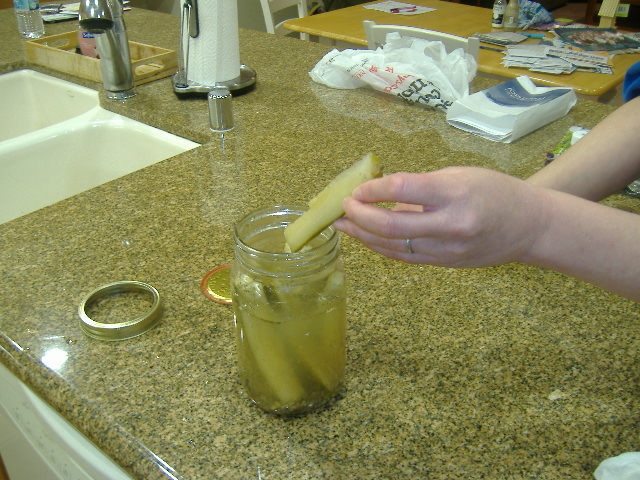
Score an assist to Sacramento-area gardener/blogger Carri Stokes for this pefect pickle creation. She came through with some rather interesting cucumber seeds last spring after I'd failed to pick up a starter plant or plant an Armenian cucumber vine from seed. Although Armenian cucumbers aren't listed as pickling cukes -- they should be. Why? They're tough. That crunchy taste doesn't bend to six months in a canning jar filled with vinegar, water, salts and spices. Every pickle that comes out of that jar CRUNCHES like a pickle should.

But -- as it turns out -- the seeds that Carri provided were something special. What came out of those seeds looked like an Armenian cucumber vine -- but the cucumbers were some of the strangest creations I've ever seen come out of a cucumber patch. Armenian cucumbers are normally light green in color and ribbed. As you can plainly tell from this photo -- what we got was something that was sized like your average Armenian cucumber -- but it was a dark green with less ribbing.

What gives? It turns out that Carri had planted her Armenian cucumber next to another variety called a Suyo Long -- a Chinese variety that produces long -- slender cukes that are dark green and quite bumpy. I knew these cukes weren't Suyo Longs. They weren't the standard Armenian either. What were they then? It appears the two plants cross-pollinated at some point -- and that cross-pollination continued with the next generation. I had a cross.

I must admit -- I was a tad worried last summer. But not anymore. The cross produced the best of both varieties -- and resulted in the best darn pickle I have ever tasted in my life -- bar none. These are truly incredible -- and will be in high demand later this summer during the last week of Legislative Session at the State Capitol in Sacramento.

This is also known as Legislative Hell Week or "The Crush" in some circles. It's a time when lobbyists of all shapes and sizes prowl the hallways in hopes of getting a bill passed -- or even defeated in some cases. The particular Senate Office that I serve in is also the office for the Vice-Chair of the Senate Rules Committee. And it's a long-held Capitol tradition that this office is opened to lobbyists during the final week -- so they can have a place to sit down and relax for a minute -- while helping themselves to coffee, soft-drinks and assorted snacks that are provided.

Last year -- as sort of a lark -- I brought in a jar of our home-canned pickles to provide an alternative to the pre-packaged snacks of pretzels or peanuts. They sat there for a few hours -- bypassed by many -- until a transplanted Upstate New Yorker turned California lobbyist found them. After that? The pickles vanished in the space of minutes. The next day? I brought in another jar. Same result: Gone in Sixty Seconds.

I would soon come to find out that the pickles reminded this particular lobbyist of a corner deli back home. But he also assured me that mine were much better -- and his attention to those jars (here, try this!) created somewhat of a feeding frenzy. I made a promise to the many new fans of our home-canning efforts that day. If I was still in the same office next year? The pickles would return.

I supose I also owe Carri a jar or two. Perhaps she'll part with some Limoncello? Fat Chance!

The Curious and Compelling Case of the Cat-Sized Cucumber!

Monday, July 20, 2009

How does a cucumber get this big?


Seriously? What is happening in our garden this year? We knew something was up several months ago when Venus harvested a baseball sized radish. Then, we followed that up by harvesting red potatoes the size of a red clay brick.

But now? A cucumber the size of Fuzzbutt the cat? That's 17.5 lbs. of cat I'll have you know. We grow them big on the Bird Farm, and that apparently applies to cats AND cucumbers.

This cat-sized cucumber plus a ton more cucumbers came straight out of the cucumber garden this weekend. I knew that we had several cucumbers to harvest, but I didn't discover the monster until I kicked it while stringing up 200 feet of electrical wiring for a seventh irrigation valve (another long story of failure I must share with you someday).

After finding the beast, I knew it was time. Venus knew it was time. So, we both dove into the cucumber beds and picked everything we could possibly find. The end result is pictured to your right, and that is only part of the harvest.


Yes, there was more.

What are two people going to do with enough cucumbers to feed an army? Why did we plant so many of them? How did they get so freaking big? We're still not sure why we're pulling super-sized vegetables out of the garden this year. This is a first for both of us. To be perfectly honest, we are trying some new gardening techniques and experiments this year. Perhaps that's the reason?

As for what to do with the haul? As a wise old man once told me, when life gives you lemons, make lemonade. And, in this case, when life gives you cucumbers, make pickles.

And that's exactly what the wife and I set out to do.

To be honest? Most of the cucumbers that we harvested were not pickling cukes, nor do they pickle well. They tend to get quite soft over time. Good pickling cucumbers are tough. That's why we specifically planted several varieties of pickling cucumbers this year, plus an Armenian slicer.

The Armenian cucumbers, pictured in this bath of ice water, are somewhat different and unique from the normal cucumber used in salads. The skin is far tougher than a normal cucumber. The flesh is far more crunchy. It's one of those "cross" cucumbers that goes well in a salad, or in a jar of pickles. And since we had plenty of them, well, it was time to get to work.


Fortunately, Venus and I both took steps last year and this year to ensure that most of the items needed for this pickling project would come straight from the backyard. We were using a standard Dill Pickle recipe that has been featured on this blog before (you can find it here). The dill, which Venus planted months ago, was in full flower. And the garlic would come from our garlic harvest that took place about three weeks ago.

Some of the other items were acquired more inventively. The red pepper flakes for example? Sure, we could have purchased a jar of those for three or four bucks at a nearby store, or we could have saved all those tiny packages of red pepper flakes that pizza joints hand out with abandon. If you have a drawer full of those packets, like we do, here's a chance to put them to work (if you guessed that I like pizza, that's a really good guess).

Other passed pickling efforts have included Thai Hot Peppers inside the jar with the pickles. It looks nice, but it also results in a batch of pickles that will burn your lips off. One needs to have a good supply of cold beer nearby just to handle the heat that comes off that pickle. Soon, you've consumed so much beer that you can no longer see the pickles. We had to avoid this.

The end result of our pickling efforts is located to your left. That's 21 jars of canned Dill Pickles, the most we have ever canned in any one sitting. Venus and I managed to can 36 jars of pickles last year, and after this little project, it seems we'll beat last year's count fairly quickly. Cucumber season is just beginning. In another two weeks, we'll probably have an even larger harvest.

More beer here!

Many people have asked, what are we going to do with all of those pickles and, secondly, are we madly insane? There might be an element of truth to that second question, but as for the first, there's nothing like a present of home-canned dill pickles at Christmas. Combine those pickles with jars of home-canned salsa, tomato sauce, pickled green beans and pickled baby corn -- and you have a gift that people will remember.

Ipods -- Schmypods. Who needs tech gadgets? I've got home-canned dill pickles.

V is for VICTORY! (and Venus)

Tuesday, May 26, 2009

Here's hoping that your Memorial Day Weekend was as productive as mine! The wife that is VENUS and I spent three wonderful days in the yard and at local nurseries, as we look for ways to creatively landscape the "Back 40" and our "fruit salad" backyard.

With gardening season now starting to move into full swing (yes -- there's still time to plant tomatoes, cucumbers, the good stuff) -- I needed to complete a rather important project that will hopefully lead to a vast improvement to our pickling project that we undertook for the first time last summer.

It's not that last year's Dill Pickle canning project was a failure, mind you. It wasn't! Venus and I canned 36 one-quart jars of different types of dill pickles last summer, and they were fabulous.

But we also learned a few things.

Not all cucumbers make great pickles. Despite our efforts to produce batch after batch of crunchy, garlic-dill pickles, some of them came out a tad "soft" after the canning process. We learned a very important lesson.

That cucumber that tastes so great in your summer salad? It may not turn out to be the best variety for pickling. Some do well, like the Armenian cucumber. But the Burpee hybrid? The Diva? If you like soft pickles, then you'll like these varieties. But if you want pickles to have a semblance of CRUNCH when you eat them, you may want to try another variety.

Venus and I spent last winter pouring over the seed catalogues and possibilities. We finally settled on two or three different seed packets for "pickling" cucumbers, and gardening friend Carri Stokes was kind enough to provide seeds for the highly desired, and very crunchy after canning, Armenian cucumber.

But -- all of these seeds presented a problem. Where do we plant them all? The cucumber bed I created last year is perfect for three or four varieties of cucumbers. But not eight. And, it's probably not wise to mix pickling cucumbers with slicers.

To put in short and sweet -- we needed another planter bed. And that's just one project that we knocked out this weekend.

However, this box is unlike the Lincoln Log boxes that I've described in great detail in previous posts on this blog (Planter Boxes on a Budget). This project would utilize standard Redwood fenceboard purchased from Home Depot, a Redwood 2X4, about 100 gold screws, three Makita cordless drills, a belt sander and finally, redwood stain to protect the finished project.

This was a big deal.

I was delighted to find the standard Redwood fenceboard on sale this weekend at the man's toy store, Home Depot. I was even more delighted when I discovered that not only was the desired fenceboard on sale (think CHEAP) -- it was also LOCAL. That's right. This is Mendocino County redwood -- the best redwood on the planet in my humble opinion.

Plus, at a price of $1.67 per wide fenceboard and $1.29 for the smaller trim boards, I wasn't going to argue. Bill Bird knows a deal when he sees one. This was a deal. Plus -- Home Depot would do a large part of the required cutting for me!

After purchasing the standard six foot long boards (well -- almost six feet -- they do cheat just a tad), I instructed my handy-dandy Home Depot wood-cutter to lop off the ear from the fenceboard in question -- lop off another one and a half feet from all four of the larger boards that would make up the sides of this box. I also had him cut the 2X4 into six pieces that were about eleven inches long.

These 2X4 pieces would hold my box together.

Venus' father (my father-in-law), the retired rocket scientist who knows all when it comes to box building (or any other subject -- just ask him), provided the "brains." He also served as the steady hand cutting the redwood trim boards, which had to be cut at a perfect length.

I must admit, he's far better with a table saw than I am.

This was a fairly easy project once we got all the tools in place. We used one Makita to drill pilot holes for the screws, another for the countersink and the third for the actual screw driving. Screws would then be driven into the 2X4 pieces placed in the corners, plus two more located in the center of the box for reinforcement.

I've found that putting the box together is actually the easy part of any planter-box building project. The toughest part of the job is installing the trim, or finishing boards. You can't be off by more than an 1/8th of an inch, otherwise it's back to the drawing board and back to table saw for another piece of wood.

The trim boards serve two purposes. First -- they look darn good! Secondly, they provide badly needed reinforcement for the box in question. A planter box doesn't need them mind you, but they do help hold everything together. And a planter box will last longer with as much reinforcement possible.

Trim boards required the same installation process as the front and side boards. You drill the pilot hole, countersink each pilot hole, then drill the gold screw home. There are 12 trim boards on the box, including two in each corner.

And finally, the box is finished off with a final piece of trim: "V for Venus."

I have several different methods of constructing planter boxes in the backyard -- and I'll be honest with you -- this is the most difficult. It is one of the cheapest boxes to build -- the cost is about $30 when you add in the cost of wood, screws, sandpaper and stain. But it does require some previous wood-working knowledge.

These boxes are quite rough by the way. This is cheap redwood fenceboard after all. So -- after the screwing is done -- out comes the belt sander and a storm of redwood dust to "smooth out the edges." The final step is transporting it to the garage -- where stain is applied.

And this is how the finished project looks. I'm guessing that there are about 100 screws in this box. The stain will provide protection against the elements outside. My hope is this box will grow a record number of pickling cucumbers for our pickling efforts this summer.

The yard will provide most of the ingredients for the pickling project. Fresh dill weed is already growing, and some of it is actually starting to flower now. A special kind of garlic is probably a month away from harvest, as are the Thai Hot Peppers that are growing in one of the main planter beds. The only ingredients not to come from the backyard will be the water, vinegar and canning salt.

Here's hoping for a tasty pickle.