Showing posts with label Carri Stokes. Show all posts

The Muse

Sunday, July 10, 2011

Seignac Guillame: The Muse
It's no secret that bloggers sometimes get tired of blogging. The blog becomes a drag, man. When the wife starts referring to herself as a "Blog Widow," to a newspaper reporter no less? Houston, we have a problem!

Sometimes, we just plain run out of ideas. I mean, how many times can I write about the subject of garlic before it gets a little plain and a little dull? I've written so much about heirloom tomatoes that nothing comes as a surprise anymore. Suddenly, blogging becomes a chore.

That's when things go south. While most bloggers try to make it work with advertising, and some do a pretty good job at making a living, most of us do this for the joy of "putting pen to paper." This is nothing more than our journal -- a cyber journal at that. "Dear Diary, today that little girl with red hair threw a tomato at me..."

For some bloggers, even the good writers, the stress is just too much. They up and quit. They don't come back. The blogging landscape is littered with "dead blogs" that haven't been updated for years. One of the latest bloggers to put down the pen is Prudence Pennywise, a wonderful writer with a sharp wit.

Prudence Pennywise
Guess what? She got tired. I don't hear from Prudy anymore. I miss hearing from her. Prudy came up with some fantastic recipes and the blog earned her a spot on a local cooking show. It earned awards. It earned a faithful readership. It earned well-deserved attention. But not anymore.

Does this mean Bill Bird is going away? Hah! Fat chance Fredo! Dream on dude! This is still a lot of fun for me, although I don't have the time I once had to pay attention to it. I don't update it as often as I would like. Sometimes I lose focus. Sometimes I run out of ideas -- or I don't know how to frame a particular subject or post. Call it "Blogger Block." It's like writer's block. Yes, we get it too.

And then -- that "moment" comes. It always does. It's a seminal moment. Something happens -- somewhere -- and you are literally struck with inspiration. The block that frustrated you time and again is suddenly gone. You can't type fast enough.

Artichoke in Bloom
Sometimes that inspiration will come from the wife that is Venus. Sometimes? It comes from a different blog posting -- perhaps something that Farmer Fred Hoffman wrote about earlier in his blog. In this particular case -- my inspiration stemmed from one, simple, solitary line: BLOOMING ARTICHOKES: BEE CRACK.

It's the title of a post written by Sacramento garden blogger Carri Stokes and it brought a smile to my face as soon as I read it. Carri has a rather unique and wonderful way of communication in her blog. Not only is the posting true -- it's laugh out loud funny. And -- I may not have been the only blogger inspired by this posting. Some days later, Farmer Fred would write about "following a friend in the garden."

Hello Kitty Hive
The posting also made me think about what my colony has been feeding on this spring and summer. The bees inside that neon-pink Hello Kitty hive have been literally humming with activity. The numbers inside that hive have increased exponentially and the hive is now back to pre-swarm levels. I have once again been blessed with a strong queen. A strong queen means a strong hive.

But a strong hive also requires a strong food or pollen source. The Bird Back 40 will never contain enough blooming plants to fill that need -- but I've come to discover (happily I might add) that the colony has found numerous and abundant pollen sources in the yards and parks that dot North Natomas. In other words, they're doing just fine.

If there is one side benefit to budget cutbacks in the Sacramento City Parks and Recreation Program, it would have to be the state of numerous parks in North Natomas. The acres of grass set aside for family fun and gatherings are no longer bright green and tightly manicured as they once were. Although this might sound bad, it's actually been a benefit to all things bee.

Typical North Natomas Park: Covered in Clover
Without the constant maintenance and upkeep, clover has proliferated throughout park settings. Clover does not react well to many modern lawn fertilizers. In many cases, clover has been classified as a "nuisance weed," and the lawn fertilizers are specially formulated to knock it out. This is especially vexing to bee colonies. For if blooming artichokes are indeed "bee crack," then clover would represent the Surf n' Turf restaurant special. Bees can't get enough of it.

No matter how hard I try -- I haven't been able to track colony flights out of the Bird Back 40. I can tell which general direction they're heading. But once a bee picks up speed, it's very easy to lose sight of them. There is no doubt in my mind, however, that they found nearby parks inviting. A close check of those fields of clover revealed hundreds if not thousands of them, collecting as much pollen as possible before flying back home.

Honeybee Raiding Clover: North Natomas
Were they bees that belonged to the Hello Kitty Hive? That's somewhat impossible to tell. But the nice thing about pollen sources is this: they are plentiful and usually multiply in abundance. Plants that produce the kinds of pollen that bees can't resist are often the cheapest forms of landscaping found anywhere. And the new subdivisions that have sprouted out near Sacramento International Airport are planted with acres of pollen producers. There is no shortage of pollen out north.

Intentional? I think not. Cost is usually the determining factor in the growth of new subdivisions -- that and housing demand (which there hasn't been much of lately). But some how, some way, it works. Nature has found a way.

Bee Crack indeed.

A Haircut That HURT!

Sunday, April 10, 2011

Leggy Heirloom Starter Plants Flopping Over
It was time. I just couldn't bear to look at them anymore. "Them" is pictured to your right. This is how my heirloom tomato starter plants look at the moment as I put them through the "hardening off" process by introducing them to the harsh sunlight of outdoor life.

I was hoping that the introduction to outside conditions would be the kind of "tough love" my heirloom tomato starter plants would need to develop tough stems at the base. And while the "tough love" approach of direct sunlight, cool spring temperatures and breezy days is having the desired effect -- it's not going to result in the kind of stem growth we need that will allow these plants to stand upright.

Leggy starters like these aren't a problem if you've finally arrived at the magic "plant out" date. You can take a variety of actions when faced with the problem of "leggy" starter plants. You can either dig a deep hole and plant the root system and most of the stem deep into soil. Or -- you can dig a long trench and bury most of the plant in soil except for the top four or five inches.

There's just one problem. We're not at "plant out" date yet. In fact, as much as I hoped for an early plant out date -- it ain't gonna happen children. It's still too cold outside. Oh -- sure -- the afternoons (like this afternoon) are wonderful. But our nights are still cold. There's also a chance of another cold rainstorm or two in the long-range forecast. To plant out now? That's like rolling the dice at a craps table. And I don't want to come up snake eyes -- not after caring for these starter plants for as long as I have.

A Leggy Stupice Heirloom Starter
So -- what's the alternative? Continue to let them flop over like they have been? That's a three foot long Stupice starter plant that I'm holding in my fat paw in that photo to the left! Do you know what happens to starter plants that flop over like that? Eventually -- they break in two. Or worse yet -- they snap at the base of the plant. Know what that means? GAME OVER!

No thanks.

The second option? Transplant into larger pots. In my case? I would need much LARGER pots that would allow me to plant these leggy starters deeply. Stems that are planted into soil WILL develop a secondary set of roots. That's one of the nice things about tomato plants -- you can bury them deeply and not hurt them. But -- there's just one problem. I didn't have that many half-gallon pots. I certainly did not have the extra soil on hand. Finally, transplanting into that large of a new pot could possibly delay plant out which should come at the end of this month.

Time for a haircut? Mebbe!
Transplanting is only half the battle. Once transplanted, you've got to allow the starters to expand and grow a new set of roots -- otherwise you can shock them by removing the plants from starter cups during plant out. Even worse -- you can snap a tender starter in half. Know what that means? GAME OVER!

So -- what's a tomato nutcase like Bill Bird to do? I suddenly remembered that I had rooted several varieties of basil in a glass of water during the last growing season. Sacramento area gardener Carri Stokes assured me it would work. And -- it did work. Rooting those basil starters brought back an even more distant memory where Venus and I had taken the same steps with a cutting of lemon thyme that Venus received from a colleague at work. The cutting developed root systems while placed in a cup of water before we transplanted it into the herb bed. Today, it's one of the most prolific herbs in the backyard bed (it's also a good pollen source for the bees -- but more on that later).

And so the inevitable thought crossed my mind. If you can root herbs like basil and thyme by placing cuttings in a glass of water -- can you do the same with tomato plant cuttings? Will they take root in a glass of water? Can they successfully transplanted into starter cups after rooting in water?

Snip, Snip!
For questions like these and more -- I usually turn to the TomatoMania forum or Group on Yahoo. It's a community of like-minded heirloom tomato nutcases like myself -- where you can ask questions and get quick answers. Sure enough -- they all answered in the affirmative -- so the haircut activity took place in earnest earlier today.

Trust me when I tell you: this was anything but EASY. Venus and I have babied these starters from seed for months. We've made every effort to provide them with good soil, light, water, heat -- all the elements one needs for producing starter plants indoors. To suddenly WHACK them back by several feet seemed a little inhuman -- but it had to be done.

And if the action resulted in additional starter plants for family and friends???? Well -- there could be an upside to this endeavour. At least 300 people at work have asked me to "put them on the list" for starter plants. This is one impressive list -- and no I won't be able to fill every last order or desire -- even if every plant roots.

Will They Take Root?
So today -- the three-foot long Stupice got a nice "haircut." So did the two-foot Brandywine. Tigerella also offered up a nice top stem -- as did Bradley, Kelloggs Breakfast, Marianna's Peace and a few others.

The cuttings from each starter plant have been placed in clear plastic cups -- as pictured -- filled with cool water -- labeled and placed on a bright and sunny location on a windowsill. A number of things could happen in the next two weeks. They could root. A marauding cat could knock them into next week (always a possibility in the home for wayward and bratty cats). Or, they could simply shrivel up and die.

As with every gardening experiment? Time will tell!

For Reals???!!!

Friday, May 28, 2010

And Now!!! For the latest edition of "You Can Do That???"

Bill Bird Productions Presents: "I Didn't Know You Could Do That!!!"

For Real? Honestly and truly?

The things you learn while gardening and blogging! I didn't know you could do that. But I know now -- because I have the proof growing in a kitchen windowsill.

See that basil? That's not just any basil in a glass. This is "special basil." It's basil that will soon find it's way inside a raised bed in the Bird Back 40 (as soon as I get around to building the next one).

One of the most enjoyable things that I've gained from spilling my guts about gardening into cyberspace is the people that I run into here and there. When I started writing about my successes and misfortunes (mostly misfortunes) a couple of years ago -- well -- it was intended to be a family affair.

After all -- I don't have a whole lot of time on the weekends to be on the phone. That's valuable gardening time you understand. There's nothing quite like the downer of getting ready to plant something in a raised bed -- only to have the phone start jangling inside the house. Call it bad gardening karma.

So -- that's one reason why I started to write -- so family could see what I was up too. Lo and behold -- other people started to look in at what I was doing from time to time -- and after that -- I got to meet some of these very interesting folks.

Fred Hoffman doesn't count -- because I already knew him. But there's Carri Stokes in Sacramento -- Greg Damitz in Roseville -- and I can't forget Nels Christenson in South Natomas. Connecting with all of them -- and others -- has brought a new understanding and -- more importantly -- NEW IDEAS about gardening.

One of those new ideas comes from the mind of Carri Stokes. And it's growing on the kitchen windowsill.

I didn't know you could take cuttings of basil -- or any other herb for that matter -- and literally "root it" in a glass of water. It didn't even begin to dawn on me that this was an easier way to grow basil -- rather than grow it from seed. Do you see the root systems in this glass? That's what develops after ten days of sitting in a glass of water.

These "rooted" cuttings will be placed into starter cups filled with soil this weekend and will probably sit in the windowsill for another four or five days until they take root -- and at that point -- Venus and I will begin to harden them off outside.

I should have known this practice was possible after Venus received a small cutting of lemon thyme right after we moved into the new household. That "cutting" actually sat in a glass of water for quite some time before I finally built the new herb bed for the backyard -- and this is how it looks two years later.

As you can see -- the "small cutting" has essentially taken over the herb bed in question.

A cutting of lemon thyme anyone? I appear to have more than both the wife and I need at the moment.

I've come to discover -- during my my short years of gardening experience -- that there is more than just "one" basil variety. In fact -- I don't know if there is such a thing as a "normal" basil. If there is one -- I suppose it would have to be the Sweet Italian variety that you find in most nurseries.

But there is so very much more...

In fact -- some people love basil so very much -- that there's even a website dedicated to this very herb. The following information is Reprinted/Excerpted with Permission from, www.basil.info:

Basil is a member of the mint family and is very similar in appearance. The most popular kind of basil used in cooking is sweet basil, but some of the other more widely-known types are clove basil, lemon basil, and cinnamon basil.

With so many varieties, it can be difficult to choose. Here are just a few types, with a brief description, to help in your quest for the perfect basil for your savory dish:

• Sweet basil-the best known, it has a scent of clove when fresh.


• Genovese basil-has a similar flavor as sweet basil and is almost as popular.


• Napolitano basil-favored by many for pizzas.


• Lemon basil-also called "hoary basil," has a lemony smell, like the name implies, but has a sweet taste.


• Thai basil-has a scent of licorice with a hint of mint. Purple stems and flowers add beauty and taste to many Thai dishes.


• Cinnamon basil-also called Mexican spice basil, has the same compound found in cinnamon which gives it its strong fragrance.


• Holy basil-also known as 'sacred basil' since it's used in worship in India.


• Purple basil-rich and spicy, it has more of an anise flavor than Genovese or sweet basil.

My thanks to Dr. Christianne Schelling at http://www.basil.info/ for providing the information above. The information provided here is only the tip of the iceberg. I urge you to visit her website to learn more.

Basil -- as you may have learned -- is a very important part of the Bird backyard garden. It's an essential ingredient in our Heirloom Tomato Martinis -- and probably has a lot of other uses that I'm not aware of yet because -- well -- did I tell you that Heirloom Tomato Martinis are really good???

Nasturtiums N' Garlic Oh My!

Friday, May 7, 2010

Hmm....

Can we call this a case of "companion planting" that works?

I think so!

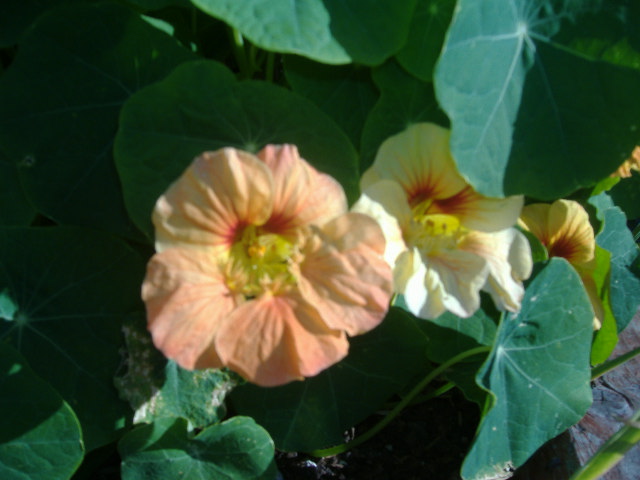
The latest sign of Spring that has finally Sprung in our North Natomas suburban farm is this test companion planting of garlic and nasturtiums in one of the raised beds near the back fence. This wasn't a mistake folks. Venus planted nasturtium seeds and garlic cloves at the same time last fall just to see "what happened."

And this is the show we're getting at the moment. It's just beginning too. For the longest time -- Venus was concerned that the large nasturtium plants growing within the garlic were not going to flower. But that thinking has changed just within the past week.

In other words -- the show is just getting started.

This isn't the only garlic and onion bed where Venus mixed in some nasturtium seed last fall -- but it does appear to be the most successful. The nasturtium plants have grown so large now that they're popping out of the garlic bed.

All appears to be well.

Score a big assist to fellow gardener Carri Stokes on this rather surprising development. I wasn't aware you could even grow nasturtium in Sacramento. Although it's a common sight on the coast of California (some might even call it a weed) -- I thought our climate was just a tad too hot for nasturtium to do well here.

Obviously -- I thought wrong. Carri informed us that she had successfully grown it from seed. We saw the proof in Carri's yard last spring. So -- Venus set about planting her own little nasturtium patch last fall.

Venus' favorite? So far -- that would have to be the "Creamsicle" variety sold in seed packets from Renee's Garden. "Flower treasures for the eye & heart," the packet claims. I guess I can't argue much.

As for me? I tend to like the sharper colors in the mounding "Cherries Jubilee," also offered through Renee's Garden. Venus and I picked up both packets last fall while shopping for seed garlic at Peaceful Valley Farm Supply in Nevada City.

What's the most unique thing about Nasturtium? Obviously -- it's more than just a pretty flower. These are EDIBLE flowers folks. Yes -- you heard me right -- you pull them right off the vine and eat them on the spot. Or -- you can save them to decorate the salad offering later that night.

What's that? What do they taste like? Well -- I suppose you have to try one and find out for yourself!

I'm not sure just how much of a show or harvest that we will get from this little "planting experiment." At some point -- the Sacramento summer gets to be just a tad too much for nasturtium. Like the artichoke plants that are planted nearby -- they will take on a rather unhappy look -- whither -- and eventually perish.

But -- score one for a companion planting experiment for now. Garlic + Nasturtium = SUCCESS!

I'm Just PICKLED Pink!

Saturday, April 3, 2010

Bleah! Sorry folks -- but it's the only word I can think of after waking up this morning with the "Mother of all Hangovers" (thank you Saddam Hussein!). This one is a DOOZY.

It's safe to say that Venus and I spent most of our Good Friday being VERY BAD indeed. After trying and failing miserably to get our taxes done (our accountant decided to take the day off -- and didn't tell us) -- we embarked on our annual "Pacific Adventure!"

Oops -- slight typo there. There should be an *O* at the end of "Pacific." As in -- Pacifico. What is the "Pacifico Adventure?" Find the nearest Hole-in-the-Wall Mexican-themed restaurant -- order up some Pacifico beer -- dip a tortilla chip into salsa and eat -- sip (well, gulp actually) on the Pacifico.

We repeated this very process throughout our one hour lunch -- and didn't stop once the chips ran out. Foolish behavior? Yes indeed! But -- your Honor -- Pacifico is one FINE beer. That's my only defense.

Therefore -- I thought it highly appropriate to bring you today's posting: PICKLES! Why not? I'm pickled, right? I is -- therefore -- I am. Or something like that.

Actually -- I've been intending to write about this subject for quite some time now -- ever since we sampled the 2009 crop that has been brining away in some one-quart canning jars in the pantry of our kitchen. Although I did serve these pickles at our annual Super Bowl party -- I never did get around to sampling them. By the time I reached the dish -- they were gone!

I should have known then.

There are those days -- and men know this all to well -- where you've just got to have a pickle. I'm not sure how and where the mood strikes -- but it does -- and you'd better have some pickles on hand otherwise you're going to be severely disappointed.

Sure enough -- that urge came just the other day -- and I'm pleased to report that the Bird family was well-prepared for the "L'assaut du Cornichon!" (Attack of the Pickle). About 25-to-30 jars of our special and well marinated Dill Pickle creation were on hand -- so you can guess what happened next.

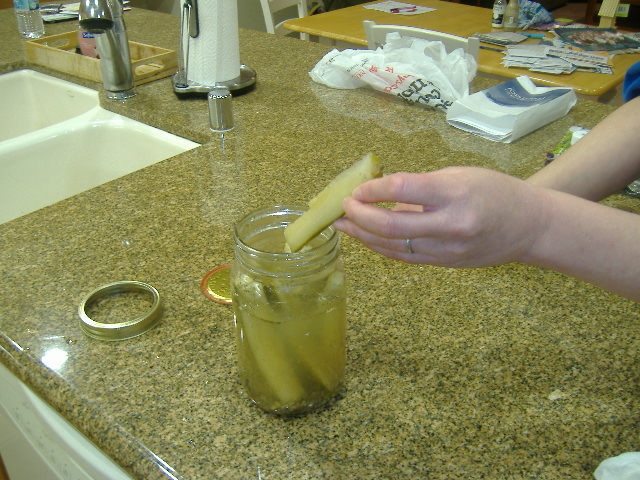
Lovely! It's just about the best word that I can think of when describing the first test of what Venus and I carefully and meticulously canned last summer in our North Natomas kitchen. The basic Dill Pickle recipe comes courtesy of All Recipes. But Venus and I have expanded upon this in recent years with various herbs and spices.

It also helps that all of the spices in question came straight from the backyard -- right down to the dill flowers and the Inchelium Red garlic. About the only thing that didn't come from the backyard garden is the pickling salt. Don't worry though -- we're getting there.

Some of the canned jars also included whole Thai Red Peppers -- which is more than enough to give the pickles a little bit of a spicy jolt! Once you open a jar of these pickles -- said jar doesn't last long. You can't stop at "just one."

Score an assist to Sacramento-area gardener/blogger Carri Stokes for this pefect pickle creation. She came through with some rather interesting cucumber seeds last spring after I'd failed to pick up a starter plant or plant an Armenian cucumber vine from seed. Although Armenian cucumbers aren't listed as pickling cukes -- they should be. Why? They're tough. That crunchy taste doesn't bend to six months in a canning jar filled with vinegar, water, salts and spices. Every pickle that comes out of that jar CRUNCHES like a pickle should.

But -- as it turns out -- the seeds that Carri provided were something special. What came out of those seeds looked like an Armenian cucumber vine -- but the cucumbers were some of the strangest creations I've ever seen come out of a cucumber patch. Armenian cucumbers are normally light green in color and ribbed. As you can plainly tell from this photo -- what we got was something that was sized like your average Armenian cucumber -- but it was a dark green with less ribbing.

What gives? It turns out that Carri had planted her Armenian cucumber next to another variety called a Suyo Long -- a Chinese variety that produces long -- slender cukes that are dark green and quite bumpy. I knew these cukes weren't Suyo Longs. They weren't the standard Armenian either. What were they then? It appears the two plants cross-pollinated at some point -- and that cross-pollination continued with the next generation. I had a cross.

I must admit -- I was a tad worried last summer. But not anymore. The cross produced the best of both varieties -- and resulted in the best darn pickle I have ever tasted in my life -- bar none. These are truly incredible -- and will be in high demand later this summer during the last week of Legislative Session at the State Capitol in Sacramento.

This is also known as Legislative Hell Week or "The Crush" in some circles. It's a time when lobbyists of all shapes and sizes prowl the hallways in hopes of getting a bill passed -- or even defeated in some cases. The particular Senate Office that I serve in is also the office for the Vice-Chair of the Senate Rules Committee. And it's a long-held Capitol tradition that this office is opened to lobbyists during the final week -- so they can have a place to sit down and relax for a minute -- while helping themselves to coffee, soft-drinks and assorted snacks that are provided.

Last year -- as sort of a lark -- I brought in a jar of our home-canned pickles to provide an alternative to the pre-packaged snacks of pretzels or peanuts. They sat there for a few hours -- bypassed by many -- until a transplanted Upstate New Yorker turned California lobbyist found them. After that? The pickles vanished in the space of minutes. The next day? I brought in another jar. Same result: Gone in Sixty Seconds.

I would soon come to find out that the pickles reminded this particular lobbyist of a corner deli back home. But he also assured me that mine were much better -- and his attention to those jars (here, try this!) created somewhat of a feeding frenzy. I made a promise to the many new fans of our home-canning efforts that day. If I was still in the same office next year? The pickles would return.

I supose I also owe Carri a jar or two. Perhaps she'll part with some Limoncello? Fat Chance!

V is for VICTORY! (and Venus)

Tuesday, May 26, 2009

Here's hoping that your Memorial Day Weekend was as productive as mine! The wife that is VENUS and I spent three wonderful days in the yard and at local nurseries, as we look for ways to creatively landscape the "Back 40" and our "fruit salad" backyard.

With gardening season now starting to move into full swing (yes -- there's still time to plant tomatoes, cucumbers, the good stuff) -- I needed to complete a rather important project that will hopefully lead to a vast improvement to our pickling project that we undertook for the first time last summer.

It's not that last year's Dill Pickle canning project was a failure, mind you. It wasn't! Venus and I canned 36 one-quart jars of different types of dill pickles last summer, and they were fabulous.

But we also learned a few things.

Not all cucumbers make great pickles. Despite our efforts to produce batch after batch of crunchy, garlic-dill pickles, some of them came out a tad "soft" after the canning process. We learned a very important lesson.

That cucumber that tastes so great in your summer salad? It may not turn out to be the best variety for pickling. Some do well, like the Armenian cucumber. But the Burpee hybrid? The Diva? If you like soft pickles, then you'll like these varieties. But if you want pickles to have a semblance of CRUNCH when you eat them, you may want to try another variety.

Venus and I spent last winter pouring over the seed catalogues and possibilities. We finally settled on two or three different seed packets for "pickling" cucumbers, and gardening friend Carri Stokes was kind enough to provide seeds for the highly desired, and very crunchy after canning, Armenian cucumber.

But -- all of these seeds presented a problem. Where do we plant them all? The cucumber bed I created last year is perfect for three or four varieties of cucumbers. But not eight. And, it's probably not wise to mix pickling cucumbers with slicers.

To put in short and sweet -- we needed another planter bed. And that's just one project that we knocked out this weekend.

However, this box is unlike the Lincoln Log boxes that I've described in great detail in previous posts on this blog (Planter Boxes on a Budget). This project would utilize standard Redwood fenceboard purchased from Home Depot, a Redwood 2X4, about 100 gold screws, three Makita cordless drills, a belt sander and finally, redwood stain to protect the finished project.

This was a big deal.

I was delighted to find the standard Redwood fenceboard on sale this weekend at the man's toy store, Home Depot. I was even more delighted when I discovered that not only was the desired fenceboard on sale (think CHEAP) -- it was also LOCAL. That's right. This is Mendocino County redwood -- the best redwood on the planet in my humble opinion.

Plus, at a price of $1.67 per wide fenceboard and $1.29 for the smaller trim boards, I wasn't going to argue. Bill Bird knows a deal when he sees one. This was a deal. Plus -- Home Depot would do a large part of the required cutting for me!

After purchasing the standard six foot long boards (well -- almost six feet -- they do cheat just a tad), I instructed my handy-dandy Home Depot wood-cutter to lop off the ear from the fenceboard in question -- lop off another one and a half feet from all four of the larger boards that would make up the sides of this box. I also had him cut the 2X4 into six pieces that were about eleven inches long.

These 2X4 pieces would hold my box together.

Venus' father (my father-in-law), the retired rocket scientist who knows all when it comes to box building (or any other subject -- just ask him), provided the "brains." He also served as the steady hand cutting the redwood trim boards, which had to be cut at a perfect length.

I must admit, he's far better with a table saw than I am.

This was a fairly easy project once we got all the tools in place. We used one Makita to drill pilot holes for the screws, another for the countersink and the third for the actual screw driving. Screws would then be driven into the 2X4 pieces placed in the corners, plus two more located in the center of the box for reinforcement.

I've found that putting the box together is actually the easy part of any planter-box building project. The toughest part of the job is installing the trim, or finishing boards. You can't be off by more than an 1/8th of an inch, otherwise it's back to the drawing board and back to table saw for another piece of wood.

The trim boards serve two purposes. First -- they look darn good! Secondly, they provide badly needed reinforcement for the box in question. A planter box doesn't need them mind you, but they do help hold everything together. And a planter box will last longer with as much reinforcement possible.

Trim boards required the same installation process as the front and side boards. You drill the pilot hole, countersink each pilot hole, then drill the gold screw home. There are 12 trim boards on the box, including two in each corner.

And finally, the box is finished off with a final piece of trim: "V for Venus."

I have several different methods of constructing planter boxes in the backyard -- and I'll be honest with you -- this is the most difficult. It is one of the cheapest boxes to build -- the cost is about $30 when you add in the cost of wood, screws, sandpaper and stain. But it does require some previous wood-working knowledge.

These boxes are quite rough by the way. This is cheap redwood fenceboard after all. So -- after the screwing is done -- out comes the belt sander and a storm of redwood dust to "smooth out the edges." The final step is transporting it to the garage -- where stain is applied.

And this is how the finished project looks. I'm guessing that there are about 100 screws in this box. The stain will provide protection against the elements outside. My hope is this box will grow a record number of pickling cucumbers for our pickling efforts this summer.

The yard will provide most of the ingredients for the pickling project. Fresh dill weed is already growing, and some of it is actually starting to flower now. A special kind of garlic is probably a month away from harvest, as are the Thai Hot Peppers that are growing in one of the main planter beds. The only ingredients not to come from the backyard will be the water, vinegar and canning salt.

Here's hoping for a tasty pickle.