And So It Begins...

Saturday, May 19, 2012

Bird 2012 Heirloom Tomato Crop (Partial)
Ready or not kids -- the 2012 summer gardening season is now swinging into full gear. Got those tomatoes planted yet? Check! What about those cucumber vines? Check! Watermelon and pumpkin seed planted? Check! Green onions? Carrots? Squash? Beets? All in? Good!

Now you can take a trip to the Bird Back 40 and give Bill and the wife that is Venus a hand! I'd like to tell you that the garden planting is all done but truthfully, with a garden this large and this diverse, there is always another seed to plant and another chore to accomplish. Short and sweet? It never seems to end.

I get the most joy out of watching the wife plant the heirloom tomato seedlings that we nurtured through the winter months. I'm still a poor study at that "hardening off" process, with leaves me with starter plants that look like they went through a northern squall before they reached the Backyard of Bird.

First Stage PVC Cage Construction
Rather than those green, leafy, picture-perfect starter plants that you see by the thousands at your local big box stores and area nurseries -- my plants are more like poor cousins. They are the "poster children" so to speak of a grower who turned on full bore sunlight before the plants were ready for the "Full Monty."

No matter I suppose. They look pretty darn good after the wife gets done with planting them. Add in some tender care, a fertilizer supplement or three, lots of prayer and just good fortune and the little darlings look pretty darn good. I was forced to install the first 16 PVC cages before the month of June -- which is a pretty good start by our book.

The First Stupice of 2012
Not only are they growing large, green and lush, nothing brings a smile to an heirloom tomato growers eye more than the site of actual TOMATOES forming on those great looking plants. Tomatoes we have Ladies and Gentlemen. You can always count on the Czech import "Stupice" (Stoo-Peach-Kah) to produce an early bushel. I discovered this after growing this variety for the first time last year. It's back for a second run in 2012.

Venus and I have set about 28 plants into the ground so far and we are slowly clearing out spring garden space for more. Because in the world of heirloom tomatoes, the mathematical equation of "X number of heirloom tomatoes" yields the answer of "Never Enough."

Tomatoes Love Radishes
I wish I could tell you the exact names of every variety I've planted, but that would force me to run outside with a flashlight to read little sticks where the wife has scribbled something closely related to chicken scratch. I would be forced to return with the report that we're growing the varieties of "Blargh" and "Snizzle," which wouldn't be exactly correct.

It's safe to say that we're growing a lot this year -- which includes a lot of new varieties like the Indigo Rose. This isn't exactly heirloom territory. The Indigo Rose is a rather new entry into the world of tomato culture. Recently developed at Oregon State University, Indigo Rose is the first, true "designer tomato" in garden culture if you will. It turns dark purple when ripe and is supposed to contain high levels of antioxidants.

Indigo Rose Tomato
I guess that's supposed to be good for you, right? I'm all for healthy eating. Especially because I don't do nearly enough of it. I do know one thing, however. It probably won't improve the wife's writing. Which means I'm looking forward to my first bite of "Blargh."

All fun and pranks aside, May marks the start of my favorite gardening season. Gardeners dream of a bushel of tomatoes and peppers every summer -- and that elusive goal of making your own fruit salad with everything harvested fresh from the backyard.

A thick slice of freshly harvested beefsteak tomato on my backyard barbequed hamburger? Sounds like healthy eating to me...

A Gift for Mother's Day

Sunday, May 13, 2012

From L-R: Gene, Mildred, Mom, Francis. The Doran Clan
Mother's Day is somewhat difficult for both Venus and I. We both lost our mothers at far too young an age. Venus' mother passed from cancer in 2004, not long after we were married and barely a year after the birth of her first grandchild, Marquitos.

My mother, pictured above, 3rd from the left, passed at the age of 63 from a sudden heart attack in 1991. I was 27 years old and very much alone. It would be years before I would meet the love of my life in the wife that is Venus and the true healing would begin.

Bright Flowers for Mother's Day
I sometimes wonder what in the world marketing companies are thinking of when they blast loud statements that proclaim REMEMBER MOM ON MOTHER'S DAY!!!! Thank you, sir. I remember just fine. Thank you for reminding me. Not that I didn't want to be reminded.

I do sometimes allow myself to wonder what mom would think of the gardening paradise that Venus and I are slowly building in the Bird Back 40. Would she like it? A bit overboard perhaps? Mom was a fan of both gardening and citrus trees in the yard. She lamented often about a grapefruit tree that refused to grow an inch, nor would it set fruit.

Hanging Fuchsia
She was particularly pleased however, when my father-in-law and I dug up a rather unproductive lemon tree that had been sitting in a shady portion of the yard for years, not doing much of anything. Once we moved to a sunnier location, however, this do-nothing lemon bush suddenly sprang to life and started to deliver a bushel of large, sweet and sour lemons. Score points for the youngest son and father-in-law. She was pleased.

Spring was, by far, mom's favorite season. You could count on her visiting the plants section at our nearby Longs or Thrifty Drug Store and bringing home a plant or two. A six-pack of tomato starter plants almost always found its way into her shopping cart.

Fuchsia Flowers
And -- of course -- mother absolutely HAD to have her hanging fuchsia. Spring would not be complete without one or two fuchsias hanging from the back patio. I looked forward to the day when she would bring them home. It brightened up our rather drab Modesto backyard. It signaled the official start of summer. The long winter was officially over.

When I spotted this beauty hanging in the garden section of an ACE Hardware store in Tracy on the day before Mother's Day, well, it was an impulse purchase that simply could not be ignored. Mother would have appreciated the gift of a fuchsia on Mother's Day.

While mother may have loved her fuchsia -- they didn't love her back. Fuchsias do well in a coastal environment and also enjoy a bit of shady protection from the hot afternoon sun. But in late June and July, when the Delta Breeze shut itself off from the Modesto area and our famous furnace-like summers set in, the fuchsia was history.

Mom did her level best to keep it alive, but it would invariably shrivel up and die by mid-July. It was then that I would hear the familiar lament about the cooler conditions in her home state of Oregon and her dislike for the brutal summer conditions that graced our San Joaquin Valley.

I didn't understand mother's fascination with fuchsias then, but I do now. They were a reminder of her childhood in Eugene. It was there where fuchsias and blackberry vines grew wild and profusely. When her Modesto fuchsias kicked the bucket, it was a reminder that her childhood had done much the same.

So -- for you mother -- on this Mother's Day -- a fuchsia hangs for you in the Bird Back 40. I'm not sure how long it will live -- or if it will kick the bucket as so many of the Modesto fuchsias did. But this is how I remember you on Mother's Day.

Why We Garden

Sunday, April 29, 2012

The Wife That is Venus with "Godzilla"
It's a seminal moment in the world of backyard vegetable garden. One doesn't grow an artichoke the size of the wife's head all that often. Yet that is the "vegetable of the day" that the wife that is Venus is holding. It's the garden payoff after coaxing artichoke monsters to grow into the size of Godzilla-like proportions during the fall, winter and early spring months.

The spring crop has arrived.

Venus and I have been munching on artichokes since harvesting the monster above right last weekend. The blast of warm rain during the week proved to be a welcome event as artichoke plants love cool, rainy weather and suck up the moisture.

Our Spring Artichoke Crop
Artichokes are one of those rare, coastal plants that will not only grow in the Sacramento region -- but thrive. The brutal onset of our furnace-like summer conditions ensures we will not get a followup fall crop, but it doesn't matter. By the time spring artichoke season ends? We will have consumed so many of them that just the sight of artichokes will bring on that familiar -- somewhat sick -- feeling.

Artichokes? Again? Really? I'd rather have a serving of frozen cardboard, please.

In other words -- the spring season quenches our artichoke desire just fine. There is no need for a repeat.

A unique variety: The Pineapple
Venus and I started growing artichokes when we first ventured into this world of vegetable gardening after the purchase of our first North Natomas spread in 2003. I use the word "spread" somewhat facetiously. Most North Natomas backyards are the size of mere postage stamps.

Why Sacramento City leaders argue against the ills of childhood obesity and then allow the construction of subdivisions with backyards not big enough for kids to skip a rope in is beyond me. Where do you expect them to run off that excess energy? The street?

Sorry -- I allowed myself to enter "rant" stage. Back to the subject: Monster artichokes.

Standard "Globe" Artichokes
Artichokes tend to grow rather quickly and will take up all available space. Many people have asked me how much room is needed to grow artichokes? My response is, "how much room do you have?" The point is, artichokes will take up that space and then keep right on growing into that spot you had reserved for azaleas.

In our case? With our smaller than small, postage-stamp sized backyard? We forced our artichoke plants to grow up rather than out. While this effort did work and did produce somewhat of a payoff, it also produced very tall and skinny artichoke plants that would sometimes snap in two due to the weight of the crop it was holding.

Our Artichoke Patch: One of Two
It was a sight that would bring tears to your eyes.

Venus and I started with four artichoke starter plants purchased from an Elk Grove nursery that has long since closed. I wish I could tell you the names of these varieties, but I honestly cannot. They were not labeled. We spotted four plants sitting on the corner of a shelf all those years ago and grabbed all four. End of story.

I didn't want to lose those productive varieties when my wonderful wife and I moved into our larger-than-life spread some years later. So, I proceeded to dig up the well developed root systems, stick them in pots, transported them to a new home and stuck them in a raised bed. They didn't so much as blink an eye. New growth emerged from the raised bed almost immediately. Transition = success.

The Pineapple: Unusual tips
But it's this very transition that does cause some consternation. These varieties -- which grow to massive sizes -- do not have a name. We call them our pineapple variety due to the well developed tips that appear on each artichoke. They look much like the rind of an pineapple. But this looks like no other variety grown in California -- commercially or in a garden setting.

Most artichoke leaves have a smooth, rounded ends. Some are somewhat sharper than others -- but none have this outlandish tip that is pin-sharp to the touch before cooking and quite soft after 90 minutes of steaming. I suppose it could be a mutation of the standard Globe or Imperial Star, or it could be a very old heirloom variety that has withstood the test of time in many a backyard garden.

Preparing for Harvest
No matter. This is our favorite variety for many a reason. The leaves are soft, buttery and tasty after cooking. The hearts are of a massive size -- the big payoff for an artichoke connoisseur. The early season stems are just as tender and flavorful as the heart itself with early season production, but will grow tough and stringy as the weather warms up.

No need to serve this baby with a side of anything other than a mixture of butter and garlic salt. This is a meal in itself.

I should know. I've had a few of them this past week. And a few more are yet to come. Venus and I expanded upon our artichoke experiment a few years ago. Instead of one or two plants, there are now seven or eight. That makes for a tasty crop.

Long live the Pineapple.

MORE ABOUT ARTICHOKES:

Saveur Magazine has a nice listing of artichoke varieties here (no sign of our Pineapple, however).

The Artichoke Advisory Board of California has a listing of commercial varieties here. Can you spot our mystery variety? We can't.

The Greens of Spring

Sunday, April 22, 2012

Bowl of Home Grown Color
...And so it begins. My favorite garden season followed by my most treasured garden season. Spring and summer are a delight for gardeners like myself. These seasons bring a bounty of delectable, mouthwatering, homegrown produce like what you see pictured to your right.

Every last morsel in that bright yellow bowl came straight from the raised beds in the Bird Back 40. It hasn't been amended with anything purchased at a Farmer's Market, or our nearby Safeway or Raleys/Bel-Air. Not that I'm a critic of our local produce suppliers. It's just that -- well -- when's the last time you purchased a purple radish the size of a golf ball or larger at your local store?

Selection of Radishes and Asparagus Spears
I'm fortunate in that the wife that is Venus can grow one mean and mighty radish. She can turn an ordinary French Breakfast radish into a French Breakfast, Lunch and Dinner. One might think a radish this size would have the fine taste of wood. Nope....

This is prime fresh greens season in the Bird Back 40 -- though if this blast of heat keeps up it will probably end as quickly as it started. Lettuce tends to bolt -- and quickly -- when our famous Sacramento furnace heats up. So -- enjoy it while you can because the season will be gone before you know it.

2012 Lettuce Crop-Bird Back 40
We're fortunate this year in that the starter plants were delivered to use courtesy of the Department of Plant Sciences at UC Davis. These starters were unlike anything I've seen before or since and have grown rapidly since Venus set them into the ground a little over a month ago. They have grown to the point where we can enjoy fresh greens and radishes nearly every night of the week.

The only thing that's missing? Why! Fresh, vine-ripened tomatoes of course!

Of all the varieties that we have growing in the Bird Back 40 this year -- I suppose I'm partial to the red leaf. It's unlike any red leaf lettuce I've ever seen before. Most lettuce varieties that are billed as "red leaf" have a touch of green in them -- usually at the base of each leaf. But not this variety. It's a straight, dark, wine-red, glossy color from start to finish.

Developing Head of Lettuce
I'm not sure if I'm sold on the look or taste, but both are darn good.

Home grown lettuce is unlike anything you're going to find in local stores. It's not packed with water like the standard, iceberg lettuce heads (my favorite for taco salad dishes). It's a little more dense. It's a little more dry. And it's a lot more tasty. You didn't think lettuce had a taste? Try home-grown lettuce. It's incredible.

I suppose the same is true with the radishes that are now spring from the soil with abundance. That round, red globe in the market produce section does indeed look like a radish. Unfortunately, it doesn't have the kind of snap-to-attention taste that a purple, pink or yellow Easter Egg radish has.

Venus' Used and Abused Salad Spinner
I suppose what I'm trying to tell you here is that this isn't just a salad. You can find an ordinary salad just about anywhere. Nope, this is better described as an experience. And our spring experience is just getting started, provided the blast-furnace of summer doesn't snap on a little too early.

It's spring. Time for a salad or two.

It's SWARM Season!

Saturday, April 14, 2012

Hello Kitty Hive Back in Action
Hey Baby? Wanna get stung?

Gentlemen -- it's not the kind of pickup line that is going to win many style points -- if you get my drift. While some ladies might be up to the challenge, a line like this is likely to result in another type of sting, in the form of hand against cheek. That's her hand -- your cheek. So do be careful.

After many fits and starts -- SWARM season is finally underway in Northern California. The queens in wild colonies of bees that span many of our wild areas, including the Sacramento and American Rivers, have spent all winter building up brood populations. And once these numbers get to a certain point, the hive splits. A new queen emerges -- and the old queen leaves -- usually taking about half of the colony with her.

A Wild Swarm for our Neon Pink Hive
This is nature at its finest. This is how many backyard beekeeper hobbyists like myself, acquire new hives. The bees that you see flying about our neon pink Hello Kitty hive pictured above right and to the left are the result of a wild swarm. This was my very first swarm call. It was my very first attempt at capturing a boatload of bees, and bringing them home to the backyard, Hello Kitty Hive.

Whaddya know? It worked!

There are two ways to bring a colony of bees into your backyard: wild swarms and packaged bees. I must admit, I'm a fan of wild swarms over the packaged bees for reasons that I will get into a bit later. But first -- I need to thank someone. Her name is Lauren Scott. Thanks to Lauren, I have a wild swarm that is so large, so healthy and so active, that it will probably produce honey this year rather than next.

That's a nice advantage.

Swarm Catcher on the Loose!
If you're going to get into the swarm catching business, the number one rule of thumb is: BE PREPARED. Bees don't operate by the clock. They generally don't swarm at night, but can swarm in the morning, mid-afternoon or even late afternoon. There is a very short window of time for capturing a swarm like the one pictured above.

To put it short and sweet? There is no time to drive home, get dressed up in swarm catching duds, then return to the scene of the swarm. By that time it could be LONG gone, and you will have missed a golden opportunity. This is why I keep my beekeeping equipment in the back of my truck. Every tool a beekeeper needs to hive a wild swarm is right at my fingertips. You'll never know when a swarm call will happen. But, during the spring months, it will happen.

In the case of Lauren Scott? She noticed the buzzing activity outside her downtown Sacramento home about two weeks ago. Most swarms can be kind of scary to the uninitiated. They're loud. They make quite the racket. Bees will whiz and buzz right by your ears in a frenzied, excited, agitated state. If you have a fear of getting stung, getting caught near a wild swarm is not a nice place to be.

Lauren's Swarm-A FAT ONE!
However, this is often the safest way to approach a colony of bees. They are in an excited state because a queen has left the hive. Remember that bees are insects and react instinctively. The overriding instinct during a swarm is: protect the queen from harm. If you see a large mass of bees -- a swarm -- that has come to rest on a tree branch or a fence -- understand that there is a queen in the center of that mass. The worker bees and drones have come to rest around her.

Bees will react with a stinging party for two reasons: The first reason you may have learned as a child. If you step on a bee, and you're barefoot as I was all those years ago, you're going to feel a nice little jolt at the bottom of your foot. It is not pleasant. The second reason that bees will sting is an instinctual response to "protect the hive." If bees feel threatened by your presence around a hive, believe me, they will let you know it.
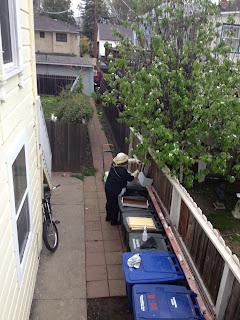
Swarm Collection Underway
But in the case of the wild swarm that Lauren spotted -- there is no hive to protect. Therefore, there is no reason for bees to sting. Indeed, bees are in their most docile state right after they've swarmed. Now, this doesn't mean that you should approach a swarm without protection. There are no guarantees in the world of beekeeping. And I'm not guaranteeing that you won't get stung once or twice if you get too close to a particular, agitated swarm. In the world of beekeeping, the number one rule of thumb is: Never Say Never. Capice?

I had spent the entire winter preparing for this swarm call. I'm still not comfortable enough around bees to approach a hive without protection. There are some beekeepers who will do this job in a t-shirt, shorts and sandals. This is not my approach. This is not for Bill Bird. Bill Bird is a chicken. Bill Bird opts for protection. And protection means a thick suit, gloves, veil, smoker, water bottle and more.

One more thing? The beekeeping community does not produce bee suits in Bill Bird type proportions. They probably do, but it would have to be a special order. I hate special orders. Special orders cost $$$. And if the "special order" suit is two sizes too small once it arrives? Tough luck beekeeper. Time to put on some shorts and sandals.

Preparing for Swarm Collection
So -- in my case? I improvised with a pair of common overalls from Dickies Mens Wear. While I would prefer these overalls to be in a white or light color, Dickies doesn't make anything that large in a white or light color. So -- you purchase the dark blue option and live with it. Working in dark colors around a hive isn't always the smartest option. In my bee suit I resemble a big blue bear. Bees and bears do not mix well. Bees don't like bears for the havoc they often bring when breaking into a hive for honey. A colony of bees can and will react with a stinging party if they are bothered by a particular dark color.

But in my case? I had no choice. It was either dark blue or shorts and sandals.

Swarm Below
The particular colony that Lauren spotted had come to rest against a fence post in a side yard of her downtown Sacramento home. I was lucky. That swarm could have landed on a tree branch 20 feet out of my reach. It could have landed on top of a home. It could have landed on a second story windowsill.

But, instead, this queen chose the temporary perch of a fence post that was about five feet off the ground. The workers settled around her. It was a mass of bees. Early swarms are large swarms. And this was one large swarm that would eventually cover five full frames. For beekeepers? This is like winning the lottery.

As I approached this mass of bees for the first time, I remembered the swarm catching lessons that I had learned from other beekeepers. The number one rule of advice? Stay calm. Stay focused. Bees can smell fear. After placing my swarm catching box on a waste can directly below the mass of bees, I sprayed them with smoke and then started squirting them with a water bottle.

Why I Keep Bees: Honeybee Pollinates Cherry Tree
Why the smoke? There's something about smoke that serves as a calming influence. It also reduces the numbers of bees that will attempt to fly away. The water acts as the same deterrent. Bees can't fly with wet wings. And the weight of the water will eventually cause this mass of bees to fall. This is exactly what I wanted, as I had strategically placed the swarm catching box just below them.

It is a magical sight when large swarms like this fall into a swarm catching box. It looks much like running water as streams of bees gently fall into the box below. Once the stream stops -- it's time to bring out the water bottle for more water treatment on the bees that remain firmly on the fence post. Your goal as a beekeeper is to ensure that the queen gets inside that box. Once she's there, the worker bees and drones will follow, almost like a small army.

The collection effort worked better than I ever could have imagined. When most of the bees had fallen into the box, I gently placed frames inside and closed up the top. I then proceeded to remove a small plug at the side of this swarm collection box. This was the real test of my efforts. If I had captured the queen? Bees would march right through that opening and into the box. If I hadn't captured the queen? There would have been a mad rush to escape.

Imagine the satisfaction that washed over me as I watched the bees march, two-by-two, side-by-side, through that small, dark opening and into the darkened swarm collection box. I had captured the queen. This swarm collection was a success.

Hello Kitty Hive
Despite this successful collection, I wasn't out the woods just yet. The next step was to transport the colony home and then "hive it" into the waiting Hello Kitty hive. Neither step is easy. Bees don't like long car trips. Have you ever taken a cat to the Veterinarian? Bees react in much the same matter. There's always that chance they'll come swarming up out of the swarm collection box and right into your face once the cover to the swarm collection box has been removed.

That's no fun. Trust me.

Luck, however, would once again prevail. The colony was calm. Most of the bees had settled onto the five frames inside the swarm collection box and showed no intention of leaving. The next step was to place each frame inside the Hello Kitty Hive -- shake the remaining bees out of the box and into the hive -- cover it and step away.

Once again -- Lady Luck was with me. As I stepped away from the hive and started to pull off my bee catching gear -- it suddenly struck me how easy this process was. I didn't notice that stray bee on my neck as I was congratulating myself on a job well done. I realized -- proudly -- that I hadn't been stung once during the entire process.

That is until that stray bee flew into my ear and proceeded to insert a well-placed DAGGER.

The joys of beekeeping.

Gardening Hits and Misses

Tuesday, April 3, 2012

If you've followed this rant for any length of time, you probably know that the Bird Back 40 is a creation that Baron Victor Von Frankenstein would be proud of. It's one massive experiment in all things gardening and fruit production. I don't follow rules. I break them. If someone tells me "it can't work," I try it anyway.

Sometimes it works. Sometimes it doesn't. I've posted more than once about my little gardening experiments here and there about the yard, but it came to me the other day that I had failed to post updates. Lest someone repeat my many mistakes, here's an update on gardening hits and gardening misses (ie: massive failures) in the Backyard of Bird.

Successful Pluot Graft-Bird Back 40
HIT: Grafting of fruit trees. I'm a relative newb when it comes to the world of grafting. This spring was my first experiment into the world of creating several different kinds of fruit on just one tree. The name of this blog posting: A Dead Man's Party.

This little experiment in all things grafting is still a work on progress. Some grafts still haven't sprouted yet, but others have, as evidenced by the photo to your left. This is the Flavor Finale Pluot tree that the wife that is Venus and I planted just three years ago.

Flavor King Pluot Graft
There are six different grafted branches on this tree. As of this date, four have popped. We're still not quite out of the woods yet. A strong wind could blow some of these grafted branches right off the tree if the taping doesn't hold. But if these grafted branches do form a a strong union with the Flavor Finale tree -- I've gone from a single variety of pluot to a four-in-one. The advantage to this is four different kinds of pluots all ripening at different times of the spring and summer.

This means a prolonged harvest of fresh, tree-ripened fruit from the backyard, provided the pesky mockingbirds don't beat me to the punch. I have reason to worry, because these two have shown that they can and will beat me to the punch. They stripped this tree last year. Not a single pluot survived.

Strawberry plants don't like bags!
MISS: Strawberries and flowers planted in bags that hung from the fence line. Originally profiled in the blog posting of The Bag Man, the use of Original Al's Flower Pouch for strawberry and annual flower plantings was a miserable disappointment.

The goal of this little experiment was to put my fence line to work in all things strawberry and fruit production. I already use portions of this fence line for trellising crops like cucumbers and boysenberries, so why not strawberries and flowers? It seemed like a natural fit.

Thank goodness I only invested in ten bags.

As Good As It Gets
I'll be honest with you. It just did not work. The ten strawberry plants that I ordered from Sakuma Brothers Nursery never really did take off. In fact, they looked mighty unhappy over the course of an entire summer. Despite plenty of water, fertilizer and good drainage, the UC Davis cultivar "Chandler" never really did take to the bag idea. About half of them died during the course of the summer. The others gave up the ghost during the fall and winter months.

I suffered the same disappointment with annual petunias that were planted in early June. Nephew Marquitos and niece Celina showed off their fine work soon after they finished planting. This is about as good as it got. Despite extensive watering and fertilization, the petunias never really did take off. And -- in the world of gardening -- if you can't make a petunia grow -- that's a really bad sign.

Gaviota Strawberries in Raised Bed-2nd Year
HIT: Strawberries planted beneath fruit trees. Originally profiled in the blog posting "A Very Berry Bird Backyard," this one is a hit kids. Venus and I will enjoy a nice little harvest of Gaviota strawberries this year (another UC Davis cultivar I might add) to prove it.

The idea for this little experiment came from Folsom City Arborist Ken Menzer, who hosted a course that we attended two years ago on all the production of all kinds of fruit in the backyard. The course included a hands on demonstration of the Backyard Orchard Culture (BOC) method of fruit tree production, which we use to this day in the Bird Back 40. He also had some rather interesting tips that panned out quite well and other that failed miserably.

Backyard Orchard Culture: Apple Trees
One tip that did fare rather well? Strawberries planted underneath groves of apple trees. Menzer's contention was the strawberry plants, which will grow just about anywhere (except in bags against my fence), will open up cracks in the soil line. This in turn makes it easier for water and nutrients to reach the roots of fruit trees that are just inches below. That wasn't the only benefit in Menzer's opinion. The root system of the fruit trees in question would spread much easier thanks to the loose soil created by strawberry plants.

So far? So good! This is one tip that worked. The ten Gaviota strawberry plants that Venus and I ordered from Sakuma Brothers Nursery last spring have expanded into a collection of close to 50-75 plants. They are all flowering nicely this spring after a late winter addition of nitrogen fertilizer. As for the apple trees above in this 5X3 foot raised bed? This is another experiment in BOC group planting. Now entering Year 2, all are flowering nicely this spring.

Consider this a "hit" of major proportions. This isn't the last BOC planting for the Bird Back 40. Other beds will be added. And those beds will contain different varieties of UC Cultivar strawberries (which happen to be my personal favorite for size and overall production).

No Blueberries here-Just Weeds
MISS: Blueberry plants beneath peach and cherry trees. Originally profiled in the blog posting "A Very Berry Bird Backyard" and again in the followup posting "A Very Berry Experiment -- AKA: They Stay," this was another planting idea that we received from Ken Menzer. We were presented with slides of this very successful fruit tree and blueberry bush arrangement from his own backyard.

The thinking behind this idea was very similar to the practice of planting strawberry plants beneath apple trees. Blueberry plants, which have shallow root systems, help crack open the soil line and allow water and nutrients pass easily to the fruit tree roots not far below. An added benefit was that fruit trees helped shield blueberry bushes from blazing sunlight during those hot Sacramento summer afternoons.

Photo Courtesy of Peaceful Valley Farm Supply
This sounded like another brilliant idea, so Venus and I both invested in four different Southern Highbush varieties called "Misty" and "Sharp Blue." Unfortunately, I don't have any photo evidence to show what really happened. The blueberry bushes are long gone. All bought the farm during the first or second year of growth.

This was not a good idea.

The first to ring the alarm warning was none other than gardening mentor and Lifetime Master Gardener Fred Hoffman, aka "Farmer Fred." The long-time host of the KFBK Gardening Show on NewsTalk 1530 KFBK and Get Growing on Talk 650 KSTE immediately objected to the pairing.

“What is the pH of the soil where you planted the blueberries," Hoffman questioned. "If it is above 6, you may have poor production. This is why blueberry planting around here is recommended for containers, where you can control the pH.”

Flowering Granny Smith Apple Tree
As I would come to discover, I jumped without looking at the bottom first. Fred was right on the money. The soil pH requirements for fruit trees and blueberries are dramatically different. Although this arrangement might work in some different locations that offer different soils, it didn't work in the hard clay slop that dominates the Sacramento Riverbottom.

Bottom line? Blueberry plants need to be planted in containers or raised beds where pH levels can be closely monitored. The four bare root varieties that we invested in are but a distant memory now.

And, so, there you have it. These aren't the only four experiments that resulted in success or massive failure, but they do represent the top four that I have written about. Remember that gardening is an adventure in the unknown. There are no "tried and true" methods as some would have you believe. If you're going to garden, you're going to experience failure. That's just part of the game.

But sometimes, every once in a great while, you hit upon an idea that not only works but works better than you ever could have imagined.

And that is the payoff.