Showing posts with label Duke Avocado. Show all posts

The Flowers of Spring

Sunday, April 3, 2016

Honey Crisp Apple Tree in Full Bloom
"April Showers Bring May Flowers," my mother once crooned. She usually started screeching after a surprise rain storm wiped out whatever her youngest boy had planned for the day -- an event that was usually outside. Because, what boy wants to be stuck inside when the sun is shining outside?

Thank God our house had some thick walls -- because mom's singing was pretty brutal. Brutal enough to drive a boy into a garage in an attempt to find some auditory relief. Perhaps that's the way she wanted it. Perhaps I'm not giving mom enough credit...

Granny Smith Apple in Bloom
Spring is special because it brings a bounty of flowers to the Bird Back 40. And, in our case, every single tiny flower brings the promise of a fruit payoff later this summer. I've come to that age (OLD), where I appreciate the finer things in life. And nothing brings greater joy than a Honey Crisp Apple tree doing it's best Granny Smith Apple imitation.

This is year five for the Honey Crisp. It's delivered exactly one eye-popping crop so far -- and that came in year two. The dreaded Fire Blight would strike in year three, wiping out an entire crop. And last year? Last year the Honey Crisp bloomed in exactly one spot. That's a crime, because the Honey Crisp Apple is that good.

Duke Avocado Tree in Bloom
But this year is somewhat different. This year is somewhat exciting. The temperamental Honey Crisp is covered with blooms and honey bees. The Fuji Apple is also blooming heavily -- a first for this tree as well. And the Granny? The Granny Smith apple was meant to bloom. It always blooms. When doesn't a Granny bloom? If you're looking for a good pollinator tree, look no further than the Granny. That tree is rather ridiculous. It blooms early. It blooms mid-season. It blooms late. Even after you think the Granny is done blooming, surprise! There's another set of buttery pink blossoms.

The story is pretty much the same across the Bird Back 40. The blossom period for the peaches and nectarines is just about over. The thorn less blackberry vines are in full bloom. The Shuksan strawberry plants are going to town. Even the Duke Avocado tree is covered with more blooms and bees than I can possibly count. Step anywhere near that tree and you'd swear there was a beehive hidden somewhere in there.

Duke Avocado Blooms
But the most surprising development isn't the surprisingly heavy crop of Royal Rainier Cherries. It's not the myriad of mandarins that are covered with a carpet of white. No -- the most surprising development was the number of blooms on the Harrow Delight Pear tree. I planted this tree three years ago. I dutifully chopped it in half to knee level to encourage low branch development. And I was told it could take 4-5 years before the Harrow Delight produced its first crop.

Instead, the Harrow Delight bloomed in year three and set a nice crop of pears. This is important because I fell in love with the Harrow Delight at a Dave Wilson Nursery fruit tasting event held several years ago at the Fair Oaks Horticulture Center. Even though the wife that is Venus were sampling a bevy of different fruits on this particular day, one item stood out among all the others. I kept going back for more. It was the Harrow Delight Pear.

Harrow Delight Pear in Bloom
The Harrow Delight is one of two varieties planted in a raised bed that are supposedly resistant to the scourge upon fruit kind known as Fire Blight. It was introduced in 1982 from the Harrow Agricultural station in Ontario, Canada. The Blake's Pride Pear, which is also billed as Fire Blight resistant, was developed by Richard Bell with the ARS Appalachian Fruit Research Station in Kearneysville, West Virginia in 1998.

Unfortunately, I will have to wait on the Blake's Pride as it did now flower this spring. The old-fashioned Bartlett Pear, which is not resistant to blight and is planted in the same raised bed as the other two varieties, flowered heavily this year.

Harrow Delight Pears
No sign of the dreaded blight yet this year. I'm keeping my fingers crossed and trying a new organic solution of water and apple cider vinegar to keep the blight at bay. I do have something stronger, BUT, I really don't like what this particular chemical did to the fruit composition last year. So it stays on the sideline.

Half the work of growing home-grown fruit takes place in the spring. Is the area clear of weeds (weeds steal water)? Has the appropriate fertilizer been applied? Is it getting enough water? Are the fruit trees protected from various ills, like blight, that can strike in the spring?

If the answer to all four questions is "YES," congratulations. You should have a tree full of fruit. Of course, a million and one things could happen between now and harvest time that could spoil that tempting looking crop. As backyard fruit growers, this is the cross we bear.

So -- congratulations. Springtime has arrived. The fruit trees are in full bloom. The honey bees are out in force. And, so far, mom hasn't been tempted to start crooning "April Showers Bring May Flowers."

Venus and The Duke

Sunday, November 2, 2014

Venus and The Duke Avocado Tree
Yeah, yeah, I know. It's not quite as snappy as "Bennie and The Jets," but give it a few years. Pretty soon it will just roll right off the tongue. Because Venus and The Duke are going to be telling their story for a very long time. At some point -- in the very near future I hope -- I will be posting photos of the fabulous guacamole that Venus will whip up from a very rare crop of Duke Avocados.

There's my fine lady to the right standing next to her favorite fruit-bearing tree in the Bird Back 40. It hasn't yielded a single fruit yet. But with avocado trees you need a little bit of luck and an awful lot of patience. I've come to learn a little of both following a near lifetime of killing avocado tree varieties right and left.

The Duke: October 2013
The Duke Avocado, which was barely two feet tall when I first planted it in it's permanent spot in a protected side yard exactly one year ago last October, laughed at the December frosts that coated the Bird Back 40 last year. While other citrus trees either gave up the ghost completely or died back by half, the Duke sailed through the freezing conditions with nary a scratch on it. In fact -- I'll make the point that it actually grew a full leaf set during last winter's colder than cold conditions. These conditions I might add, have doomed other avocado plantings in the past.

While I wouldn't consider myself the absolute authority on the Duke Avocado tree -- I have discovered a lot of information about it that is not contained in previous blog posts about this incredibly rare, freeze tolerant, avocado tree. Yes -- you're eyes did not fool you. This is one of the few tropical fruits that not only withstands sustained freezing conditions, it appears to prefer them. There is no other avocado variety on this planet, as far as I can tell, that offers this wonderful advantage. While most avocado varieties can be very touchy about climatic conditions, the Duke appears to be bullet and idiot proof.

Armstrong Nursery Catalog: 1929
This is a good thing -- as my idiot meter seems to spin out of control from time to time.

How do I know that the Duke is nearly bullet proof? From experience and lots and lots of research. The most recent discoveries about this ancient variety came only recently thanks to an inquisitive librarian by the name of Kelly Zackmann who toils for the public library system in the Southern California city of Ontario. This city was, at one time, home to one of the most groundbreaking and innovative nurseries in California: The Armstrong Nursery.

The nursery business closed up shop in 1970 following the death of founder John Armstrong, who lived to be nearly 100 years old. Although it continues today under the brand of Armstrong Garden Centers, with locations scattered about Southern California, there is no family connection anymore. And when the Armstrong family decided to finally sell the business following John Armstrong's passing, they had 70 years worth of records and other information that needed to be hauled away.

1929 Catalog Contains First Mention of The Duke
Thank goodness it didn't wind up in some landfill. Instead, it was donated to the City of Ontario public library system. The contents inside 80 boxes filled with horticultural history was carefully cataloged, stored and then largely forgotten. I knew about this history and where it was stored, but I figured out fairly early on that I wasn't going to make a special trip all the way to Ontario to dig through 80 boxes of Armstrong Nursery history. I'm nuts people -- but not that nuts.

Why the interest in old horticulture history? Because it was John Armstrong who saw the great promise that the Duke Avocado offered. It was Armstrong who would receive cuttings from the Mother Duke tree that grew from seed at the Sunnyslope Nursery located near Bangor in Butte County in 1924. It was Armstrong who attempted the very first grafting attempts of this unique tree. And it was Armstrong who, for decades, exclusively offered the Duke Avocado through his extensive and profitable catalog business.

1937 Armstrong Nursery Catalog
Short and simple? Without Armstrong's work, this avocado variety probably wouldn't exist. He saw its potential and for years he marketed the Duke Avocado as the ideal tree for planting in "cold interior districts." Although Armstrong would discontinue his catalog business at some point, he would continue to offer the tree on a wholesale basis to California nurseries up until 1971. That was right about the time the Armstrong family sold the business.

Meticulous research notes kept on the Duke tree from the late thirties and into the forties confirm that the tree, for some reason, does not bear well on the coast of California. However, the further inland it is planted, the better it does. The research tells the story of a ten year old Duke tree in Pomona that produced 3,000 fruits in one year. Groves of Duke trees in Arizona were reported to do even better.

Armstrong Nursery Research Notes on The Duke Avocado
Groves of Duke Avocado trees in Arizona? Yes, at one time they were grown there. Unfortunately, the passage of this thing called "time" tends to change the topography somewhat. The ranch where these groves once grew in abundance in Tucson, AZ was sold, subdivided and now contains nothing more than housing subdivisions. It happens to the best of us I suppose.

The Duke tree I have growing in the side yard of the Bird Back 40 grew five feet in one year. It is green, lush and very healthy. It now stands close to seven feet tall. According to further research notes obtained from Armstrong Nursery, Duke trees begin to bear fruit four or five years after planting. While I'm hopeful that my healthy Duke tree will begin to bear something next year, it probably isn't going to happen.

Venus and her Duke Avocado Tree
Patience, young man. Patience.

If you want to learn more about my quest to discover and grow a freeze tolerant avocado variety in North Natomas, I suppose it's best to start from the beginning. You can find followup reports here, here and even here.

YeeHaw for the MayHaw!!!

Monday, February 24, 2014

100 Percent Pure Mayhaw Jelly
There's something mighty good going on at the Bird House these days. And -- it's one of the few times I must admit -- where this mighty good stuff did not spring from the grounds of the Bird Back 40. Nope -- didn't come from here. Our fruit trees might be flowering a tad from this early spring. But what we've got didn't come from the Bird Back 40 because -- to be quite honest -- it just doesn't grow here.
 
I'm talking about the Mayhaw tree. While most fruits and vegetables sold across the good ol' United States of America hail from California -- the same cannot be said about the Mayhaw. It's native to a small stretch of the south -- the swampy parts of the south that is. The Mayhaw tree grows wild in the swamp lands of Louisiana and southern Mississippi -- with parts of northern Florida thrown in for good measure.
 
Maxine Mayhaw (courtesy Travis Callahan)
The thing is this: If you live in a swampy area of the south? Chances are there's a Mayhaw tree growing nearby.
 
That jar of jelly pictured above is 100 percent pure, southern grown and made in a country kitchen, Mayhaw Jelly. It comes from the kitchen of Travis and Diana Callahan, straight from a little town called Abbeville, Louisiana. And let me tell you -- from experience I might add -- Mayhaw jelly is one of those "little treasures" that not many people get to enjoy.
 
Why is that? Well -- for one thing -- the Mayhaw tree isn't widely grown. Secondly, it hasn't been all that long since someone discovered the Mayhaw fruit is not only good for things such as jelly, syrup and wine, it's downright fantasmogoric. I invented that word. It's translation is "mighty good."
 
Maxine Mayhaw Jelly (courtesy Travis Callahan)
How did I come into this jar of very special Mayhaw jelly? As it turns out? My connection to the Duke Avocado paid a little bit of a dividend. Travis Callahan is a fan of the blog that is Sacramento Vegetable Gardening. He's also a backyard fruit growing enthusiast. And if there's one thing Travis is looking for? It's an avocado tree that can survive the freezing conditions that sometimes grip southern Louisiana. They don't get them often -- but they do get them.
 
Travis would literally stumble over the blog that is Sacramento Vegetable Gardening one night while searching for an avocado variety that could not only survive freezing conditions, but thrive in them. Since the Duke Avocado, which was borne in ice-cold Butte County, can not only survive but thrive in these conditions, well, count Travis as a might bit interested.
 
Mayhaw Fruit (courtesy Travis Callahan)
And so -- thanks to the wonders of email and introductions -- Travis and I struck up a conversation. It was during this conversation where I would learn about his website and his absolute love and dedication to the Mayhaw tree. One day I offered Travis a trade: One jar of the moderately famous Roasted Garlic, Pepper and Heirloom Tomato Salsa for a jar of pure Mayhaw Jelly.
 
He accepted. And I WON. Boy did I win. I mean -- BIG TIME. I should have shipped Travis and his wife a case of salsa for this jelly -- because this jelly is like none other.
 
Maxine Mayhaw Tree (courtesy Travis Callahan)
The Mayhaw is an early producing tree that produces a fruit very similar to the Manzanita bush here on the west coast. Translated, the Manzanita means "little apple." The Mayhaw produces a fruit similar in appearance. Harvested straight from the tree? I'm told, and I've read, the Mayhaw isn't all that impressive. Perhaps this is the reason it was ignored for so long. Early settlers, I've learned, noticed that Native Americans avoided the Mayhaw. Perhaps this is the reason is took so long to be discovered.
 
But -- mix Mayhaw fruit with a little bit of sugar -- and something special happens with the chemical reaction. Mayhaw jelly tastes a little bit like strawberry jam. It may look like a tiny apple, but tastes nothing like it. It is indeed unique. Perhaps this is one reason why growers are planting acre after acre of Mayhaw trees.
 
Ripe Mayhaws (courtesy Travis Callahan)
Jars of pure Mayhaw jelly have been known to command a premium price. Travis tells me that often, the Mayhaw juice is cut with apple juice, which is cheaper, to produce larger batches of jelly. Mixing Mayhaw juice with common apple juice, I'm told, is a crime. Yet it does happen. This is because the demand for Mayhaw jelly, once a deep southern secret, continues to grow.
 
The best jars of Mayhaw jelly come from a home kitchen. And that's what we have here. I wish I could share this experience with you, but I can't. There just isn't enough Mayhaw jelly to go around. But trust me when I tell you that the Mayhaw tree deserves a spot in in California agriculture. And thanks to the wonders of modern horticulture, it may not be long before that happens.
 
Mayhaw Jelly and a Hello Kitty Toaster!
Hey, if we can get blueberries to survive and thrive in the Golden State, why not the Mayhaw? Then, and only then, might you get the chance to sample the treasure known as Maxine Mayhaw jelly.
 
And that's darn good.

The Memory of Generations Gone By

Monday, September 30, 2013

Introductory Garden: Western Pacific Rail Road Depot
My friends -- I don't often do this. But -- this time -- I had to make an exception. I am regularly approached by one person or another offering cash or product trade for space on this blog. I turn the vast majority of these requests down because this is not a commercial blog, nor did I ever intend it to be one. This is simply one man's diary of gardening in Northern California -- nothing more.

But -- from time to time I do manage to touch upon on a subject that touches others in the Northern California area. It's not intentional. But when you write about Northern California experiences, people and places, you're bound to strike a chord with someone. In this particular case, it appears I did. And I had to share it with you.

Branches of an Heirloom Duke Avocado Tree
The message below comes from a reader named Martha Smith, who stumbled across this blog after shopping for Duke Avocados at the Chico Farmer's Market this past weekend. Dukes are now "in season" across Northern California markets, so if you're interested in trying out a variety that is native to Northern California, get while the getting is good. Duke Avocado season doesn't last long.

Martha wrote to me after reading my latest post about my personal adventure with the Duke Avocado here. Additional updates about the Duke can be found here and here.

In Martha's words -- I have not changed a thing:


"Dear Bill,

About 6 or so years ago, I had mentioned to my father that I was traveling to Oroville. He said, "if you have the time, go by The Depot, and visit the trees. It is there that your grandmother fell in love with  your grandfather. She would wait at the small grove of trees for his train to come in."

Note: This was the secret lovers meeting place, because he was not approved by her father.

Duke Avocado Trees: Oroville
So I went there and saw the  old carvings into the trees from long ago. Carving each others initials into the tree trunk was the way back then. It must have been one of the biggest ways to proclaim their love for each other, out-loud.

I also noticed the sign of "do not touch". But I had to touch the trunk. Just once to experience the whole idea that their love for each other had been spoken in this very spot, long ago. That would have been in the mid-1930's.

I had put that experience and details away in my heart until today.

I was at the Chico Farmers market and saw the green avocado's  with the sign that read Duke Avocado's.

Curious and all, I asked a few questions and was satisfied with trying them. Then I set out to search the internet for information.

Western Pacific Rail Road Depot: Oroville
Thankfully I found your website and want you to know how glad I am for your research. You have just made  a beautiful fall day even better.

When I see the Duke, it will always represent a link to my ancestors who lived in the area.

Thank you again,

Martha Smith


No, Martha, thank you for sharing a wonderful story. Take care, and God Bless.

PURCHASE DUKE AVOCADOS: Duke Avocado season starts in late September and continues through mid-to-late October depending upon availability. There is only one Northern California grower that has a collection of these unique trees. They are located on the grounds of a 2,000 acre family ranch known as Chaffin Family Orchards, located just north of Oroville. The Chaffin Family sells Duke Avocados at farmer's markets in Chico and Paradise until the supply runs out for the year. Please visit the ranch website for more information.

The $70 Chicken

Friday, January 4, 2013

Pastured Chicken: Chaffin Family Orchards
I don't often make New Year's Resolutions. However, I am quite good at breaking them. Which is probably why I don't make a lot of New Year's Resolutions. But if there's one thing that I resolve to do in 2013 -- it's this: Invest in more $70 chickens.

What's that you say? A $70 chicken? Is this a chicken made out of gold, perchance? I know what you're thinking. The last time you visited your local supermarket, you didn't see any of them $70 chickens. Nor would you buy such a thing. Chickens are cheap! Especially if you watch the sales and buy in bulk like we do thanks to a handy-dandy floor freezer.

Foster Farms Chicken!
The wife that is Venus and I do happen to "shop the sales." I must admit -- I am a tad partial to my Foster Farms chicken. I grew up less than a stone's throw from an old Foster Farms processing facility on McHenry Avenue in Modesto (it's a fire station now), which is Foster Farms "home territory." It's also the home of one of the last "Chicken Barns," but we'll save that story for another day.

If Venus and I spot a store ad for Foster Farms whole chickens selling at a price of 79-cents or 89-cents per pound? Count us "there" and attempting to corner the market. We have a million and one different recipes for chicken dishes, ranging from beer can chicken, honey-barbequed chicken, fried chicken, baked chicken... You get the story. Chicken is a fabulous meal.

The $70 Chicken: Cut Up and Ready for BBQ
But the $70 chicken? The $70 chicken is special. The $70 chicken is never on sale. The $70 chicken is available only for a few weeks every year. If there's one thing I've learned, it's this: Foster Farms cannot compete with the $70 chicken.

What am I? "Made of gold," you ask? Not hardly. But I've discovered something quite good and I'm not letting go of it.

The Logo Says It All
During my months of research on the Duke Avocado, it's storied beginnings in Butte County and it's legendary ability to withstand frosty cold conditions I began to gain awareness of a 2,000 acre family farm located just north of Oroville. Five generations of the Chaffin family have farmed this land, and according to the words printed on their own family website: "have had a deep respect for the environment, preservation of open space, promoting wildlife and producing food for the local community."

I would come to learn that more than just Duke Avocados came from the Chaffin operation. The family presses their own olive oil from old growth Mission Olive trees. I was shocked to receive a recent email from the ranch operation, informing me that one can purchase "shares" in the upcoming olive harvest and olive oil production. SHARES? In olive oil? I'd heard of purchasing stock in companies or precious minerals, but OLIVE OIL? I remember chuckling at the thought.

Shares? In Olive Oil? You Kidding?
As it turns out, the joke was on me. By the time I seriously got around to thinking about purchasing a share or two, none was to be had. I suffered the same disappointment when I waited to place orders for an upcoming grass fed beef sale. I balked at the price. By the time I finally ginned up the courage to buy? There was nothing left to buy, not so much as a soup bone.

I couldn't begin to understand, yet, why these products would vanish so quickly. It's not like grass-fed beef is hard to find. It's more expensive than conventionally produced beef, but it's easy to find if you know where to look. But never had a I run across a situation like this: Wait, and you'll be SORR-EE.

Chaffin Broilers on Pasture
I vowed that I would not make the same mistake when I was alerted to sales of Chaffin's pastured chickens. They are sold only twice a year, in the spring and fall,  and like the grass-fed beef, if you wait too long to place that order...

And -- so -- I placed that order.

It wasn't until I traveled to the Nevada City Farmer's Market that sunny October morning did I truly realize just what I had done. First: Nevada City is a LONG way off the beaten path from the Bird Back 40 when it comes to purchasing chicken. Let's just say the neighborhood market is just a tad closer. Secondly, I wasn't expecting a price tag of -- GULP -- $70 for three chickens.

OMG! Have I Lost It Completely?
It was at that crucial point where I read the fine print. Pastured chickens cost $4.95. Not per chicken mind you. That's $4.95 PER POUND. With each chicken weighing anywhere from 4-5 lbs., I could just see the reaction from the wife that is Venus. I would soon be sleeping in the backyard with the cats...

What's so special about pastured chicken? Again, from the Chaffin Family website: "Because about a third of a truly pasture raised chicken's diet actually comes from forage of grass and bugs in the pasture, they have more healthy fats like Omega 3's and CLA (Conjulated Linoleic Acid) in the meat. They are allowed to be happy and joyful chickens, which adds to the quality of the meat."

BBQ Chaffin Chicken: Heaven on Earth
Yeah, OK, but here's the $64 question: Are they really worth $70?

That is a question that I will leave to you, faithful blog explorer. What I can tell you, however, is this much: There is a world of taste difference between those chickens that sell for $5 or $6 in the store, and those that have been raised on pasture grass and bugs. You'll notice it in the first juicy bite of one of those very special chickens.

I've never tasted chicken like this before. I'm not sure how to describe it to you in simple terms, but I can tell you that only one of the original three chickens is left in the freezer and the wife is saving it for one very special event. A special event deserves a special chicken. The taste of any meal prepared with a Chaffin pastured chicken is incredible.

And now the final question? Will I gin up the courage to buy more next spring? But of course! I'm beginning to like spending nights in the backyard with the cats...

Visit the Chaffin Family Orchards website here.

The Legendary Duke Avocado, Part Deux

Sunday, October 28, 2012

Duke Avocado Trees: Old Oroville Depot
An avocado tree that can not only withstand freezing conditions but laugh in the face of a one Mr. Jack Frost himself? An avocado that offers a higher oil content than the Hass? An avocado variety that can withstand root rot conditions that have doomed other trees in the Bird Back 40? Say it ain't so! I must have one!

Consider this a followup to a journey that started many moons ago during that one night where I could not sleep. I was desperately seeking Susan, err, for an avocado variety that could withstand our colder than cold Northern California winters. It was that night that I discovered the Duke, its ability to withstand freezing winter temperatures and its interesting history, which I wrote about several months ago.

Introductory Garden: Old Oroville Depot
The posting about the Duke has generated the largest response from readers since Venus and I painted a beehive Hello Kitty pink and proceeded to get stung silly while attempting to become amateur beekeepers. That's a good word: Amateur. Another good word is foolhardy. But I digress.

The quest to grow an avocado tree in our micro-climate cold North Natomas Back 40 by reaching back into Northern California history to grab a bit of the past has been an interesting journey indeed. My singular attempt to bring this 100-year old variety called the "Duke" into the present day has now grown to involve the efforts of several growers, some connected with California Rare Fruit Growers (CRFG) and some not.

First Graft Attempt: FAIL!
When I signed off on the last posting, I was attempting to graft Duke scions onto three different avocado root stocks provided by David Johnson, an avocado aficionado who has painstakingly turned his Waterford backyard into a rain forest-like shrine to all things citrus. If you think "you can't grow that here," David is probably growing it, and growing it successfully.

And now? The rest of the story.

I suck at grafting. I really do. It's a skill that I've not yet acquired, despite some early grafting success that I experienced last spring with my pluot and plum trees. Grafting stone fruit scions to other stone fruit trees is MUCH easier than grafting citrus, a painful lesson I would learn after watching every single avocado graft I attempted curl up, turn a none-too-pleasant shade of black and DIE.

After watching my repeated grafting attempts fail and fail and fail again, nearly destroying three avocado root stocks in the process, fate would smile upon me rather fondly. A fellow avocado NUTCASE like me learned of my struggles and advised: "Contact Sam."

GRAFTING: IRANIAN STYLE

Venus Beneath Monster Duke Avocado Trees
"Sam" is actually a nickname for a one Samad Janfeshan, who lives in a quiet Arden Oaks Vista neighborhood. I would later come to find out that Sam is quite famous, provided one of your primary languages is Persian. I am told he still takes phone calls from all areas of Europe and the Middle East thanks to his knowledge and experience in the field of all things horticulture. As I would come to find out, Sam employed a highly successful grafting technique learned while tending the family ranch in Iran.

How did "Sam" get from an orchard in central Iran to Sacramento? That's a story even more interesting than his grafting technique and a backyard that is a shrine to his marvelous grafting abilities. Like many Iranian citizens, Sam was fortunate enough to attend our institutions of higher education in California. Unfortunately for Sam, during this particular period in time, things got a little crazy in his home country.

Ayatollah Khomeini
It was during this time that the Shah would be overthrown, the U.S. embassy would be raided and hundreds taken hostage and a figure known as the Ayatollah would come to power. Overnight, a once-staunch U.S. ally in the Middle East would become decidedly anti-American. Sam, who watched events unfold from the safety of California, decided he wanted no part of the new direction his country was headed in and worked to become a citizen of the United States. He would give up the farm, but never lose his love for fruit trees and other horticultural endeavors.

I am more than fortunate to be steered in this man's direction. He saw the troubles I was having. He scolded me silly for my amateurish grafting attempts and proceeded to teach me a skin-grafting technique that I've never seen performed before. It's a technique that has resulted in multiple plum, mulberry and other fruit tree offerings that grace the family backyard. Yet, you will find none of these varieties at your local nursery. You will, however, find them in Iran.

Duke Avocado Leaves: Brilliant Yellowish Green
It suddenly struck me that if Sam could successfully grow fruit trees native to Iran in the backyard of his Sacramento home, he could probably solve my grafting problems with the Duke Avocado. Call that a rather fair assumption. Every graft Sam attempted survived. Three sorry looking avocado root stocks have been transformed into legendary Duke Avocado trees.

Not satisfied with his success on three trees, additional root stock was procured from a long-time member of the Sacramento Chapter of the CRFG where Sam again demonstrated his successful grafting skills. Additional Duke scion wood was also farmed out to David Johnson and other CRFG growers who are slowly bringing this heirloom avocado tree back to life.

THE BIG TEST
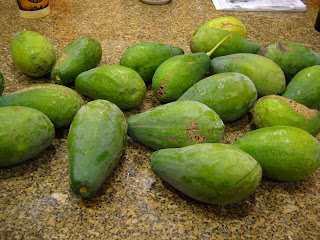
Freshly Harvested Duke Avocados
Although I've uncovered a lot of information about the legendary Duke line and discovered old Duke trees in locations scattered throughout Butte County, one big piece remained missing from this equation. What does a Duke avocado taste like? Was this variety abandoned so long ago because it tasted like the inside of one of my old tennis shoes? I had always strongly suspected that the Duke was abandoned by commercial growers because it was a poor shipper. But I couldn't prove that. Not yet anyway.

I would have to wait for Duke season that finally arrived this month. Duke trees are alternate bearing, which means in some years you get a heavy crop of avocados and other years the pickings are slim. 2012 turned out to be one of those lean years. As I gazed into the treetops of the Duke trees in the Oroville Depot Introductory Garden earlier this month, I found what I was looking for.

Fruit Harvesting Basket for Fat People
It was also 30 feet off the ground. While I was once a champion tree climber in my youth, quite a few years have passed since then, and considerable pounds have been added to my once wiry frame. I wasn't about to scramble up a tree -- avocado or no avocado. Fortunately I had come armed with a fruit harvesting basket like the once you see pictured, plus a handy dandy telescoping handle that put the Duke fruit well within my reach.

I can't begin to describe the joy and satisfaction I felt as I pulled that very first piece of fruit off this heirloom tree and brought it slowly downward. Months of reading, research and phone calls had finally resulted in this moment. Upon grabbing my first Duke avocado, I brought it up close to my ear and gave it a vigorous shake. This was the final test. If this was truly a Duke avocado, the seed would be loose inside the piece of fruit. You can imagine my smile when I heard that tell-tale "thunk-thunk-thunk" sound as the seed bounced around inside.

Loose Seed Pit: Duke Avocado
That tell-tale sign of seed thumping plus the thin green skin confirmed, finally, that this was the Duke Avocado. What was once lost had been found again. After pulling 20-25 avocados from the largest of the two Duke trees in the Oroville Depot, I departed for a nice lunch in the Western Pacific Brewing Company before embarking for home.

I WENT THROUGH ALL THIS TROUBLE FOR THIS?

The first true taste-test of the Duke avocado would take place later that night as I presented the Duke haul to the avocado snob that is the wife that is Venus. The wife that is Venus knows her avocados. The wife that is Venus also has her own avocado TOOL for removing seeds and skins from the precious fruit. I would come to discover that this tool is useless with Duke avocado. It's designed for working with thicker-skinned varieties like the Haas, Mexicola and Fuerte.

Duke Avocado: Right-Hass Avocado: Left
As I watched Venus slice into the first of the Duke fruits, the first wave of doubt washed over me. This wasn't a soft, smooth, creamy avocado. Not hardly. The first taste of the Duke fruit confirmed the worst of my fears. It featured the consistency of a crunchy apple. It was also quite tasteless. What had gone wrong? Had I picked it too early? Was the Duke abandoned because it had the consistency of a rock?

Color me disappoint.

It was a few days later when I received a message from gardening friend Nels Christensen, who I had gifted with four Duke avocados. He messaged me to tell me that he was in the process of making guacamole. "GUACAMOLE!" How does once make guacamole with rock hard avocados? Nels messaged back to inform me that the Dukes had softened to the point to where they were pliable.

Creamy Delicious Duke Avocados
As it turns out, my worst fears were nothing to worry about. Duke fruit does not turn soft and ripen on the tree. Duke avocados are quite hard at harvest. But after picking? They ripen VERY quickly. In two short days my collection of apple-consistency avocados had developed the consistency of a squishy sponge. They were more than ready for consumption.

I began to understand why the Duke had been labeled a "poor shipper." It ripens so fast at harvest, and turns so soft, that it would be incredibly difficult to keep these avocados from spoiling in large numbers. Growers would have been required to move boxes of fruit from field to store bins within a day or less. This effort also would have required consumers to snap up all of the fruit before it could spoil. And as I would come to find out, Duke fruit will spoil quickly once it's been harvested. That window of 48-72 hours isn't much.

THE FINAL PAYOFF

My First Duke Avocado Harvest
So -- what does a Duke avocado taste like after it's been allowed to ripen? A little bit like heaven, my friend. Just a little bit like heaven. Duke avocados are creamy good -- offering a higher oil content than the Haas avocado -- which is the standard bearer in the commercial avocado market. Duke avocados also have a nutty flavor not found in the Hass and other avocados.

The skin of the Duke avocado is another treat not to be missed. Skins found on commercial avocados are much thicker and do, in fact, taste like the inside of one of my tennis shoes. But that's not the case with the Duke skins. They are fabulous and serve as a wonderful addition to consuming a piece of Duke fruit.

The Duke!
Since we had far more avocados than we knew what to do with, or eat in any one setting, Venus creamed many of them, mixed in some lime juice to keep it from spoiling, and stuck the finished product into a freezer. It will make for a nice guacamole snack during the next Super Bowl, when the 49ers destroy whatever AFC Team is foolish enough to take the field against them.

As far as the final reviews of the avocado snobs who tasted this year's fruit? I must admit -- those reviews are mixed. Nels Christensen and his wife prefer the Bacon avocado variety. Count David Johnson as a fan, as he consumed his Duke avocados with the skin still on. And as for the wife that is Venus?

The wife that is Venus is looking forward to the day when she will be able to harvest the first of many Duke avocados from her own backyard tree. And, my friends, that is really all that counts.