
 |
| 2013 Bird Garlic Crop |
The picture to your immediate right will indeed confirm that the 2013 garlic crop is indeed planted in the Bird Back 40! Not just planted -- but literally jumping out of raised beds that dot our crazy little cul-de-sac corner dedicated to all things vegetable and fruit.
So what's the big deal? We grow garlic every year, right? Well, yes, that is true. Except that this year it nearly didn't happen. This year was nearly a complete bust thanks to election limits on my free time and the Ultimate Digging Machine known as Bandi the adorable mutt.
 |
| Damaged Planter Bed |
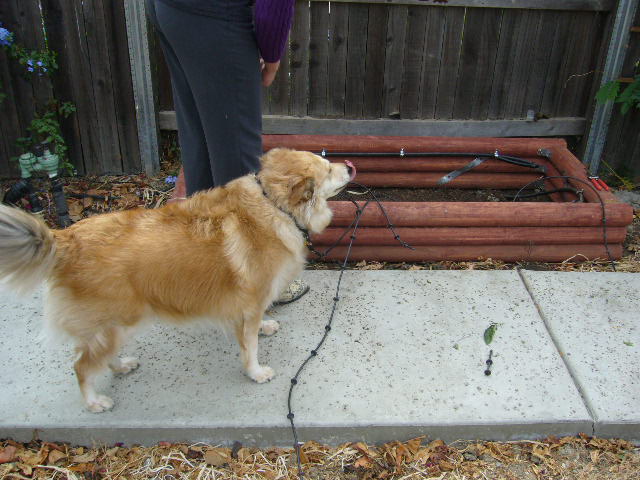
As it turns out -- the mutt is good at not just digging. Seems she can take apart a planter bed with one swift kick of a back leg. And she managed to do just that some weeks back -- destroying a planter bed that was destined to hold the Bird 2013 garlic crop.
I have always wondered how long these cheaply constructed gardening beds were going to last -- and now I know. Profiled here several years ago, it appears these "gardening beds on a budget" have a lifespan of five to six years. After that? It's time to repair, rebuild or in my case, start from square one.
 |
| Ultimate Digging Machine at Play |
The first hint of trouble came when I spotted fresh dirt on the ground and knew that digging doggy had been up to no darn good. Bandi is clearly past her "puppy stage," but that playful and somewhat destructive side does surface every now and then. That's especially true if she spots a vole (field mouse) duck into one of the beds.
A vole? I must DIG! I must FIND! Do voles taste like BACON? I must find out!
Although the cats that grace the Bird Back 40 get their fair share of "vole treats," these thing reproduce so quickly and in such massive numbers that there's always one or two for Bandi to chase in a futile effort from gardening bed to gardening bed. Keep in mind, she never does catch one. She just leaves her tell-tale sign behind, which is usually a nice little hole in the ground or bed.
Yes Fred, I know. You warned me. You were right.
 |
| Gardening Bed Damaged Beyond Repair |
When I first noticed that the Ultimate Digging Machine had partially destroyed part of one of my older planter beds, my thoughts first turned to "repair." A few well placed gold screws, I believed, would solve this problem. After all -- the bed had been screwed together once before. It certainly could be repaired in the same fashion, right?
Wrong.
I would come to discover that the Ultimate Digging Machine had finished what Mother Nature started a long time ago. Wood that once those golden screws so securely was now so brittle that it fell apart into tiny pieces at the slightest touch. It was done. It was finished. There would be no repair. There would be no 2013 garlic crop.
Or so I first thought.
 |
| Damaged Gardening Bed Logs |
But the more I thought about it? I just couldn't let it go. This bed has been the source of so many mouthwatering crops and harvests that I just could not write it off. I grew champion Cherokee Purple tomatoes in this bed! Last summer's crop of green onions and several different types of basil was raided quite often I must say. Lettuce had grown here in the fall. The last harvest had been a fat onion crop.
Let it go? Write it off? Leave a big hole in the ground? Perish the thought. As Oscar Goldman of Six Million Dollar Man fame once intoned: "We Can Rebuild Him." It wouldn't be easy. This was bare, open ground when I built the first bed five years ago. There was nothing to get in the way. The rose bush to the left of the bed was added later. That honeysuckle vine covering up our second beehive was added later. And that nice little sidewalk framing the bed against the fence was added just this spring.
 |
| Gardening Bed and Drip Irrigation System Removed |
In other words, I didn't have a lot of room to operate. And, to add insult to injury, the old bed would have to be removed piece by piece, along with the drip irrigation system, before I could proceed with new bed building efforts. Removing an old, wooden garden bed is quite the inconvenience to the Black Widow spiders and other creepy-crawlers that had since moved in and long ago called it home.
The first step involved removing numerous layers of gardening soil. It was removed the same way it was added -- with shovel and wheelbarrow. I would come to discover that those golden screws that had held the bed together so securely years ago had since disintegrated and would sometimes just break into two brittle pieces upon removal. Some of these "Lincoln logs" as I call them were so brittle they easily snapped into two or three pieces once they were removed. Years of gardening and usage, plus natural elements of rain, cold and heat can do a lot of damage.
 |
| We Can Rebuild Him |
Yet -- up and out the old bed came -- piece by piece -- leaving surprised spiders and insects to bolt and scramble away. I was left with a bare spot in the ground and started over with the same system I had employed so many years ago: Assemble the new bed in layers, stack, align, screw and reinforce. The re-installation of the drip irrigation system allowed me to make several improvements that will serve to save precious water supplies, yet ensure that the irrigation reaches every last corner.
By the end of the day? The new bed, which looks a lot like the old bed (minus the black widow spiders), had been installed. Old, tired soil was mixed in with some new planter mix and compost, and what was once old and tired was new again. Venus planted the garlic varieties of Lokalen, Bogatyr and California Late White in short order. The cloves have since sprouted, and everything looks just dandy.
 |
| Goodbye Old Bed: Hello Potash! |
As for the remains from the old bed? I have quite the growing pile of lumber scraps from previous bed building efforts and other "around-the-house" projects. I wasn't interested in growing the size of that scrap pile, which is why I was happy to have a handy-dandy fire pit installed this previous spring.
Old wood burns fast and hot and leaves behind a helpful gardening supplement: potash or potassium, which is an essential ingredient for any gardening project.
And, as for the Ultimate Digging Machine? She most definitely approves of the new addition. Here's hoping that next "urge" to dig strikes in places where I want to add additional fruit trees next spring.


