Showing posts with label west sacramento. Show all posts

The Life of a Potato Farmer

Thursday, May 24, 2012

All Blue Potato Flower
It's been said -- by those who are much smarter than me -- that once you grow potatoes, you will always grow potatoes.

This also includes the caveat of: Whether you want them or not.

I'm here to tell you that the old saying is indeed truth. Potato plants are literally popping up in different raised beds around the Bird Back 40, even though I'd swear that I didn't plant seed potatoes there.

Ultimate Digging Machine & Cohort at Rest
Of course I didn't. They are springing up from what remains from last year's crop. OR -- they got moved by some critter from one bed to another. This I can believe, especially upon watching the Ultimate Digging Machine derive great pleasure from flipping plums and other produce she finds on the ground straight into the air.

It's not a plum or a potato. It's a dog play toy. Sometimes those leftover potatoes wind up in the strangest places, which begs the question of, "how did THAT get THERE?"

Lush, Green Potato Plants in Raised Bed
I'll admit -- the wife that is Venus really went to town on potato planting efforts this year. Seed potatoes were procured from a variety of places -- including the standby Peaceful Valley Farm Supply. But we also found a nice selection of reds and fingerlings at our nearby Big Box Lowes in West Sacramento.

Venus planted all varieties in early March, while the weather was somewhat cold and rainy, but the less-than-stellar weather conditions didn't hurt growth conditions much. The reds and fingerlings were the first to break the soil line, but have also been the last to flower.

Fingerling Potato Flower
The "All Blue" and "Colorado Rose" varieties purchased at Peaceful Valley got off to a somewhat later start, but the All Blue is putting on quite the show at the moment with a bevy of blue flower clusters in the garden.

I have discovered -- not completely by accident mind you -- that raised beds are perfect for growing a large, healthy and lush potato crop. The loose soil conditions that exist in these beds are perfect for root crops like potatoes, carrots, even radishes. When you begin to notice that the soil line begins to crack in numerous places and also appears to rise by an inch or more -- it's good news.

That's a LOT of French Fries!
Something very good is taking place underneath that soil line. One begins to dare to dream of home-grown french fries -- which are like none other.

While the honeybees that grace our backyard mostly ignore the potato flowers of white, blue and purple -- the same can't be said of the native pollinators. I've come to discover that carpenter bees -- those giant black and yellow bees that one can hear coming from 100-yards away -- have particular liking for these flowers. And they always make sure to pollinate the nearby flowers hanging from tomato plants after they've drilled into the potatoes.

This isn't a bad thing, people.

Potato Flowers: Signs of Spring
If all goes according to plan? In the next week or two, the plants themselves will begin to die back slowly. The flowers will wither and drop. Spuds will literally be forced above the soil line by potato monsters that lurk and continue to grow below.

Red, White and Blue potato salad for the 4th of July? Sounds good to me! A serving or two of french fries is almost certainly on the menu. Roasted red potatoes with garlic? Bring it on!

But -- I'm getting a bit ahead of myself. For now -- let's enjoy that annual potato flower show.

A Tomato Grows Here

Friday, September 3, 2010

Three months ago -- Kathy Hilke and I were discussing where to have turkey sandwiches for lunch. Kathy and I worked together in the Capitol Office of Senator Sam Aanestad for nearly seven years. And yes -- we also found time to take part in a bowling tournament or two -- as evidenced to the photo to your right.

Yesterday -- Kathy Hilke died. She was 52. An evil scourge called cancer claimed her last breath. A scourge that wasn't uncovered or discovered until it was far too late.

Sometimes -- life isn't fair. In Kathy's case -- it wasn't. 52 year old women are not supposed to pass away from cancer. I find it hard to believe -- even for one minute -- that this is what God designed. Kathy loved God. She was deeply religious. Yet -- she also loved life.

I guess it still hasn't sunk in quite yet. We used to talk regularly every single day of the work week. If I wasn't doing everything within my will to drive her up the wall -- then she was doing the same to me. We liked each other.

We also shared a love of all things heirloom tomatoes.

It really doesn't seem all that long ago that she left work. She complained of a shortness of breath. Like me -- she had dealt with regular back pain -- but was otherwise a completely healthy woman.

Or so it seemed.

The shortness of breath was initially diagnosed as pneumonia in that second week of June. She was given medication. She was sent home. When the breathing problems worsened two days later -- she checked herself into the hospital.

It was there they found them: the tumors. One was in her kidney -- pressing up against her spine -- the real source of years of back pain. But that wasn't the worst part. Gone untreated for God knows how long -- the kidney tumor had metastasized into many small tumors in both lungs.

The tumors were causing her lungs to fill up with fluid.

The two physicians that I work with assured me that various steps could be taken -- and they were. Yet -- at the same time -- I detected a hint of sadness in their eyes. They had seen this before. They would never tell me what they were truly thinking. But I could guess.

Still -- it's OK to pray for miracles.

Kathy showed me one such miracle of life once. It was located in the West Sacramento Trailer Park where she lived. Across the street from her home -- under a covered patio that blotted out the sun -- in the crack of a dirty driveway sidewalk -- a cherry tomato plant bloomed with prolific life.

Impossible? Not if you had seen it. I did.

Kathy would bring me a sack of these red cherry tomatoes just BURSTING with flavor from time to time. One plant seemed to yield thousands of them. Yet it received no care. It received no sun. There was no water source to speak of. It would die back in the winter and spring to life in the summer.

Who knows how long it had been there.

A child of that plant grows in the Bird backyard this year. The tomato variety known as West Sac Crack -- in honor of Kathy's discovery -- burst forth out of a crack in the inhospitable clay soil of our yard this spring. Lord knows -- we didn't plant it there. It's nowhere close to a source of water.

Yet it not only survives. It thrives. We know it to be the West Sac Crack variety because it is the only red cherry tomato that we have ever planted in our backyard. Sure enough -- it has that same -- old world tomato taste.

I guess now we will call it Kathy's Miracle. That is appropriate -- as Kathy touched and blessed all that came into her life.

Kathy is survived by her mother, Shirley, a sister and two brothers. Her father, Richard, who she adored, passed away Tuesday morning.

The CRACK is BACK!

Monday, August 2, 2010

It's getting to be that time of year when weird things start taking place in the backyard. I haven't mulched it all yet -- though I'm getting there -- and I sometimes wonder why. The mulch doesn't last long. It gets swallowed and digested by the crack you see to your immediate right.

I'm not exactly sure how deep this crack goes -- though I've tried tossing pebbles down that hole and never quite reached the bottom. I can tell you that these cracks -- which are opening up pretty much everywhere -- are fairly deep. What's down there? I don't want to know. I'm hoping it's the Mother Lode -- but hope springs eternal.

But that's not the only crack that is spreading across the Bird Back 40. This here -- to your left -- also counts as a "crack" -- although I'm sure you've noticed that this is a plant and not a crack in the ground. Look closer. Indeed -- you'll see that the plant has indeed sprung from a crack in the soil.

I'm not sure where it's getting water from. There's nothing in the form of drip irrigation nearby. It doesn't get fertilzer. It doesn't get care. Before you start thinking that I'm a terrible tomato-parent -- please understand this much: this plant does much better if I up and ignore it. The only thing I'm allowed to do is harvest said plant. That's it. The moment I start caring for it -- is the moment that something goes wrong.

My friends -- I give you the red cherry variety known as "West Sac Crack." Seeds for this variety were procured from a VERY productive red cherry tomato plant that was growing through a crack in the driveway of a West Sacramento trailer park. Make that a COVERED driveway.

That's right. A co-worker discovered this plant four years ago. It didn't get any water. It hardly received any sunlight. It didn't belong to anyone. It just grew through a crack in the driveway -- and it has come back year after year after year.

My co-worker was good enough to harvest about fifty red cherry tomatoes and bring them to me at work. We had NO clue of where the plant came from. There were no tomato gardens nearby. People at trailer parks come and go -- so we had no idea how this plant got there -- nor how it grew so well. It was just *THERE* when my co-worker moved in.

So -- Venus and I gifted it with the name "West Sac Crack."

I seeded this plant a few years back. I started a few starter plants from that saved seed. I gave said starter plants a prime spot in a raised bed filled with the best planter mix soil that money can buy. The starter plant received regular irrigation and only the finest fertilizers. Guess what? It fell flat on its face.

It was somewhat productive. Yes -- it did have that distinctive taste. But it didn't grow into the bush that I had seen in West Sacramento. It wasn't covered with red cherry tomatoes like the parent plant in West Sacramento. It was -- at best -- a moderate producer. I wasn't impressed with it -- therefore -- I made the decision to not try it again.

Little did I know that West Sac Crack had other plans.

A volunteer sprang from the soil last season. Like many volunteers I let it grow -- just "because." I wanted to see what variety was growing out of my crummy clay soil. And -- not just growing mind you -- but thriving. When I saw those cherry tomatoes turn a bright shade of red? There was only one possible source: West Sac Crack. And it gave me a bounty of cherry tomatoes last season.

Did I replant this year? Oh heck no! I knew that neighborhood birds of the feathered variety had been feeding off the excess as well -- and thought I might see it spring to life again. Sure enough -- across the yard? A cherry tomato plant sprouted and grew well in the most inhospitable of locations. And -- once again -- it is thriving.

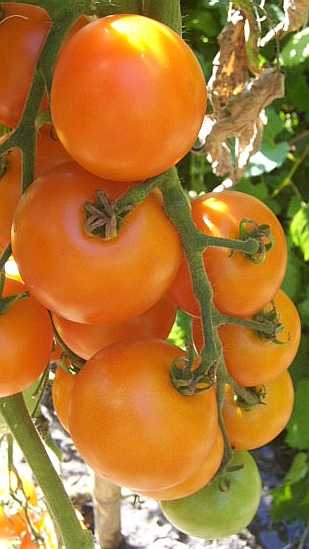
This isn't the only cherry "volunteer" to be sprouting up in the Bird Back 40 this season. A large orange cherry is also producing SCADS of tomatoes. I'd like to report that this is a Sungella variety -- except I've never planted a Sungella (large orange cherry). However -- it just might be a cross between a SunGold and a Pineapple Beefsteak that had been planted nearby.

It could also be a cross between a SunGold and Mortgage Lifter -- that has somehow retained its bright orange color. The thing is -- I'm just not sure. I don't think I'll ever know what it is.

I can tell you this much -- however. It sure is good. And that's the nice thing about growing heirloom tomatoes in the backyard. You're never quite sure what you're going to get -- but whatever it is -- it's guaranteed to be good stuff.

March Update: Babies Move to a New Home

Monday, March 16, 2009

The heirloom tomato starter plants currently growing in the North Natomas home of Bill and Venus Bird are doing well. So well as a matter of fact that it was time to take the next step in the seed propogation effort.

Moving day had come.

I could tell because the plants that we started in this Jiffy starter tray were developing "root legs," and my fear was that if they didn't get a new home and soon, they just might walk away. Plus -- they were hitting the top of the grow lights, which is never a good sign. And those long stems that you see in abundance? That's not a good sign either.

There's a term for this -- and it's called "leggy." And this happens to a lot of indoor growers who do not have standard greenhouses. Starter plants tend to develop very weak stems when reaching for heat or a light source or both, and that's not good when you're growing tomato starter plants. Strong stems are needed for leaf growth and development. If the plant gets top heavy -- SNAP! You've just a lost a starter that you've spent a good month growing.

So, the "project" so to speak this weekend was to move the babies to a new home. This required a couple of different steps: A nice place to stretch out and work -- some new cups for the tomato and pepper starters and some good compost that the tomato and pepper plants will appreciate over the next month and a half.

Venus and I found the planter mix after a trip to the Big Box store that is Lowe's in West Sacramento, and the cups came courtesy of Farmer Fred Hoffman (Fred can just about find anything). After setting everything up in ye olde GarageMahal, including a tarp to cover the garage floor, Venus and I were ready to get to work.

In past years, we have used each Jiffy Peat Moss Pod to start three to four seeds -- or plants -- each. But separating the plants from the pod, without damaging the intertwined root systems, wasn't easy. And it was extremely messy. We usually wound up losing one or two starter plants from each pod anyway, so this year we tried something a little different:

One plant per pod.

And this made the process of transplanting pods into cups much easier. All you needed to do was scoop -- pack the dirt down -- drop in a pod with a plant -- cover with more composted soil -- label the plant and move on to the next pod.

The tomato starters, however, required a little more care than the peppers. Since the plants were so "leggy," we actually had to bury most of the stem in the compost, leaving only the top leaves exposed. This is actually a reccommended practice if you're going to start tomato plants from seed. Tomatoes are one of the few plants that will actually develop a second set of root systems resulting from a buried stem. And that, in time, will hopefully result in a stronger, thicker stem above.

As for the pepper plant starters, well, they didn't require this sort of "deep burial" treatment. All of the bell pepper plants had nicely developed stems, with good leaf structure. These were the easiest of plants to transplant into new cups.

This also happens to be the absolute worst year I've experience when it comes to actual germination rates. In previous years, tomato plants have always germinated faster -- and at better rates -- than the bell pepper counterparts. But, not this year. The bell pepper seeds gave us germination rates of nearly 100%

But the tomato seed? While some rows did better than others -- the total germination rate was probably 60%. In some cases, we had zero germination. We will not be enjoying Andrew Rahart's Jumbo Red this year, because none of the pods planted with seed germinated. The same holds true with another heirloom variety called Red Reif Heart.

But, don't feel sorry for us. We're not crying. We have more than enough started to plant five or six tomato and pepper gardens rather than just one. This includes a large variety of heirloom tomatoes and peppers. All of these plants are now sitting under a special contraption that I put together last week in the GarageMahal.

I can't take credit for inventing this PVC contraption. It sprang from the mind of an A-Type personality engineer who works for Intel and lives in the Rocklin area. But, while I could never invent something like this -- I am very good at looking at pictures or instructions and making a duplicate copy.

Which is exactly what I did!

All of these plants will remain indoors for about the next month (four weeks). By mid-April, if the weather has warmed sufficiently, I will take the next step in the "growing from seed" process and place the babies outside for what is called the "hardening off" process.

Details on that -- and more -- to come. But for now -- everthing is just dandy in North Natomas.