Showing posts with label gardening. Show all posts

Happy Gardening New Year!

Thursday, January 1, 2015

Good morning and welcome to 2015! Wait, the clock says 12:12 PM! Did I really sleep that long? I've got to stop watching those New Year's Eve broadcasts on Univision. That's right, I said Univision. Even though most of the programming flies right over my head (I don't speak the best Spanish), I do like the fact that they put live crews at Disneyland in Southern California to ring in the New Year.

That's much better than watching one of the major networks repeat a New York City ball drop that took place three hours earlier, don't you think? Univision also isn't afraid to highlight singers who are over the age of 30. Jeez, when did I get so old and crotchedy?

Disneyland Rings in 2015
The new year means a new start to gardening efforts. And you thought time slowed down for gardeners during those winter months? Perish the thought! Winter time is planning time. If you're into serious gardening like me and the wife that is Venus (plus countless others) -- winter is just as important as spring, summer and fall. For it's the steps we take right now that either assure our success, or spell our doom, come summertime.

So what is on Bill Bird's gardening agenda for the first day of 2015? More than one or two items actually. Here is just a smattering of some of garden planning that takes place during this non-slow period of the year.

Seeds from Lockhart Seed
SEEDS, SEEDS, SEEDS: If you grow your garden from seeds, as we do, now is the time to start ordering seeds for the coming spring and summer. My work on this front actually started weeks ago. Our first stop was to the Mother of all seed stores in the San Joaquin Valley: Lockhart Seed in Stockton. There you will find most of everything you need for a full scale garden -- but not everything.

Seed catalogs that arrive by the dozens during this time of year plus seed websites offer the selection you can't find at seed stores. Most of my heirloom tomato seed -- for example -- comes from two or three different sources. Tomato Grower's Supply offers a warehouse selection of many major heirloom and hybrid tomato offerings. I'm also a fan of the breeding efforts of Bradley Gates, who runs Wild Boar Farms in the heart of the Napa Valley.

Tomato Selections from Wild Boar Farms
The Gates operation doesn't offer heirlooms. But he does offer selections that he's created on his own -- such as the Pink Berkeley Tie Dye and Cascade Lava. Other seeds come from other gardeners who save seed from the particular plants they liked in 2014. This is how I obtained seeds for the Ukrainian Heart tomato. They came as a trade that I engineered with Davis gardener and California Rare Fruit Grower (CRFG) member Marta Matvienko. Marta send me seeds for Ukrainian Heart. In return, I sent her seeds for Black Cherry -- a volunteer that sprang from the garden last year.

I also owe Marta a smattering of Blue Lake Pole Bean Seeds. Why? Because I was dumb enough to buy a pound of these seeds from Lockhart Seed. And I won't be planting a pound of pole bean seeds. Ever.

Ordering seeds is also the first step in the process. Tomato fanatics like me and the wife that is Venus will start planting these seeds indoors starting in February. Seed starting efforts for hot peppers, like the Ghost pepper for example, start even earlier. Some people have already started seeds for the Ghost and Scorpion peppers. This is because these types of varieties demand long growing seasons. Starting hot peppers in January means a nice harvest in July or August -- right when the tomatoes ripen.

Salsa anyone?

FRUIT TREES: The next two months are premium months for bare root fruit tree season. Major fruit tree suppliers like Dave Wilson Nursery in Hickman are already in the process of shipping tens of thousands of every fruit tree variety you can possible imagine to nurseries all over the West Coast and elsewhere. I'm not sure how big the DWN footprint actually is (I've never asked). But since they are the primary supplier for all things pluot, plumcot and other recent fruit tree introductions, I can imagine they get a lot of business.

And you thought Christmas season was busy?

One of my favorite activities is to browse the fruit tree selections on the DWN website. There you will find photos and entries about every fruit tree they offer. Not sure if you want a plum or a pluot? Torn between apples and apricots? Should it be a pear or a pomegranate? The DWN website, plus planting recommendations might answer some of those nagging doubts.

And there's nothing like a bit of fresh fruit pulled from a backyard or front yard tree during the summer. Bare root season is also the best time for planting because there's not as much stress placed on the tree as it's hauled from nursery site to that premium spot you've picked out for it in your yard.

Flavor Finale Pluot Tree in Winter
FRUIT TREE CARE: Now that the leaves are off the multitude of fruit trees I have scattered about the Bird Back 40 -- it's time to start thinking about winter care to prevent spring problems. There's a lot to worry about -- from peach leaf curl to the dreaded fire blight. Spraying early for insect control might erase or even lessen the expected bug invasion during the spring and summer.

I've come to discover that there's a particular bug that enjoys my Flavor Finale pluot tree as much as I do. If I fail to do anything to control it -- this invading army will infect and destroy every leaf on the tree. The most effective control I've found against this bug is to treat the tree once in the winter and again in the spring -- AFTER it has stopped flowering (we don't want to be spraying the helpful pollinators -- now do we?).

Grapevines in Need of a Haircut
Winter time is also pruning time -- especially for items such as wine or table grapes or fruit trees planted together in a Backyard Orchard Culture setting. Some fruit trees -- like the Granny Smith apple for example -- need a little "convincing" to enter that needed winter slumber. While many apple tree selections gladly shed every last leaf during the first blast of arctic weather -- the Granny stubbornly holds out like a petulant child who isn't quite ready for bedtime.

So how does one "convince" a Granny Smith apple tree to shed every last leaf? Yell at it? Call it bad names? Insult it? No, nothing that dire. Simply put on your winter gardening gloves and pick every last leaf off. Granny will get the message.

Finally -- winter time is a perfect time for fruit tree GRAFTING. This is why many CRFG Chapters hold scion exchanges during the months of January and February. The Sacramento Chapter is no different. This year's scion exchange will take place on Sunday, January 18 from 10:00 to 1:00 at La Sierra Community Center (5325 Engle Rd., Carmichael 95608).

And here you thought winter time was a "slow time" for us gardening fanatics. I'm tired already!

The Domek Family Chicken

Saturday, December 6, 2014

Domek Family Chicken Before Cooking
Now that you've finished off the last of those pesky Thanksgiving leftovers -- it's time to get back to some normal eating behavior, right? And, lucky for you, I've got a dish that is just about perfect for anytime of the year -- be it holidays or be it just a normal weekend.

There is no official name for this dish so I've taken the privilege of naming it the "Domek Family Chicken." I'll be honest with you. The "Domek" stands for a Sacramento gardener by the name of Andy Domek, whom I'm fortunate enough to work with at the State Capitol. Who says Democrats and Republicans can't get along? Andy's the Democrat. I'm the Republican. Which just goes to show that gardening blood may be thicker than political.

Rosemary Bush-Bird Back 40
We all agree on one point: This is one fine chicken. It's a beer can chicken type recipe -- but it's unlike any beer can chicken recipe I've run across before. I've also taken the advantage of modifying this recipe somewhat to add in some spices that are growing well -- perhaps too well I might add -- in the Bird Back 40.

That particular spice is featured above left. This is an "after" shot by the way. This was taken "after" I'd hacked this plant back to manageable proportions. It wasn't easy. It had grown across the sidewalk during an uncontrolled spring and summer growth spurt. Hacking it back took the better part of an afternoon. And while it looks rather sad right now -- don't be worried my friends. This plant will explode with new growth once next spring rolls around -- trust me.

Dried Rosemary Anyone?
How do I know this? Because this particular plant of the herb variety grows like a weed in the Sacramento area. By now you've probably guessed this "herb weed" is, in fact, rosemary. Half of North Natomas is landscaped with rosemary because it's so easy and cheap to grow. Its blue flowers yield tons of pollen for foraging bees. And rosemary with chicken goes together like vanilla ice cream and hot fudge sauce. The two were made for one another.

The Domek Family Chicken recipe didn't originally call for rosemary. But I'll tell you this much -- it was one fine addition. It added a spiciness and flavor that really made this a unique meal. Another addition was the garlic. Not because I wanted it. Garlic was an absolute requirement.

Rosemary
If you've ever worked with rosemary before -- especially fresh rosemary -- you've come to learn that this is one tough herb to chop up. The leaves of the rosemary plant are incredibly tough. How tough? I've placed rosemary leaves stripped from woody stems into a standard food processor, flipped that switch on high speed, waited for 30 seconds and then shut it off only to find out that the rosemary leaves were still intact. They're extraordinarily tough to shred into tiny pieces.

Yet -- tiny pieces is what I needed.

But I've learned a trick during the rosemary preparation process. Combine those tough rosemary leaves with seven or eight cloves of garlic in a food processor set on high speed and something wonderful happens. Those rosemary leaves suddenly give up the ghost and can be shredded into tiny bits and pieces. An added plus is shredded garlic that sticks to the rosemary like glue.

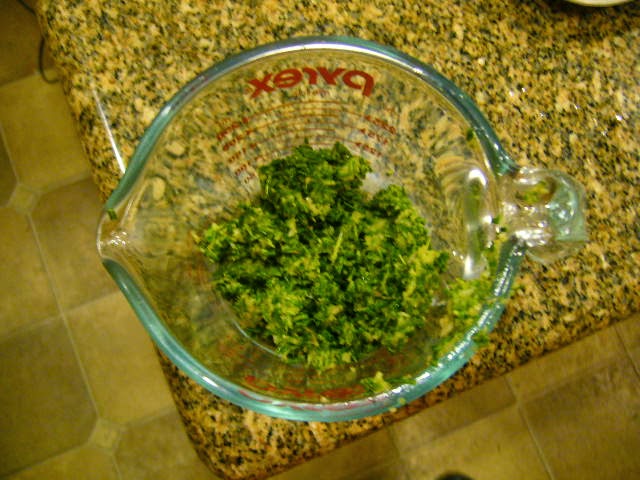
Chopped Rosemary and Garlic
Just what I needed.

Andy's directions were fairly specific. Once all of the spices were mixed together, you were required to spread it generously all over every inch of the chicken. This included shoving quite a bit of this seasoning mixture UNDER the skin. This is no easy task because if the skin breaks during this process, well, it's tough to keep this mix from falling off the chicken and onto the grates of the barbecue below. So, please, do be careful.

If you've never cooked chicken in a beer can setting, there are some things you'll want to watch out for. First -- you'll have to find some way to open and drain off all that beer. It's a terrible thing, but someone's got to do it. If you happen to have a lot of spare herbs thanks to a well established herb garden like we do -- the next step is to cram as many herbs into that beer can as possible. The final step is to fill it back up -- about halfway mind you -- with a nice white wine like chardonnay or sauvignon blanc.

Beer Can Chicken Roaster
If this means you have to open, and then finish, a bottle of wine -- well -- someone has to suffer. Might as well be you.

There are beer can chicken roasters that can be purchased at your local store like the one pictured, but I'll be honest, you don't really need one. It does make the transfer of the chicken to the can a little easier, but it's not absolutely necessary. To prepare the well-seasoned chicken for grilling, using Andy Domek's fine words of advice: "Place the cavity of the chicken over the beer can, tuck the wings behind the body and sit it up on the grill so it looks weirdly like it is lecturing you. Set your barbecue on low heat and roast for 60-70 minutes."

Another bit of added advice? Be armed with a well filled spray bottle and pay close attention to the chicken for at least the first 30 minutes as the barbecue will sometimes flare and we don't want to be setting our fine chicken friend on fire, now do we?

And now -- the recipe for Andy Domek's Famous Beer Can Chicken:

Andy Domek and a TURKEY???
1. Open a can of cheap beer (I personally am fond of the award winning beer out of Wisconsin -- Pabst Blue Ribbon).
2. Drink Pabst Blue Ribbon.
3. Shove some herbs inside the can -- I like a sprig or two of rosemary and fresh thyme. Fill can halfway back up with white wine.
4. Set aside.

Make a paste with:

1 tablespoon kosher salt.
½ tablespoon cinnamon
½ tablespoon ground ginger
½ tablespoon cumin
½ tablespoon turmeric
½ tablespoon coriander (optional—I like coriander so I add it)
1 teaspoon of black pepper
4-5 tablespoons of fresh rosemary leaves (dry is fine too)
4-5 cloves of garlic
2 tablespoons olive oil
Juice of one lemon or lime

Directions: Chop rosemary and garlic together in food processor until it reaches a fine paste. Add together with salts, spices, olive oil and the juice of one lemon or lime. Mix well. Coat chicken with mixture, loosening and lifting skin to place spice mix directly on chicken.


Roast for one hour.

Snap! Crackle! Pop!

Friday, May 16, 2014

Snap, Crackle and Pop Here to See You
I know what you're thinking. I really do. You saw the title of this latest blog posting and your heart sank. "Bill Bird has gone commercial," you thought. "He's traded in his heirloom tomatoes for some kid's cereal!"

The shame, the shame of it all.

But that's the furthest thing from the truth. You see, this blog posting could be named many things. It could be called "Gardening Hurts." It could also be called "Gardening Season is Over," because both titles would represent the truth. Gardening does sometimes hurt. And gardening season, although it's just now getting underway for some folks, has come to a rather abrupt end in the Bird Back 40.

Nice toes! NOT!
At least -- that's the story for crazy blog writer Bill Bird. As for the wife that is Venus? She may carry on with her seed planting ways. Her faithful husband will watch her efforts from the patio with a beer in one hand and a sad smile. For the first time in years, I cannot join her. I can only sit and watch.

You've probably guessed by now that I'm not schlepping for some kid's cereal. That "Snap, Crackle, Pop" sound I heard last weekend was all too real. Unfortunately, I didn't hear it while pouring milk onto a kid's cereal (although I wish now that I had). I heard that sound while stepping off the sidewalk in the Bird Back 40 while moving a heavy wheelbarrow load of compost to the in-ground test gardening bed. Unfortunately again, the sound came from my right foot.

That wasn't right. Did I step on something perchance? No? Is that blood? Where did that blood come from?  From me? Those are the thoughts that first crossed my mind when I suddenly dropped that wheelbarrow load of gardening product and looked down. The bottom of my ankle began to ache. Which really isn't all that strange because at my age, after a weekend full of gardening, my feet not only REEK to high heaven they are also quite sore.

Life in a BOOT that Never Comes Off
But this was a different kind of sore. And the soreness grew into a pain that had me limping back to the garage and settling into the nearest chair. Something wasn't right. It wasn't until I tried to get back up some 30 minutes later (to attempt to resume gardening no less) did my ankle let me know that things were "not OK."

The hours following my little "garden accident" are still somewhat of a blur. I blame that on the numerous emergency room doctors and nurses that I visited that evening. For each one came armed with a horse-shaped pill, a glass of water and the instructions of: "Here, take this."

Percocet Fog
Since those pills made me feel somewhat better -- I had no problem with repeating the line of: "What? Another Percocet? For me? Sure!"

I would learn later that Percocet makes you somewhat happy and somewhat groggy. I don't really remember a lot of detail from those emergency room visits and followups with the Podiatrist, except that a partially torn Achilles Tendon and an aggravated bone spur in the heel are going to keep me out of action and in a lot of pain for quite some time.

I swore off the Percocet a few days back. I'll live with the pain instead. How people get addicted to prescription pain killers I'll never know. They just make me feel groggy and play all sorts of negative havoc with my digestive system. Plus, to be honest, I don't remember the pain ever really going away. I suppose it made the pain manageable, but given a choice, I'll opt for a clear mind and a painful foot any day of the week.

Off Limits! Verbotten! Do Not Pass Go!
And so -- that's it kids. The 2014 gardening season is finished for me. My number one love of life, other than the wife that is Venus, is off limits. There will be no digging in the dirt. There will be no weeding. There will be no fertilizing, no planting of seeds, no drip irrigation repair. Zip, nada, nothing.

There will only be this damn boot on my leg, a damn sore right heel bone and a cranky gardener who can only watch while others do.

I'll be honest with you. There's not much fun in that.

A Ghost Rises

Sunday, March 2, 2014

The Ghost Rises
There's something mighty special taking place in one corner of the North Natomas heirloom tomato farm extravaganza belonging to yours truly -- and the wife that is Venus. Plants are just popping out all over in anticipating of the onset of spring -- and that includes the Bird 2014 heirloom tomato and pepper summer garden.
 
The most interesting item to emerge this morning? That would be it -- pictured above right. That, my fine gardening friends, represents a first for the Birdhouse. It is truly something special. It's called the Ghost Pepper -- and it's become a somewhat special and legendary ingredient in the moderately-famous and always in demand Roasted Garlic, Pepper and Heirloom Tomato Salsa.
 
Ghost Pepper Seeds
The Ghost pepper -- my friends -- is a hands down winner. But I don't recommend that you sample one fresh from the garden. That might cause a bit of indigestive pain -- if you get my drift.
 
You see -- the Ghost Pepper -- also known as Bhut Jolokia -- is a rather warm pepper. I say this facetiously. The Ghost Pepper was once know as the hottest pepper on the planet, bar none. It's since been surpassed by others -- but that Scoville unit rating of one million is still nothing to be laughed at. The Ghost Pepper produces a taste that is so stinging hot, that it rates just a notch below standard police-grade pepper spray.
 
Bird 2014 Summer Garden under Shop Lights
None of this matters to the wife that is Venus. Once she discovered my plans to grow the Bhut Jolokia in the Bird Back 40, it's been "GAME ON." You see, the correct pronunciation of this pepper might be something akin to "Boot Holoka," but when it comes to the Bhut Jolokia the wife that is Venus suddenly reverts to the tender age of ten.
 
Which means I become the "Bhut" of all jokes. Bhut Jolokia has suddenly become my second name. Or, if I'm doing something to annoy her (which is quite often), I am nothing more than a "Bhut Jolokia."
 
Pick a Peck of Peppers
We were warned -- before planting our pepper and tomato seeds two weekends ago -- that the Ghost Pepper could take a rather long time to germinate and emerge from the soil. Germination can sometimes take up to a month. But this morning -- barely two weeks after planting -- the first Ghost Pepper seedling emerged. I'm sure it will be followed by others.
 
The emergence of the Bhut Jolokia actually beat out a few other pepper varieties -- which concerns me a tad. We didn't buy any pepper seeds this year -- other than the Bhut Jolokia of course -- because the gardening seed box (a repurposed box that once held a pair of size 13 sneakers) is jammed with pepper seed purchases made in previous years. Planting pepper seeds that are more than two or three years old is akin to rolling a pair of dice. Sometimes it comes up sixes. And sometimes it's snake eyes -- as in no germination at all.
 
Venus Plants Tomato Seeds
The Ghost Pepper has another thing going for it. Unlike our previous experience with other hot peppers -- the Bhut Jolokia does not lose its mega-byte of hotness after cooking for a solid hour or processing in a pressure canner for 30 minutes. We experimented with this pepper quite a bit last year, thanks to the generous donations of South Natomas gardener Nels Christensen.
 
The last experiment turned out to be the best: Four Ghost Peppers in a batch of salsa that resulted in eleven one-pint jars. Named "Ghost to the Post" in honor of former Oakland Raiders tight end Dave Casper (and the Ghost Pepper, of course), these eleven jars resulted in the best salsa we've ever created in the Bird family kitchen. Finally, after years of trial and many errors, we've produced something with a real kick.
 
Grow! Grow! Grow!
I look forward to this summer when we can hopefully combine ripened, red hot Ghost Peppers with the fine tomato selections offered by Brad Gates and his Wild Boar Farms. Peppers -- especially hot peppers -- are an essential ingredient in not just salsa -- but the many brands of tomato sauce that we create and can for winter use. Why confine yourself to a store purchase of tomato sauce mixed with one kind of pepper and one kind of basil -- when you can have six?
 
And so my friends, while I do recommend the Bhut Jolokia for your backyard pleasure, I also preach caution. Because this pepper has a real bite and kick to it. Treat it with the respect and care it deserves. Because if you're not careful, the Ghost Pepper just might kick you square in the Bhut.

Don't Bother Me! I'm Gardening!

Monday, May 13, 2013

Test Bed: Bird Back 40
I dread the month of May. I really do. I shouldn't. This is my "can't miss" gardening month. I should love it to death. But, instead I dread what the change in seasons brings. Now I know how full-time farmers must feel. I must fight for my time in the great outdoors that is the Bird Back 40.

May is the month when the offers for my gardening time come rolling in. The big brother emails: "Let's spend the entire Saturday hiking up a trail and go fishing!" The sister-in-law says: "Don't forget -- It's First Communion Services this Saturday." This doesn't include the offers to attend various all day parties, weddings, birthdays and other "must attend" events.

This also doesn't include the renters who haven't paid rent for two months and then suddenly decide to move. And, of course, they leave the place in a fine mess.

Bird Tomato Garden in May-Off to a Good Start!
Don't these people garden? Don't they understand that May is the month when gardens are installed? Miss a month and you don't get it back. You can't plant green onion or carrot seeds in mid-June, people. It's too hot. Germination rates are low. Trust me on this, I've tried.

Things get so busy during the month of May that I don't even get the time to blog about it. Check the list people! It's been two weeks! That's an eternity for bloggers. Yeah, there's lots to write about! But when am I going to find the time? 

Cucumbers planted? CHECK!
When you garden as extensively as the wife that is Venus and I do, it takes more than a "day or two" to install a full summer garden. Most people don't understand this. To them, it's plant and forget. And then they wonder why the tomato plants aren't producing in August. If you desire a productive and healthy summer vegetable garden, you've got to put in the time. And that can mean hours of prep before the first tomato plant is even planted.

The latest project came just this weekend with the preparation and planting of the Bird Test Bed located in a side yard. Thanks to our recent spate of hot weather with little in the way of rainfall, the hardened clay yielded to the Mantis Rototiller as easy as hardened concrete. Guess what happens when a spinning Mantis hits concrete? If you're guessing it jumps -- good guess. But, if you're serious about this business, you've got to bear down and provide a little more muscle. Otherwise, no corn crop for those outdoor summer dinners!

Six kinds of Basil? Really? Pesto Party!
A summer dinner without corn on the cob is a crime.

The test bed located above right, by the way, may look bare now. But, trust me with this people, it's been loaded with seed. I put in the corn. Venus put in the pumpkins, squash and some spare tomato plant leftovers and a few flowers to beautify the spot as well. This is AFTER I'd spent the better part of a Sunday morning churning up the dirt, adding compost and other items that summer vegetables crave, and churning it up once more again. Then it's time to make rows -- and finally -- install drip irrigation.

Then and only then -- is it time to plant.

Flowering Potato Plants in May-Bird Back 40
Think there's any time for all-day fishing trips with a chore like this? Taking a five hour break for First Communion Services? Cleaning out a rental? Attending this event or that event? I sometimes wonder how full-time farmers drown out the noise and concentrate on the job that has to be done. Then again -- full-time growers get to dig in the dirt all week. They're lucky. I'm lucky if I get a day.

Despite the non-gardening demands on my weekend time -- things are going fairly well. While I'd like to say the job is done -- that would be a bit of a lie. There's that spring garden bed to tear out, especially since spring came and went in the space of 30-seconds this year. You know summer is serious when it doesn't give lettuce plants a chance to bolt. When those tender-crisp leaves turn brown, whither and die in the course of 48 hours? Summer's here and it's here to stay.

Eggplant-Bush Beans and Carrots! Oh My!
Not to worry, right? Because I can finish off the gardening project next weekend, right? Nope! I won't be gardening. Why not? Don't ask!

But, so far, Memorial Day Weekend is wide open!

After a Storm: CRY!

Tuesday, April 9, 2013

Tree Rose After Wind Storm: Bird Back 40
There are gardening writers in the local blogosphere (is that even a word?) who offer helpful and handy tips of what steps to take now that a storm has come and gone.

I'm here to tell you that I am not one of those bloggers. If you're looking for good advice, go elsewhere. If you're looking for "can't possibly fail" gardening tips, you've tuned to the wrong channel. But if you're here to laugh at my misfortunes, congratulations, you've reached Nirvana.

I suppose the point I'm trying to make is that it doesn't take long for Mother Nature to utterly destroy what took you months to build. Mere hours of misfortune can result in epic disaster, especially if you've devoted an entire Bird Back 40 to this insane gardening endeavor.

St. Patrick's Rose Stem Ripped from Bush
Case in point? That nice looking tree rose bush pictured above right? That's not just any tree rose, my friend. That is the St. Patrick's tree rose. It was a gift to the wife that is Venus a few years back for her birthday. I would later to have to invest in another tree rose that went with the St. Patrick as it snapped in two following a rather ferocious wind storm.

That's gardening for you. Investment and epic failure. I'm here today to tell you that I babied this tree rose like no other when the first spring shoots began to emerge in February. It was given the best fertilizer on a once-a-month schedule. Daily and deep watering would follow. And if any bad bugs appeared to munch on those yet-unopened rose buds? They got a shot of something special, which also protected said tree rose from other maladies of the fungal variety.

Flavor Finale Pluot Tree: Mangled
But, in the end, when a sustained wind rips through the North Natomas river bottom, as it did this past Monday, it really doesn't matter. Because those howling winds just about tore everything to shreds, or mangled it to the point where it looks like someone beat on it with a crow hammer.

Those branches and buds of the Saint Patrick's tree rose that I'd cared for, nurtured, performed concerts for now lie in a heap on the ground. They are broken. They will not be roses. They will be waste for the Green Waste can. I am disgusted. What a waste.

Pluots That Will Never Ripen
That same despair and disgust applies to just about everything that Venus and I nurtured during those spring months. Why did we graft those new varieties to the Flavor Finale Pluot? So they could produce more pluots that the wind could just knock off the tree?

Oh, and that ingenious little contraption that I wrote about here that makes a nice little cover for my tomato plant starters? I also discovered, sadly, that it makes great kite material. This is after it blew off somewhere into Yolo County. I might find it someday and mount on a wall as a testament of good ideas gone very wrong.

Broken Arapaho Blackberry Vines
Never again will I visit those emerging Arapaho blackberry vine flowers and get visions of blackberry pie or blackberry cobbler. Not with visions like this one. Tender blackberry vines and sustained gusting winds do not mix. Something's gotta give, and it wasn't the wind.

Our spring of discontent doesn't end there. There's no need to "cull" the peach trees of extra peaches. Mother Nature did it for us. Whether we wanted to do it or not. Consider it done. And as desperate as I am, I will NOT try to glue those peaches back on the tree. Unless, of course, someone tells me it can be done.

If it didn't break, it got bent. If it didn't get bent, it flew two counties to the south. There was a time when the spring artichoke crops were close to growing over the fence. Not anymore. Some of them are growing to the east, while others grow to the west. Some are growing down. Did they survive? Sure! Will those plants snap off at the base under the weight of a heavy artichoke crop come this spring? By golly you betcha they will!

Bent Artichoke Plants
So, dear gardeners, take heed. No matter what measures you take to prevent disaster, no matter how hard you try, Mother Nature can undo all of it with a single blow. And then you begin to wonder why this lady doesn't like you so much.

A wise gardener once wrote the following: Gardening is cheaper than therapy and you get tomatoes." If that's the case, this must be a case of shock therapy at it's best.

In the Dead of Winter...

Monday, January 14, 2013

Something Green This Way Comes
Gardening does not take a holiday in the dead of winter. Your body might feel like taking a holiday. Those playoff games inside a warm home and a soft couch sure are a lot more tempting than that frozen piece of mud doubling as your half-landscaped backyard. Not much is moving out there, except for the occasional dive of a humming bird.

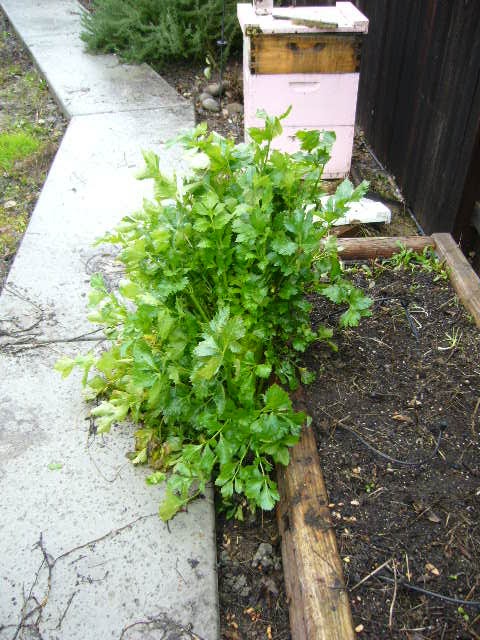
But plants are growing. I give you "Exhibit A" to your upper right. Exhibit A made for a tasty snack during the 49er playoff win against Green Bay. Exhibit A is growing like a weed in the Bird Back 40. Exhibit A shouldn't be growing in this particular spot because a one Bill Bird did everything in his power to kill it last summer.

Gardening Exhibit A
But Exhibit A knows far more and is far tougher than a gardening screwup like myself. It is proof positive that "you can grow this," even if you do everything within your power to "not grow this here or now."

By now, you may have recognized that green plant with the parsley-looking top growing in a very brown and frozen over area of the Bird Back 40 is, in fact, celery. It's not just one celery plant -- it's several. And it's some of the tastiest, most tender I might add, celery that we've been lucky enough to enjoy.

You may begin to ask, "what celery is this that grows so well?" Well, you may ask. My answer would be something akin to a shrug. You see, I'm really not too sure what kind of celery this is. So, we'll just call it celery and be done with it. You may also notice from the photo above that this particular patch of celery is growing OUTSIDE of -- and in FRONT of -- a raised bed.

Home Grown Celery: A Crunchy Treat
To add insult to injury, it's also got a piece of concrete covering the top of it. No matter I suppose. The celery known as "Exhibit A" is doing just fine and dandy without the benefit of a raised bed, regular irrigation or anything closely resembling good soil. There's a two-or-three inch spot between the sidewalk and that raised bed. Exhibit A has found that to be a nice home indeed.

Blame the wife that is Venus for this celery that grows so prolifically. She decided to plant celery seeds in this bed one fall several years back, and it did grow. Everything the wife plants grows. But, to be honest? We didn't like it. The celery that sprouted looked nothing like the celery you can purchase for fifty cents to a buck in your local supermarket. It was thin. Worse yet? It was tough and stringy. We ate some and let the rest of it grow until it was time to tear it out and move onto "Crop B."

You have no business here!
But the stringy celery had other plans I guess.

At some point the celery either went to seed, or one of the cats dug out a starter plant -- who knows -- maybe both happened. But, at some point, celery plants started to grow OUTSIDE the raised bed rather than inside (gardening is tough to contain). I didn't think much of it. I would cut it back with the weeds that would spring up outside the bed. A year later? I hired some guys to pour concrete on it so I could have a walkway in front of the bed. "End of Celery" I thought at the time.

The celery had other plans.

It was while I was removing a prolific number of pole beans from this raised bed last September when I suddenly realized this patch of celery that I'd abused through the years was really getting in my way. Worse yet? There were bugs on it. Last year was a particularly buggy year in my gardening world, and not just for celery. Bugs got into everything -- from pole beans to grapes and flowering bushes like roses. I don't really like spraying what I eat with insecticides anymore, even if they are deemed "safe for the garden." So I let the bugs have their share and got what was left.

Hey! This is GOOD!
But Mother Nature has her way of dealing with bugs that infest the garden. It's called cold weather. And while I was dealing with gall bladder issues during November and December, Mother Nature was delivering one frosty blow after another to the Bird Back 40.

End result? Crisp, clean, bug-free celery for our lazy football weekends. It's celery so good, that we can add it to our dinnertime soups at night, or we can just munch on it raw during game time. Does it taste better with onion dip? Of course! Everything tastes better with onion dip! That's a rule, isn't it?

But it's just another reminder that "you can grow that here." No need to buy celery, or carrots, for that matter in the local grocery store. We can dig that up outside, even in the worst of weather.

Chopped Celery for soups and side dishes
Dead of winter? It might be a tad brown outdoors at the moment. But it's not quite dead.

NOTE: The wife that is Venus claims full naming rights for the Sacramento Vegetable Gardening title of "Dead of Winter." She wanted you to know that.