Showing posts with label saint patrick tree rose. Show all posts

Goodnight Sweet Darling

Monday, December 31, 2012

Trimmed Tree Roses: Bird Back 40
When the lure of the yard becomes too much -- even in cold weather -- you know that one is progressing nicely from gall bladder removal surgery. After the first week at home after surgery? I couldn't even look at the yard. Now? A month and a half later? I can't wait to get out in the mud with a pair of chompers!

Now, that's progress!

It's that time of year again where we must say "goodnight" to the many tree and rose bushes that grace the Bird Back 40. This is always been a rather tough job for me because these roses have provided the wife that is Venus with multiple vases of flowers during the spring and summer months. A vase of home grown roses earns "points." Purchasing said roses does not. Remember this lesson boys: Grow Your Own.

Pruned St. Patrick's Tree Rose
Now -- before we go any further here -- let me issue this warning. I am not a professional Rosarian. I am a professional screwup -- but we'll save that post for another day. My "experience" with trimming rose bushes comes from watching others do it, plus a few online tips and tricks. There are going to be some experienced folks (Fred) who will shudder at the sight of this whack job, but I can tell you this much.

I've come to learn that it really doesn't matter HOW I cut these roses back. What matters is that I DO cut them back. After three or four years of solid growth, the roses have always jumped back to life in the spring. And some, like the Stinkin Lincoln (aka Mister Lincoln), are now large enough to grow right over the fence line and keep right on growing.
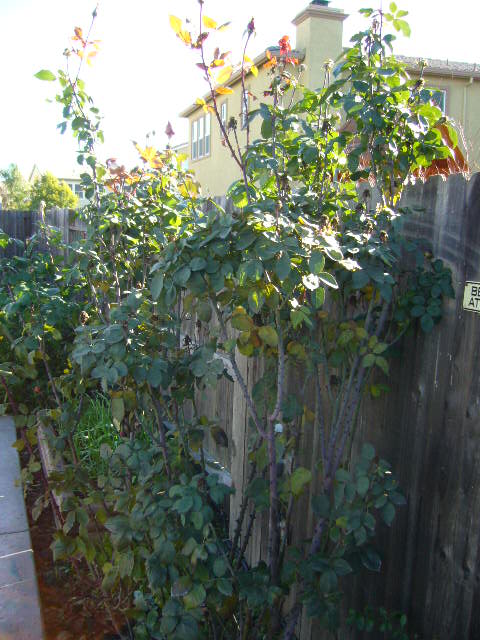
Mister Lincoln in Winter
By the way, does anyone know why the favorite known as Mister Lincoln is sometimes referred to as the Stinkin Lincoln? The answer is at the bottom -- but if you've already guessed -- I'm sorry but you don't win a prize. You have earned my respect, however. But, again, this is no prize.

There are two basic things that I keep in mind when trimming a rose bush. The first is locating and identifying the strongest and largest of the newest "canes" that developed during the previous spring and summer. The second thing that I watch out for is trimming said bush so it doesn't grow out and block off a walkway, as some of them have in recent years. This doesn't always result in a perfect, round cut. But my madness works in other ways.

Trust me, this is a madness.

Fat Purple Cane: Save Him!
This purple colored cane on the Mister Lincoln is exactly the kind of growth that I'm looking to preserve. Older canes are black and somewhat woody and easy to distinguish from the newer canes that emerged earlier this year. This happens to be one of the nicest, fattest canes that emerged from the Mister Lincoln this year. This is a cane that I will want to preserve for newer growth that will emerge next spring.

Another plus: The cane is growing in a direction next to the fence line. Roses against fence lines make for the perfect show. Roses growing out and covering a sidewalk can be problematic, especially if the rose has thorns. And the Mister Lincoln has thorns. They are big, FAT thorns that tend to rip and shred clothing and skin if you're not careful. This isn't something you want growing into a walkway that was installed the previous spring.

Unlike previous years, when I didn't have to worry about sidewalk protection, I would keep and preserve the strongest canes no matter which direction they grew in. I can't do that anymore. So -- any cane jutting out near a walkway, no matter how nice or strong, gets pruned back completely. Harsh? Mebbe. But a rose bush like the Stinkin Lincoln will eventually get the message and grow in areas you want growth to occur in.

A "Must Have" When Trimming Rose Bushes
The number one rule to remember when cutting back roses is this: Wear gloves. Wear heavy gloves. Wear gloves heavy enough to protect your hands against thorn abuse because no matter how careful you are, you're going to get nicked and pricked. The second rule to remember? Carry Bactine. Carry lots of Bactine and maybe a Hello Kitty brand First Aid kit.

Unlike previous years, I can no longer fit cuttings from eight rose and tree rose bushes into one green waste can, no matter now many small pieces I chomp the cuttings into or how much I jump up and down on the green waste can. It just doesn't work anymore. The rose bushes that Venus and I transferred over from the old North Natomas spread five years ago are now firmly established. And all of them have responded with so much growth that it usually takes two packing sessions and two days of cutting before the job of a winter nap is done.

No More Room at The Inn!
Another important step to remember is removing leaves from around the base of a freshly whacked rose bush. This isn't always easy (remember: THORNS). However, this job can be accomplished with a strong broom or a blast from a blower. Removing leaves means non-beneficial bugs don't have a place to overwinter and gives new spring shoots a chance to grow unimpeded.

Finally? The hardest part about cutting back a rose bush? It's not the thorns, as I may have led you to believe. It's not the job of chomping canes into small bits so one can pack a green waste can. No -- the hardest part of cutting back a rose bush is cutting back a rose bush that has been placed next to a yellow beehive. Make that an "active" yellow beehive.

Curious Bees
This is actually a nice sign if you're into the business of keeping bees as a hobby. An active beehive in late December means the colony inside that yellow colored hive has survived the summer and fall months and is overwintering well. It means there is a strong queen somewhere inside that yellow box. And it brings the promise of swarms in the spring for additional hives and honey production next year.

Yes, it does also mean you get the occasional visit from a curious bee or five. But I've come to find out that if you don't bother them, most of the time, they won't bother you.

Mister Lincoln Rose Bush
MISTER LINCOLN: Introduced by Swim and Weeks in 1964, the Mister Lincoln is one of the most enduring red hybrid tea roses ever developed. While other red roses have come and gone, the Mister Lincoln has endured the test of time and is a favorite of many growers. It is also the most fragrant of all hybrid tea (long-stemmed) roses, earning it the well-deserved nickname of "Stinkin Lincoln."

A Frosty Cold One?

Sunday, January 22, 2012

St. Patrick Tree Rose-Bird Back 40
The dead of winter really doesn't offer much in the way of garden blogging topics. There are chores to take care of, of course. If you're going to have a garden, you're going to have an endless list of chores that seems to grow with every passing year. You just can't "plant and ferget" as some people would think.

Sacramento Bee Garden writer (when are we going to add Editor to her title, hmm???) recently hosted a Garden Writing Workshop for bloggers like me, called "Germinating Ideas for Your Blog." Unfortunately, when one is fortunate enough to serve in the Office of Senate Republican Leader, one has no time for such outside endeavors. Maintaining a blog like this becomes a real chore. Sadly, I would miss this gathering as I've been forced to miss others.

Tree Rose in winter-Bird Back 40
But it does bring an interesting question to mind: Where do I find topics to write about? Let's be honest here friends, one can only write so much prose about heirloom tomatoes. After awhile, it just gets boring. And the last crime I want to commit is that of boredom.

I'm a fan of photos in the blog. I need and want color. It helps tell a story that mere words cannot. Therefore, if I see a particular picture in the Bird Back 40 -- like the one above or the other to your left -- that begins the process of "blog idea germination." But I also need more than just pictures -- I need a story to go with it. Sometimes -- if I'm very lucky -- the story carries a second meaning.

These photos represent the current state of the two tree roses that I have planted in the backyard. One is a Weeks "two-fer" (two different varieties of roses grafted onto the same root stock). The other is a St. Patrick, a birthday gift for the wife that is Venus several years ago when she was mourning the loss of her mother, Patricia, from cancer.

Tears of a Tree Rose
The photos you see represent the current state of both roses. I recently cut them back. And if you're wondering if roses *cry* -- well -- wonder no longer. The ice you see forming at the end of each cut represents sap escaping from a fresh cut -- a rose tear caught in the moment so to speak. It begs the question of "a frosty cold one?" Indeed.

I won't lie. Both of these roses gave me plenty of trouble at first. We get a lot of strong spring and summer winds blowing through our Sacramento River bottom home. Strong winds and tree roses do not mix. The stalks either bend or, in some cases, snap right in two. That's how the Weeks "Two-Fer" adopted the rather unfortunate name of "Two-Pieces." A spring wind snapped it in half during the first spring bloom.

Bummer...

Weeks "Two-Fer" 2009
But -- where there's a will? There's a way. The wood stakes that I had been using just weren't strong enough to support a tree rose full of blooms. Wood tends to bend -- and when wood stakes bend -- so do tree roses. One good blow from the north and SNAP! It's an emergency trip to the nearest nursery to hunt for a suitable replacement.

The nursery also carried the fix I was looking for in the form of strong metal stakes, sets of foam holders that attached to both stake and tree rose, plus some strong green gardening tape to hold it all together. I installed the fix last spring after the first big bloom, when once again the Weeks "Two-Fer" began leaning dangerously to the left.

I'm happy to report that the fix actually worked. The tree roses haven't been a problem since both stakes were pounded into the ground and fastened to each rose. They stopped waving too and fro during those surprise spring and winter windstorms. They took every gust like a champion. The stake "fix" also allowed the base of each tree rose to grow thicker and stronger.

It's my hope then that this "fix" is a permanent one. You see -- there are other -- more important duties to take care of on winter weekends like this. It's not necessarily garden related -- mind you -- but if you're a fan of a certain football team that resides in San Francisco, weekends like this have become very important.

There's not as much time for gardening on days like these. Not when Alex Smith is doing his best "Joe Montana" impression. The days of listening to the 49ers lose yet another game while working in the backyard are long gone. There's something special going on in the City by the Bay, kids.

As you might be able to tell from the photo, the question of "a frosty cold one?" takes on an entirely different meaning...

Indeed. That's where blog ideas are born.

Our Lady at Work

Monday, November 2, 2009

The Autumn months of October and November are proving to be a real show-stopper in our North Natomas Back 40 in terms of outright color production.

The rose bushes planted in "strategic" areas around the yard are just going nuts with colorful production. I've already highlighted two of them on this blog (Scentimental and Venus' favorite, Saint Patrick). Now it's time for another that simply tugged on the wife's heartstrings the moment she saw it pictured in a Jackson and Perkins catalog.

Gentle gardeners -- I give you -- Our Lady of Guadalupe.

If you're beginning to figure out that Venus is a certifiable Catholic -- that would be a mighty fine guess!

What's the difference between a normal Catholic and a "certifiable" Catholic?

Don't ask!

But -- back to the subject. I know from experience -- mind you -- that what looks great in a Jackson and Perkins or Weeks catalog doesn't necessarily transfer into the same success at home in the front or back yards. There's a lot of work that goes into making a rose bush look "picture perfect," and sometimes that rose just doesn't look like what was pictured.

Then -- there are cases of "dumb luck." Put Bill Bird in that category.

Venus and I purchased Our Lady of Guadalupe soon after moving into our first North Natomas home in 2003. The selling point? For Venus, obviously, it was the name. But she also liked the fact that Our Lady of Guadalupe had been "blessed by the Diocese of Los Angeles, and proceeds from the sale of the rose supported Hispanic College Fund scholarships."

So -- I wasn't one to argue. I purchased the rose. I gave it a prime spot in our first home against a fence. The rose got nice amounts of compost, fertlizer and water. And this rose responded to that wonderful and loving care by promptly FLOPPING during its first five years.

And Gentle gardeners -- I mean this one really just FLOPPED. How do you put it in gardening terms? Latin Terms? "Stinkus Alottus?"

What went wrong? I'm not sure. It just didn't grow all that well. It was one of the smallest Floribunda roses I'd ever seen -- never growing beyond a height of two or three feet. Oh sure, it would produce some nice roses. But it was hidden away -- blocked by other roses located in the front and the side -- other roses that performed -- well -- much better to be brutally honest.

When Venus and I made the move to our new North Natomas compound with a backyard actually large enough to turn around in -- the decision was made to bring some of the existing roses from the old yard over to the new yard. We had overplanted anyway at the old yard -- so why not?

But -- in my opinion -- the rose named "Our Lady of Guadalupe" didn't make the cut. "It's too small," I told Venus. "I'll buy you something else."

She promptly delivered the universally recognized, one-finger "Gardener's Salute" to inform me that I'd -- uh -- lost the argument.

It just goes to show that I should listen to my wife more often.

I'm not sure what I did right this time around -- nor what I did wrong last time. But I can tell you that Our Lady of Guadalupe immediately responded in a positive way to the new digs. It grew to a height of three feet during its first year after transplant. This year? It's slowly approaching the five foot mark. I've never witnessed such a lavish display out of this rose bush before.

Since rose bushes like this one normally take three years before putting on a really good show -- I can only imagine what will happen next year.

Our Lady of Guadalupe attracts a number of beneficial insects to the garden -- including bees -- although the bees in the nearby, neon-pink, "Hello Kitty" hive don't pay it much attention (no, they're not retarded, but I might be).

Color Me Fall

Wednesday, October 21, 2009

Fall colors normally aren't as vibrant as those you will find in the spring and summer -- but the backyard is still spitting out some beautiful scenes. Oh sure -- those summer flower arrangements are starting to look a little tired (I'm partial to the Rainbow of Color design myself) -- but if you look hard enough -- you'll find some things are still going strong.

I didn't get everything done in the Back 40 that I wanted to get done this summer. I never do. The main section of the lawn that I was hoping to plant? Unplanted. The thirty-plus yards of garden soil I wanted to move in? I'm at five and counting. The greenhouse? Still a long ways off.

I suppose that's the way it works with us Weekend Warrior types. There's never enough time in the day. Weekends just seem to fly by. There's always that one "project" that must be accomplished first before moving onto backyard landscaping pleasures.

But I did get at least one project finished. Venus has her tree rose. Not just any tree rose mind you -- the one special tree rose that my wife has wanted since we were first married. I finally got around to locating the one remaining Saint Patrick tree rose left in the Sacramento area this summer.

This rose holds a special meaning for my wife. It was her mother's favorite rose. In every house her mother and father purchased during a ten-year span of home-flipping in Auburn, Rocklin and finally Sacramento -- you will find the Saint Patrick tree rose. And -- beside that special rose -- is the Celtic Cross of St. Patrick.

When Venus' mother passed away quite unexpectedly four years ago following a long battle with cancer -- I knew she longed for the Saint Patrick tree rose and the Celtic Cross. It is, quite simply, her favorite spot in the yard.

Unfortunately, the recent rain and windstorm that hit the Sacramento area (and the rest of California I might add) -- did some rather wicked damage to the wife's special rose. Not only did it lose blooms -- it's no longer standing straight as an arrow. I suppose I have learned the "curse" of tree roses. I don't care how well you have it staked. If Mother Nature throws a vicious curveball of sustained rain and winds -- that perfectly placed tree rose is no longer standing at attention.

Yet another project for me to take care of this weekend. The companion tree rose took at even worse hit.

One of the most pleasant surprises in the backyard has to be the Pomegranate tree that Venus and I stumbled upon last summer at Lowe's in West Sacramento. It wasn't the variety I wanted -- but it looked nice and the price was more than right. So -- I didn't get the pomegranate variety of Wonderful. I purchased the variety of "Sweet" instead. Or -- so I thought. As it turns out -- I may have purchased a mislabled variety. This tree is churning out fruit that look strangely like a Wonderful.

This picture simply doesn't do justice. The fruits were starting to color to a deep red when I took this two weeks ago. They are all now a deep -- candy-apple red in color. It wasn't ready to harvest two weeks ago when I was disappointed to find white kernals inside of a "test harvest" fruit. I'm not sure what it will look like now -- although I'm willing to give it a little more time.

I am somewhat surprised by this tree -- the rate of growth -- and fruit production. What had been a small starter tree last summer has blossomed into one of the fastest-growing, most prolific fruit trees in the backyard. It was covered with red and yellow blossoms earlier this spring -- and has tripled in size. I can only imagine what will happen next spring.

If you are looking for a beautiful landscape tree that produces more than just flowers and blooms -- I highly reccommend the Pomegranate. The spring-time blooms are staggering in color and a highly favored source of pollen for honeybees and Carpenter bees alike.

Plus -- I'll admit -- I love a splash of fresh pomegranate juice in my margarita! And I also ran across an interesting recipe for pomegranate syrup here, courtesty of Jenn's Cooking Garden.

Sadly -- the display of color located to your immediate right no longer exists. It was one of the last sunflower displays out of the summer garden -- and a big display of color at that. The flowers from this variety of sunflower were perfect for vase cuttings (combined with the Saint Patrick tree rose, of course).

I'm not exactly sure where I received the seeds for this one variety. They may have been sent to us through a bee research project at San Francisco State University. Seeds from this variety may have been collected from a wild plant growing on the side of Elkhorn Blvd., a hop, skip and a jump away from our North Natomas compound.

I know this much: Despite the landscaping headaches that sunflowers can pose, they are a welcome addition to our "Edible Garden" landscape. While not necessarily edible for humans, they are a favorite place to forage for our "Hello Kitty" beehive.

And they do put on a mighty fine show of color.