Showing posts with label North Natomas. Show all posts

Fear the Beard!

Wednesday, July 9, 2014

Beard of Honeybees (A Swarm)
Sometimes -- even vegetable garden bloggers can hit mental subject roadblocks. It happens to the best of us. And, in my case, it happens to the worst of us. I knew I wanted to write about bees. But you just can't put pen to paper without having some sort of interesting subject matter in mind.

As it turns out -- the bees did all the work for me -- clearing that mental roadblock with one swift buzz.

While I had intended to write about the return of the bright pink Hello Kitty themed hive box -- I needed more than that. I wrote about Hello Kitty years ago. It's old news. Yeah -- I keep bees in a box painted bright pink with a Hello Kitty character stenciled on the side. What's so weird about that? Doesn't everybody do that?

The Return of the Hello Kitty Hive Box
As it turns out -- the honeybees I keep in two brightly painted hive boxes (pink and yellow) did all the hard work for me. They did what bees naturally do. The queen inside one of those colonies did such a fantastic job at laying eggs that the colony grew far too large for the multiple boxes I had assembled. And when a colony grows too large for the space it occupies: it swarms. That swarm is pictured above, right. And, yes, that's a closeup on my part. Bees that swarm rarely sting, and the swarm came from one of the most gentle colonies I've ever had the pleasure of keeping.

This is how new colonies are born or created in the wild. Normally, bees swarm in the spring or early summer. While it's not uncommon for colonies to swarm in the summer, it is rare. In most cases the queen stopped laying eggs weeks ago. I just hope she gets started up again to rebuild colony strength. Because, the unfortunate thing about swarms is this: about half the colony vanishes in the space of a day or two.

Second Hive Box with Bees "Bearding" in Front
That equals into a dramatic loss in honey production -- if you're keeping honeybees for such a thing.

I literally had to start over this year. The colony I'd nursed for the better part of two years, gifted to me by another beekeeper who got out of the business, up and vanished on me last winter. I didn't see much activity out of that hive in December after freezing weather set in. That got me worried. When spring finally rolled around and the weather warmed, a hive check revealed the worst of news. The colony was long gone.

I'll be honest, I missed them. A yard without an active box of pollinators around is an empty yard. It's a quiet yard. Once you've kept bees for a year or two, you're hooked. It's tough to live without them. One would think a beekeeper would get tired of excited bees whizzing to and fro and thonking into the back of one's head. Not so. They are like children. And when children leave, it gets quiet. Too quiet.

Hive Boxes-Face to Face-Shaded by Wisteria
I would come to discover that last year was a particularly nasty year for beekeepers -- and not just hobbyists like myself. When I discovered that one of the most experienced members of the Sacramento Area Beekeepers Association (SABA) reported the loss of 100 colonies, I suddenly didn't feel so bad about losing my single, solitary hive. Honeybee loss hits everyone equally -- from the very experienced to the novice bonehead like myself.

I could have taken several actions to acquire new colonies. I could have purchased a package of bees plus a queen -- but I'm not a fan of that approach. There's no guarantee that the queen you're purchasing is a strong one, and the process of introducing a new queen to a colony is tricky. If you don't know what you're doing (SEE: BILL BIRD), the queen can get killed during the introduction process.

Swarm in a Nearby Pluot Tree
The second approach, which is the cheapest one I might add, is waiting for an established, wild colony to swarm. Colonies that swarm in the spring often come from strong hives that feature strong queens, which means there's a good chance that the swarm will contain a nice young, strong queen as well. The problem with this approach is waiting for the phone to ring. Sometimes it does. Sometimes it doesn't. You've also got to be prepared for a swarm call 24/7. Since I work full-time, bee hunting availability is at a premium.

The third option, which I chose this spring after getting a very nice offer from a very nice SABA member, is called a "Nuc Transfer." This involves the transfer of a queen, several frames of bees and several frames of honey to an existing hive box. The attractive offer came from SABA Treasurer Kate Morton, after I'd moaned about the loss of my colony the previous winter.

Honeybees "Bearding" in Front of Hive Box
"You want bees," she asked? "I have bees." When she quoted me a price so ridiculously low, I couldn't shout "SOLD" fast enough. I probably shouldn't be telling her this. She'll probably try to sell me another colony or three.

Sure enough -- her assurances of strong hives and strong queens were not empty promises. The swarm pictures included in this blog posting are proof of that. What initially started as three frames of bees in a small box -- something we call a "honey super" -- turned into three boxes stacked on top of one another overnight. Both queens were laying eggs at record rates. While I thought there was a chance one or both colonies might swarm, I also believed the addition of a true hive box at the bottom would prevent it.

Hah! Fat chance! Another boneheaded beekeeping move on my part. Add another one to a very long list.

Honeybee Collecting Siam Queen Basil Pollen
While I'd like to tell you that I kept and hived that swarm for myself, I'm not the best liar in the country. First and foremost, I've already tested the patience of nearby neighbors more than enough. Two colonies are fine. A third would be a little much. And while the City of Sacramento does encourage hobbyist beekeeping efforts, they also want beekeepers to limit the number of hives to just two. Two is exactly what I have. Adding a third, no matter how badly I wanted them, wouldn't have been the best of ideas.

Besides -- there's a popular poem regarding swarms that take place during the month of July. I didn't invent this. I'm not sure who did. But to beekeepers across the country -- and the world for that matter -- it's almost like a passage from the bible:

“A Swarm in May is worth a load of hay
A Swarm in June is worth a silver spoon
A Swarm in July ain’t worth a fly.”

Fear The Beard!
Why are swarms that take place in May or June more desirable than those in July? It has to do with pollen production, and the ability of a colony to gather enough pollen to produce enough honey stores for the winter months. In many areas of the country, pollen production begins to dry up in July. The harder pollen is to find -- the harder it is for the bees to make honey. And if a colony can't produce honey -- it's doomed. It will not survive the winter.

But that didn't stop a beekeeper from Loomis from making the trip down to our North Natomas farm to take a chance on this swarm. Like many beekeepers, this particular gentleman had retired from the rat race that is full-time work to take on the full-time hobby of beekeeping. My swarm, which sprang from Kate's bees, are now his colony.

Best of luck to the little buggers. I will miss them.

POSTSCRIPT:

If you're thinking the hobbyist beekeeper route might be the life for you -- I cannot stress the importance of belonging to a member organization like the Sacramento Area Beekeepers Association. Here you will find the meetings and helpful people who are essential to getting started. And they will more than welcome you to the club as there's always room for more. Please feel free to drop by the SABA booth at the upcoming State Fair! You just might run into the wife that is Venus and her kook of a husband. Sample free honey! See honeybees in a glass enclosed demonstration hive! The SABA booth is always a top draw for kids and parents alike.

Don't Say it's Over!

Friday, November 15, 2013

Pumpkin Harvest: Bird Back 40
But I'm not ready for it yet! Don't go there! Are you serious? My favorite time of the year known as summer gardening season is over? But it can't be! Seems like just yesterday that I planted those tomato bushes. It can't be gone this quickly, can it?

Welcome to my annual ritual: DENIAL. As you've heard it said before, probably on more than one occasion, it ain't just a river in Egypt.

Actually, if you checked ye olde calendar, which I'm loathe to do this time of year, one comes to find that summer gardening season ended more than a few weeks ago. It really ended with the onset of cool temperatures in the morning. That tends to play havoc with the sugar content in vine-ripened heirloom tomatoes. One can literally "taste" the end of summer.

Whoa! Time for a Haircut!
But when the brown, featherly leaves of downtown Sacramento begin to rain down and rest during my annual pilgramages to downtown Sacramento, I know the time has come. I'm just not ready to say goodbye just yet.

The end of summer gardening season also brings on a massive cleanup job in the Backyard of Bird. Every bush and every tree produces a little something during summer gardening and fresh fruit season. And, when the summer ends, it's time to clean up.

Unfortunately -- those tiny green waste cans do not do us much justice out here in the northern burbs. While I could really use a service like "The Claw" around my house during this time of the year -- the monster doesn't travel this far out in my direction. So -- the job of "disposing" of the summer garden usually results in stacked piles of garden rubbish around the backyard.

Common End of Summer Sight
Those piles will sit and wait for space to open up in the green waste can. Or, if I'm lucky, one of the neighbors will lend a hand with a half empty can. I've already learned one valuable lesson with my last green waste can, which busted into an unholy and warped cauldron that scared neighborhood children half to death.

We're not doing that again.

So -- piles here and there it is. I've also learned a bit of "patience" (aka "laziness") on the job. Rome wasn't built in a day. It wasn't also taken apart in a fortnight. Some projects can sit and wait until space opens up at the olde inn. Then and only then does it get scheduled for the "fall haircut."

The end of the summer gardening season also brings sadness. There are no more nightly visits to the Farmer's Market that we call our backyard. While some summer crops are still producing -- most are curled up and long gone. It's both sad and tough to reach for a jar of canned tomatoes that we prepped earlier in the year, rather than picking them fresh off the vine.

Test Bed: All Played Out
I'm just not ready to say goodbye!

Still -- the onset of Fall brings new challenges. What, for example, are we going to do with that line of pumpkins from this year's extraordinarily successful pumpkin patch pictured above? Share them with friends? Yes -- there's some of that. Carve pumpkins for Halloween? Absolutely!

But I also wouldn't be completely forthcoming if I didn't say that there's a little bit of a pumpkin pie in those pumpkins. We just might have plans for pumpkin bread. And then there's that recipe for pumpkin soup with barley that looked pretty darn good.

Short and sweet? You can lot more with pumpkins other than carve a scary face and roast some pumpkin seeds.

Summer Garden Pile: Scheduled for Removal
Fall is also a time to start thinking about other crops. There's garlic seed to stick in the ground for next year's garlic crop. And -- one just can't do without Tall Telephone Garden Peas, which are also planted now in anticipation of a fat spring harvest. Since you failed to remove every last potato from the ground last summer, the spuds you left behind have rewarded you with a nice fall crop.

So, no, the onset of Fall isn't a complete and total bummer. There's also time for a weekend nap in the schedule, where one can dream about next summer's heirloom tomato crop.

But...But...But... All I Needed was a Bag of Fertilizer!

Wednesday, March 13, 2013

Bag of Fertilizer and a WHOLE LOT MORE!
We've all been there before, right? Men are even better at this than women when it comes to shopping. It's called "straight line focus." When we need to buy something -- no matter what it is -- us dudes get in, get out and get on with it!

Well, some of us dudes do...

The mission on the weekend before last? Get thee a bag of fruit tree fertilizer! Rain was scheduled to move in later that week. There's no better way to fertilize a fruit tree than to spread out a handful around the tree before a gully washer. You can't get better a more equal shot of fertilizing a fruit tree than what Mother Nature provides with a good soaking. The timing was right.

Green Acres is the Place to be!
As luck would have it, the lovely wife that is Venus and I were in Roseville on this particular day, just a block or two away from Green Acres Nursery. A nursery is the best place to acquire the type of fertilizer I was looking for (I cried when Capital Nursery closed, taking my favorite blend with it). The goal on that Sunday afternoon? Get in -- get that fertilizer -- get out and get home.

Not so fast, pahdner...

The first thing that struck Venus and I as we pulled into the parking lot were the numbers of people who were flowing in and out of the store on a late Sunday afternoon. The place was packed. For those who predict an end someday to the retail nursery business, not so fast. Green Acres was hopping.

Leveling Out a Half Wine Barrel
The second thing that struck us? Hey! Look at those half-wine barrels made from oak! Darn! "Wouldn't that look good in that empty spot in the Bird Back 40," I mentioned to the wife. She nodded in response. Note to self: There's ALWAYS an open and empty spot in the Bird Back 40!

As we entered Green Acres on my quest for fruit tree fertilizer, it suddenly dawned upon me that the wine barrels up front just might be the ticket for that elusive Southern Highbush Blueberry that I've always wanted to grow, but failed miserably at in previous years.

Sharp Blue Blueberry Plant Starter
A quick check with the handy-dandy Green Acres sales associate confirmed that suspicion. Of course, had Green Acres been in the business of selling elephants, I'm sure he would have confirmed an elephant could indeed be grown in that barrel. It is his job, after all, to move product. And he spotted two suckers a mile off! That would be me -- and the wife that is Venus.

As luck would have it -- Green Acres had a fairly nice supply of blueberry selections grown by our friends at Dave Wilson Nursery. Nearly every fruit tree in the Bird Back 40 is a Dave Wilson Nursery special. They've only been growing and selling fruit trees for about a zillion years. They kind of know what they're doing.

Navajo Blackberry
And -- as luck would have it? Those blueberry starter plants were located right next to blackberry starter plants! Who would have thought to pair those two together? Certainly not us, the suckers. I'd heard a lot of nice things about that Navajo Blackberry plant, and with yet another empty spot in the Bird Back 40, we could pare it with the purchase of a Sharp Blue Blueberry!

Ah -- but that's not all my friends... I've learned from harsh experience that blueberry plants will not survive unless they are treated with loving care and planted in a soil with a low pH. The higher the acid content, the better, and the clay soils that dominate our North Natomas spread just don't offer that pH requirement that blueberries need to survive and thrive.

Southern Highbush Blueberry
They would do well, however, in that half wine barrel (made from oak no less). But I would need more than just a barrel. I would need a special soil that blueberry plants thrive in.

Guess who came to the rescue? Why, our helpful, handy-dandy, Green Acres sales associate. Are you surprised? Cash registers were lighting up in this associate's eyes. I had come in -- after all -- for ONE (1) bag of fruit tree fertilizer. I would exit Green Acres with so much more, making said sales assistant quite happy in the process.

If you've ever wondered why children -- they made us do those stupid word math problems in school? This is the reason why: One half wine barrel (made from oak, no less) holds 4.5 cubic yards of soil. Each bag of the special mixture that I would need, contains 1.5 cubic yards of a soil high in acid content. How many bags of soil do the suckers need? If your answer was three, congratulations, you passed sixth grade.

Specially designed for blueberries AND Azaleas
As we exited Green Acres that late Sunday afternoon with one half-wine barrel, three bags of soil, a Sharp Blue blueberry starter plant, a Navajo blackberry starter plant and ONE (1) bag of fruit tree fertilizer I suddenly realized I should be allowed near any nursery again until spring has come and gone.

But as for that Southern Highbush Blueberry? I must admit -- it does look good. And with the fruit trees and vines now planted and properly fertilized, bring on spring and summer and those wonderfully delicious home-grown fresh fruit months...

Instant Gratification and Gardening

Friday, February 1, 2013

Feed Your Citrus Trees! Feed Them!
Instant gratification and gardening do not mix. The words instant gratification and gardening, when used in the same sentence would represent an oxymoron. There are no quick results when it comes to digging in the dirt. There are only successes and failures.

If I had to compare gardening with anything, it would probably be a turn at a Las Vegas craps table. Sometimes you hit it big -- real big -- know what I mean? And then, at other times, you're informing the wife that is Venus that she'll be making the house payment this month. And perhaps the next...

Owari Satsuma Mandarin-Bird Back 40
I bring this up because even an experienced gardening screwup like Bill Bird can still make some fairly basic mistakes by expecting to see too much in too little of a time. Case in point? Growth on the citrus and stone fruit plantings that currently dot the Bird Back 40.

I harken back at this point to some wonderful advice provided to us by Ken Menzer, the arborist employed by the City of Folsom. Ken is known to provide classes from time to time on various subjects that include fruit tree trimming and other tips and advice.

Long Gone Blueberry Planting-Bird Back 40
Yes, it is Ken Menzer who told the wife that is Venus and I to plant blueberry bushes beneath our fruit tree collections. Sadly, that experiment failed. I would later come to discover that both have different pH requirements and a couple of Southern Highbush plants would go on to kick the proverbial bucket.

But -- I must say that Ken's advice about planting strawberry plants beneath fruit tree groupings was spot on the money. His other advice that I took to heart and would later abandon? Fertilize fruit and citrus trees once a month -- every month -- without fail. "It doesn't take much," I recall him telling us. "Just a handful here and there every month."

Apple Trees and Strawberry Plants in Winter
At first? At first I followed his advice to the letter. I dutifully purchased bags of fertilizer for my many citrus and fruit tree plantings scattered across our North Natomas backyard. Every month -- without fail -- eight table grape vines got a little something. The same with those peach trees over there -- and the nectarines in the front yard -- they got the same treatment. Nobody got the cold shoulder.

But at some point in this journey -- I can't place exactly when -- I sort of fell out of this practice. I'm not sure why. Perhaps I got a little disappointed when the fruit trees failed to "take off" after six months of loving care? Perhaps it's when Capital Nursery went out of business, taking that supply of fruit tree fertilizer I loved so much.

Dancy Mandarins! Yum!
I can't remember when I did it. Point is? I did it. I stopped when I should have continued. Why? Because last year those fruit trees that I'd lovingly cared for suddenly sprang to life. One peach and one pluot tree doubled in size over the course of a summer. The three nectarine trees started acting like they had ingested some of Jack's "magic beans." The Dancy Mandarin delivered a whopper of a harvest this year -- the largest ever.

The same can pretty much be said for most fruit and citrus tree offerings scattered in and throughout the Bird Back 40. I had one of my best production years ever. I ate table grapes until I was sick of table grapes. Sick of table grapes? That's a crime!

Fruit Tree Fertilizer (now gone)
Even after one whopper harvest or growth spurt after another, I still failed to put two and two together. I never have been the best at math, I will admit. But this equation is fairly basic. As the Scotts Fertilizer pitchman once begged: "Feed Your Lawn! Feed it!"

It wasn't until just recently -- fairly recently I'm ashamed to admit -- did that proverbial light suddenly snap on in the rather darkened spot between my ears. This wasn't some mistake. Last summer's growth spurt and good harvest was probably due to Ken Menzer's good advice. And, unfortunately for me, I'd stopped following it at some point.

Improved Meyer Lemon After Frost Damage
I'm happy to report that I'm "back on the wagon" again. I'd committed the gardening sin of expecting instant gratification from my garden. Worse yet, I'd abandoned a practice that had served up some mighty fine peach cobbler desserts over the course of a summer.

The $64 question is -- did I wait too long to resume what had served me so well? I can tell you this much: I won't go expecting instant results...

Christmas Garden Gifts

Wednesday, December 26, 2012

A Merry Bird Christmas
I had intended the title of this post to be "last minute gardening gifts for Christmas." Uh yeah, I'm a tad late. In fact, I'm not really done with Christmas shopping quite yet. Because, when it comes to the wonderful wife that is Venus, Christmas comes 365 days a year.

However, I did run into some problems this year when she retorted "NOTHING," in response to my question of "what do you want for Christmas, dearest?" That's a rather tough answer. If I had actually put nothing under the tree for Christmas Day, I could see myself camping in our North Natomas backyard for a rather extended stay.

A Favorite Bird Gardening Haunt
Though I am a fan of camping, I'd rather pass on the somewhat cold and quite waterlogged Bird Back 40. Besides, there's really no place to pitch a tent. Unless I want it to float away.

Still, the wife deserved something for Christmas Day. And, as I walked the aisles of Emigh's Ace Hardware this Christmas season (one of my favorite haunts), plenty of gift-gardening opportunities presented themselves. Instead of receiving "nothing," she would get items that made digging in the dirt that much more enjoyable.

Plus -- these are the types of things that vegetable gardeners really can't be without.

Cat Play Toys -- aka -- Garden Labels
PLANT LABELS: It's a simple thing actually, but you'd be surprised how quickly these things vanish in the Bird Back 40. Every row of seeds -- every tomato plant -- deserves a plant label. Sure -- our pesky cats have been known to knock a few of these into next year (bad cat!), but labels keep the garden in order. They also help us tell the difference between Atomic Red Carrots, Solar Yellow Carrots, and Cosmic Purple Carrots.

What's that? Purple carrots? They really make those things? Why, yes they do! Not just "make" them, but grow them. Carrots come in the colors of the rainbow and thanks to some fine work by researchers in all things vegetables, come packed with nutrients. Each row gets a label -- and with some 20 odd raised gardening beds -- that's a lot of rows.

Garden Sloggers for the Bird Back 40
GARDEN SLOGGERS: This is the one gift that made the wife's Christmas morning. Venus appreciates a pair of good shoes -- and now she's got a pair for her exploits in the Bird Back 40. I've been promised that these sloggers are appropriately named, and can handle wind, rain, mud or anything else that Mother Nature can throw at them.

I found the sloggers hanging on a back wall near the gardening department and couldn't resist. Call it an "impulse purchase." And -- try as they might -- our pesky cats cannot chew holes into these things.

Green Stretch Tape
GREEN GARDENING TAPE: Somehow we manage to go through miles of this stuff. If there's one rule in the Bird Back 40 garden? You can never have enough gardening tape for odd jobs. Tomato plants looking overgrown and somewhat disheveled? Put the green gardening tape to work. Branches bending under the weight of far too much fruit? Bring on the green gardening tape! Want that tree to grow up instead of out? Where's my tape?

Tape is also used to ensure that vines grow up a fence line rather than on a sidewalk or walkway, where they can be trampled by a herd of marauding cats (notice a theme here?).

Okra, Cucumbers, Onions, Oh My!
SEEDS: You can't have a garden without gardening seeds. Since Venus tends to plant everything from seed, you'd be surprised how many we actually go through. We also normally plant more than one variety of each vegetable. I mean, why grow just one variety of cucumber when you can have five? It's like growing just one variety of tomato, which will never work.

I also make sure to buy several packages of green onions -- one of my garden favorites. In fact, I'm still pulling green onions that are leftover from last summer's garden. Purchasing several packets of the same thing ensures that we'll never run out of them, as we did three years ago when we ran out of green onion seed. Or when the pesky cats dig them up and scatter them to the wind.

GIFT CERTIFICATES: I've got to give credit to my brother Andy for dreaming this one up. A gift certificate to Peaceful Valley Farm Supply in Nevada City? Can you say "the perfect gift?" My thanks to Charlotte "Daffodil Planter" Germane for whispering into my brother's Facebook ear while he was searching for Christmas items.

And while we're on this particular subject -- why is one of Sacramento's best nurseries located in Nevada City? Not that I'm complaining, of course, but I'd probably wind up living there if they'd just move a tad closer to home.

Precious "The Destroyer"
Thanks to these last minute gardening gift items and a few more surprises, Christmas Day came and went without a hitch. To borrow a line from Twas the Night Before Christmas, "not a creature was stirring, not even a mouse."

It didn't help matters much when Precious decided to invade the Christmas Village and make it her personal nap spot for the day (nobody moves Precious from her nap spot). But the fact that she didn't actually destroy it in the process, or knock over any carefully placed figures has to count for something.

I just wish she'd show the same respect when knocking carefully placed plant labels into the next century.

The Crenshaw Surprise

Sunday, September 16, 2012

Vine Ripened Crenshaw Melon
On the first weekend of the 2012 NFL Season, the garden in the Bird Back 40 delivered a sweet treat in the form of a Crenshaw melon. Here on the second weekend on the 2012 NFL Season, the garden is about to deliver five more.

Fresh off watching the San Francisco Giants pull even closer to a National League West title and my suddenly reborn Fresno State Bulldog football team deliver and eye-popping rout of the Colorado Buffaloes, I can tell you that life is pretty sweet at the moment. It's almost as sweet as the Crenshaw melons that are coming off the Bird Back 40 vines in eye-popping numbers.

A Sweet Surprise Awaits
I've never grown this melon before. Shame on Bill Bird. Because this melon has now found a permanent home in our North Natomas soil. Short and sweet? The Crenshaw melon loves the Bird Back 40. So, we'll love it back.

The melon pictured above and to your immediate left is the payoff for watching this treat turn from a bright green to a dull yellow. The rind of this melon also tends to die back near the blossom end, which makes it an inviting target for birds and bugs. I watched -- anxiously -- as this treat started to ripen, hoping and praying that the Birds would get to this treat before the mockingbirds that frolic and sometimes curse our backyard.

Crenshaw Melon Chunks
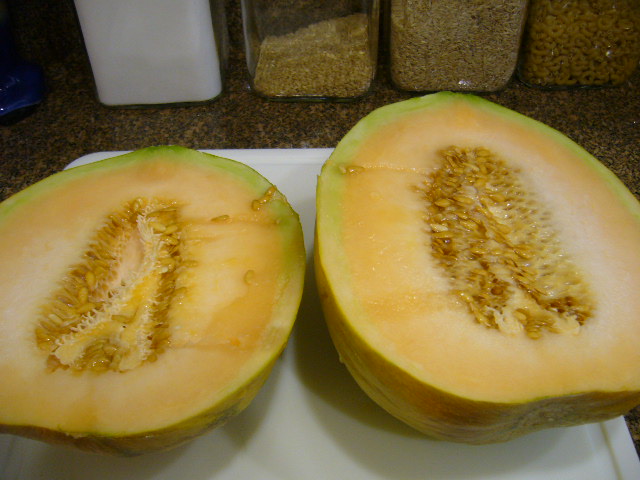
Consider this prayers answered. The melon slowly ripened until it told us it was finally ready last Sunday morning. I was rather curious. Our first experience with this melon was rather disappointing. I had picked the first one a smidge too early. Although it was pleasantly sweet, it was nothing like the sweet tastebud surprise we were about to receive.

That taste and wonderful texture grabbed my attention fairly quickly. What exactly is a Crenshaw melon and why I have I waited so long to plant said variety? From our friends at wiseGEEK:

Crenshaw Melons on the Vine
"Crenshaw melons were bred by crossing casaba melons with Persian melons, also sometimes called muskmelons. The favorable traits of both melon varieties successfully manifested in the cross breed, and it quickly became one of the more popular melons on the market. The melons can be eaten plain as a snack food, mixed in with fruit salads, or wrapped in prosciutto for a twist on the classic prosciutto wrapped melon appetizer."

I'll admit, it's been a strange melon season in the Bird Back 40. August is normally the strongest month for melon production, and while we've pulled our share of cantaloupes and small watermelons from the vine, August production hasn't been anything to really write home to mom about.

Georgia Rattlesnake Watermelon
But September? September is a decidedly different story. Those Georgia Rattlesnake watermelon vines are suddenly popping with late season production. While the cantaloupe and Sangria watermelons have largely played themselves out, the Crenshaw vines are putting on a real show with production I've never witnessed in a backyard melon patch before.

The big question mark is, will the weather hold? Melons like long, hot summer days. They don't dig cool fall temperatures. Mother Nature has done her part by delivering a mid-September heatwave, but the days are getting shorter. That can play havoc with melon vines and varieties that need 60-80 days to deliver a firm, vine-ripened melon.

The Crenshaw: Sliced and Ready to Chunk!
I don't have any doubts about the Crenshaw melons that are now just starting to turn yellow. But that Georgia Rattlesnake? Why did you take so long to show up? Thank you for coming, but please, hurry up! This weather isn't going to last forever!

There is no better weekend treat than a sliced Crenshaw melon. Starting your day with a bowl of fruit procured from your own backyard vines is the final payoff for a summer of vine-tending work. And, after one bite of a vine-ripened Crenshaw melon, a gardener comes to realize that it was worth the effort and that much more.

The One-Two Punch of Epic Crop Failure

Saturday, June 16, 2012

A Plum Disaster: Snapped Branch
Yes -- it does indeed happen to the best of us. Or -- in my case -- the worst of us. Not everything is a screaming success at the Bird Ranch for Wayward Heirloom tomato plants. That's all I ever let you hear about -- the screaming successes. There are failures. Trust me. There are failures and plenty of them.

But what happens when you combine an epic failure with a natural disaster? The end result is a dramatically reduced Santa Rosa plum crop. You know this crop. You know it well. It's the crop you've been tending and babying through the spring months. From the very first flower, to the first hint of fruit on a branch, it's the first tree you see every time you step outside the front door.

Hello Santa Rosa Plum Tree. How are you feeling today? That's a nice looking tree of fruit, my friend. I look forward to sampling some of it in a few months.

Avoidable Disaster Unless You're a Glutton
You see -- I talk to my fruit trees because -- well -- if you haven't guessed it by now -- there's this slight edge of insanity that runs in my family. We like talking to inanimate objects. We even think the family dog is listening to our deep conversations, when in all honesty, all the family dog can hear is "blah, blah, blah, FOOD!"

The pictures above right and to the left should more than demonstrate the first part of this year's tragedy. The broken branch picture above and the plums in the wastebasket are what greeted me when I arrived home from work a week ago last Friday. You see -- I had failed to cull the tree of plums properly. And this is what happens when you dismiss the talk of mentors who know more than you do. They say "cull, cull, cull," and you think: "blah, blah, blah, PLUMS!"

Plums Needlessly Gone to Waste
I had cast more than one nervous glance at those branches slowly bending in a downward direction thanks to the weight of a massive plum crop. But rather than react with a cull party, I prayed for salvation. I hoped the branches would survive long enough for that massive load of plums to ripen and then: PLUM CITY!

I'm such a glutton.

But there would be no such plum party. Salvation would not arrive in the form that I expected, but I would hear from Mother Nature a short time later. First things first? I had a broken branch to deal with. There were a lot of plums to get off the ground. And there were other branches to save from a similar disaster. This wasn't the only bender. Others were straining under the size of the biggest Santa Rosa plum crop I've ever grown.

A Little Rope Goes a Long Way
Rather than taking the wife that is Venus out for a much deserved dinner out last Friday, I spent the hours cleaning plums off the grass, chopping up a broken branch and -- thanks to an assist from a friendly neighbor -- propping up other branches that were also close to snapping in two. I had already lost one branch loaded with plums. I dare not lose another. I might not get 80 plums off that branch. But at least I'll get ten, right?

Or so the thinking goes.

But that fickle thing called fate has a funny way of screwing with this thing called life. This wasn't the only disaster that would befall the Santa Rosa plum tree. It was the first of two big jolts that reduced what should have been a healthy crop to "better luck next year, kid."

AT&T Park: San Francisco
You see -- last weekend was a birthday weekend for yours truly. That's right. Bill Bird turned the ripe old age of 39. Again. I can't tell you how many times I've turned the ripe old age of 39. I've sort of lost count. But it was the anniversary of that date -- that much I can tell you. Since I am the luckiest man on the face of this planet, with the greatest wife in the entire universe, I was treated to a San Francisco Giants game the very next day.

A blast of wind greeted us as we pulled out of the driveway that Saturday. Both Venus and I agreed that if we had wind problems in the valley -- the Bay Area would probably be perfect. And it was. Sitting in those outfield bleacher seats, watching the Giants clobber the Rangers ("Whatsa Matter With Gentry??? He's a BUM!!!), was the best gift any 39 year plus man could ever ask for.

Wind and Plums do NOT Mix
There was no wind to worry about in the City by the Bay on that particular day -- but guess what? It was blowing pretty fierce through the Sacramento river bottom. Although I had prayed for salvation -- I got a surprise late spring sustained gust of wind instead. Wind and plums do not mix well. Wind tends to blow plums right off the tree.

And that is exactly what took place on Saturday, June 9th, 2012. While I was vainly chasing balls that Giants outfielder Angel Pagan was tossing into the centerfield bleacher seats, a rather unexpected jolt of wind blew through and blew what was left of the still unripened but oh-so-close Santa Rosa plum crop to the ground. The carpet of plums was so thick in some places that it covered the grass. I would spend that Sunday loading up the green waste can with what I had hoped to be a massive plum harvest.

Better Luck Next Year Kid
Those recipes I'd printed out for plumtinis? Plum cocktails? Plum punch? Plum cobbler? Those can wait for another year. While a few plums do remain, it's not going to be the large-scale harvest that I had hoped and dreamed for.

And that's my personal one-two punch of Santa Rose plum tree epic crop failure. Better luck next year kid.