The Politics of Melon

Sunday, August 19, 2012

Rich Sweetness 123 Melon
It's got nothing on the Politics of Dancing, but it sure does taste better!

It's that special time of year when the summer garden that you've carefully tended weekend in and weekend out begins to pay off here and there with some interesting surprises. As the wife that is Venus knows, I like to mix things up a bit from year to year. Why keep growing the same type of tomato, onion, carrot or any other vegetable for that matter, when there are so many interesting other possibilities?

Case in point? The photo directly to your right. I call it the "Fiona Ma" melon -- when in reality -- it's not. But the seeds did come from Fiona Ma, who represents the 12th Assembly District in the California State Assembly and is also a candidate for Board of Equalization, District 1. This is indeed a melon, but it's like no melon I've ever seen or tasted. And it's putting on a bright orange and yellow striped show in the Bird Back 40 this year.

CA Assemblymember Fiona Ma
The seeds for this unique melon actually come from Baker Creek Heirloom Seeds, but Assemblymember Ma was promoting "agricultural sustainability" while giving away packets of this melon seed during a recent Democrat event attended by my left-leaning, Democrat brother.

What did my brother do with this particular gift? He gave it to his right-leaning, Republican brother who gardens, which just goes to show that "agricultural sustainability" doesn't exactly fall within rigid party lines. Besides, my brother wouldn't know what "agricultural sustainability" was unless it was bottled, packaged and sold on a shelf at Trader Joe's.

Pocket Sized Melons with a Punch
Baker Creek markets this little gem of a melon as the Rich Sweetness 123 melon. The online catalog description says: "Incredible little melons from the former Soviet Union. The fruit are a beautiful red, striped with golden yellow and weigh only about ¼ lb! The flesh is pure white and quite sweet. These have a very refreshing taste and are very fragrant. One of the best new varieties we’ve discovered in the last few years."

This little gem of a melon plus many others are putting on an August show to remember in the Bird Back 40. It is indeed fresh melon season in Northern California. And the seeds that the wife that is Venus and I carefully sowed last spring are now producing tasty melons in all shapes and sizes.

Sangria Watermelon
Not everything is a success in the melon patch, of course. What in gardening is? I am missing out on some of the larger, whopper sized watermelons that I planted earlier this year. But who needs whopper sized melons when the Sangria is popping watermelons in the shape of a small bowling pin?

And then there's that "mystery melon." What is it? I don't know! It's a "mystery." But it sure does taste good! Venus seems to think it's some sort of a crenshaw variety, but there's just one eensy-teensy problem with that. See, I don't remember planting crenshaw melon seeds. It might be a crenshaw! It might not! What I can tell you with all honesty is this: it's darn tasty.

"Mystery Melon"
I suppose it could also be a casaba melon. But there's just one eensy-teensy problem with that as well. See, I don't remember planting casaba melon seeds. Hmm....My memory is slipping (the wife is not surprised).

Combine this sudden richness of melon crops with fresh O'Henry peaches and table grapes that are putting on a bang-up show -- and you've got a fruit salad fit for any king or queen. And, try as I might, I never can really get tired of eating fruit procured from the numerous trees and vines sprouting in the backyard.

Melons, Grapes and Peaches: Oh My!
I don't know if I'm really promoting "agricultural sustainability" or not. I don't think of it in that way. I tend to simplify things a bit more. My way of thinking goes like this: I like melon. I plant melon. If someone wants to put a label of "agricultural sustainability" on Venus and I are doing -- that's fine I suppose.

Just as long as I get the fruit salad payoff. 

Onion Ring King and Queen of North Natomas!

Saturday, August 11, 2012

Homer Bucket of Onions: Partial Harvest
It's about that time of year when the wife that is Venus and I play this little game of "let's make dinner." That is -- we will tell one another that we want to make a particular dish, but need to purchase things such as "tomatoes, peppers, zucchini, onions, green onions, etc."

Of course -- this is our version of a ginormous joke -- since we have ginormous amounts of these things protruding from the summer garden beds. We've reached that Nirvana time of year when every carrot is at least a foot long and two inches thick, each tomato weighs at least a pound and is loaded with flavor and one green onion is larger than the bunches of five or six green onions sold at the local grocery store.

A Garden Whopper: The Candy Onion
In short? Gardening life is good. It's very good. Every meal features something fresh. And if it doesn't? Someone made a royally bad mistake. Even something a simple as a frozen pizza tastes better with extra toppings of chopped up bell peppers and green onions. And WHY are you eating frozen pizza when you can whip up a garden fresh soup featuring a hodge-podge of fresh this and that?

The frozen pizza can sit and wait in the freezer.

It is indeed harvest time on the Bird Ranch for Wayward Heirloom Tomatoes. The heirlooms are popping. The squash is prolific. Bell peppers make for a sweet and tasty treat. But one of the bigger successes just came out of the ground just last month: one of the largest and sweetest onion harvests we've ever had the pleasure of taking part it.

Bunches and Bunches of Candy Onions
No matter where you turn in the Bird GarageMahal, you're going to run into a Homer five gallon bucket of onions here -- or another five gallon bucket there. Or you just might run smack dab into onion monsters that are hanging and curing from an exposed set of rafters. Short and sweet? We got onions. Lots and lots of onions.

I would have to characterize this year's "onion experiment" with Dixondale Farms in (flat as a) Pancake, Texas a tremendous success. I have never grown onions this huge or this tasty before, and never before in the numbers that we experienced this year. Sure -- there were a few "duds in the bunch." But that's to be expected with just about anything when it comes to gardening (at least for yours truly). But as I began to pull mammoth whopper after mammoth whopper from the ground, I knew this was one of them rare experiments that had totally succeeded.

Onion Starters in February
Excuse me while I cry for a moment. This just doesn't happen often.

Unlike past years, when I would plants onion and garlic bulbs at about the same time of year (October), I waited to order my onion crop. It wouldn't arrive until early February. In the meantime, I educated myself on what I had done wrong in the past. I would come to discover that no onion is like the other. All of them are different. Some grow well in some areas. Others do not.

It was during this research that it dawned on me that purchasing that package of onion bulbs from my local nursery in September or October wasn't the wisest of decisions. Sometimes those packages contained onion bulbs that were not intended for, nor would grow to a large size, in the Sacramento Valley. Why would a nursery or Big Box store do that? Simple! It's the same question as, "why would they sell that Hass Avocado tree" when they know it will perish in our cold Sacramento climate?" Or, "why are they selling tomato plants in February when tomato planting season isn't for another two months?"

Red Candy Apple Onions
Simple! It's because people who don't know any better (see: Bill Bird) will happily fork over $20 for it. And if it dies? That's OK too! Because the people who sold you the wrong kind of onion bulbs or that avocado tree that kicked the bucket know all too well that you'll be back in another couple of months to fork over another $20 in a vain and wasted attempt to correct the problem.

It's called "marketing for dummies."

I finally got around to listening to the patient advice of a South Natomas vegetable gardener who has been at this game a little bit longer than I have, and gave into his suggestion of giving Dixondale Farms the old college try. After reading, and more importantly, understanding the different between "long-day, intermediate-day, short-day" and "Green Day" onions, I finally understood what I'd been doing wrong.

Green Day Onions. KIDDING!!! They're CANDY!
Note: To the uninitiated, there is no such thing as "Green Day" onions. If you ask for them at a nursery, you're likely to earn a howl of laughter or a blank stare. "Green Day" isn't an onion. "Green Day" is a rock-n-roll band.

Short and sweet? If you plant the right kind of onion bulb or onion start, fertilize, water and care for it properly, you will be rewarded with monster-sized onions. Monster sized onions mean monster sized onion rings -- made with a fresh beer batter.

Sure! You can use your onion crop for healthy things like salads and such! There's nothing wrong like that! But only I can tell you the wonderful taste behind taking a healthy thing like a freshly grown onion, dipping it into a batter and dropping it into a vat of hot oil!

Mix in rings procured from a home grown Super Star white onion, add in some beer, flour and salt, and you've got a meal fit for a King or Queen.

Simple Beer Batter Recipe

1 cup beer (the better the beer, the better the onion ring)
1 cup flour
1 egg
1 teaspoon salt
1 teaspoon paprika
1 teaspoon onion or garlic powder
1/2 teaspoon cayenne pepper
Vegetable oil for frying

Onion Rings in Waiting
Mix all items, minus the vegetable oil, together in a bowl until smooth. If the batter does not take on the consistency of a pancake batter, add more beer.

Cut off both ends of an onion (preferably home grown), and proceed to cut into slices anywhere from a half inch to an inch thick. Separate slices into individual rings.

Fill frying pan with raised edges with a half inch of oil and heat to medium-low. Proceed to dip each onion ring into the beer batter, using tongs to add directly to hot oil. Turn when edges turn light brown. Remove from heat when both sides are light brown and drain. Add additional salt, if needed, for taste, or a favorite dipping sauce!

Mind Your Own Beeswax!!!

Wednesday, July 25, 2012

Beehive Display: California State Fair
This just happens to be one of my favorite lines that sprang from manning the "Bee Booth" at the California State Fair this past Monday. Though it was a Monday afternoon, and things were a tad slow on the fairgrounds, it didn't stop the kids from coming inside to check out a display case of live bees, ask questions and get a tasting of several different types of honey.

It's that special glass display case to your upper right that garnered most of the interest. It's a representation of a small bee city inside that glass case. The kids were surprised to learn that most hives were far larger -- containing anywhere from ten to 20 frames instead of the two frames pictured inside that case.

Beekeeping Booth: California State Fair
I like working with kids when it comes to bees. The kids are fascinated by the show and the honey -- and come armed with lots of questions. Thank goodness they have someone like me around -- as I would respond with the following answers:

Question: "Will those bees sting?"
Answer: "Why don't you put your hand in there and find out."

Question: "What happens if you open the top of that display case?"
Answer: "I don't know. Let's find out, shall we?"

Honey Samples at CA State Fair Booth
Question: "Where should I keep bees? The backyard?"
Answer: "No, the best place is your bedroom."

Question: "Are bees friendly?"
Answer: "Of course! They just told me that they want to go home with you!"

Question: "Why does the Queen have a dot of yellow paint on her?"
Answer: "That's not paint. It's her mood ring. Just wait and see what happens when it turns red."

Editor's Note: Somewhere, someone with the Sacramento Area Beekeeping Association (SABA) is firing off a nasty email to the President with the following report: "NEVER LET BILL BIRD ANYWHERE NEAR THE STATE FAIR BEEKEEPING BOOTH AGAIN!!!!"

Venus Dishes the Honey
I can't blame them...

All kidding aside, the booth experience proved to be far more enjoyable than I ever could have imagined. There are lots of activities, sights, sounds, foods, experiences, etc. that can grab a child's attention. But, even the attraction of chocolate covered bacon or a deep-fried twinkie couldn't overcome the fascination that resulted from a two-frame display of living, breathing, buzzing, bees.

As I stood there, talking with both parents and children alike, it struck me that I've come a long way in this now three-plus year experiment in beekeeping. It brought back long ago memories of running from a single, solitary bee that had taken a liking to the hive frames I'd kept stacked in the garage, waiting for my first colony of bees to arrive. How could I keep an entire colony if I was scared of one, single, solitary bee?

The Infamous Neon Pink Hello Kitty Hive
From those first, halting steps, somehow I'd emerged as an experienced beekeeper. When did this happen? Did this transformation take place after I captured and hived my first wild swarm? When I first procured honey from the backyard hive? Perhaps when I added the second hive to the Bird Back 40?

Overnight I've gone from someone asking the questions to the person providing the answers. When did this happen? I suppose it comes from the experience of working a hive on your own for the very first time. I suppose it comes from the experience of watching a mass of annoyed bees suddenly erupting from a hive towards my face after a long and not so comfortable trip in the car.

At some point in time the wife that is Venus and I went from cautious beginners to actual beekeepers. I'm just trying to figure out exactly when this happened. Perhaps it was the joy of watching Lenny, our 14 lb. Maine Coon Kitten, learn a very hard lesson that paws should never be stuck into the front of a hive opening?

Or perhaps it's the despair of realizing that you've lost yet another hive to Colony Collapse Disorder (CCD), and wondering what you did wrong, if anything. There's nothing more distressing than discovering an empty hive that is packed with honey stores for the winter. Why did they up and leave all this behind? Perhaps it's the vow to never let it happen again?

Dave Mason Concert: CA State Fair
There's nothing more pleasing, in my opinion, than watching a hive at work in the backyard. You enjoy them while they are there. You miss them when they are gone. It's one reason why that once you become a beekeeper, you'll always be a beekeeper.

One hive is never enough. Two is twice as nice. Perhaps that idea of a third colony in the bedroom isn't such a bad idea after all.

Flaming Lips

Tuesday, July 24, 2012


Claussen Style Refrigerator Dill Pickles
I'm not going to make many friends by posting experiences and recipes about a dish that is so hot it will burn your lips straight off!

But, I'm going to do it anyway.

It's mid-July in the Bird Back 40 and canning season has arrived. It would be nice if one could make an appointment with the garden for such things (how does next Tuesday sound to you?), but gardens don't make appointments. And one look at the vast number of ripening tomatoes kind of makes one feel -- uneasy. Hey -- I can eat tomatoes like nobody's business. But I don't plan on bathing in them anytime soon.

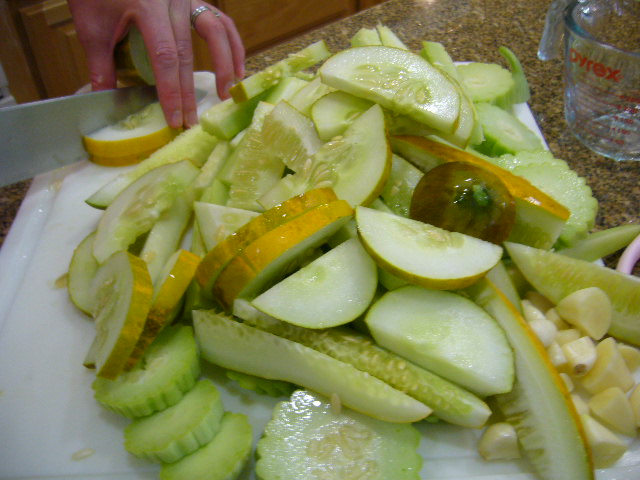
Pickling Cucumbers from the Bird Back 40
In this particular case -- the growing numbers of pickling cucumbers were causing the latest bout of concern. Look! There's one there! There's another! Soon -- glee would turn to dread with the question of, "where did those other five come from?" What in the world were we going to do with all those pickling cucumbers?

Easy! As the photo above demonstrates -- when the garden gives you pickling cucumbers -- you make pickles! You make lots and lots of pickles.

In our case that's about 12-one-quart jars and two refrigerator containers of lip-smackin (and lip-burnin' I might add) refrigerator pickles. Refrigerator pickles and canned pickles use the same types of recipes, with one major difference. Refrigerator pickles are not put through a canning process that can sometimes result in the bummer result of: soft pickles. Since you're not cooking them -- there's no chance for them to get soft. The downside to this equation is refrigerator pickles don't last as long, and can't be stored in a pantry until the urge to consume hits you.

Sliced and Ready for Canning
Thus the name: Refrigerator pickles.

I must admit kids -- I am somewhat surprised. I'm also pleased to no end. See -- this year's garlic harvest was really nothing to write home about. I had intended to write a blog posting about this latest failure because half of the garlic harvest really wasn't a harvest at all. In fact, it was a complete bust. Garlic bulbs that should have been fat and happy with flavor were instead small and soft. In some cases? They disintegrated completely after the wife that is Venus and I pulled them out of the soil.

What remained of the harvest was rather small. There were no fat bulbs of garlic to be harvested this year. The best we got was something that you could purchase from your local grocery store. Where's the fun in that? The whole point of gardening is to produce a product that you CAN'T find in the local produce aisle.

Underwhelming Garlic Harvest? Mebbe Not!
In that respect? We failed. MISERABLY!

This underwhelming garlic harvest has been sitting in and stinking up the garagemahal for about the past month --curing ever so slowly. As it turns out, this weekend's canning project was the first true test of our garlic growing efforts. Each jar would contain at least one clove of garlic and maybe more depending upon the size of said clove. How did our garlic turn out?

My bandaged lips should be the first sign that things weren't nearly as bad as I thought. In fact, the bandaged lips should indicate that this underwhelming harvest produced some of the hottest and tastiest garlic the Bird Back 40 has ever churned out. As I slowly bit into and savored that first test of home-grown garlic my eyes turned wide. They proceeded to turn even wider as that slow-moving burn sensation moved from lips to tongue to cheek. They nearly popped out of skull when the first whisps of smoke started to emerge from my ever-widening mouth.

Fresh Flaming Lips Garlic
Holy Moly! Where did this heat come from? My lips are on fire! Quick! Water! Something! Ice! Defibrillator! 

This is some good garlic! Much better than I ever could have imagined. Perhaps things aren't nearly as bad as I had believed they were.

Will the burn of the garlic transfer and infuse the dill pickles that are now slowly marinating on our front kitchen counter? Quite possibly. It's one reason why this year's refrigerator pickle production didn't also include a jalapeno pepper for each jar. We didn't feel the additional heat was needed. Our intention isn't to send our consumers screaming to the nearest available fire department location. Our intention is to provide them with the best pickle taste ever.

Not Concerned With Pickles Nor Garlic
The best pickle taste is a mix of many things. It's salty. It's sweet. It's hot. It's cool. It's briny. It tastes like butter. In short -- it tastes like no pickle you've ever tasted before.

That's the goal with home-canned pickles. Sure! You can buy those kosher dills in any supermarket. Spears or chips -- you'll find them there.

But they won't taste anything like what we've got here. They probably won't burn your lips clean off either. Which, I suppose, is a good thing. But when burned lips result from a harvest that was better than expected -- well -- it's almost worth the price of Ace brand bandages.

CLAUSSEN STYLE REFRIGERATOR DILL PICKLES

This recipe is measured per jar, with the exception of the brine, depending upon the number of pickles you can pull from the backyard garden patch. We prefer pickling cucumbers, because they are a tad tougher than slicing cucumbers. Armenian cucumbers also work well because those tough skins retain that crunch, even after brining.

Fresh Dill Weed
The basic water to vinegar ratio is three cups water to two cups white vinegar. Some recipes call for using cider vinegar, but that didn't sound appetizing to us, so we're sticking with straight, standard, white vinegar. Feel free to double or triple this brine amount, but stick with the ratio of three cups water for every two cups of white vinegar.

Bring three cups water to a boil and remove from heat completely to cool. After water has cooled -- add two cups vinegar. This is your standard brine mixture.

The ingredients listed below are what we used for each one-quart jar of pickles. You don't have to use one-quart jars. One gallon jars work just as well, or even plastic containers (think Gladware, Rubbermaid, etc.). We put our jars into a water bath canner for ten minutes to sterilize properly, but there are others who just run them through a hot dishwasher.

To each one quart jar, adding the following:

Two to three sprigs of fresh dill (which you remembered to plant this past spring)
One to two cloves of garlic, whole or cut in half
One Bay Leaf
One tablespoon of sea salt or canning salt
One teaspoon each of dried dill, mustard seed and peppercorns


Packed Jars: Ready for Brine
Fill each jar with the required amount of seasonings, pack pickle spears or chips into jars, ladle in brine, seal, shake and set aside. Transfer to refrigerator after canning process is complete. Shake and turn jars upside down or right side up every day for ten days. 

After 10-15 days, the refrigerator pickles should be ready for a pickle feast. Here's hoping you don't burn your lips off.

Battle Sacramento

Thursday, July 19, 2012

Ripening Fantasy Seedless Table Grape
It will never be quite as exciting as "Battle Los Angeles" but my own personal battle against invaders from the sky is now on in the Bird Back 40. It never once occurred to me that planting a row or two of table grapes would be enough to bring an invasion from above -- I suppose you could call it a hard lesson in life.

You see -- I should have planted eight table grape vines for myself and the wife that is Venus, plus another 80 for the invaders pillaging the backyard. It's either that, or call in the United States Marines.

Staff Sgt. Nantz: All Hands on Deck!
The invaders in this case are the always-present, always squawking (loudly), mockingbirds. They have a love for all things table grapes, cherries, peaches and whatever they can dig into it seems. And they have no intention of leaving until harvest season comes to a close.

What does this mean? It means I need to take extra special measures to protect that ripening crop of tasty Fantasy grapes ripening above -- and those Suffolk Red grapes further down to the left. Special measures include a lot of bird netting and one very interested Maine Coon Kitten (Lenny has grown into a rather large and curious kitten).

Table Grape Vines in Spring-Bird Back 40
This marks the third season for table grape production in the Bird Back 40 and all eight original vines are in production. A ninth vine, the Venus table grape, was planted a year later and on the other side of the property. It's had some trouble adapting to this Northern California climate, but is slowly finding its way.

This year's crop -- I'm pleased to report -- is probably three times the size of last year's crop. And we're just getting started here children. I'm told --by those in the know -- that the size of these crops will keep increasing on an exponential level until these vines reach full maturity in five to six years.

Red Suffolk Table Grapes
By that time -- a true army of mockingbirds will have descended.

My experiments with increasing the actual size of these grapes has been both hit and miss -- and are probably related to the fact that each variety flowers and ripens during different times of the year. The Fantasy variety featured up top -- for example -- is now nearly dark and is slowly gaining sugar content. Estimated harvest date? The first or second week of August. The Suffolk Red variety ripens next in mid-to-late August.

Other varieties, like the time-honored Thompson, won't be ready to harvest until mid-September or later. That's provided the mockingbirds are kind enough to leave one or two berries behind.

Flowering Grapevines: A Beautiful Sight
There are several different actions that growers can take to increase the size of table grapes. One method is trunk girdling, which involves the removal of a thin strip of bark around the trunk. According to the University of California Master Gardener Program? This can increase the size of the berries by anywhere from 10% to 30% when done correctly.

But girdling isn't recommended for vines that are less than four or five years old. It also takes a practiced hand. One wrong move? You've got a problem. I'm not that good with knives just yet and may never be quite that handy.

Black Monukka Table Grapes
Fortunately -- there is another way to achieve larger table grape sizes. This is through the use of a natural hormone called Gibberellic Acid or GA-3. Although its difficult to find for the home backyard, most commercial growers use GA-3 extensively. Applying (spraying) GA-3 at just after bloom set and again a week or two after the grapes have formed should result in fatter grapes.

In my case? It's been hit and miss. Both the Red Suffolk and Fantasy grapes have that large and familiar teardrop shape. But the Black Monukka and Thompson grapes are still quite small and may never grow to a large size. This may be due to the fact that I didn't quite hit that "window of opportunity" correctly. In my case? Time will tell.

Monster Table Grape Vines
Why grow table grapes at home? Why not! Like anything pulled from the tree or vine at the peak of ripeness -- there's nothing quite more rewarding than growing your own. Home grown table grapes are a time-honored summer treasure to be savored and celebrated. There are trials and tribulations and battles to fight. But that sweet crunch of one berry after another makes it all worth it and more.

A Red, White and Blue 4th of July

Saturday, July 7, 2012

Sack of Potatoes-Bird Back 40
It's getting to be about that time in the summer gardening year, where the yard is yielding entire meals for breakfast, lunch and dinner. Instead of heading for the pantry or refrigerator for our evening meal? Venus and I find ourselves in the Bird Back 40 first -- because one never knows what the garden is going to yield from one day to another.

Who needs a normal Saturday morning breakfast of turkey bacon and eggs, when you can treat yourself instead to five or six tree-ripened June Pride peaches instead? June Pride peach season is going to be short and sweet this year due to a couple of factors. One, the crop isn't all that big. Secondly, I'm choosing not to net the tree because of an explosion of branch growth that I'd rather not see bent to the ground. What happens when you fail to net a treasure like the June Pride peach? Can you say "Bird Buffet?" And I'm not talking about Bill or Venus Bird either -- but rather -- our fine feathered friends.

But that's the price we'll pay -- at least for this year. I'm willing to sacrifice the harvest in hopes of a much larger crop next year thanks to the exponential growth on both Bird Back 40 peach trees.

Yukon Gold Potatoes
But peaches aren't the only thing popping this July in the Bird Back 40. The multitude of crops that the wife that is Venus and I planted with care during the early spring months of March and April are now coming of age. In other words, the grand summer harvest is now underway. As you can probably guess by now, some of this harvest involves some of the best potatoes you will ever dig out of a backyard plot.

I have swooned before about potato harvests like this in past blog postings, and while there's not much more to say, there certainly is a lot to eat. Potatoes like these, which you'll now find in some stores (at a premium price I might add), bring special meals. Who wants a normal potato salad on the 4th of July when you can dress it up instead with nature's colors of red, white and blue?

All Blue Potato Monsters
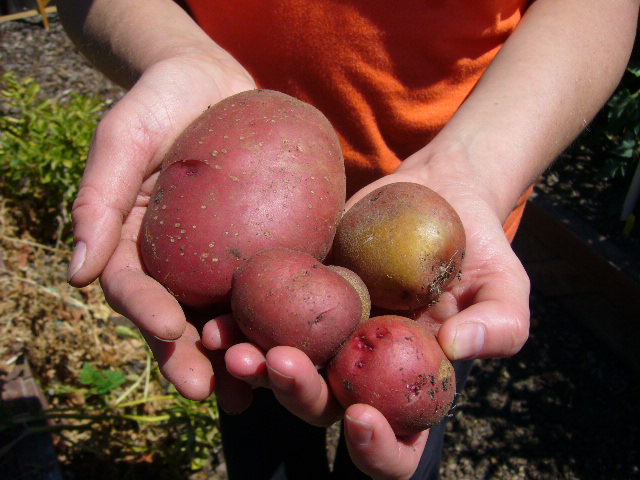
This year's harvest once again involved a variety called "All Blue," featuring potatoes that are a dark purple-blue on the outside and just as purple and blue on the inside. Like many of these special hybrids, the color never fades, not even after steaming, frying or baking. We've also come to discover that you're not going to pull a lot of fat, baked-potato-size All Blues from the garden plot, unless you benefit from some heavy and sustained rainfall during the late spring months.

We didn't get that jolt of late spring rainfall this year. Instead, Mother Nature greeted us with a blast of furnace heat.

But not to worry! Because the garden plot contains more than just All Blue potatoes! There are Colorado Rose potatoes in this 4X8 raised beds. Does a fat Yukon Gold strike your fancy? Yellow banana fingerling potatoes? Bite size spuds? Whoppers the size of your outstretched hand? You'll find that and more in this bed in yet another successful year for spud production.

Colorado Rose and Yukon Gold Potatoes
Venus and I have already put the harvest to work in a number of dishes. There's more than just that Red, White and Blue potato salad to sample. How about some home-crafted vegetable beef soup that features not just potatoes, but carrots, squash, onions, green onions, tomatoes and mounds of fresh herbs procured from the backyard garden?

If that doesn't make the proverbial mouth water, then this recipe for traditional Nicaraguan Pollo Tapado most certainly will. Venus and sampled this dish a decade ago when we traveled to the home of the Sandinista Revolution, Esteli, Nicaragua, for the marriage of Venus' brother. While we have tried to duplicate this dish through the years, we have always fallen just short. But the recipe link above, which we stumbled upon just a day or two ago, nearly nails what we had at that Esteli dinner table all those years ago.

You'll notice that this recipe calls for both potatoes and rice. Nicaragua is the only nation that I know of that can get away with two starch products in one meal creation. They break the rules and make it work.

Raised Bed Potato Farming
My thanks once again for the fine potato seed providers at Peaceful Valley Farm Supply located in picturesque Nevada City. They have never once let me down, but it's best to order early, as demand almost always outpaces supply. That's why I must admit that additional seed potatoes were supplied by the Big Box store known as Lowes.

It's time for lunch, kids. Forget the fast food and the pantry. Let's see what tasty garden treat that backyard garden has to offer, shall we?

Eureka! It's a (Lemon) Boy!

Saturday, June 30, 2012

Vine Ripening Stupice Tomatoes
It's getting to be that time of year where things really start to pop in the Bird Summer Vegetable Garden. That long awaited garden harvest is starting. And that most treasured of summer crops, heirloom tomatoes, are slowly beginning to ripen up.

Venus and I actually started snacking on a few of them a couple of weeks back. The Czech variety known as Stupice (pronounced "Stoo-Pee-Chay" or "Stu-Pick," take your pick) is once again producing tomatoes at a prolific rate. I profiled this variety last year (Stupice is as Stupice Does) and not much has changed really. It is, once again, growing at a rather prolific rate and setting golf-ball sized tomatoes in bunches of three to seven in a raised bed that holds seven other plants.

Where Did That Lemon Boy Come From?
I sometimes wonder how I ever did without this wonderful variety. If you're looking for a tomato plant that you can't possibly screw up, or is guaranteed to produce, Stupice is your girl.

It is getting to be the time of year, however, when the garden begins to reveal little surprises here and there that you were not expecting. One of those surprises came just last night. As we were strolling through the garden in the fading daylight, I made the observation that it was going to be rather difficult to spot ripened tomatoes in one particular bed because it was flush with green growth.

Fat Shady Lady Production
As I got on one knee to inspect this bed, there was that rather familiar jolt of yellow joy. Through the darkened green leaves of numerous plants, there sat two baseball sized, yellow, vine-ripened Lemon Boy tomatoes. That's like hitting the lottery for gardeners, my friends. There's nothing more scrumptious than a vine-ripened Lemon Boy tomato. That yellow color holds the promise of a sweet, sour and tangy surprise for supper that you were not expecting.

Combined with a handful of bright red Stupice tomatoes and raw green zucchini? You've got a meal fit for King and Queen my friends. The wife that is Venus and I like to mix it all up with some red wine vinegar, a drop or two of olive oil, cracked salt and pepper, plus fresh oregano. I don't know why I've made the mistake of cooking zucchini all these years. It's much better raw off the bush, sort of like the way that one would enjoy a sliced cucumber.

The Indigo Rose Tomato
I would have taken a picture of this production, but it didn't last. It was, as they say, "Gone in Sixty Seconds."

I do enjoy inspection time in the garden. It's that time of year now where this annual walk yields daily surprises. A lot can change over the course of 24-hours. There are new tomatoes here. That plant over there looks like it grew a foot overnight. Is that Indigo Rose ripe yet? Is it ever going to ripen? Where did all those Brandywine tomatoes come from?

The Indigo Rose is one of the newer and more exciting introductions to the Bird Back 40 this year. It's anything but an heirloom. I like to call it the world's first "designer tomato." Developed a few years ago at Oregon State University, the Indigo Rose is the first, perfect, Deep Purple tomato. It looks nothing like a tomato should, yet it is a tomato. While not uniformly purple, this variety will ripen when the bottom of the fruit turns red and the shoulders turn from a shiny to dull color.

World's First "Designer Tomato?"
Much like the Stupice, the Indigo Rose sets anywhere from three to seven tomatoes per bunch and is growing at a rather eye-popping rate. Much like an heirloom, the Indigo Rose is open-pollinated. This means it won't develop one crop and quit. It will continue to grow and set tomatoes through the summer months, and deliver a whopper of a harvest.

Now who is going to complain about that? Buehler?

I must admit not everything has been "peachy keen" in the garden this year. The whitefly infestation was especially heavy this year, which may be due to the fact that the commercial growers nearby converted those vast, open fields nearby into rice production once again. It's the first time in five years that these fields have been put into rice production, and while the vast open stretches of water are a pleasure to look at, it could be the reason why there are so many whiteflies, it looks like a bank of fog has descended.

Bird Tomato Garden in June
Whiteflies are problematic. Whiteflies carry disease. They love to settle into fruit trees and tomato bushes. Early blight has been a problem with some plants this year, especially those heirloom varieties that don't have much resistance to it. While the infestation may be mostly gone now, the damage they cause can last for months after. When they are this thick and prolific, there is simply no getting rid of them.

But -- when it comes right down to brass taxes -- there is no such thing as the "perfect year" when it comes to gardening. There's always going to be a nagging problem here or there -- some rock thrown from an overpass that you weren't expecting to rain down and cause havoc on your windshield.

As Frank Sinatra once crooned: "That's life, that's what people say. You're riding high in April, Shot down in May. But I know I'm gonna change their tune, When I'm right back on top in June."


And Frankie was known to love his tomatoes...