Showing posts with label Stupice. Show all posts

Eureka! It's a (Lemon) Boy!

Saturday, June 30, 2012

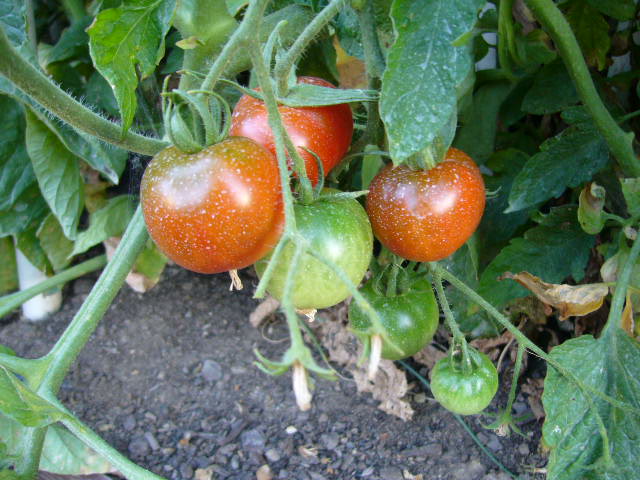
Vine Ripening Stupice Tomatoes
It's getting to be that time of year where things really start to pop in the Bird Summer Vegetable Garden. That long awaited garden harvest is starting. And that most treasured of summer crops, heirloom tomatoes, are slowly beginning to ripen up.

Venus and I actually started snacking on a few of them a couple of weeks back. The Czech variety known as Stupice (pronounced "Stoo-Pee-Chay" or "Stu-Pick," take your pick) is once again producing tomatoes at a prolific rate. I profiled this variety last year (Stupice is as Stupice Does) and not much has changed really. It is, once again, growing at a rather prolific rate and setting golf-ball sized tomatoes in bunches of three to seven in a raised bed that holds seven other plants.

Where Did That Lemon Boy Come From?
I sometimes wonder how I ever did without this wonderful variety. If you're looking for a tomato plant that you can't possibly screw up, or is guaranteed to produce, Stupice is your girl.

It is getting to be the time of year, however, when the garden begins to reveal little surprises here and there that you were not expecting. One of those surprises came just last night. As we were strolling through the garden in the fading daylight, I made the observation that it was going to be rather difficult to spot ripened tomatoes in one particular bed because it was flush with green growth.

Fat Shady Lady Production
As I got on one knee to inspect this bed, there was that rather familiar jolt of yellow joy. Through the darkened green leaves of numerous plants, there sat two baseball sized, yellow, vine-ripened Lemon Boy tomatoes. That's like hitting the lottery for gardeners, my friends. There's nothing more scrumptious than a vine-ripened Lemon Boy tomato. That yellow color holds the promise of a sweet, sour and tangy surprise for supper that you were not expecting.

Combined with a handful of bright red Stupice tomatoes and raw green zucchini? You've got a meal fit for King and Queen my friends. The wife that is Venus and I like to mix it all up with some red wine vinegar, a drop or two of olive oil, cracked salt and pepper, plus fresh oregano. I don't know why I've made the mistake of cooking zucchini all these years. It's much better raw off the bush, sort of like the way that one would enjoy a sliced cucumber.

The Indigo Rose Tomato
I would have taken a picture of this production, but it didn't last. It was, as they say, "Gone in Sixty Seconds."

I do enjoy inspection time in the garden. It's that time of year now where this annual walk yields daily surprises. A lot can change over the course of 24-hours. There are new tomatoes here. That plant over there looks like it grew a foot overnight. Is that Indigo Rose ripe yet? Is it ever going to ripen? Where did all those Brandywine tomatoes come from?

The Indigo Rose is one of the newer and more exciting introductions to the Bird Back 40 this year. It's anything but an heirloom. I like to call it the world's first "designer tomato." Developed a few years ago at Oregon State University, the Indigo Rose is the first, perfect, Deep Purple tomato. It looks nothing like a tomato should, yet it is a tomato. While not uniformly purple, this variety will ripen when the bottom of the fruit turns red and the shoulders turn from a shiny to dull color.

World's First "Designer Tomato?"
Much like the Stupice, the Indigo Rose sets anywhere from three to seven tomatoes per bunch and is growing at a rather eye-popping rate. Much like an heirloom, the Indigo Rose is open-pollinated. This means it won't develop one crop and quit. It will continue to grow and set tomatoes through the summer months, and deliver a whopper of a harvest.

Now who is going to complain about that? Buehler?

I must admit not everything has been "peachy keen" in the garden this year. The whitefly infestation was especially heavy this year, which may be due to the fact that the commercial growers nearby converted those vast, open fields nearby into rice production once again. It's the first time in five years that these fields have been put into rice production, and while the vast open stretches of water are a pleasure to look at, it could be the reason why there are so many whiteflies, it looks like a bank of fog has descended.

Bird Tomato Garden in June
Whiteflies are problematic. Whiteflies carry disease. They love to settle into fruit trees and tomato bushes. Early blight has been a problem with some plants this year, especially those heirloom varieties that don't have much resistance to it. While the infestation may be mostly gone now, the damage they cause can last for months after. When they are this thick and prolific, there is simply no getting rid of them.

But -- when it comes right down to brass taxes -- there is no such thing as the "perfect year" when it comes to gardening. There's always going to be a nagging problem here or there -- some rock thrown from an overpass that you weren't expecting to rain down and cause havoc on your windshield.

As Frank Sinatra once crooned: "That's life, that's what people say. You're riding high in April, Shot down in May. But I know I'm gonna change their tune, When I'm right back on top in June."


And Frankie was known to love his tomatoes...

And So It Begins...

Saturday, May 19, 2012

Bird 2012 Heirloom Tomato Crop (Partial)
Ready or not kids -- the 2012 summer gardening season is now swinging into full gear. Got those tomatoes planted yet? Check! What about those cucumber vines? Check! Watermelon and pumpkin seed planted? Check! Green onions? Carrots? Squash? Beets? All in? Good!

Now you can take a trip to the Bird Back 40 and give Bill and the wife that is Venus a hand! I'd like to tell you that the garden planting is all done but truthfully, with a garden this large and this diverse, there is always another seed to plant and another chore to accomplish. Short and sweet? It never seems to end.

I get the most joy out of watching the wife plant the heirloom tomato seedlings that we nurtured through the winter months. I'm still a poor study at that "hardening off" process, with leaves me with starter plants that look like they went through a northern squall before they reached the Backyard of Bird.

First Stage PVC Cage Construction
Rather than those green, leafy, picture-perfect starter plants that you see by the thousands at your local big box stores and area nurseries -- my plants are more like poor cousins. They are the "poster children" so to speak of a grower who turned on full bore sunlight before the plants were ready for the "Full Monty."

No matter I suppose. They look pretty darn good after the wife gets done with planting them. Add in some tender care, a fertilizer supplement or three, lots of prayer and just good fortune and the little darlings look pretty darn good. I was forced to install the first 16 PVC cages before the month of June -- which is a pretty good start by our book.

The First Stupice of 2012
Not only are they growing large, green and lush, nothing brings a smile to an heirloom tomato growers eye more than the site of actual TOMATOES forming on those great looking plants. Tomatoes we have Ladies and Gentlemen. You can always count on the Czech import "Stupice" (Stoo-Peach-Kah) to produce an early bushel. I discovered this after growing this variety for the first time last year. It's back for a second run in 2012.

Venus and I have set about 28 plants into the ground so far and we are slowly clearing out spring garden space for more. Because in the world of heirloom tomatoes, the mathematical equation of "X number of heirloom tomatoes" yields the answer of "Never Enough."

Tomatoes Love Radishes
I wish I could tell you the exact names of every variety I've planted, but that would force me to run outside with a flashlight to read little sticks where the wife has scribbled something closely related to chicken scratch. I would be forced to return with the report that we're growing the varieties of "Blargh" and "Snizzle," which wouldn't be exactly correct.

It's safe to say that we're growing a lot this year -- which includes a lot of new varieties like the Indigo Rose. This isn't exactly heirloom territory. The Indigo Rose is a rather new entry into the world of tomato culture. Recently developed at Oregon State University, Indigo Rose is the first, true "designer tomato" in garden culture if you will. It turns dark purple when ripe and is supposed to contain high levels of antioxidants.

Indigo Rose Tomato
I guess that's supposed to be good for you, right? I'm all for healthy eating. Especially because I don't do nearly enough of it. I do know one thing, however. It probably won't improve the wife's writing. Which means I'm looking forward to my first bite of "Blargh."

All fun and pranks aside, May marks the start of my favorite gardening season. Gardeners dream of a bushel of tomatoes and peppers every summer -- and that elusive goal of making your own fruit salad with everything harvested fresh from the backyard.

A thick slice of freshly harvested beefsteak tomato on my backyard barbequed hamburger? Sounds like healthy eating to me...

A Bite of a Vine-Ripened Tomato...

Saturday, November 26, 2011

Remains of the Bird 2011 Heirloom Tomato Garden
It's a slice of heaven. It sure is. That taste. That texture. That wonderful, tangy surprise of a summer fruit is all but a distant memory now. This is the current state of the Bird tomato garden in late November. Fairly sad isn't it? They are still producing here and there, which is one reason why I haven't torn them out yet and moved on.

It's hard for me to admit that the season is over. What is coming off the vine now cannot compare, in any shape or form, to the tasty treats that the wife that is Venus and I enjoyed earlier this summer. But it's also loads better than the tomato shaped rocks you'll find in your local produce department these days.

At some point -- the 2011 summer garden will be removed and I will be forced to admit that it's all done.

I'm just not quite there yet. If you live for backyard gardening like I do, winter is a lonely time indeed. But, before this garden is indeed removed and plowed under, it's high time we look back to the summer favorites from 2011. There are some new entries on this list. As with any summer tomato garden, some varieties did well and others -- well -- better luck next year!

OUTSTANDING:

Eva Purple Ball Tomatoes
1. Eva Purple Ball: This was a new entry to the Bird Back 40 home for wayward heirloom tomatoes. I'd heard about this variety from other growers across the country, but again, what does well in New England or Arkansas doesn't necessarily translate into guaranteed success on the Left Coast. Growing heirloom tomatoes is a crap shoot anyway. Some do well, some not. Put this one in the "Did Very Well" category. A single bush yielded 50-80 gorgeous slightly pinkish, slightly purplish large tomatoes, some very close to the 1 lb. range. You'll find this tomato in our salsa, tomato sauce and whole tomato canning efforts from this summer.
2. Marianna's Peace: After a rather poor showing last season, MP bounced back in a rather eye-popping fashion this year. Our plant was susceptible to some early Blossom End Rot (BER) problems during the spring, but those vanished as the weather warmed. MP is one of the best tasting heirlooms I've ever tasted, and it wasn't unusual for this vigorous plant to set four new tomatoes at once. That's always a good sign.
3. Black Krim: One of the tastiest offerings in the field of black (or purple) tomatoes. When a single Black Krim bush delivers a bushel of 40-50 tomatoes? It's a good year.
Stupice Tomato
4. Stupice: If you can describe Stupice with one word? It would have to be WOW! Outstanding production from a variety that wins in backyard gardens from East to West and all points in between. Stupice sets tomatoes in large clusters, much like small cherry-sized tomatoes. They grow to about the size of a golf ball or larger. Not the best processing tomato due to size, but perfect for salads, snacking in the yard, or fresh salsa creations (fresh Rooster's Beak?). If you have room for just a few plants in your yard, I highly reccommend this productive variety.
5. Campbell's 1327: I don't know if I'll ever be able to thank the person who saved this variety from the brink of extinction, but they deserve some sort of recognition. Once the standard-bearer of processing tomatoes used in Campbell's Soups, it was tossed aside and abandoned for those hard-as-a-rock processing tomatoes that can withstand bruising on bumpy trips down long country roads from farm to processing plant. Campbell's 1327 is one of my "Reliable Reds," and produces bushel after bushel of round, red and ripe tomatoes that are blemish free and tart on the tastebuds.

GOOD:

1884 Tomato
1. 1884: Seeds for this variety were provided at the last moment by Sacramento gardener Nels Christensen. I can see why he's partial to it. 1884 delivers large, meaty red tomatoes that reveal a surprising orange-colored flesh once they've been sliced open in the kitchen. A wonderful processing tomato and perfect slicing tomato for those big barbequed turkey burgers that deserve a big slice of tomato on top. Originally discovered in 1884 by a Mr. Williamson in the debris after the big flood in Friendly, West Virginia, this variety will find home in the Bird Back 40 again.
2. Green Zebra: It's been a few years since I've been happy to report a large haul of green zebra tomatoes, and this was just one of those years. My former boss at the workplace, who is rather partial to this variety, received his fair share of the crop. It wasn't unusual to pick anywhere from 10-15 tomatoes during weekly harvests, which makes for a pretty darn good year.
Thessaloniki Tomato
3. Thessaloniki: It doesn't roll off the tongue easily, but this was one productive plant in the Bird Back 40. Thessaloniki is a rare Greek heirloom, introduced to the USA in the 1950's by Glecklers Seedsmen, Ohio. Nice production, nice size, outstanding old world tomato taste. The only reason this particular variety didn't make it to the outstanding list is that it is just a common red tomato.
4. Celebrity: It's the only non-heirloom that found it's way into the Bird tomato crop this year, and for good reason. You can depend upon a bushel of round, red, ripe and mostly disease free tomatoes from Celebrity. While other varieties susceptible to disease battled Blossom End Rot, Celebrity stepped up to the plate in a big way with some nice production.
5: Evil Seed: A big, beautiful black beefsteak type tomato that I will never the true origin of. The original plant was delivered to my desk several years ago with the name "Rainbow" attached to the side. The funny thing is, there is no Rainbow tomato that I know of -- especially a black tomato variety. The gentleman who produced this offering wound up doing some none too kind things to his wife and children, thus the wife stuck it with this unfortunate name. It's an unfortunate story for a great tasting tomato.

JUST PLAIN BAD:

No Brandywines in This Bunch!
1. Brandywine: It kills me to put this variety on my list because I absolutely LOVE Brandywine tomatoes. Although I was encouraged by some early season production, most developed BER and the plant just petered out on me by the time July rolled around. When the backyard garden produces one or two Brandywine tomatoes? It's generally not a good year. I hope for better luck next year.
2. Yellow Brandywine: Jeez -- what a Debbie Downer I am. Two varieties of Brandywine in the Bird Back 40 and I get squat. Yellow Brandywine was an absolute bust. Several seed sources do note that this variety can be "finicky to grow," and I can confirm as much. I will not attempt to grow this variety out again.
3. Mortgage Lifter: I either can't find a reliable seed supplier for this variety, or I'm just having the worst of luck. This marks my third year for growing this treasured heirloom, and while I do receive a few of them, it's not enough to warrant that much space in the Bird tomato garden.
4. Azoychka: This is one of my favorite Russian heirlooms, and after some rather encouraging early season production, Azoychka started to produce golf-ball sized tomatoes that were really nothing to write home about.
Processed Tomatoes Ready for Winter Storage
5. Bloody Butcher: I'm surprised this one landed on this list because Bloody Butcher is normally a wonderful, early-season producer. Not this year. It didn't produce early. It didn't produce late. It didn't produce much at all, and BER took most of them.

And there you have it. Although these 15 varieties represent half of what we grew in the Bird Back 40 this year -- these are the varieties that stood out the most in terms of production or disappointment. Other varieties that at least deserve an honorable mention include Caspian Pink, which grew well in the in-ground test bed and produced some very tasty tomatoes late in the season. Cherokee Purple is yet another treasured variety that did moderately well, as did Kelloggs Breakfast, Beefsteak, Druzba, Lemon Boy and Jubilee.

As 2011 begins that slow slide into 2012 -- all that's left are the memories of last year and the promise of what is to come.

A Tomato for Every Occasion

Wednesday, August 10, 2011

Andrew Scrivani for The New York Times
It's that time of year when the answer to every question is: Tomatoes. Understand? If I ask the lovely wife that is Venus, "what's for dinner?" The answer is: TOMATOES.

What's for lunch? TOMATOES. Breakfast? TOMATOES. What's your favorite drink? TOMATO COLLINS!

With a splash of gin, of course.

The point is -- with an overload of tomato production -- you start looking for recipes that call for fresh heirloom tomatoes and lots of them.

Fortunately -- I found such a recipe. It's pictured above. Yeah, it's fancy alright. But thanks to my San Joaquin Valley tastes -- I lowered it down to proper "valley standards." The official title of this dish, featured in the uppity-duppity New York Times no less, is (and I quote): Penne With Heirloom Tomatoes, Basil, Green Beans and Feta.

Leftover Tri-Tip from Sunday Night Dinner
I'll be honest. I fiddled around with this recipe a bit -- and came up with a new name of: Penne With Heirloom Tomatoes, Basil, Green Beans, Feta AND LEFTOVER TRI-TIP.

Heh...

The official tomato for this dish? None other than Stupice, which is churning out golf-ball sized tomatoes faster than we can consume or give them away. This is the perfect tomato for a dish such as this, because the Stupice has a zip that goes well with slivered basil and Feta cheese.

Plus, uh, we have a lot of Stupice on the vine. Stupice anyone?

Fresh off the vine Pole Beans
There's another reason why I picked this dish out of the 24-odd recipes featured in the New York Times. It also called for a healthy offering of fresh green beans. What a coincidence, as we have pole beans and bush beans coming out of our EARS at the moment. This is the perfect dish at the perfect time.

Plus -- uh -- we had the leftover tri-tip from Sunday night's dinner.

Hey man -- you go with what you got. To be honest? We could have added squash, eggplant, green onions, carrots and a multitude of other vegetables that are producing like madness in the Bird Back 40 at the moment (pumpkin anyone?).

But we left that for another evening and another dish that I like to call "Hodge Podge Garden Soup." Hodge Podge Garden Soup, by the way, can easily be turned into "Hodge Podge Garden Casserole" and "Hodge Podge Garden Omlet." Those meals are yet to come.

Stupice Tomatoes with Basil and Seasonings
The recipe, which calls for "salt and pepper to taste" was also modified somewhat to include freshly ground black pepper -- because nothing says "fancy" like freshly ground black pepper. Plus, let's be honest here, OK? Freshly ground black pepper is REALLY good -- especially when you combine it with vine-ripened heirloom tomatoes warmed by our famous Sacramento Valley sunshine.

The dish is fairly easy to make -- and Venus and I made this a team effort. While she chopped up the pole beans and basil, I took care of slicing and dicing the Stupice tomatoes and grinding up the black pepper. It seemed somewhat criminal to add a boxed pasta like Penne, but we haven't started growing the fresh ingredients used for fresh pasta yet.

Yet, I say. The Bird Back 40 is an experiment in all things gardening. Who knows what we might be growing in another five to ten years.

Stupice Tomatoes for SNACKING!
The finished dish, which is detailed below, was indeed a slice of heaven. Anything combined with fresh heirloom tomatoes and basil from the backyard garden is usually a slice of heaven. But this dish in particular was pretty darn good -- and also made for a nice lunch at work the very next day.

We don't let good heirloom tomatoes go to waste in the Bird House.

Do you have a favorite dinner/lunch/breakfast recipe that features heirloom tomatoes and other good stuff from the backyard summer garden? If so -- please feel free to leave it behind -- because we're always taking suggestions.

And now -- without further delay -- the recipe for Penne With Heirloom Tomatoes, Basil, Green Beans and Feta (with whatever barbequed delicacy you may have leftover from the night before. Don't be picky. This meal works with anything).

This recipe first appeared in the August 5th, 2009 edition of the New York Times and may be accessed here.


Penne With Heirloom Tomatoes, Basil, Green Beans and Feta

By MARTHA ROSE SHULMAN

Sweet, juicy heirloom tomatoes lend themselves well to uncooked tomato sauces. In summer, I make quick meals out of chopped ripe tomatoes, pasta and green vegetables.

6 to 8 ounces fresh green beans, trimmed, strings removed if necessary, and broken in half if very long
2 cups chopped fresh ripe tomatoes
2 tablespoons extra virgin olive oil
1 plump garlic clove, minced (more to taste-we used more)
Salt and freshly ground pepper to taste (I like to use a very good coarse sea salt or fleur de sel for this)
1 teaspoon balsamic vinegar (optional)
2 tablespoons slivered basil (we used more)
2 ounces crumbled feta (about 1/2 cup)
3/4 pound pasta (penne or fusilli are good choices)

1. Combine the olive oil, tomatoes, garlic, basil, salt and pepper in a large bowl, and let sit for 15 to 30 minutes (or longer).

2. Bring a large pot of generously salted water to a boil. Fill a bowl with ice water. Add the green beans to the boiling water, and boil four to five minutes, depending on how crunchy you like them. Remove with a strainer or skimmer, and transfer to the ice water. Allow to cool for a few minutes, then drain and set aside.

3. Bring the water back to a boil, and add the pasta. Cook until al dente, about eight minutes. When the pasta is ready, drop the green beans back into the water to heat, then drain the pasta and beans and toss at once with the tomato mixture and the feta. Serve hot or room temperature.

Yield: Serves four.

Stupice is as Stupice Does

Wednesday, July 13, 2011

Bird Tomato Garden-One of Three Beds
Greetings from the Frankensteinish North Natomas tomato farm that is the Bird Back 40 -- a place we lovingly refer to as "Disneyland for Drunks." Things are right fine in the hood as you can attest from the photo to your immediate right. Our heirloom plantings are now approaching a height of six feet and are green -- lush -- healthy and productive.

A quick check of the garden reveals the following tomato count: Campbell's 1327? LOADED. Eva Purple Ball? LOADED. Black Krim? LOADED! The notoriously cranky and sometimes unproductive Marianna's Peace? LOADED FOR BEAR!

Celebrity and Eva Purple Ball Production
Getting old yet? You know things are going well when you spot a bit of color behind a green tomato leaf -- and pulling that leaf aside reveals the wonder that is a ripening Azoychka. You know things are going REALLY WELL when you pull aside said leaf and are struck with the sight of five ripe Azoychka tomatoes.

Where in Hades did they come from and how come I didn't notice this before? Did someone put those there?

Safe to say -- the wife that is Venus and I are somewhat blessed with tomato production this year. We're off to a rather outstanding start. I've never experienced a year in the garden where there wasn't at least one loser among the bunch. Usually? There's more than one.

But not this year. Not yet anyway.

Ripening Stupice Tomatoes
The big heirloom tomato winner so far this year? No doubt in my mind. It's the heirloom offering known as Stupice. And despite my rather "stupice" play on words in the title of this blog posting -- Stupice isn't pronounced "Stoo-Piss."

This variety, one of four sent to the United States from Czechoslovakia by Milan Sodomka (source: Seed Savers), is actually pronounced "Stoo-Pee-Chay" from what I've been told. Still others have related the pronunciation of "Stu-Pick."

Pick your poison -- because this variety is anything but (poison).

Stupice is one of those rare potato-leaf tomato plants that does not produce beefsteak tomatoes. In my short experience with growing heirlooms? If you're growing out a potato leaf -- it usually means you're growing out any version of Brandywine (there are several), Marianna's Peace or numerous others that feature large and crazy looking tomatoes.

Stupice here, Stupice there, Stupice everywhere!
But not Stupice. This one is different. And that makes it special.

The first clue that I'd decided to grow something special is when every seed I planted not only germinated -- but was the first to germinate. It was the fastest growing tomato starter in the Bird bedroom-converted-tomato-nursery. It's one of several varieties that received a "haircut" before plant out. Every cutting from that plant would yield new plants that I eagerly gave away to family and friends at work.

Since I had not grown this variety before -- I did not know what to expect. I had heard from many tomato growers on the Yahoo Forum TomatoMania that Stupice was an absolute winner in many a backyard garden. But what does well back east in New England or somewhere in the Midwest doesn't necessarily transfer into great success on the Left Coast.

Crazy Stupice Production
However -- the Stupice is one of those plants that ignores all rules. It appears to do well in just about every region it's been planted -- and I can personally attest that list includes Zone 9A -- the Sacramento Territory. Although the raised bed that holds the Stupice also holds seven other tomato plants -- the Stupice has grown up and through nearly the entire bed. I'm discovering new branches that are anywhere from four to six feet away from the main stem -- held aloft by other plants in the bed (which are also doing well I might add).

My first indication that this plant was going to be a winner in the garden is when it unfurled a blossom set normally reserved for cherry tomatoes like SunGold or Sweet 100. When each blossom set resulted in a setting of four to seven young tomatoes? I knew I had something special. Stupice continues to proliferate throughout its garden setting -- putting out blossoms in every square corner of the 4X8 foot raised bed. It was also the first to ripen in abundance, beating early producers like Bloody Butcher and Early Girl.

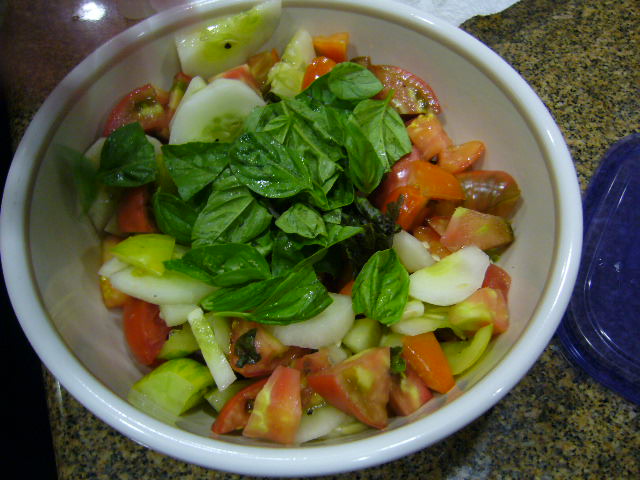
Stupice tomatoes with cucumber and basil anyone?
There will come a time -- not all that far away I might add -- when a singular harvest of Stupice will result in a bowl of 30-40 ripe tomatoes -- with hundreds more yet to ripen. Consider Stupice to be your classic garden tomato -- in that it will produce enough tomatoes to fill every salad bowl with a bounty of production or will serve as your "snacking" tomato while you harvest others from the yard during the peak season of production.

As far as the taste is concerned -- rank Stupice with some of the best tasting heirloom tomatoes. It still can't hold a candle to the taste explosion and surprise that is a vine-ripened Cherokee Purple, Brandywine or Kelloggs' Breakfast -- but a bowl full of Stupice is a bowl full of summer heaven just the same. The one and only knock against Stupice? It's not a good processing tomato. It's about the size of a golf ball or a bit larger. That makes it a tad larger than a large cherry tomato, but it's still not large enough to be canned as a whole tomato.

But that shouldn't stop you from making a gallon or ten of fresh Stupice tomato sauce!

Monsters in the Backyard

Sunday, May 29, 2011

PVC Support Cages-Bird Back 40
Eye popping. Astounding. Scary.

No -- I am not referring to the size of my stomach. Though that does need some work -- and is monsterish in a monster sort of way -- the monsters I am referring to are pictured to the right. This scary mass of growth is the Bird 2011 heirloom tomato garden barely five weeks after plant out.

Yes -- those are the famous Thomas Matkey PVC cages that have now been installed. This is just the first tier. The second tier will come in another few weeks. Setting this up -- this year at least -- was no easy task. The cages in front of you took the better part of two days to install.

And they are not installed as well as I would like.

Assembled Matkey PVC Cage Tier
In a "normal" tomato year (what year is really normal?) -- I lay the first tier construction over the plant -- mark off the holes with stakes -- remove the tier and pound PVC supports into the ground where the stakes have been placed. This usually makes for a fairly good fit -- although it never is quite "perfect." But -- PVC is forgiving. It bends. So -- if a post isn't exactly straight? You can bend it somewhat to where the first tier assembly will snap right on with no problems whatsoever.

But -- again -- this is a "normal" tomato year. This year has not been "normal" by any stretch of the imagination. Rain and hail have wiped out a couple of weekends that would normally be reserved for gardening purposes. Family issues -- such as cleaning out the house of my dear, departed father-in-law -- have claimed another couple of gardening days.

Lush 2011 Heirloom Tomato Garden
And so -- when I finally did find the time to start assembling the PVC supports -- I discovered (much to my chagrin) that every single plant had grown far to large and far to lush for me to place a tier assembly over the top of said plant. Any attempt to fit that square peg into a round hole resulted in (HORRORS!) broken branches -- bruised stems -- torn leaves -- blossoms knocked to the ground and early season production pounded into the ground.

Instead -- I was forced to adopt a tactic that I employed some two years ago when I again waited far too long to put the PVC cages on.

This little installation trick involves putting the entire cage together first -- attaching four 30-inch vertical supports to the assembled first tier (pictured above) -- and then hammering it into the ground from above. This is difficult as you need to drive all four PVC supports in at the same time -- all at the same level. One wrong "THWACK" with the rubber hammer can (and did) cause the assembled tier to suddenly break apart.

Pound! But Don't Break!
Extra care and attention must also be given to the entry points for each 30-inch PVC vertical. The tomato plants had grown so large and lush that many had grown right into one another. We don't want to be pounding stakes through branches, now do we? We also don't want to drive stakes through the drip irrigation sprinklers that are now buried under massive, lush tomato leaves and branches.

Dear neighbors: If you were wondering why I was using a flashlight to peer into tomato plants during the light of day -- now you know the reason why. It wasn't a sudden fit of insanity -- though that probably isn't far off.

Early Season Production: Green Zebra
And now? A bit of good news! All 24 PVC cages are now assembled and hammered into place. Despite the crummy May weather -- the rain and hail hasn't stunted growth nor has it led to the onset of disease (which is always possible when you're cramming tomato plants into a small space). Most plants are now three feet tall, with the exception of the Marianna's Peace, which is closer to four.

Installing PVC cages from above also means a close inspection of each plant, which revealed quite a bit of early season production. Nearly every plant has set at least two or three early season tomatoes. The early producers like Bloody Butcher, Tigerella, Stupice and Early Girl have set decidedly more.

The monsters are growing. Beware.

And now -- to answer a few questions:

How much to these PVC Cages Cost? Each cage costs $7 to $10. The most expensive pieces -- the PVC Cross -- sell for $1 each. Each cage requires four crosses. The top tier is constructed with PVC T's -- which are decidedly cheaper.

How strong are PVC Cages? I've never lost a single one. They hold up to strong winds, heavy crops, marauding cats, whatever Mother Nature can throw at them.

Are the PVC pieces glued together? No -- otherwise I'd never get them apart. They hold together quite well without glue.

How many years have you used this design? This is the fourth year of use for these cages. Not one piece has ever broken or so much as cracked.

What is the biggest drawback? If there is a drawback -- it's the time involved. Each piece must be cut to size. Putting each cage together also takes time.

How do you build these cages? Step-by-step instructions, with photos, can be found here.