The Crenshaw Surprise

Sunday, September 16, 2012

Vine Ripened Crenshaw Melon
On the first weekend of the 2012 NFL Season, the garden in the Bird Back 40 delivered a sweet treat in the form of a Crenshaw melon. Here on the second weekend on the 2012 NFL Season, the garden is about to deliver five more.

Fresh off watching the San Francisco Giants pull even closer to a National League West title and my suddenly reborn Fresno State Bulldog football team deliver and eye-popping rout of the Colorado Buffaloes, I can tell you that life is pretty sweet at the moment. It's almost as sweet as the Crenshaw melons that are coming off the Bird Back 40 vines in eye-popping numbers.

A Sweet Surprise Awaits
I've never grown this melon before. Shame on Bill Bird. Because this melon has now found a permanent home in our North Natomas soil. Short and sweet? The Crenshaw melon loves the Bird Back 40. So, we'll love it back.

The melon pictured above and to your immediate left is the payoff for watching this treat turn from a bright green to a dull yellow. The rind of this melon also tends to die back near the blossom end, which makes it an inviting target for birds and bugs. I watched -- anxiously -- as this treat started to ripen, hoping and praying that the Birds would get to this treat before the mockingbirds that frolic and sometimes curse our backyard.

Crenshaw Melon Chunks
Consider this prayers answered. The melon slowly ripened until it told us it was finally ready last Sunday morning. I was rather curious. Our first experience with this melon was rather disappointing. I had picked the first one a smidge too early. Although it was pleasantly sweet, it was nothing like the sweet tastebud surprise we were about to receive.

That taste and wonderful texture grabbed my attention fairly quickly. What exactly is a Crenshaw melon and why I have I waited so long to plant said variety? From our friends at wiseGEEK:

Crenshaw Melons on the Vine
"Crenshaw melons were bred by crossing casaba melons with Persian melons, also sometimes called muskmelons. The favorable traits of both melon varieties successfully manifested in the cross breed, and it quickly became one of the more popular melons on the market. The melons can be eaten plain as a snack food, mixed in with fruit salads, or wrapped in prosciutto for a twist on the classic prosciutto wrapped melon appetizer."

I'll admit, it's been a strange melon season in the Bird Back 40. August is normally the strongest month for melon production, and while we've pulled our share of cantaloupes and small watermelons from the vine, August production hasn't been anything to really write home to mom about.

Georgia Rattlesnake Watermelon
But September? September is a decidedly different story. Those Georgia Rattlesnake watermelon vines are suddenly popping with late season production. While the cantaloupe and Sangria watermelons have largely played themselves out, the Crenshaw vines are putting on a real show with production I've never witnessed in a backyard melon patch before.

The big question mark is, will the weather hold? Melons like long, hot summer days. They don't dig cool fall temperatures. Mother Nature has done her part by delivering a mid-September heatwave, but the days are getting shorter. That can play havoc with melon vines and varieties that need 60-80 days to deliver a firm, vine-ripened melon.

The Crenshaw: Sliced and Ready to Chunk!
I don't have any doubts about the Crenshaw melons that are now just starting to turn yellow. But that Georgia Rattlesnake? Why did you take so long to show up? Thank you for coming, but please, hurry up! This weather isn't going to last forever!

There is no better weekend treat than a sliced Crenshaw melon. Starting your day with a bowl of fruit procured from your own backyard vines is the final payoff for a summer of vine-tending work. And, after one bite of a vine-ripened Crenshaw melon, a gardener comes to realize that it was worth the effort and that much more.

Baby Got Beet

Saturday, September 15, 2012

Beet on Steroids?
With all due apologies and respect to Sir-Mix-A-Lot, "Oh my God Becky, look at her BEET. It is SO big!"

That is, indeed, one very big beet. And since it was grown personally by the wife that is Venus -- I do feel safe in saying "Baby Got Beet."

When Venus pulled this out of one of our raised beds a couple of nights ago and literally needed the services of a wheelbarrow to get this monster inside -- my original thought was the following: "she planted beet seeds far too close to one another and they sort of all glaumed (is that a word?) on together."

Not an invader from another world: Just a beet
Hey, if "glaumed" is good enough for the incomparable Henry Wadsworth Longfellow -- it's good enough for the blog that is Sacramento Vegetable Gardening. But, I digress.

This much is true: The wife does have a well documented green thumb. This much is also true: She doesn't pull basketball sized beets from the garden every other day of the week. Yes, we do get the occasional baseball sized radish. But that's kind of rare.

As is this monster of a beet.

Speaking of which -- what does one do with a beet the size of a basketball? Set up a hoop and net? Use it as a bowling ball? Welcome to the Bird House! Coffee? Tea? A gallon of Borscht?

Bigger than your ordinary water bottle
That was -- after all -- the second question to Venus. This is after I came home and nearly tripped over the thing. At that point came the second question, which went sort of like this in a calm and relaxed way: "HOLY COW!!! WHAT ARE YOU GOING TO DO WITH THIS???"

I suddenly had visions of going on a diet consisting solely of beets. Not that beets are bad, mind you. Bill Bird loves beets in a salad or other setting with other vegetables. But Bill Bird does not bathe with beets. Bill Bird does not dream of bathing with beets.

Side note? Beets have been around for a very long time. The earliest recorded history has them popping up in Babylonia in the 8th Century BC. Although ancient Romans considered beets to be an aphrodisiac, that really isn't such a big deal since Romans considered just about everything to be an aphrodisiac.

Creature from the Black Magoon
So what does one do with a monster like this? One can't just cannot tear into a beet freshly harvested from a raised backyard bed. It's not like a peach that is freshly harvested from a backyard tree. These things need processing. More precisely, they need to be boiled for a good hour or three before they are tender enough to slice and serve as -- well -- beets.

Have you ever tried boiling a bowling ball? I haven't either. But I can tell you this much. It ain't all that easy. But the wife would not be deterred. If she grew a beet the size of Third World Country, she was going to make sure that ever last bit of said Third World Country didn't go to waste.

Monster Beet After Processing
Grabbing the largest pot in the pantry -- a pot normally reserved for processing other crops like tomatoes and turning them into pints of good things like sauce and salsa -- Venus dropped in the beet monster -- filled it with water and started the process of turning bowling ball into something consumable.

Darn if that lady didn't know what she was doing!

A myriad of thoughts ran through my mind during this process. Would said monster ever get soft enough to process? Would it have the fine taste of "wood grain" after processing? Beets don't often get this large, and these were safe questions to ask.

Hey! That Doesn't Look Half Bad!
But something rather amazing happened when Venus removed her prize beet from the Bird processing pot after three hours of boiling. It sliced open. Not only that -- it sliced open easily. Inside? A deep and pretty shade of mahogany revealed itself. There was no wood here. It sliced the way a beet should slice.

But how would it taste? I was still rather skeptical! Would this be a woody waste of time? Imagine my surprise at the first bite. A blast of sugary sweetness greeted Bill Bird's taste buds. This wasn't just any ordinary beet! It's the best beet that Bill Bird has ever tasted!

My mind immediately turned to the empty pint jars in the pantry. We have processed beets before -- on many occasions. There's nothing more enjoyable than tearing into a jar of sliced beets that you processed the summer before on a cold, dark winter eve. Home processed beets are not as sweet as the commercial counterparts sold in grocery stores. They are also far more tasty.

Sliced Beets for the Masses
But the wife had other plans. Process her prized beet? Away with you husband! One doesn't process a golden garden surprise like this. It is to be consumed over the process of several meals. Try as you might, the taste of fresh garden beets is hard to duplicate. As a matter of fact, I still have the taste of this special beet in my mouth, even though said beet is long gone at this point.

It's the kind of taste that makes you wish you had just a little bit more. Baby Got Beet? Sir-Mix-A-Lot would most definitely approve of this message.

The Relic

Saturday, September 1, 2012

Plain Old Tomato Paste (YAWN)
The item pictured to your immediate right no longer serves any useful purpose. It is covered with dust. It sits in a kitchen cupboard accomplishing nothing at all other than blocking our path from other useful food items. It is as useful as that old television set gathering dust in your garage. If this was the "Utlimate Computer" episode from original Star Trek series fame, the name of this can would be "Captain Dunsel."

It short, it is the "most uninteresting can in the world."

So why keep it around then? That's a good question! Perhaps it serves as a reminder of a different time in our lives.  Perhaps we might need this in a pinch one day in the near future, however I doubt that very much. It has as much use now as that old jar of Herdez brand salsa, which has since been washed out and now contains syrup for pancakes (recycling! It works!).

Recent Garden Harvest-Salsa Anyone?
This is the State of Bird -- 2012. Venus and I haven't purchased a jar of anything containing a tomato product in God-knows-how-long. Purchases of tomato sauce, tomato paste, whole tomatoes, cut up tomatoes, tomatoes with herbs, tomatoes-infused-with-garlic, hot salsa, medium salsa, etc. haven't been on a Bird shopping list for years. This is what it means to garden. Call us snobs, and perhaps we are, but why buy any of these things when we can create an even better product and bottle it up at home?

Snobs we are. Because that's what we do. And, perhaps, it might be the reason why I haven't been blogging much as of late. August means harvest season in the Bird Back 40 -- and what a whopper of a harvest it's been. Although it's petered off somewhat, the garden will continue to produce as long as weather permits. And if the good Lord gives us the kind of weather that pays off in another 15 pint jars of lip smacking Roasted Garlic, Pepper and Heirloom Tomato Salsa, Herb-infused tomato sauce or additional quarts of whole heirloom tomatoes -- I won't complain.

Herbed Picante Tomato Sauce
Our latest project containing garden grown goodies is pictured upper left. Harvests like these were the norm during the months of July and August. And with each and every harvest of peppers, tomatoes, herbs, etc -- a tasty canning project awaited. Would it be fresh cut up tomatoes with herbs and peppers? Pickled peppers perhaps? Sliced and pickled Mucho Nacho Jalapeno peppers? It really depended upon what the garden gave us on that particular harvest day.

If there's one other hard lesson I've learned about home-canning efforts, it's this. One does not make an appointment with the garden to tackle a canning project. The garden doesn't make an appointment with you, either (next Sunday good with you? OK!). The vegetable garden tells you when it's ready. Best be prepared. Miss a day? Miss a lot. When the garden is ready, you're ready. Those fifty ripe tomatoes aren't going to sit around and wait for you forever and a day.

Whole Tomato Canning Project-Summer 2012
Although we're far short from calling ourselves master canners -- or master anything for that matter -- we've done this enough times to know exactly what kind of tools we'll need and what kind of jobs must be accomplished. Putting together a home-canned salsa -- for example -- is far more difficult than a project of whole tomatoes. A simple batch of Roasted Garlic, Pepper and Heirloom Tomato Salsa is far from simple, and requires multiple steps from roasting to peeling to chopping to processing.

Exact measurements are an absolute must for projects like these. If you're not following time-tested canning recipes to the letter, or pushing the envelope a bit, you're risking a trip to your local hospital and a stomach-pump procedure. Although a procedure like this has never been performed on yours truly, it doesn't exactly sound like a fun way to spend a Saturday night!

A Caitlin Contreras Original
Naming rights also come into play when you're tackling a project like this. Who wants to give a home-canned project a name like "tomato sauce" or just plain ol' "salsa." Why confine yourself to terms like "medium" and "hot" on the spicy scale? Why not "volcanic" instead? Or -- hold a Facebook naming contest as we recently did for our last batch of salsa. Although Dan Vierra (former Sacramento Bee garden editor and writer) was on his game with suggestions like "Cremation Mix," it was Caitlin Contreras who knocked it out of the park with her suggestion of "Almost-As-Hot-As-Venus."

The wife that is Venus approved. Caitlin's double-entendre name selection also earned her a free jar of salsa.

The payoff for all this hard work comes in the dead of winter. Grocery stores are selling rocks disguised as red tomatoes for $3 lb. or more.  Although you can pick up two or three cans of off-brand sauce for a buck, there's nothing quite like the feeling or SMELL of opening a jar of heirloom tomatoes that you processed the previous summer. That fresh-from-the-vine harvest smell and experience wafts up and encompasses an entire kitchen.

Summer's Bounty: Heirloom Tomatoes
That, my friends, is the payoff. This is what makes all that hard work worth it and more. Dinner that night will be reminder of those carefree warm summer days.

Snobbery has its rewards.

Did someone say recipes? You can find the recipe for our original Roasted Garlic, Pepper and Heirloom Tomato Salsa here. Another favorite is posted below. All have been tested and are "canning safe."

Herbed Picante Tomato Sauce
(a Sharon Howard original recipe)

NOTE: Food processor or blender required...You will also need canning equipment like this.

24 cups smooshed tomatoes whirred smoothish
4 cups chopped herbs of your choice
1 cup finely chopped jalapeno peppers (including seeds)
12 TBSP bottled lemon juice
2 TBSP coarse salt.


I use basil, oregano and parsley but you can use only one or two or three and you don't need to use equal amounts, in other words you can go 2/3 basil 1/3 parsley just DON’T increase the amount of herbs or peppers. Bill and Venus use whatever herbs they have in large amounts from the herb garden. This includes basil, oregano, sage, majoram, spicy oregano, thyme, etc.

Directions:

Fresh Garden Herbs
Add all items together and bring to a rolling boil. Lower heat to a high simmer, you want to see some action but not a full boil. After coming to the boil a foam will form, skim it off.

Place your one-pint canning jars in the dishwasher, when the jars are done so is the sauce. I generally cook about an hour, you can go longer. I don't like to cook less than an hour 'cause I want some thickening to take place while canning so it doesn't need to much cook time when I use it.
Place canning lids into a pot of hot water after washing. Bring to a simmer, but not a full boil.

Fill jars as normal. Wipe tops of jars to ensure a tight seal. Seal to finger tight with lids and rings. Hot Water Bath for 45 minutes. Or pressure can at 15 lbs. for 25 minutes.

The Politics of Melon

Sunday, August 19, 2012

Rich Sweetness 123 Melon
It's got nothing on the Politics of Dancing, but it sure does taste better!

It's that special time of year when the summer garden that you've carefully tended weekend in and weekend out begins to pay off here and there with some interesting surprises. As the wife that is Venus knows, I like to mix things up a bit from year to year. Why keep growing the same type of tomato, onion, carrot or any other vegetable for that matter, when there are so many interesting other possibilities?

Case in point? The photo directly to your right. I call it the "Fiona Ma" melon -- when in reality -- it's not. But the seeds did come from Fiona Ma, who represents the 12th Assembly District in the California State Assembly and is also a candidate for Board of Equalization, District 1. This is indeed a melon, but it's like no melon I've ever seen or tasted. And it's putting on a bright orange and yellow striped show in the Bird Back 40 this year.

CA Assemblymember Fiona Ma
The seeds for this unique melon actually come from Baker Creek Heirloom Seeds, but Assemblymember Ma was promoting "agricultural sustainability" while giving away packets of this melon seed during a recent Democrat event attended by my left-leaning, Democrat brother.

What did my brother do with this particular gift? He gave it to his right-leaning, Republican brother who gardens, which just goes to show that "agricultural sustainability" doesn't exactly fall within rigid party lines. Besides, my brother wouldn't know what "agricultural sustainability" was unless it was bottled, packaged and sold on a shelf at Trader Joe's.

Pocket Sized Melons with a Punch
Baker Creek markets this little gem of a melon as the Rich Sweetness 123 melon. The online catalog description says: "Incredible little melons from the former Soviet Union. The fruit are a beautiful red, striped with golden yellow and weigh only about ¼ lb! The flesh is pure white and quite sweet. These have a very refreshing taste and are very fragrant. One of the best new varieties we’ve discovered in the last few years."

This little gem of a melon plus many others are putting on an August show to remember in the Bird Back 40. It is indeed fresh melon season in Northern California. And the seeds that the wife that is Venus and I carefully sowed last spring are now producing tasty melons in all shapes and sizes.

Sangria Watermelon
Not everything is a success in the melon patch, of course. What in gardening is? I am missing out on some of the larger, whopper sized watermelons that I planted earlier this year. But who needs whopper sized melons when the Sangria is popping watermelons in the shape of a small bowling pin?

And then there's that "mystery melon." What is it? I don't know! It's a "mystery." But it sure does taste good! Venus seems to think it's some sort of a crenshaw variety, but there's just one eensy-teensy problem with that. See, I don't remember planting crenshaw melon seeds. It might be a crenshaw! It might not! What I can tell you with all honesty is this: it's darn tasty.

"Mystery Melon"
I suppose it could also be a casaba melon. But there's just one eensy-teensy problem with that as well. See, I don't remember planting casaba melon seeds. Hmm....My memory is slipping (the wife is not surprised).

Combine this sudden richness of melon crops with fresh O'Henry peaches and table grapes that are putting on a bang-up show -- and you've got a fruit salad fit for any king or queen. And, try as I might, I never can really get tired of eating fruit procured from the numerous trees and vines sprouting in the backyard.

Melons, Grapes and Peaches: Oh My!
I don't know if I'm really promoting "agricultural sustainability" or not. I don't think of it in that way. I tend to simplify things a bit more. My way of thinking goes like this: I like melon. I plant melon. If someone wants to put a label of "agricultural sustainability" on Venus and I are doing -- that's fine I suppose.

Just as long as I get the fruit salad payoff. 

Onion Ring King and Queen of North Natomas!

Saturday, August 11, 2012

Homer Bucket of Onions: Partial Harvest
It's about that time of year when the wife that is Venus and I play this little game of "let's make dinner." That is -- we will tell one another that we want to make a particular dish, but need to purchase things such as "tomatoes, peppers, zucchini, onions, green onions, etc."

Of course -- this is our version of a ginormous joke -- since we have ginormous amounts of these things protruding from the summer garden beds. We've reached that Nirvana time of year when every carrot is at least a foot long and two inches thick, each tomato weighs at least a pound and is loaded with flavor and one green onion is larger than the bunches of five or six green onions sold at the local grocery store.

A Garden Whopper: The Candy Onion
In short? Gardening life is good. It's very good. Every meal features something fresh. And if it doesn't? Someone made a royally bad mistake. Even something a simple as a frozen pizza tastes better with extra toppings of chopped up bell peppers and green onions. And WHY are you eating frozen pizza when you can whip up a garden fresh soup featuring a hodge-podge of fresh this and that?

The frozen pizza can sit and wait in the freezer.

It is indeed harvest time on the Bird Ranch for Wayward Heirloom Tomatoes. The heirlooms are popping. The squash is prolific. Bell peppers make for a sweet and tasty treat. But one of the bigger successes just came out of the ground just last month: one of the largest and sweetest onion harvests we've ever had the pleasure of taking part it.

Bunches and Bunches of Candy Onions
No matter where you turn in the Bird GarageMahal, you're going to run into a Homer five gallon bucket of onions here -- or another five gallon bucket there. Or you just might run smack dab into onion monsters that are hanging and curing from an exposed set of rafters. Short and sweet? We got onions. Lots and lots of onions.

I would have to characterize this year's "onion experiment" with Dixondale Farms in (flat as a) Pancake, Texas a tremendous success. I have never grown onions this huge or this tasty before, and never before in the numbers that we experienced this year. Sure -- there were a few "duds in the bunch." But that's to be expected with just about anything when it comes to gardening (at least for yours truly). But as I began to pull mammoth whopper after mammoth whopper from the ground, I knew this was one of them rare experiments that had totally succeeded.

Onion Starters in February
Excuse me while I cry for a moment. This just doesn't happen often.

Unlike past years, when I would plants onion and garlic bulbs at about the same time of year (October), I waited to order my onion crop. It wouldn't arrive until early February. In the meantime, I educated myself on what I had done wrong in the past. I would come to discover that no onion is like the other. All of them are different. Some grow well in some areas. Others do not.

It was during this research that it dawned on me that purchasing that package of onion bulbs from my local nursery in September or October wasn't the wisest of decisions. Sometimes those packages contained onion bulbs that were not intended for, nor would grow to a large size, in the Sacramento Valley. Why would a nursery or Big Box store do that? Simple! It's the same question as, "why would they sell that Hass Avocado tree" when they know it will perish in our cold Sacramento climate?" Or, "why are they selling tomato plants in February when tomato planting season isn't for another two months?"

Red Candy Apple Onions
Simple! It's because people who don't know any better (see: Bill Bird) will happily fork over $20 for it. And if it dies? That's OK too! Because the people who sold you the wrong kind of onion bulbs or that avocado tree that kicked the bucket know all too well that you'll be back in another couple of months to fork over another $20 in a vain and wasted attempt to correct the problem.

It's called "marketing for dummies."

I finally got around to listening to the patient advice of a South Natomas vegetable gardener who has been at this game a little bit longer than I have, and gave into his suggestion of giving Dixondale Farms the old college try. After reading, and more importantly, understanding the different between "long-day, intermediate-day, short-day" and "Green Day" onions, I finally understood what I'd been doing wrong.

Green Day Onions. KIDDING!!! They're CANDY!
Note: To the uninitiated, there is no such thing as "Green Day" onions. If you ask for them at a nursery, you're likely to earn a howl of laughter or a blank stare. "Green Day" isn't an onion. "Green Day" is a rock-n-roll band.

Short and sweet? If you plant the right kind of onion bulb or onion start, fertilize, water and care for it properly, you will be rewarded with monster-sized onions. Monster sized onions mean monster sized onion rings -- made with a fresh beer batter.

Sure! You can use your onion crop for healthy things like salads and such! There's nothing wrong like that! But only I can tell you the wonderful taste behind taking a healthy thing like a freshly grown onion, dipping it into a batter and dropping it into a vat of hot oil!

Mix in rings procured from a home grown Super Star white onion, add in some beer, flour and salt, and you've got a meal fit for a King or Queen.

Simple Beer Batter Recipe

1 cup beer (the better the beer, the better the onion ring)
1 cup flour
1 egg
1 teaspoon salt
1 teaspoon paprika
1 teaspoon onion or garlic powder
1/2 teaspoon cayenne pepper
Vegetable oil for frying

Onion Rings in Waiting
Mix all items, minus the vegetable oil, together in a bowl until smooth. If the batter does not take on the consistency of a pancake batter, add more beer.

Cut off both ends of an onion (preferably home grown), and proceed to cut into slices anywhere from a half inch to an inch thick. Separate slices into individual rings.

Fill frying pan with raised edges with a half inch of oil and heat to medium-low. Proceed to dip each onion ring into the beer batter, using tongs to add directly to hot oil. Turn when edges turn light brown. Remove from heat when both sides are light brown and drain. Add additional salt, if needed, for taste, or a favorite dipping sauce!

Mind Your Own Beeswax!!!

Wednesday, July 25, 2012

Beehive Display: California State Fair
This just happens to be one of my favorite lines that sprang from manning the "Bee Booth" at the California State Fair this past Monday. Though it was a Monday afternoon, and things were a tad slow on the fairgrounds, it didn't stop the kids from coming inside to check out a display case of live bees, ask questions and get a tasting of several different types of honey.

It's that special glass display case to your upper right that garnered most of the interest. It's a representation of a small bee city inside that glass case. The kids were surprised to learn that most hives were far larger -- containing anywhere from ten to 20 frames instead of the two frames pictured inside that case.

Beekeeping Booth: California State Fair
I like working with kids when it comes to bees. The kids are fascinated by the show and the honey -- and come armed with lots of questions. Thank goodness they have someone like me around -- as I would respond with the following answers:

Question: "Will those bees sting?"
Answer: "Why don't you put your hand in there and find out."

Question: "What happens if you open the top of that display case?"
Answer: "I don't know. Let's find out, shall we?"

Honey Samples at CA State Fair Booth
Question: "Where should I keep bees? The backyard?"
Answer: "No, the best place is your bedroom."

Question: "Are bees friendly?"
Answer: "Of course! They just told me that they want to go home with you!"

Question: "Why does the Queen have a dot of yellow paint on her?"
Answer: "That's not paint. It's her mood ring. Just wait and see what happens when it turns red."

Editor's Note: Somewhere, someone with the Sacramento Area Beekeeping Association (SABA) is firing off a nasty email to the President with the following report: "NEVER LET BILL BIRD ANYWHERE NEAR THE STATE FAIR BEEKEEPING BOOTH AGAIN!!!!"

Venus Dishes the Honey
I can't blame them...

All kidding aside, the booth experience proved to be far more enjoyable than I ever could have imagined. There are lots of activities, sights, sounds, foods, experiences, etc. that can grab a child's attention. But, even the attraction of chocolate covered bacon or a deep-fried twinkie couldn't overcome the fascination that resulted from a two-frame display of living, breathing, buzzing, bees.

As I stood there, talking with both parents and children alike, it struck me that I've come a long way in this now three-plus year experiment in beekeeping. It brought back long ago memories of running from a single, solitary bee that had taken a liking to the hive frames I'd kept stacked in the garage, waiting for my first colony of bees to arrive. How could I keep an entire colony if I was scared of one, single, solitary bee?

The Infamous Neon Pink Hello Kitty Hive
From those first, halting steps, somehow I'd emerged as an experienced beekeeper. When did this happen? Did this transformation take place after I captured and hived my first wild swarm? When I first procured honey from the backyard hive? Perhaps when I added the second hive to the Bird Back 40?

Overnight I've gone from someone asking the questions to the person providing the answers. When did this happen? I suppose it comes from the experience of working a hive on your own for the very first time. I suppose it comes from the experience of watching a mass of annoyed bees suddenly erupting from a hive towards my face after a long and not so comfortable trip in the car.

At some point in time the wife that is Venus and I went from cautious beginners to actual beekeepers. I'm just trying to figure out exactly when this happened. Perhaps it was the joy of watching Lenny, our 14 lb. Maine Coon Kitten, learn a very hard lesson that paws should never be stuck into the front of a hive opening?

Or perhaps it's the despair of realizing that you've lost yet another hive to Colony Collapse Disorder (CCD), and wondering what you did wrong, if anything. There's nothing more distressing than discovering an empty hive that is packed with honey stores for the winter. Why did they up and leave all this behind? Perhaps it's the vow to never let it happen again?

Dave Mason Concert: CA State Fair
There's nothing more pleasing, in my opinion, than watching a hive at work in the backyard. You enjoy them while they are there. You miss them when they are gone. It's one reason why that once you become a beekeeper, you'll always be a beekeeper.

One hive is never enough. Two is twice as nice. Perhaps that idea of a third colony in the bedroom isn't such a bad idea after all.

Flaming Lips

Tuesday, July 24, 2012


Claussen Style Refrigerator Dill Pickles
I'm not going to make many friends by posting experiences and recipes about a dish that is so hot it will burn your lips straight off!

But, I'm going to do it anyway.

It's mid-July in the Bird Back 40 and canning season has arrived. It would be nice if one could make an appointment with the garden for such things (how does next Tuesday sound to you?), but gardens don't make appointments. And one look at the vast number of ripening tomatoes kind of makes one feel -- uneasy. Hey -- I can eat tomatoes like nobody's business. But I don't plan on bathing in them anytime soon.

Pickling Cucumbers from the Bird Back 40
In this particular case -- the growing numbers of pickling cucumbers were causing the latest bout of concern. Look! There's one there! There's another! Soon -- glee would turn to dread with the question of, "where did those other five come from?" What in the world were we going to do with all those pickling cucumbers?

Easy! As the photo above demonstrates -- when the garden gives you pickling cucumbers -- you make pickles! You make lots and lots of pickles.

In our case that's about 12-one-quart jars and two refrigerator containers of lip-smackin (and lip-burnin' I might add) refrigerator pickles. Refrigerator pickles and canned pickles use the same types of recipes, with one major difference. Refrigerator pickles are not put through a canning process that can sometimes result in the bummer result of: soft pickles. Since you're not cooking them -- there's no chance for them to get soft. The downside to this equation is refrigerator pickles don't last as long, and can't be stored in a pantry until the urge to consume hits you.

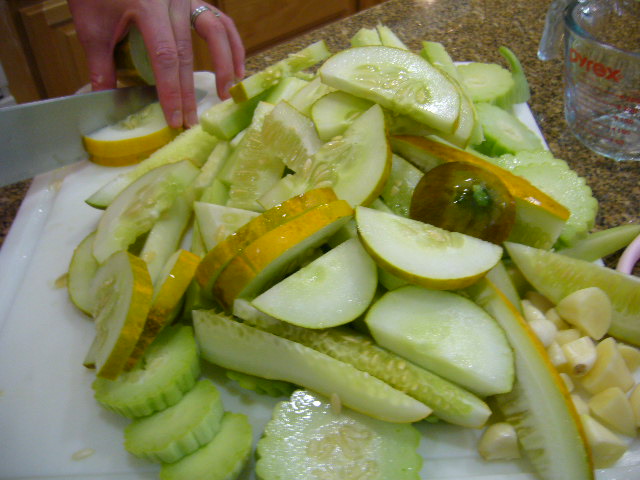
Sliced and Ready for Canning
Thus the name: Refrigerator pickles.

I must admit kids -- I am somewhat surprised. I'm also pleased to no end. See -- this year's garlic harvest was really nothing to write home about. I had intended to write a blog posting about this latest failure because half of the garlic harvest really wasn't a harvest at all. In fact, it was a complete bust. Garlic bulbs that should have been fat and happy with flavor were instead small and soft. In some cases? They disintegrated completely after the wife that is Venus and I pulled them out of the soil.

What remained of the harvest was rather small. There were no fat bulbs of garlic to be harvested this year. The best we got was something that you could purchase from your local grocery store. Where's the fun in that? The whole point of gardening is to produce a product that you CAN'T find in the local produce aisle.

Underwhelming Garlic Harvest? Mebbe Not!
In that respect? We failed. MISERABLY!

This underwhelming garlic harvest has been sitting in and stinking up the garagemahal for about the past month --curing ever so slowly. As it turns out, this weekend's canning project was the first true test of our garlic growing efforts. Each jar would contain at least one clove of garlic and maybe more depending upon the size of said clove. How did our garlic turn out?

My bandaged lips should be the first sign that things weren't nearly as bad as I thought. In fact, the bandaged lips should indicate that this underwhelming harvest produced some of the hottest and tastiest garlic the Bird Back 40 has ever churned out. As I slowly bit into and savored that first test of home-grown garlic my eyes turned wide. They proceeded to turn even wider as that slow-moving burn sensation moved from lips to tongue to cheek. They nearly popped out of skull when the first whisps of smoke started to emerge from my ever-widening mouth.

Fresh Flaming Lips Garlic
Holy Moly! Where did this heat come from? My lips are on fire! Quick! Water! Something! Ice! Defibrillator! 

This is some good garlic! Much better than I ever could have imagined. Perhaps things aren't nearly as bad as I had believed they were.

Will the burn of the garlic transfer and infuse the dill pickles that are now slowly marinating on our front kitchen counter? Quite possibly. It's one reason why this year's refrigerator pickle production didn't also include a jalapeno pepper for each jar. We didn't feel the additional heat was needed. Our intention isn't to send our consumers screaming to the nearest available fire department location. Our intention is to provide them with the best pickle taste ever.

Not Concerned With Pickles Nor Garlic
The best pickle taste is a mix of many things. It's salty. It's sweet. It's hot. It's cool. It's briny. It tastes like butter. In short -- it tastes like no pickle you've ever tasted before.

That's the goal with home-canned pickles. Sure! You can buy those kosher dills in any supermarket. Spears or chips -- you'll find them there.

But they won't taste anything like what we've got here. They probably won't burn your lips clean off either. Which, I suppose, is a good thing. But when burned lips result from a harvest that was better than expected -- well -- it's almost worth the price of Ace brand bandages.

CLAUSSEN STYLE REFRIGERATOR DILL PICKLES

This recipe is measured per jar, with the exception of the brine, depending upon the number of pickles you can pull from the backyard garden patch. We prefer pickling cucumbers, because they are a tad tougher than slicing cucumbers. Armenian cucumbers also work well because those tough skins retain that crunch, even after brining.

Fresh Dill Weed
The basic water to vinegar ratio is three cups water to two cups white vinegar. Some recipes call for using cider vinegar, but that didn't sound appetizing to us, so we're sticking with straight, standard, white vinegar. Feel free to double or triple this brine amount, but stick with the ratio of three cups water for every two cups of white vinegar.

Bring three cups water to a boil and remove from heat completely to cool. After water has cooled -- add two cups vinegar. This is your standard brine mixture.

The ingredients listed below are what we used for each one-quart jar of pickles. You don't have to use one-quart jars. One gallon jars work just as well, or even plastic containers (think Gladware, Rubbermaid, etc.). We put our jars into a water bath canner for ten minutes to sterilize properly, but there are others who just run them through a hot dishwasher.

To each one quart jar, adding the following:

Two to three sprigs of fresh dill (which you remembered to plant this past spring)
One to two cloves of garlic, whole or cut in half
One Bay Leaf
One tablespoon of sea salt or canning salt
One teaspoon each of dried dill, mustard seed and peppercorns


Packed Jars: Ready for Brine
Fill each jar with the required amount of seasonings, pack pickle spears or chips into jars, ladle in brine, seal, shake and set aside. Transfer to refrigerator after canning process is complete. Shake and turn jars upside down or right side up every day for ten days. 

After 10-15 days, the refrigerator pickles should be ready for a pickle feast. Here's hoping you don't burn your lips off.