Showing posts with label Diamond Muscat. Show all posts

Can't You Just Taste That???

Saturday, March 29, 2014

Table Grape Cluster-Thompson Vine
I know I can! Know what that is pictured to the right peeps? That, my friends, is a cluster. Not just any cluster mind you. And not the kind of cluster that Gunny Highway (Clint Eastwood) popularized in "Heartbreak Ridge." Nope! The picture to the right represents a big, fat CLUSTER of Thompson Table Grapes. And clusters just like this one are now emerging on every shoot emerging from the Thompson Table Grape vine.

Know what that means? It means a boatload of Thompson Table Grapes come this summer. And boatloads of table grapes are not a bad thing -- at least not in my book anyway.

Haircut Needed!
The table grape clusters now emerging by the hundreds it seems from the Venus, Fantasy, Black Monukka and Diamond Muscat vines, to name a few, follow on the heels of a haircut party held several weeks ago in the Bird Back 40. These vines, which emerged last year, managed to grow and cover the sidewalk you see pictured here and there. They also managed to grow right into the nearby pluot tree. Not only did they grow into it -- tendrils from these vines wrapped themselves around pluot tree branches and grew clear to the other side of the tree.

It wasn't all that unusual then -- to see a cluster of table grapes growing inside the pluot tree. And it did make for nice conversation.

Vines Before Pruning
Properly maintained? One single table grape vine will produce anywhere from 50 to 60 lbs. of table grapes. That's more than you and I can eat in any one sitting or two or three sittings for that matter. Now -- multiply that kind of production with nine table grape vines. There comes a point in the season where it's open season on table grape production, and I can't give them away or juice them fast enough.

The trick is to make sure the vines are properly maintained. The mass of vines you see pictured above looks like a really bad haircut, or someone just got up from a hard night's sleep. Most of these vines will not survive the pruning process that takes place when you're getting your mini-vineyard ready for spring and summer production. The wood that produced last years crop gets pruned away first -- along with any vines that emerged from that wood.

Vines After Pruning
The wood that you keep are the strongest vines or runners that emerged from the top of the vine, or the runners that emerged from the trunk itself. Those are the vines you keep -- and you won't keep all of them either. Some grape growers practice spur pruning -- keeping the strongest two vines that grew from the top or "cordon." Other growers practice the cane pruning method -- keeping the strongest vines that emerged from the trunks.

In my case? I practice both. Some varieties do better with spur pruning. Still others do better with cane pruning. Through the years I've discovered that the Thompson performs best with the spur pruning method, while the Black Monukka produces best through the method of cane pruning. And, as for the Fantasy vine, it really doesn't matter. The Fantasy is going to churn out ping-pong sized grapes no matter no matter what method of pruning that I use.

Piles of Discarded Vines
The vines that I choose to keep -- those that will be this year's fruit producers -- are then tied to the cattle pen fencing that we installed some years ago for our table grape vineyard efforts. It's been one of our better gardening investments. Cattle pen fencing can hold cows in place -- and can also support several hundred lbs. of table grape production.

It takes the better part of a weekend to properly prune and tie up nine table grape vines -- plus dispose of the piles of discarded vines piled nearby. That's a big investment of time and energy -- but well worth it when table grape season arrives -- which comes in late June for the Venus vine and continues right into July and August when most of the other varieties ripen up.

Cattle Pen Fencing
These vines will be sprayed to protect against mildew and other damage. Gibberellic acid, or GA-3, an organic growth hormone that promotes cell growth, will also be used at some point. Although there has been some previous research that suggests the use of GA-3 limits production on the Fantasy vine, I have not found this to be readily apparent in the Bird Back 40. And GA-3 results in large grapes that are packed with lip-smacking natural sugars. Fantasy grapes are not only the best eating -- they make the finest table grape juice.

The crop is ready when the mockingbirds who mock me begin to raid the vines with impunity. But it really doesn't matter all that much. These vines produce so much fruit now that I can share some with our fine-feathered friends. Besides -- they're taking a risk by coming in this close. Because somewhere in those vines -- hiding beneath the leaves -- is our garden patrol cat: Lenny. And when a 25 lb. Maine Coon snags a mockingbird? It's game over -- at least as far as the mockingbird is concerned.

As the wife that is Venus would say, "that's nature." Cats chase birds. It's the natural order of things. Yes -- and we can add one more rule to that list: Bill Bird likes table grapes.

Tying Up Venus

Wednesday, March 12, 2014

Tie This Mess Up!
Hey now!!! All the Young Dudes have suddenly jumped up, tuned in and taken notice! Mix one part vegetable gardening with two parts of tying up Venus? Finally -- I'm about to embark on a perhaps not-safe-for-work blog post that All the Young Dudes can finally sink their teeth into!
 
Boy -- are they ever going to be disappointed.
 
Wife That Is Venus with The Venus Table Grape
This blog posting is about tying up Venus. Not the wife that is Venus. But rather, just Venus. So who is Venus all the young dudes sing out in a perfect chorus of curiosity? Venus isn't a "who." Venus is a "what." The Venus I am referring too is the Venus table grape variety that occupies one small corner of the Bird Back 40. No -- I am not tying the wife that is Venus to the fence. For any reason.
 
And suddenly, blog readership slipped back to the normal levels of 2.34 fans -- as All the Young Dudes have used their mouse or iPhones to click back to more interesting endeavors like that hot cheerleaders posting on their favorite sports forums.
 
All the Young Dudes can't be bothered with topics such as gardening.
 
Neglected Venus Table Grape Vine
My friends, it may be a tad early this year just like it was last year. But there's no denying that "spring has sprung." Ye olde calendar sitting on the wall stubbornly claims to the fact that we're still in the dead of winter. But there's no denying what is taking place before our very eyes. The trees and vines that provide us with fresh, lip-smacking fruit choices throughout the summer months have awoken from their winter slumber.
 
What does this mean? In gardening terms -- it means it's time to "get busy." And, no, that doesn't mean "get busy" with the wife that is Venus. Although she probably wouldn't mind. Nope, in this case? My attention is drawn to that Venus table grape variety that I planted several years ago when I installed rows of table grapes in the Bird Back 40.
 
Venus Table Grape in 2013
It's safe to say that the wife that is Venus is unique. So is the table grape that is Venus. It's at least unique to California. Not many people grow it locally. Developed by Dr. J.N. Moore and released in 1977 by the Arkansas Agricultural Research Station connected to the University of Arkansas, the Venus table grape is the only non-California grape that grows in the Bird Back 40.
 
And you thought California held a patent on all things grapes? Not so fast...
 
Venus Table Grape Cluster
The Venus table grape took some time to get established to our California climate, which is decidedly different from Arkansas. It grew a total of ONE FOOT in Year One after planting, when most table grapes will grow five to ten feet. The next year, the very unimpressive Venus table grape grew an additional foot, giving us a total of TWO FEET of growth in two years.
 
What a LOSER!
 
But -- little did I know. The Venus was merely taking its time. Because, in year three, when I dutifully paid all attention to the California table grape varieties that were growing quite well in the Bird Back 40 and all but ignored the Venus -- the Venus decided that it liked California. It liked California in a very big way.
 
Step One: Install and Bolt Trellis to Fence
Suddenly -- the vine that I had ignored and failed to trellis or even stake for that matter suddenly TOOK OFF. It had taken two years to grow two feet. But in Year 3? The Venus vine grew two feet in a week. It grew and it grew and it grew until it finally grew into the neighbor's yard -- six feet up a fence and it kept right on growing. By the time I thought of even adding a support for the Venus vine, it was already too late. The monster had emerged. The monster was on a rampage.
 
But the Venus did more than just grow. It produced its first crop of table grapes. And it produced them FAR earlier than Bill or the wife that is Venus EVER expected. Ripe table grapes in JUNE? Two to three months before the "California only" vines produced a batch of ripened table grapes? Can it be so?
 
Yeah, so...
 
Step Two: Tie Vines to Trellis
This year I was determined not to make the same mistake. I would not ignore the Venus Table Grape. I would not ignore the wife that is Venus. And so -- on one sunny Sunday afternoon -- I attached a trellis to the fence located closest to the Venus -- bolted it down so it wouldn't bend or break under the weight of 50 lbs. of table grapes and proceeded to tie up every last vine I could find.
 
Since I had made no effort to tie up last year's growth -- separating new wood from the old proved to be difficult. Was that particular vine last year's growth or the year before it? Did that branch produce fruit last year? If I came to the decision that it had -- it got pruned back. But it was tough to tell. Vines and branches that produced fruit the previous year will not be as giving in Year 2, which is why you want to preserve the shoots and branches that grew last year but did not produce. They will become this year's fruit producers.
 
Step Three: Enjoy Drinks
The end result is a Venus table grape vine that has suddenly erupted with new green growth as the calendar churned from February to March. The Venus gets an earlier start to the season than most table grapes. While the California varieties slumber away -- Venus is on a mission. This is probably why it ripens up so early in the season.
 
As far as taste is concerned -- I would put Venus on the same level as Black Monukka or Suffolk Red. It's not the best in the Bird Back 40. No -- that claim has been staked by Fantasy and Diamond Muscat, two of the finest tasting table grapes on the planet bar none.
 
But nothing beats fresh table grape production in late June and early July -- a solid month and a half before the California vines reach maturity. That's what makes the Venus table grape so special and why it's earned a deserved spot in the pantheon of fruit production gracing the Bird Back 40.
 
The wife that is Venus agrees. The Venus table grape is a keeper.

Muscat Love

Wednesday, August 7, 2013

Diamond Muscat Seedless Table Grape
If you've come here expecting a little Captain and Tennille action, you're going to be sadly disappointed. If you have absolutely no idea of what I'm talking about -- congratulations on that thing called "youth." Enjoy it while you can. If you are old enough to remember the good Captain and his partner, Toni Tennille, welcome to Geezerdom. We've been waiting for you to arrive. Bedpans are to your left.

I write today, not about Muskrats, but rather Muscats. What's the difference? One is an animal -- the other is a grape. Captain and Tennille wrote and sang about Muskrats, not Muscats. I'm here to sing (croon actually) about Muscats. And Muscats just happen to be growing in my backyard. It is called the Diamond Muscat, pictured above right, and is now literally ripe for the picking in the Bird Back 40.

Monster Table Grape Vines-Bird Back 40
It is also probably the most unique kind of table grape that I planted some four years ago in the Backyard of Bird. Most table grapes are sweet -- some more so than others. Indeed -- the higher the brix content -- the more desirable the grape. The Diamond Muscat is sweet -- no doubt about it -- but also offers a different kind of taste not found in most table grapes. While I'm not a big fan of wine (how can I like grapes but not like wine?), there is that subtle hint of wine grape in every bite of a Diamond Muscat. This is one special table grape.

How special? I'm so very glad you asked. According to our good friends at the University of California Integrated Viticulture website: "Diamond Muscat was released by the USDA Agricultural Research Service in 2000 as an early season white seedless with muscat flavor. The muscat flavor is pleasant and mild though it is more intense than that of ‘Summer Muscat’. It has the potential for wine or concentrate production..."

Fantasy Seedless Table Grape Cluster
It's also one good tasting table grape -- and may soon be offered through the Bird Back 40 Kitchens as a grape jelly, grape soda, grape snowcone, grape.... you get the idea.

Unfortunately, or fortunately, it happens to be one of five or six varieties of table grapes that have suddenly ripened, weeks before they were supposed to ripen. This has been one strange summer in terms of weather patterns. The early onset of summer heat brought on a bountiful stone fruit crop -- and also paid the same dividends when it comes to table grapes it appears. The nine varieties that I have planted in the Bird Back 40 are not all designed to ripen at once. That would be a grape disaster instead of grape season.

But, obviously, this year Mother Nature had something else planned entirely.

Fantasy Table Grapes (partial harvest)
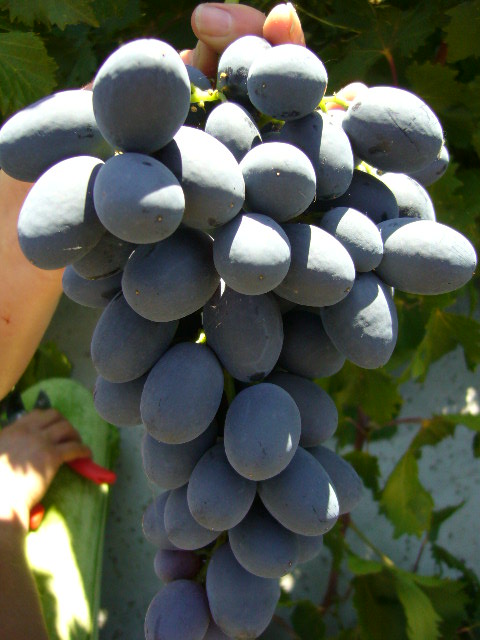
That big batch of blue table grapes pictured upper right (and immediate left), for example? That is the Fantasy Table Grape. As I write this, Fantasy Table Grape season has come and gone as we juiced the last of a 50 lb. harvest just last night. Instead of 50 lbs. of Fantasy Table Grapes, the wife that is Venus and I have about three gallons of fresh, pure, 100 percent fresh-squeezed Fantasy table grape juice.

Thank goodness the wife had the right mind to fire up that Jack Lalanne juicer.

What a Cluster!
Had our neighbors and some of our friends at work not helped out by taking many pounds off our hands, I fear there would be a lot more. We should be right smack dab in the middle of Fantasy table grape season. Instead, this batch of grapes, resembling plums with some clusters, ripened up about two weeks early. Why? Other than the wacky summer weather we've had, I have no idea why. I only know that when the mockingbirds begin to raid the table grape crop? The table grape crop is ready for picking.

Venus and I installed our table grape vines in the Bird Back 40 four years ago. Though the vines produced a nice crop in the second and third years, nothing could really prepare us for what is now taking place this year. And our friends who grow grapes for a living claim we "ain't seen nothing yet." Peak production for our table grape plantings won't come for another season or three.

Freshly Squeezed Table Grape Juice
As I keep a sharp eye on the Black Monukka, Suffolk Red, Flame and other varieties of grapes, I can believe that. The Flame is probably the strangest producer of this bunch. Most table grape varieties set clusters of flowers in the spring, and those flowers eventually turn into small grapes. At that point? Small grapes grow through the summer and turn into big grapes.

But not the Flame seedless table grape. Oh sure, the Flame set clusters of flowers early in the season just like every other seedless table grape vine did. And, oh, sure, those flowers turned into small grapes. And those small grapes have since turned into big grapes. Some have even changed color!

Mockingbird Hunter "Lenny" on Patrol
But what the Flame has done throughout the summer, which other vines have not, is continue to set new clusters. The vine flowered into July -- setting new clusters every four or five days. This means some clusters are now getting ready to ripen, while others are still green and small.

Can you say: "What a Cluster?" I know! I know...

My thanks to Sacramento area gardener Carri Stokes who first set me on this table grape adventure four years ago. I owe her a table grape -- or two.