Showing posts with label University of Arkansas. Show all posts

Berries Are for the Birds!

Saturday, May 23, 2015

Arapaho Thornless Blackberry Vine
You bet they are! And Bill and the wife that is Venus Bird like it that way! Welcome to May 2015 -- and one of the coolest spring weather patterns I think I've ever experienced in the Sacramento area. That doesn't help much when it comes to summer producing vegetable plants like tomatoes and cucumbers, but the Bird berry patch likes it just fine.

The big winner in this year's berry battle in the Bird Back 40? It should come as no surprise by now. For the second straight year and the fourth year since I brought it home and planted it, the Arapaho Thornless Blackberry is sporting a massive crop of berries that are, in some cases, three inches long and an inch thick. I wrote about this particular variety last year.

Arapaho Blackberries
The Arapaho continues to defy zone logic. The plant professionals claim it's not supposed to do well in this climate. It's more suited for cooler climates not found in my Zone 9A. It's supposed to do better on the coast and up north where it doesn't get quite as hot. But berry plants are funny customers. Arapaho berries grown on a commercial basis on the coast, where it is cooler, suffer from tip dieback. But here in the more inland, hotter, area? The Arapaho does just fine.

Time and study will determine just how well the Arapaho will do in California. Although it's not the most recent introduction from the University of Arkansas breeding program, it's still fairly new to our area and climate. Although it may eventually prove to be a bust on a commercial basis, it seems to do just fine in your ordinary home backyard setting.

Shuksan Strawberry Patch
If there is one big difference in the Bird Back 40 berry battle -- it's that the Arapaho isn't the only berry sporting a fat crop this year. Nope -- it's a tie. For in 2015 there are 20 second-year Shuksan strawberry plants putting on a big show in what will eventually prove to be the largest and most luscious strawberry harvest we've ever experienced in these parts.

The introduction of the Shuksan strawberry has been a years long, trial and (mostly) error, attempt to grow strawberries in the Bird Back 40. I wasn't interested in those small, sweet berries that emerge from most backyard settings. Nope -- I wanted in on the action that comes out of our local strawberry fields: strawberries the size of a golf ball or larger.

Shuksan Strawberries
At first I thought the answer to my berry wishes would be the Chandler Strawberry. The production was, in a word: Meh. Then I thought a combination of Albion and Gaviota strawberries would be the answer. They should do well here, right? That's what the experts told me. It's the recommendation I found online here. In fact, they advised the following: Recommended strawberry varieties for California: Albion, Aromas, Camarosa, Camino Real, Chandler, Diamante, Gaviota, Oso Grande, Pacific, Seascape, Selva, Ventana.  (According to the California Strawberry Commission)

But guess what kids? Don't believe everything you read online. Yes -- these might be great strawberry selections for some regions of California. But not here in the heat of inland California. It wasn't until I started checking each and every strawberry plant selection offered here, and checking the recommended zones very closely, did I stumble upon the Shuksan Strawberry. Recommended for Zones 4-10. That was my "Eureka" moment.

Bird Back 40 Berry Patch
If this is the kind of production I can expect from 20 second year plants, what happens next year when the additional 40 plants I ordered and planted this year swing into full production? 60 plants instead of 20? How about 80-100 plants? Strawberry overload anyone?

I'll take it.

Despite the very berry success this year -- I'm just getting started. For where there is a bare patch of dirt in the Bird Back 40 -- there's room for another small raised bed and perhaps another berry plant or two. I've got my eye on another recent introduction from the University of Arkansas breeding program. This is one is also thornless. It is called the Ouachita Blackberry -- which does well in gardening zones 5-9.

Because man does not live on blackberries alone. But, personally, I would if I could.

Shocking Blue

Monday, July 14, 2014


I know what many of you are thinking. "Hey, when did somebody do a remake of that Bananarama song?" But, for some strange and odd duck reason, I'm a fan of showing my true age. Which is old. Because this is the best version of "Venus," and it was released while many members of Bananarama were still in ponytail stage.

Venus Table Grapes-Bird Back 40
Yes -- Bananarama ripped "Venus" off from Shocking Blue -- not the other way around. And the version of this song -- plus the name of the Dutch band -- has been bouncing around in my head ever since the start of the Venus Table Grape harvest some two weeks ago.

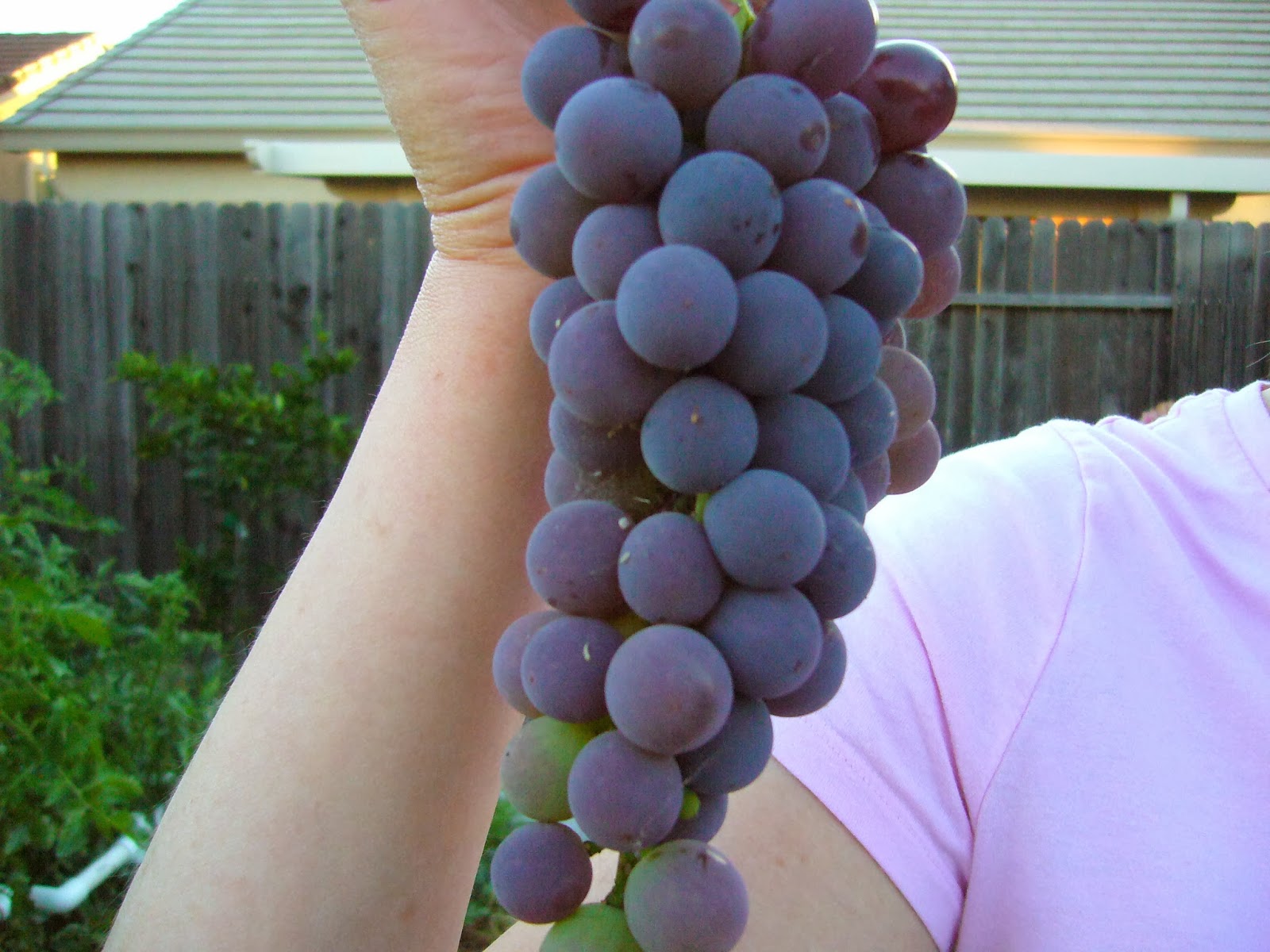
Why? Why would you ask that? OK -- I'll answer. Besides the obvious (the table grape in question is named Venus, duh), Venus grapes are a shocking blue-purple in color. Perhaps now you'll understand? Oh -- that and I can eat Venus Table Grapes until the cows come home and still not come close to finishing what is still hanging on the Venus vine. Plus -- the thieving mockingbirds and robins who raid the vine with Exlax-like regularity can eat their fill and still not come close to finishing off the stash.

Venus on the Vine-Bird Back 40
If the next question is, "why not just give them away," my response is this: I have been. I've been unloading enough Venus table grapes for neighbors to suddenly slam the door shut and lock it when they see me coming. While they are fans of the Venus -- there is something called "too much of a good thing." Two pounds of Venus grapes make for a nice gift. Four pounds wears out the welcome, if you get my drift.

Is Venus the best tasting table grape I've ever had? No -- that honor still goes to Fantasy grape. That is another shocking blue-purple grape that is still ripening on the vine and will be ready for harvest at some point next month. In fact, that's when most California table grapes start to ripen: August. That's what makes Venus so very special. Venus ripens in late June, stores on the vine very well (doesn't spoil) and produces a harvest so ridiculously large and bountiful that you'll be munching on Venus for at least two to three weeks (or longer).

Venus Grapes: Here, There, Everywhere
I suppose if I leave on the vine any longer I'll be munching on Venus raisins.

By that time even the thieving and marauding birds will have tired of it. No wonder they seem to be casting a longing glance at the Flavor Finale pluot tree. Because man, nor bird, does not live by Venus grape alone.

Another interesting fact about the Venus is it's one of the rare California table grape varieties that wasn't born nor bred in California. Nope -- the Venus hails from the University of Arkansas Division of Agriculture. It's prized by wine growers. It also makes a great grape jelly. It's not the sweetest grape in the world -- and it features a slip skin trait. In other words, there's no crunch when you bite into it.

Venus Vine-Bird Back 40
Try as you might, you probably won't find the Venus in your local grocery store. Nor do I think you'll run across it at your local farmer's market. While I'm not sure as to why the Venus didn't catch on as a marketable table grape (most grapes are coming in from Mexico at the moment), my feeling is the slip-skin trait of this variety probably didn't do it any favors. In other words, I don't believe it would ship to well without spoiling.

No matter -- because there is one place where the Venus has earned its rightful home as a reliable and hardy fruit producer: the Bird Back 40.

Mariska Veres-1970
POSTSCRIPT: Unfortunately, while researching for this blog posting I would come to learn that the lead singer of Shocking Blue, Mariska Veres, died from cancer in December, 2006 at the young age of 59. Although Veres was regarded as a sex-symbol during her years with Shocking Blue, she reportedly told the members of the band when she joined that relationships were out. Reflecting on her early fame, Veres told the Belgian magazine Flair: "I was just a painted doll, nobody could ever reach me. Nowadays, I am more open to people."

Unlike sex symbols and rock stars from her era, Veres didn't smoke, didn't do drugs and didn't drink. In fact, her drink of choice, up until the day she died, was tea.

And for you younger folks who have since joined us -- here's the version of "Venus" that you remember best:


But Will There be Enough for PIE???

Saturday, June 14, 2014

Arapaho Blackberries
My friends! The facetious, bull hockey artist known as yours truly is asking a stupid question. Why is it so stupid? Look at the evidence to your immediate right! Know what that is? That's about 5 lbs. of LIP-SMACKING blackberries harvested directly from the Bird Back 40. Know what's so special about this harvest? I'll tell you what's special.

It ain't done yet.

It's just getting started.

That 5 lbs. is a proverbial "drop in the bucket." 

Loaded Arapaho Blackberry Plant-Bird Back 40
Is 5 lbs. of freshly harvested blackberries enough for a blackberry pie? Is Bill Bird a facetious, bull hockey artist? Therefore -- we know the answer to the pie question. There's enough for pie. There's enough for two pies. Wait! Make that three pies! Anyone venture to guess, FOUR? Can you eat four blackberry pies? I honestly don't know if I could (in one sitting). But, I'll tell you this much. It sure would be fun to try!

The surprising thing about this haul from the Bird Back 40 is it came from just ONE blackberry bush. Yes, there's more. This boatload of berries came from the Arapaho Blackberry, which was nothing more than an impulse purchase three years ago at Lowe's Big Box store in West Sacramento. Hey! I needed another blackberry to complete my blackberry plantings.

Ripening Arapaho Blackberries
Up next is the harvest from the Black Satin Blackberry plant. I'll admit -- the harvest from the Black Satin is not going to be as wonderfully prolific as the Arapaho. Boo Hoo. Bill Bird gets two pies instead of five. Oh darn. Woe is me. Cue up the world's smallest violin. Oh -- wait -- did I forget to tell you about the boysenberry harvest?

I'll admit -- I didn't do any research about the Arapaho before I bought it. The bare root vine just happened to be there on that February afternoon three years ago. It looked good. I bought it. I wouldn't find out about this special plant till some years later when I finally got around to researching what I purchased. I'll be honest -- this isn't the smartest way of planning out a fresh fruit garden. Do your research FIRST -- then buy. That's a good rule of thumb.

Look Ma! No thorns!
But -- every once in a great while -- a squirrel finds a nut. In this case, the nut dropped directly from the tree and smacked me upside my head. As I would come to discover -- the best thing about the Arapaho plant is the thorns.

It doesn't have any. Say what, Willis? No thorns? Blackberry plants and thorns go together like peanut butter and jelly! A blackberry plant without thorns is one step short of sacrilege! You can do that now? The short answer is, "yes you can." A trip to the backyard blackberry patch no longer means a trip to the nearest medical center to be treated with Bactine and bandages.

Next Year's Fruiting Cane Emerges
The Arapaho is a fairly recent introduction from the University of Arkansas Department of Forestry and Agriculture. If UC Davis is famous for developing and breeding new cultivars of strawberry plants (which they are), the University of Arkansas has the market cornered on thornless blackberry production. The Arapaho, which was released to the public in 1993, is just one of many recent blackberry introductions. 

The University of Arkansas Blackberry Breeding Program has recently developed many excellent blackberry cultivars including: Apache, Arapaho, Cherokee, Comanche, Cheyenne, Chickasaw, Choctaw, Kiowa, Navaho, Ouachita, and Shawnee. Almost all of them are thornless and almost all grow and grow well from one end of the country to another.

In fact -- the one variety of blackberry that isn't supposed to grow well in the Sacramento area is, surprisingly, the Arapaho. It's recommended for Garden Zones 3-8. Bill Bird gardens in Zone 9A. I can attest that it really doesn't matter. The Arapaho loves it here -- and I have the lip-smacking pie ingredients to prove it.

Another nice thing about the Arapaho is it doesn't require any staking. It will fruit more if you do tie it to something -- but the Arapaho sends up canes as thick as a small tree trunk every spring and summer. Those canes that emerge this year will serve as the fruiting canes next season. Sure enough -- while the Arapaho was growing a boatload of fresh blackberries for Bill and the wife that is Venus this spring -- next year's fruiting cane emerged from the raised bed it calls home and has grown straight up to a height of seven feet. When next spring arrives, it will eventually get so heavy with fruit production that I'll need to tie it to something to keep it from collapsing.

Blackberry Pie! For me?
No matter. That's why God invented fences. And 4X4 posts. And concrete. And, nevermind...

As for the age of question of: Is there enough for pie? Well, photos do tell a wonderful story...

Tying Up Venus

Wednesday, March 12, 2014

Tie This Mess Up!
Hey now!!! All the Young Dudes have suddenly jumped up, tuned in and taken notice! Mix one part vegetable gardening with two parts of tying up Venus? Finally -- I'm about to embark on a perhaps not-safe-for-work blog post that All the Young Dudes can finally sink their teeth into!
 
Boy -- are they ever going to be disappointed.
 
Wife That Is Venus with The Venus Table Grape
This blog posting is about tying up Venus. Not the wife that is Venus. But rather, just Venus. So who is Venus all the young dudes sing out in a perfect chorus of curiosity? Venus isn't a "who." Venus is a "what." The Venus I am referring too is the Venus table grape variety that occupies one small corner of the Bird Back 40. No -- I am not tying the wife that is Venus to the fence. For any reason.
 
And suddenly, blog readership slipped back to the normal levels of 2.34 fans -- as All the Young Dudes have used their mouse or iPhones to click back to more interesting endeavors like that hot cheerleaders posting on their favorite sports forums.
 
All the Young Dudes can't be bothered with topics such as gardening.
 
Neglected Venus Table Grape Vine
My friends, it may be a tad early this year just like it was last year. But there's no denying that "spring has sprung." Ye olde calendar sitting on the wall stubbornly claims to the fact that we're still in the dead of winter. But there's no denying what is taking place before our very eyes. The trees and vines that provide us with fresh, lip-smacking fruit choices throughout the summer months have awoken from their winter slumber.
 
What does this mean? In gardening terms -- it means it's time to "get busy." And, no, that doesn't mean "get busy" with the wife that is Venus. Although she probably wouldn't mind. Nope, in this case? My attention is drawn to that Venus table grape variety that I planted several years ago when I installed rows of table grapes in the Bird Back 40.
 
Venus Table Grape in 2013
It's safe to say that the wife that is Venus is unique. So is the table grape that is Venus. It's at least unique to California. Not many people grow it locally. Developed by Dr. J.N. Moore and released in 1977 by the Arkansas Agricultural Research Station connected to the University of Arkansas, the Venus table grape is the only non-California grape that grows in the Bird Back 40.
 
And you thought California held a patent on all things grapes? Not so fast...
 
Venus Table Grape Cluster
The Venus table grape took some time to get established to our California climate, which is decidedly different from Arkansas. It grew a total of ONE FOOT in Year One after planting, when most table grapes will grow five to ten feet. The next year, the very unimpressive Venus table grape grew an additional foot, giving us a total of TWO FEET of growth in two years.
 
What a LOSER!
 
But -- little did I know. The Venus was merely taking its time. Because, in year three, when I dutifully paid all attention to the California table grape varieties that were growing quite well in the Bird Back 40 and all but ignored the Venus -- the Venus decided that it liked California. It liked California in a very big way.
 
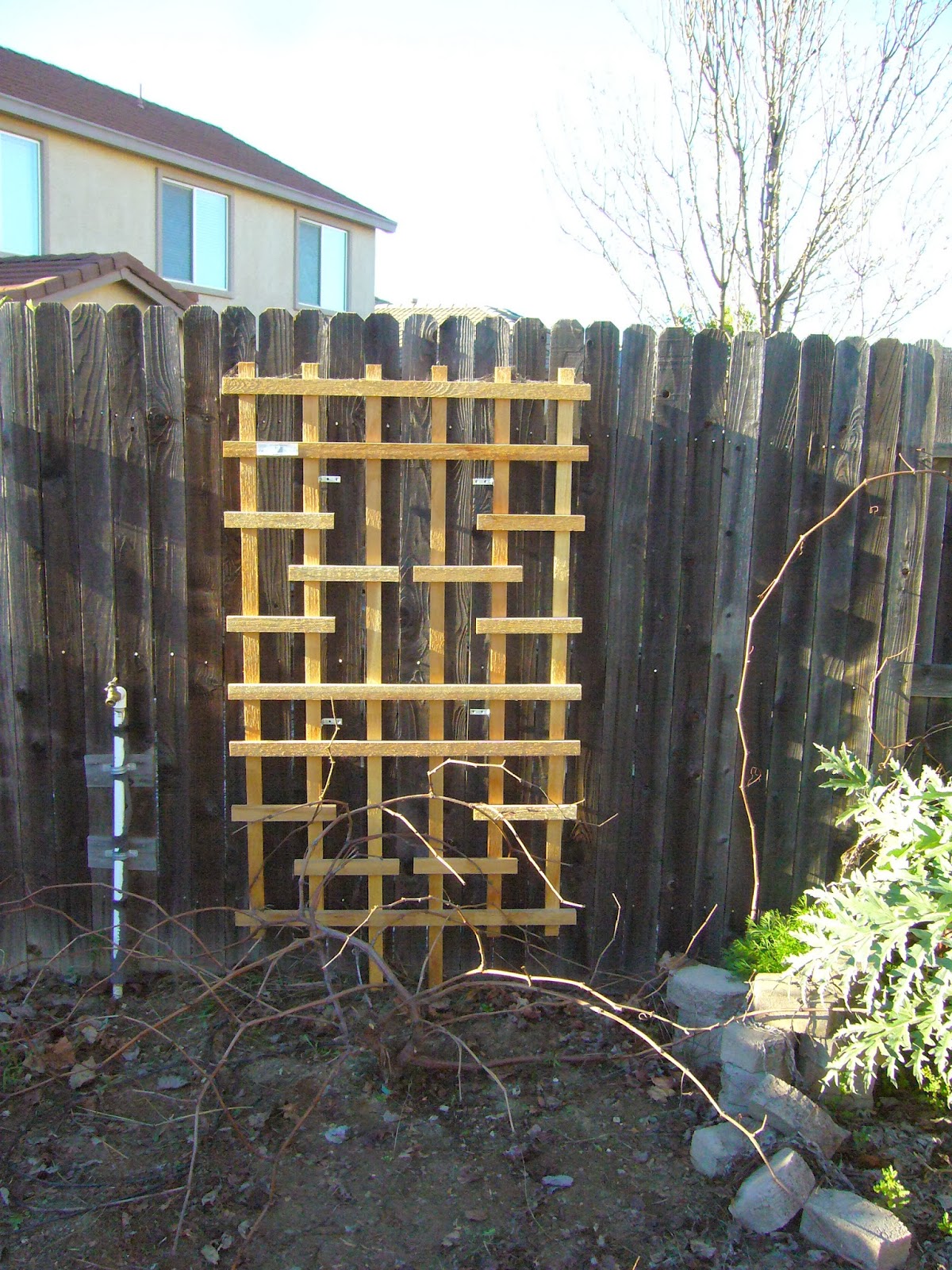
Step One: Install and Bolt Trellis to Fence
Suddenly -- the vine that I had ignored and failed to trellis or even stake for that matter suddenly TOOK OFF. It had taken two years to grow two feet. But in Year 3? The Venus vine grew two feet in a week. It grew and it grew and it grew until it finally grew into the neighbor's yard -- six feet up a fence and it kept right on growing. By the time I thought of even adding a support for the Venus vine, it was already too late. The monster had emerged. The monster was on a rampage.
 
But the Venus did more than just grow. It produced its first crop of table grapes. And it produced them FAR earlier than Bill or the wife that is Venus EVER expected. Ripe table grapes in JUNE? Two to three months before the "California only" vines produced a batch of ripened table grapes? Can it be so?
 
Yeah, so...
 
Step Two: Tie Vines to Trellis
This year I was determined not to make the same mistake. I would not ignore the Venus Table Grape. I would not ignore the wife that is Venus. And so -- on one sunny Sunday afternoon -- I attached a trellis to the fence located closest to the Venus -- bolted it down so it wouldn't bend or break under the weight of 50 lbs. of table grapes and proceeded to tie up every last vine I could find.
 
Since I had made no effort to tie up last year's growth -- separating new wood from the old proved to be difficult. Was that particular vine last year's growth or the year before it? Did that branch produce fruit last year? If I came to the decision that it had -- it got pruned back. But it was tough to tell. Vines and branches that produced fruit the previous year will not be as giving in Year 2, which is why you want to preserve the shoots and branches that grew last year but did not produce. They will become this year's fruit producers.
 
Step Three: Enjoy Drinks
The end result is a Venus table grape vine that has suddenly erupted with new green growth as the calendar churned from February to March. The Venus gets an earlier start to the season than most table grapes. While the California varieties slumber away -- Venus is on a mission. This is probably why it ripens up so early in the season.
 
As far as taste is concerned -- I would put Venus on the same level as Black Monukka or Suffolk Red. It's not the best in the Bird Back 40. No -- that claim has been staked by Fantasy and Diamond Muscat, two of the finest tasting table grapes on the planet bar none.
 
But nothing beats fresh table grape production in late June and early July -- a solid month and a half before the California vines reach maturity. That's what makes the Venus table grape so special and why it's earned a deserved spot in the pantheon of fruit production gracing the Bird Back 40.
 
The wife that is Venus agrees. The Venus table grape is a keeper.