Showing posts with label Fire Blight. Show all posts

A Harvest Like You

Wednesday, September 24, 2014

Flavor Finale Pluots-Bird Back 40
I've been waiting for this moment to be brutally honest. I've been waiting for a harvest like you. Because the planting and growing of fruit trees is an exercise in patience. You are not going to be rewarded with a bounty of fresh fruit in the first year nor the second. The third year might give you a little something. But it's that fourth year that fruit growers really look forward too.

Why that fourth year? Because as you've dutifully tended, watered and fertilized your young fruit and citrus trees, you have given them the time they need to establish large and strong root systems below the soil line. Strong roots = strong trees. Strong trees = a bounty of fresh fruit come harvest time.

Sliced Flavor Finale Pluots
But, alas, it doesn't always work this way. Sometimes the fourth year is a bust. The fifth year can be disappointing as well. Sometimes -- it's the third year. It all depends upon the fruit tree in question, where it's planted, how much sunshine it receives and how well you've cared for it. Did disease hit at some point? What about bugs? Bugs love fruit trees just as much as I do.

But there comes that moment in time, where the harvest you've worked and waited for finally arrives. You can't taste it yet. But you can see it forming before your eyes. In my case? The Flavor Finale Pluot tree that I stuck in the ground five years ago finally got around to delivering the type of harvest that I had always dreamed about, but never quite attained.

WHOA! Now that's a harvest to remember!
What is that perfect harvest? It's a harvest that is so large, that one bathes in pluots. There's enough pluots on the tree for fresh eating. There's enough pluots on that tree to make loads and loads of pluot jam and other pluot goodies. Gin drinks made with freshly squeezed pluot juice anyone? Finally -- there's still enough to give away to family, friends and neighbors -- all they can take -- and there's still enough fruit left on the tree to feed a marauding family of mockingbirds.

That, my friends, is a harvest to remember. And it took place this year in the Bird Back 40 in what will be described as an "average" fruit year by many. The weather wasn't quite right for cherries in Northern California this year, which is why the purchase of 1 lb. of cherries cost an arm and a leg in the local supermarket. Some peach varieties -- like the June Pride for example -- set very little fruit. And the three nectarine trees delivered a smattering of fresh nectarines. And don't get me started on the apples and pears -- especially when it comes to a rather nasty bug like fire blight.

Flavor Finale Pluot Tree-Bird Back 40
This wasn't what I had expected. But if you grow fruit for fun, you take the good with the bad. In some years the times are good. In others? Not so much. That's when it's time to drag out the old farmer's lament of "there's always next year."

But -- as you might be able to notice in the photo above left --there's a bit of wood propping up a branch laden with pluots. Know what that means? It was a rather right fine year for pluot production. More than right fine I should say. The dang tree was loaded to the point where some unpropped branches did actually snap under the weight of a terrifically large and luscious pluot crop.

Flavor Finale Pluot Jam-Bird Kitchens
I'll be completely honest with you. I've been privy to pluots ever since I first discovered them at a Sacramento area farmer's market more than a decade ago. I've always been a fan of home-grown plums and not-yet-dried prunes like the Clairac Mammoth de Ente (Improved French Prune). But the pluot offered a tasty feast that I quickly fell in love with. I couldn't buy enough to meet my personal demand. And I knew, fairly early on during the Bird Back 40 landscaping process, that a pluot tree would find its way home. I just wasn't sure which one it would be.

It would be November 19th, 2009 where I would conspire with another Sacramento area gardener and blogger (two of them actually) and place a large order through Bay Laurel Nursery. That order consisted of table grapes, thornless boysenberry and blackberry vines and one Flavor Finale Pluot tree. Why the Flavor Finale? Good question! You think I remember after five years of hitting hard gin like that?

Pluots...
Actually -- I did know that the Flavor Finale had recently won a Dave Wilson Nursery taste test challenge. And the fact that it ripened late -- in September no less -- was another good call. When one chooses to grow fruit trees -- you don't want everything ripening up in August. I would come to find out later that grafting different plum and pluot varieties onto the Flavor Finale was like falling off a log. If there is every such a thing known as the "Franken Fruit Tree" in the Bird Back 40, it's the Flavor Finale Pluot.

My thanks to the wonderful and wacky mind of Floyd Zaiger and his Zaiger Genetics program. Without his wonderful invention called the pluot, the first of which was introduced under the name of Flavor Supreme in 1988, my Flavor Finale harvest to remember would never had taken place.

And Now for Something Completely Ugly

Saturday, April 19, 2014

BOC Apple Orchard-Bird Back 40
Mother Nature can be viciously cruel at times, especially for those of us who yearn to dig in the dirt and plant good things to eat. Pictured to your right, my friends, is the Bird Back 40 Apple Orchard. It consists of three trees: Granny Smith, Fuji and Honey Crisp. I know this photo doesn't necessarily look all that ugly, but a closer inspection reveals the kinds of troubles that drive backyard growers crazy.

Short and sweet? Although those trees look healthy, they're not. In fact, the wife that is Venus and I will be lucky if we get a single apple this year. That's right! Three trees! One apple -- and we'll be lucky to get it. Worse yet -- there will no Honeycrisp Apple harvest this fall. That's worse than bad. It's tragic. The Honey Crisp is the best dang apple on the planet -- offering a taste explosion that cannot be missed.

Granny Smith Apple Tree-Bird Back 40
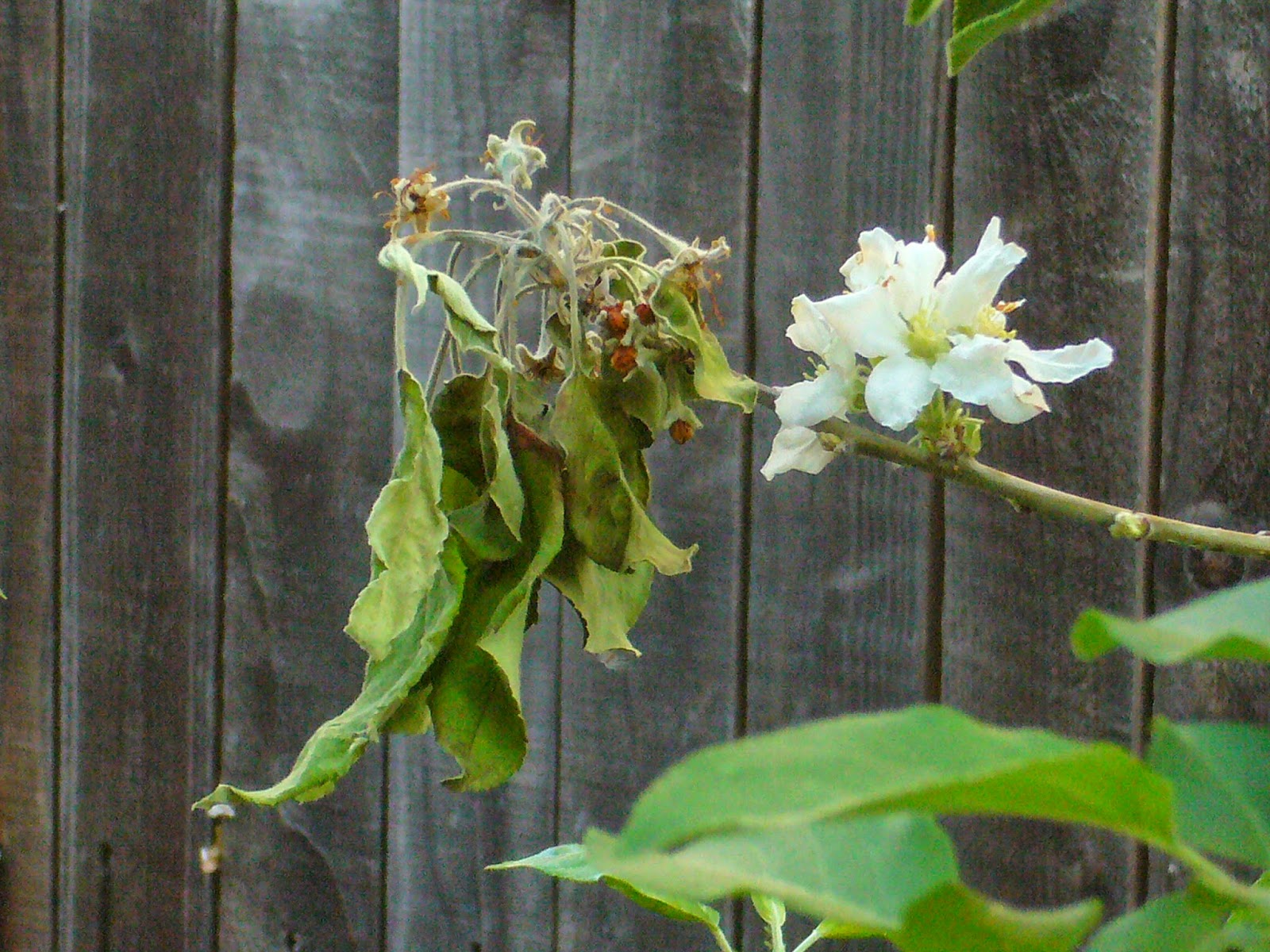
Yet -- I will miss it this year. And the photo to your left explains why. Those drooping leaves coming out at the end of one branch of the Granny Smith spell big time trouble. I first noticed this problem last week. It has since spread, slowly, to other parts of the Granny Smith and to the Honey Crisp.

This trouble is called Fire Blight. It's the first time its reared its ugly head in the Bird Back 40. I had this mistaken belief, perhaps call it a prayer, that backyard growers like myself would be spared from this scourge. Hah! Fat chance kid! The Blight is here and it's here to stay. Fire Blight means big trouble. Not only do the apple trees have it -- but the pear orchard I installed earlier this year has it as well.

Bartlett Pear-Bitten by Blight
I know what you're thinking. Why didn't you spray your trees to protect them from this bad boy over the winter? Oh, but I did. You see -- although Fire Blight has been around for a very long time -- there's still no active control for it. There is no spray, no dust, no treatment, organic or otherwise, that fights the dreaded blight. There is only one, proven method of control. And that method can result in a total crop loss, which is exactly what I'm facing.

This disease is called Fire Blight because it looks like leaves and fruit have been hit with a blow torch. The first sign of a problem is wilt. The leaves then turn a none-too-pleasant shade of brown, before fading to black. Fire Blight also spreads like wildfire.

Blackened Leaves-Granny Smith Apple Tree
I bet that you didn't know that, at one time in our not so distant past, pears and apples were kind of a big deal in Sacramento, Placer and the surrounding counties. Long before Sacramento adopted the nickname of SackofTomatoes, this was prime pear country. It still is in the southern part of Sacramento County, near the Sacramento River, but at one time tens of thousands of pear trees covered Sacramento fields from one of the county to the other.

And then, one day without warning, Fire Blight showed up. The damage was minimal at first -- but it spread like an out-of-control wildfire. Numerous controls were attempted. They all failed. Entire orchards were snuffed out in the space of a year or three. The main crop that powered the economic engine of Sacramento and the surrounding counties was dying a slow death, and nobody knew how it got here, how it spread from tree to tree and worse yet, how to stop it.

Dying Honey Crisp Apple-Bird Back 40
The answer of how the disease spread would come from horticulturists sent from UC Berkeley. It was believed that field workers were spreading the disease as they used pruning tools again and again as they moved from tree to tree, without washing them first. Today, that thinking has changed somewhat, at least in the opinion of some horticulturists who I contacted regarding my little problem. While the cleaning of pruning tools is still recommended, the belief is pollinators are spreading the pathogen as they move from tree to tree and flower to flower.

That's right -- the ordinary bee. This is where the infection starts -- when pear or apple tree bursts into bloom after a long winter's nap.

Fire Blight Strikes the Granny Smith Apple Tree
The good news? If there is any good news out of this, the "window of infection" is a short one. Once spring moves into summer, it's done. If there is any fruit on the tree that didn't get infected during the "window of infection," it's safe. But as for the branches, apples and pears that are infected? There is only one answer. That answer is pruning the infected branch back to a point where the dreaded blight can spread no further. It means the trees I've dutifully tended to a height of seven feet are about to get a rather severe haircut.

But that is my only option. Do nothing in the face of this scourge and the blight will show up again next year, stronger than the first year and left uncontrolled, will spread into the root system, killing the tree.

Honey Crisp Apple Blight Damage
I can't let that happen. I don't care how severe the cutting will have to be -- it's my only option. Do it, and I might save the tree. Do nothing, and that prized Honey Crisp will never deliver another tasty apple.

And so, those dreams I had over the winter of apple crisps, apple pie, apple juice and applesauce using our own home-grown apples will remain just that -- a dream. For this year -- Bill and the wife that is Venus are singing the farmer's lament: "There's Always Next Year."