Showing posts with label mother nature. Show all posts

And Now for Something Completely Ugly

Saturday, April 19, 2014

BOC Apple Orchard-Bird Back 40
Mother Nature can be viciously cruel at times, especially for those of us who yearn to dig in the dirt and plant good things to eat. Pictured to your right, my friends, is the Bird Back 40 Apple Orchard. It consists of three trees: Granny Smith, Fuji and Honey Crisp. I know this photo doesn't necessarily look all that ugly, but a closer inspection reveals the kinds of troubles that drive backyard growers crazy.

Short and sweet? Although those trees look healthy, they're not. In fact, the wife that is Venus and I will be lucky if we get a single apple this year. That's right! Three trees! One apple -- and we'll be lucky to get it. Worse yet -- there will no Honeycrisp Apple harvest this fall. That's worse than bad. It's tragic. The Honey Crisp is the best dang apple on the planet -- offering a taste explosion that cannot be missed.
Granny Smith Apple Tree-Bird Back 40
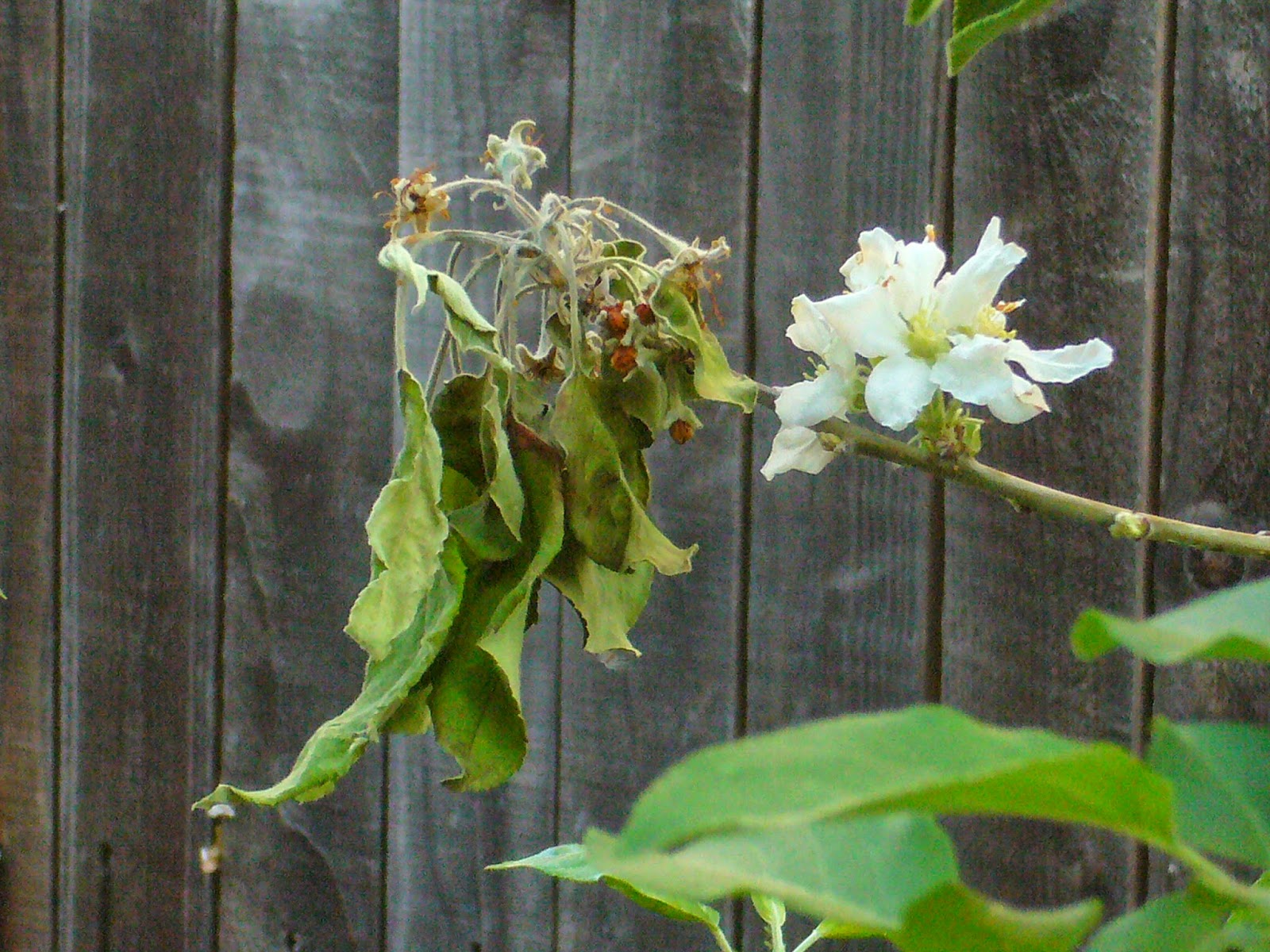
Yet -- I will miss it this year. And the photo to your left explains why. Those drooping leaves coming out at the end of one branch of the Granny Smith spell big time trouble. I first noticed this problem last week. It has since spread, slowly, to other parts of the Granny Smith and to the Honey Crisp.

This trouble is called Fire Blight. It's the first time its reared its ugly head in the Bird Back 40. I had this mistaken belief, perhaps call it a prayer, that backyard growers like myself would be spared from this scourge. Hah! Fat chance kid! The Blight is here and it's here to stay. Fire Blight means big trouble. Not only do the apple trees have it -- but the pear orchard I installed earlier this year has it as well.

Bartlett Pear-Bitten by Blight
I know what you're thinking. Why didn't you spray your trees to protect them from this bad boy over the winter? Oh, but I did. You see -- although Fire Blight has been around for a very long time -- there's still no active control for it. There is no spray, no dust, no treatment, organic or otherwise, that fights the dreaded blight. There is only one, proven method of control. And that method can result in a total crop loss, which is exactly what I'm facing.

This disease is called Fire Blight because it looks like leaves and fruit have been hit with a blow torch. The first sign of a problem is wilt. The leaves then turn a none-too-pleasant shade of brown, before fading to black. Fire Blight also spreads like wildfire.

Blackened Leaves-Granny Smith Apple Tree
I bet that you didn't know that, at one time in our not so distant past, pears and apples were kind of a big deal in Sacramento, Placer and the surrounding counties. Long before Sacramento adopted the nickname of SackofTomatoes, this was prime pear country. It still is in the southern part of Sacramento County, near the Sacramento River, but at one time tens of thousands of pear trees covered Sacramento fields from one of the county to the other.

And then, one day without warning, Fire Blight showed up. The damage was minimal at first -- but it spread like an out-of-control wildfire. Numerous controls were attempted. They all failed. Entire orchards were snuffed out in the space of a year or three. The main crop that powered the economic engine of Sacramento and the surrounding counties was dying a slow death, and nobody knew how it got here, how it spread from tree to tree and worse yet, how to stop it.

Dying Honey Crisp Apple-Bird Back 40
The answer of how the disease spread would come from horticulturists sent from UC Berkeley. It was believed that field workers were spreading the disease as they used pruning tools again and again as they moved from tree to tree, without washing them first. Today, that thinking has changed somewhat, at least in the opinion of some horticulturists who I contacted regarding my little problem. While the cleaning of pruning tools is still recommended, the belief is pollinators are spreading the pathogen as they move from tree to tree and flower to flower.

That's right -- the ordinary bee. This is where the infection starts -- when pear or apple tree bursts into bloom after a long winter's nap.

Fire Blight Strikes the Granny Smith Apple Tree
The good news? If there is any good news out of this, the "window of infection" is a short one. Once spring moves into summer, it's done. If there is any fruit on the tree that didn't get infected during the "window of infection," it's safe. But as for the branches, apples and pears that are infected? There is only one answer. That answer is pruning the infected branch back to a point where the dreaded blight can spread no further. It means the trees I've dutifully tended to a height of seven feet are about to get a rather severe haircut.

But that is my only option. Do nothing in the face of this scourge and the blight will show up again next year, stronger than the first year and left uncontrolled, will spread into the root system, killing the tree.

Honey Crisp Apple Blight Damage
I can't let that happen. I don't care how severe the cutting will have to be -- it's my only option. Do it, and I might save the tree. Do nothing, and that prized Honey Crisp will never deliver another tasty apple.

And so, those dreams I had over the winter of apple crisps, apple pie, apple juice and applesauce using our own home-grown apples will remain just that -- a dream. For this year -- Bill and the wife that is Venus are singing the farmer's lament: "There's Always Next Year."

Have Another Cold One!

Tuesday, December 10, 2013

Grapevines in Winter
It's about this time of year when Mother Nature begins to act like our favorite bartender. "Have Another Cold One," she screams as she delivers one whopper cold morning after another. It doesn't matter if you've already had enough of the frosty conditions that have blanketed the Sacramento area during the past weeks. Because Mother Nature is still in that giving mood: "Have Another Cold One!"

Notice -- I said Mother Nature begins to act like our FAVORITE bartender. This doesn't necessarily mean mean she's the MOST RESPONSIBLE barkeep. Them are two entirely different things.

Frosty Bird Back 40
As an amateur citrus grower, I've kind of come to regret the month of December in the Sacramento area. Oh sure -- the cold weather means great news for stone fruit crops like peaches, pluots and cherries because they get a nice, long winter slumber. And the longer they sleep? The happier they'll be in the morning come spring-time. But if you grow stone fruit AND citrus, this can get a little tricky.

You see -- citrus likes cold weather -- to a point. But that daily dose of "have another cold one" can get a little old. This is when cracks start to appear in the machine. All that newly emerged fall growth turns a none-too-pleasant shade of brown, which can only mean one thing. And it's not too much Brown Ale, either. It means it's time to hold a funeral for that promising growth that took place in October and November.

C-9 Christmas Lights Around Duke Avocado Tree
Responsible citrus growers, like Farmer Fred Hoffman for example, will take special precautions to protect those tender citrus babies. These responsible steps include heat-producing C-9 Christmas tree lights around the tree, an even bigger, warmer and brighter light, topped off with a special cloth covering. Isn't that nice?

By the way, this is nothing compared to the steps that the large scale citrus producers are taking. They battle the fierce cold weather with giant wind turbines, water and other measures to keep the freezing temps at bay. When a single, solitary acre of citrus plantings can produce a profit of $25K? This is nothing to laugh at, especially if you have 100-200 acres of citrus to protect. In other words, that's a lot of peel, if you get my snowdrift.

Cold Dancy Mandarin Tree
Other growers, like say yours truly, practice the hope and prayer method. This does involve stringing those warm C-9 Christmas bulbs around some citrus trees. But come on people! Covering one or two trees is one thing. When some fool decides to plant eight or nine citrus trees (me), there's just not enough C-9 lights or cloth covers to go around. Know what I'm saying?

That said, I must inform you that the time honored Bird ritual of the "hope and prayer" method isn't always 100 percent successful. And I have the blackened remains of old avocado trees and various mandarin branches to prove it. All because Mother Nature decided to announce: "Have Another Cold One!"

It gets colder than cold in the Bird Back 40. I know this to be a fact. The proof I have, as I mentioned before, are the blackened remains of four or five avocado trees that were once scattered about the yard. I also have highly sensitive thermometer equipment purchased some years back in a box of Cracker Jacks that confirms my micro-climate cold settings.

Loaded Meyer Lemon Bush
I thought it odd, however, that the equipment would yield a low of six degrees in the month of June. But if you can't trust the high quality temperature equipment yielded from a box of Cracker Jacks, what can you trust?

That said -- I must report these conditions from the Bird Back 40: So far, so good. Yes -- there's been some damage to some of the smaller mandarin trees that aren't producing citrus just yet. This includes the Clementine Mandarin and the Cara Cara orange tree. But I can also report that the Hangover citrus tree and the nearby Dancy Mandarin tree are doing just fine in this frigid "Have Another Cold One" snap.

Hangover Bearss Lime Tree
What's that you say? The Hangover Citrus Tree? Oh -- that would be the Bearss Lime tree. Which, by the way, produced a FINE crop of large and juicy limes this year. I call it the Hangover Citrus Tree for a very special reason. It's responsible for a number of weekend hangovers.

What's what you say? If I didn't mix so much tequila in that freshly squeezed lime juice, I wouldn't be suffering from hangovers? What are you? A communist? Or just my voice of reason, that I try to drown out with freshly squeezed Bearss Lime juice at every occasion possible?

There's nothing quite like freshly squeezed Bearss Lime juice. Trust me on this. I've had my share.

Murcott Mandarin
And so this holiday season, remember to follow the advice offered by Farmer Fred Hoffman. Don't follow the Bird "hope and prayer" method. For I fear that my favorite bartender is about to utter her time honored phrase: "HAVE ANOTHER COLD ONE!" And we'll get it, whether we like it or not.

After a Storm: CRY!

Tuesday, April 9, 2013

Tree Rose After Wind Storm: Bird Back 40
There are gardening writers in the local blogosphere (is that even a word?) who offer helpful and handy tips of what steps to take now that a storm has come and gone.

I'm here to tell you that I am not one of those bloggers. If you're looking for good advice, go elsewhere. If you're looking for "can't possibly fail" gardening tips, you've tuned to the wrong channel. But if you're here to laugh at my misfortunes, congratulations, you've reached Nirvana.

I suppose the point I'm trying to make is that it doesn't take long for Mother Nature to utterly destroy what took you months to build. Mere hours of misfortune can result in epic disaster, especially if you've devoted an entire Bird Back 40 to this insane gardening endeavor.

St. Patrick's Rose Stem Ripped from Bush
Case in point? That nice looking tree rose bush pictured above right? That's not just any tree rose, my friend. That is the St. Patrick's tree rose. It was a gift to the wife that is Venus a few years back for her birthday. I would later to have to invest in another tree rose that went with the St. Patrick as it snapped in two following a rather ferocious wind storm.

That's gardening for you. Investment and epic failure. I'm here today to tell you that I babied this tree rose like no other when the first spring shoots began to emerge in February. It was given the best fertilizer on a once-a-month schedule. Daily and deep watering would follow. And if any bad bugs appeared to munch on those yet-unopened rose buds? They got a shot of something special, which also protected said tree rose from other maladies of the fungal variety.

Flavor Finale Pluot Tree: Mangled
But, in the end, when a sustained wind rips through the North Natomas river bottom, as it did this past Monday, it really doesn't matter. Because those howling winds just about tore everything to shreds, or mangled it to the point where it looks like someone beat on it with a crow hammer.

Those branches and buds of the Saint Patrick's tree rose that I'd cared for, nurtured, performed concerts for now lie in a heap on the ground. They are broken. They will not be roses. They will be waste for the Green Waste can. I am disgusted. What a waste.

Pluots That Will Never Ripen
That same despair and disgust applies to just about everything that Venus and I nurtured during those spring months. Why did we graft those new varieties to the Flavor Finale Pluot? So they could produce more pluots that the wind could just knock off the tree?

Oh, and that ingenious little contraption that I wrote about here that makes a nice little cover for my tomato plant starters? I also discovered, sadly, that it makes great kite material. This is after it blew off somewhere into Yolo County. I might find it someday and mount on a wall as a testament of good ideas gone very wrong.

Broken Arapaho Blackberry Vines
Never again will I visit those emerging Arapaho blackberry vine flowers and get visions of blackberry pie or blackberry cobbler. Not with visions like this one. Tender blackberry vines and sustained gusting winds do not mix. Something's gotta give, and it wasn't the wind.

Our spring of discontent doesn't end there. There's no need to "cull" the peach trees of extra peaches. Mother Nature did it for us. Whether we wanted to do it or not. Consider it done. And as desperate as I am, I will NOT try to glue those peaches back on the tree. Unless, of course, someone tells me it can be done.

If it didn't break, it got bent. If it didn't get bent, it flew two counties to the south. There was a time when the spring artichoke crops were close to growing over the fence. Not anymore. Some of them are growing to the east, while others grow to the west. Some are growing down. Did they survive? Sure! Will those plants snap off at the base under the weight of a heavy artichoke crop come this spring? By golly you betcha they will!

Bent Artichoke Plants
So, dear gardeners, take heed. No matter what measures you take to prevent disaster, no matter how hard you try, Mother Nature can undo all of it with a single blow. And then you begin to wonder why this lady doesn't like you so much.

A wise gardener once wrote the following: Gardening is cheaper than therapy and you get tomatoes." If that's the case, this must be a case of shock therapy at it's best.

Would You Like Fries With That?

Sunday, June 26, 2011

Sack of Spuds Anyone?
It's a line I know well and repeated often during my youthful years in high school and later in college. And the answer was almost always, "yes, absolutely." Because if you're going to commit the foody sin of treating yourself to a real burger -- might as well complete the 25-to-Life sentence with a side of deep-fried french fries.

But the fries Bill Bird dished up all those years ago cannot compare to the sacks of spuds currently sitting in a cool and darkened corner of the Bird GarageMahal. The first big harvest of 2011 is now in -- and as you can tell by the photo -- we're in "Fat City."

Or -- if we convert these all to fries -- we soon will be.

After a less-than-stellar 2010 growing season -- the Backyard of Bird has bounced back with a spud harvest for the ages. A lot of factors play into a harvest like this -- which includes good seed potatoes and a green-thumbed wife named Venus willing and determined to pack every last square inch of a 4X8 raised bed with as many spuds as possible.

Colorado Rose Red monster. One of many
But there's also a lot of luck that plays into a harvest like this. You just don't grow a giant Colorado Rose Red baker like the one to your left without a little assistance from Mother Nature. And -- she delivered this year -- in spades. The late spring rains that distressed many gardeners by pelting tiny tomato plant starters with non-stop rain (and hail), turned out to be Manna from Heaven for potato growers.

The leafy potato plants that completely covered the bed soaked it all in. Inch after inch of steady rainfall hit all sections of the raised bed in an equal manner. And -- some weeks later when the plants began to die back in the graceful way that potato plants do -- a wonderful sight greeted me and the wife that is Venus.

There's GOLD in Them Thar Hills!
Tiny treasures poked from the top of every plant. Tiny treasures in every corner. Tiny treasures here. Tiny treasures there. Tiny treasures everywhere. I felt much like a gold miner in 1849 California. No need to dig into the ground son -- the gold is right here on top for the picking. Fattened by late spring rains, potatoes were literally bursting out of the ground.

I guess that late rain wasn't such a bad thing after all -- now was it?

There's a special and strange satisfaction that is so very hard to describe when you've literally lucked into a harvest like this. You forget about the hot sun beating down on your neck and back. The dirt between your fingernails isn't a bother. There's a treasure here to get out of the ground and you can't quite dig fast enough. Each shovel of dirt reveals a new prize and brings a new smile to the face of a gardener.

Fat Fingerlings
I suppose it means the work that you put into growing the crop -- the hours spent fertilizing and weeding the garden -- have now paid off with a monster harvest. While you always hope for the best when harvest arrives -- there's always a surprise here and there. There's nothing quite like finding a single Colorado Rose potato that's large enough to feed two people or fingerlings so fat with growth and production that you begin to wonder why you didn't plant more of them.

But it really doesn't hit you until you've turned over the last shovel full of dirt. You don't truly understand until you've poked through every last inch and bit of soil for spud surprises with that spade fork and get every last offering. Only then do you look at those burlap sacks fat with potatoes. And only then does it hit you.

What in Hades are we going to do with all these potatoes?

Pick a Potato
My guess is -- and it's a guess because we don't have a large scale -- that 5 lbs. of seed potatoes resulted in a harvest of 80-100 lbs. of fat potatoes. But -- without a scale -- it is just a guess. I can only tell you that those sacks were not easy to lift when the job was all said and done. Lugging them from the Bird Back 40 into the safety of the GarageMahal didn't do the back any favors.

But last night's french fries were some of the best I've ever had. Home grown potatoes are unlike anything you can find at your local supermarket, but you will find them in stores that cater to organic tastes and desires. You will almost certainly find these at Farmer's Markets scattered around the Sacramento area.

Sacks of Spuds. Harvest Completed
My thanks to the fine staff at Peaceful Valley Farm Supply for once again supplying a superior batch of seed potatoes. Special recognition to Capital Nursery as well for holding three sacks of fingerling potatoes in reserve for me when the wife that is Venus found an extra spot or two for additional seed potato plantings.

It's Sunday morning in Sacramento. Did someone say hash browns?

Snip, Snip, Snip!!!

Sunday, May 1, 2011

Smile! It's SPRING!
Let the record show -- on this day -- May 1st, 2011 -- Mother Nature finally delivered the most beautiful, warm, wonderful spring day of the year. It's been a long time coming. Yesterday's windy conditions down here in the North Natomas riverbottom frustrated me to no end. But today? Today my friends -- as the photo will show -- today is a day for wide, colorful smiles.

Let the record show that -- on this date -- Bill & Venus Bird will fire up the Mantis Rototiller and get to work on amending the test bed for the 2011 corn, melon and squash crops. But it's a little early yet. The Mantis makes quite the racket. I'll let the nearby neighbors enjoy a bit more Sunday stillness before I intrude upon their Sunday quiet.

In the meantime -- big things are literally jumping out of the ground in the Bird Back 40. If you're a fan of home grown fruit? It's a sight to behold. The fruit tree trimming practices that Venus and I learned from City of Folsom Arborist Ken Menzer last year have been put into practice. The resulting yield has been quite surprising to witness.

He was right.

Flavor Finale Pluot Tree
There are two things from Ken's class that stick out in my mind. The first? "Fruit trees grow very fast," he instructed. That surprised me because it seems like I've been waiting eons for my backyard fruit crops to produce in the eye-popping numbers that I desire. The second? The second tip he delivered, which Venus and I have also put into practice, is to fertilize fruit trees on a monthly basis.

This doesn't mean you're required to get on your hands and knees with hoe in hand and scrape fertilizer into the soil around a base of a tree either. Nope -- his instruction was to take a small handful of fertilizer and just toss it under a tree once a month. In my case? I use a set of measuring cups that I keep in the garage. Each tree gets a 1/4 cup of fertilzer or less once a month without fail.

Pluots on the Flavor Finale Pluot Tree-Year 2
The advice that he delivered -- to prune every fruit tree branch after it has developed five leafsets -- plus fertilize monthly -- has produced some impressive results as you might be able to tell from the photo to your upper left. That, my friends, is the Flavor Finale Pluot tree that wifey and I planted during the 2010 bare root planting season. It had exactly three branches on it.

Today? A little over a year later? The Flavor Finale Pluot has about 30 branches. There is fruit all over the tree. It is growing like a weed -- as are the nectarine trees that we have planted out in the front yard -- in a small corner tucked against the home. The next door neighbor -- a retired farm-hand who worked peach groves all his life in Yuba and Sutter Counties -- warned me that "it would never work."

Today -- those trees -- also planted about one year ago -- trimmed and fertilized faithfully -- are approaching seven feet in height. Each of the three trees is loaded with nectarines. Unlike the peach trees planted in the Bird Back 40 -- which are suffering from a terrible bout of peach-leaf curl this year (Farmer Fred Hoffman has an excellent and informative posting on peach-leaf curl here) -- the nectarines are healthy and loaded with new branch growth. The neighbor -- who worked commercial farms for most of his adult life -- is quite fascinated with the growth show that is taking place and is considering his own patch of home-grown fruit.

Nectarine Trees-Frontyard Orchard Culture
See? This insanity cannot be cured.

Although the pluot is not part of a grouped Backyard Orchard Culture concept planting -- I am still treating it as if it is. This means trimming the tip off each branch after five leaf-sets have emerged. The Flavor Finale Pluot has reacted to this trimming party by growing at least two-to-three new branches from each branch that has been pruned. Once the new branches have unfurled to five or six leafsets -- they too are pruned back -- resulting in a tidal wave of branch growth.

I have already started the process of pruning the pluot for the first time in 2011. The new branches that emerged with the onset of a cold spring earlier this year have already unfurled to five or six leafsets. The trick to this pruning method is to prune at least three or four times per spring, summer and fall season. It's not hard -- but it does require an hour or so of time to locate all of the new growth and prune it back. Since the new growth is green and pliable -- it doesn't take much effort. You don't even need gardening shears. Fingers and fingernails work quite nicely.

New branch (left) emerging from trimmed branch (right)
I am not quite sure if the pruning or fertilizing routines are the reason behind this rapid and sudden growth. Like everyone else who prefers home grown fruit -- I can tell you that some trees are doing well and others not-so-well (see: peaches). But I can tell you that every tree that has been subjected to this trimming and fertilization effort has resulted in rapid, eye-popping growth. There's not a failure among the bunch.

So -- if you love it? WHACK IT! Remember? With each new branch that emerges during a summer of pruning? That's just one more branch that will result in a boatload of fresh fruit the following year.

A Salivatin' Sight INDEED!!!

Tuesday, April 19, 2011

The "Pineapple" Artichoke
I like mine with BUTTER! Okay -- mebbe just a little bit of melted butter -- combined with margarine and garlic salt. That's the pefect dipping sauce for a beauty of an artichoke like this one to your right.

As for the wife? The wife that is Venus goes ALL out when it comes to the perfect artichoke dipping sauce. Sure -- there's a LOT of bit of butter -- some fresh lemon juice -- fresh herbs from the herb garden and just a tiny bit of salt.

And that makes it just right. What is your favorite dipping sauce? We're taking suggestions -- because we're about to come into a "boatload of artichokes."

I am literally licking my lips at the thought of the 2011 artichoke season. As the photo in the upper right will attest and the others below will show -- that season is just around the corner. And -- I might add -- it's also a tad early this year.

Oh, that's just tooooo bad!

The "Mother Bed"
After a disappointing 2010 artichoke season -- the "mother" plants have rebounded in a big way this spring. They've nearly grown right out of the raised bed I have them contained in and have nearly reached the top of a six-foot-high fence. I have never seen them get quite this large or quite this lush before. But I'm not complaining. Oh no -- not Bill Bird. Not in the slightest.

You see -- do you know what large and lush artichoke plants will result in? Large, lush and tender artichokes hopefully.

How do I know when artichoke season is right around the corner? It's when they begin showing up at the local supermarket -- usually at a pretty good price too. It's not all that uncommon to find them at Sacramento area supermarkets with a price tag of two for $3 or $5.

And it's well worth the price. Venus and I always make sure to purchase four or six of them. It sort of whets the appetite for what is to come. For there is nothing folks -- nothing quite like -- the taste of an artichoke that you grow right in your own backyard. It's just as unique and tasty as a home-grown tomato or any home-grown fruit. There's just something "special" about them.

Artichokes here. Artichokes there. Artichokes everywhere!
So -- "what's so special Bill Bird," you ask? Well -- I'll tell you. Our home grown chokes have a nutty -- almost walnut-like flavor to them. It's a unique taste that you don't find with artichokes that are now arriving by the thousands from coastal farming areas. Another difference? The heart of our home-grown chokes -- that "prize" that artichoke lovers yearn for -- is both larger and richer.

Another thing about artichokes? We have different types. The artichoke featured in the picture at the top is what I refer to as the "Pineapple Artichoke" because the shape of the leaves at the top very much reminds me of the tough bark surrounding a pineapple. These also make for the largest artichokes out of our artichoke patch -- but it doesn't mean the other varieties are bad. Indeed -- they are just as unique in shape, size and taste. No two are alike.

But do you know what the best part of home-grown artichokes is? They're not "two for $3." They're not even "one for a dollar." It's as many as you can get from a backyard patch through the spring and early summer months for $0. A home grown patch consisting of 10-12 productive plants can produce 75-80 good-sized artichokes. The goal? The goal is to eat so many artichokes over the next three months that you can't stand to even look at them anymore.

That's the sign of a good season!

Secondary Bed. Plants less than one year old.
This is shaping up to be a unique season -- like no other -- because as lush and large as the mother plants are -- it's the secondary bed that I planted last fall that has me intrigued. The plants in this bed were transplanted over from the mother bed. Most of them reacted to the move by falling flat on their faces. Artichokes look like death when you transplant them from one bed to another. It's just the way they are. They rebounded soon enough though -- as the photo shows. They are not nearly as large or lush as the mother plants -- but that's to be expected.

They'll get there. Give them a few years.

What is most interesting however -- is that the transplants are a good two weeks behind the plants in the mother bed in terms of production. Are they producing artichokes? You bet they are! But they haven't emerged just yet. You can spot them by digging gently into the center leaves -- it's almost like peeling back a banana. They are there -- but they are behind.

Emerging Artichoke from secondary bed
So what will happen? I'm not too sure. I've never dealt with two artichoke beds before. I never had the room for more than one. It was always my intention to create two different beds with our move to the Bird Back 40 -- but "other projects" just got in the way. I finally did get around to creating that second bed last spring -- and populated said bed with starters last fall. After falling flat from transplant -- they sprang back to life and continued to grow through the cold and wet winter months.

Although I can't tell what will happen next -- I can tell you what our hope is. Our hope is that by the time the artichokes in the mother bed begin to play out -- artichoke season will be in full swing in the secondary bed. That means an extended season. Instead of 45-days of artichokes coming out of our ears -- we'll get 90.

It might get so bad that you'll see me on the street begging passing motorists to please take them off my hands.

We'll see about that.

To flower or not to flower? That is the question...
There is another "conundrum" so to speak. Should I allow some of these delicious artichokes to actually flower as God and Mother Nature intended? They are WONDERUL pollen sources for the Hello Kitty Hive. They are THICK with pollen. The bees love them. BUT -- if you allow an artichoke plant to flower -- it will result in decreased production the following year.

Venus and I love our bees -- yes -- but we also love our artichokes! Questions! Questions!

I'll be honest with you though. This is a nice problem to have.

Oh Happy Day!!!

Friday, June 11, 2010

There's nothing like the bright and happy face of the first -- glorious SUNFLOWER to put a smile on any gardener's face!!!

Cue: Sesame Street...

This is actually a "volunteer" in the Bird Family Garden this year. Because -- after all - once you plant sunflower seeds for the first time? You're ALWAYS going to have sunflowers -- whether you like sunflowers or not. Think of sunflowers as the "gift that keeps on giving."

You'll never eradicate them all -- so put down the blowtorch son.

I must admit -- they do tend to brighten up the yard on a sunny afternoon. There's nothing quite like a morning or get-home-from-work greeting from a sunflower in the backyard. They are always there.

Check that: Most of the time -- they are always there.

You see -- gardeners might have a hard time eradicating the many "volunteer" sunflowers that pop up here and there in the yard. But Mother Nature? She can be quite cruel. One day after blessing the backyard with a bright display of sunflower color and cheer -- the winds kicked up.

Since we live in the Natomas Basin -- aka "wind alley" -- with little in the way of a natural windbreak -- the winds get quite ferocious out here.

Not even a sunflower can stand up to one of nature's sneezing fits -- and we've got a whopper of a windstorm today.

Wind and sunflowers don't mix...

Cue: Funeral March

This is the first sight that greeted the wife and I as we headed out into the Bird Back 40 today. Our shining sunflower? Gone. No -- the wind didn't bend it down. It was a lot worse than that. A sunflower can pop right back up after getting knocked flat by a strong gust.

Unless that strong gust turns into a sustained gust of 30+ MPH -- which is just about enough to snap a sunflower in two.

Unfortunately -- our sunflower -- which was just starting to open wide for the summer -- snapped at the base of the plant.

No more sunflowers for us. Not off this plant anyway.

I have to say -- this will have to go down as one of the strangest growing seasons on record. We didn't get much in the way of a spring in the Sacramento Valley. And just when you think that summer is going to bust out in the month of June? We get the kind of ferocious wind that is normally reserved for March.

I just hope the June Pride peach tree -- which is straight in the path of this blowtorch of a day -- can take it. It would be a shame to lose that harvest -- and would also bring tears to the eyes of a certain gardener in North Natomas...

Hey Buddy, Can You Spare a Cranberry Red?

Saturday, April 10, 2010

Our fifteen minutes of fame now over -- it's time to move on to bigger and better gardening delights. This is gardening season my friends. Yeah -- I know -- it may not look like it outside -- but the month of April is pretty darn crucial in terms of getting work done. If only Mother Nature would cooperate.

Venus and I are actually behind on the gardening front. At this point last year? Venus had filled up an entire 4X8 bed with two varieties of seed potatoes. By early April? The first sprouts were poking above the soil. We were on our way to a monster potato harvest that year -- and the wife's goal of a Red, White and Blue Potato Salad for the 4th of July holiday was FULFILLED.

This year? Sorry Venus. It appears were out of luck. A range of factors -- some that were out of my control -- will probably prevent an early July harvest this year.

The biggest error -- however -- appears to be all on me. I made the wrong move in assuming that I would find a bountiful supply of seed potatoes when I visited Peaceful Valley Farm Supply in the foothill community of Grass Valley two weeks ago.

Bad assumption.

Oh -- they had -- and still have a good selection of seed potatoes alright. These two bags of "All Blue" and "Colorado Rose" potatoes are evidence of that. At some point -- Venus will be chopping these up and planting them into one of our raised beds.

But -- I was too late to find our personal favorite: Cranberry Red. This is a wonderful variety. Much like "All Blue," the Cranberry Red variety doesn't lose that light red streaky color, even after cooking. Not only was Peaceful Valley out of this particular variety -- I would soon find out that EVERY nursery I contacted either didn't stock it -- or sold the last Cranberry Red spud eons before I called.

What does this mean? It probably means that Cranberry Red won't be a part of our potato plantings this spring -- OR -- it will be planted far too late to produce in time for a "Red, White and Blue" Potato Salad creation for the 4th of July. Don't be fooled. The wife creates a mean potato salad. Add in the colorful display? Suddenly -- you're the envy of every other wife at the big bash block party.

The second key factor in all of this is the weather is just not cooperating this year like it did last season. Don't get me wrong. The weather in April of last year wasn't perfect. We got very lucky when a bed of tomato plants survived a late, warm, April rain. But it was a lot nicer -- and warmer -- in April of last year than it is this year. And next week's weather forecasts are enough to make a grown gardener cry.

But that's Mother Nature for you. I can still remember my mother singing the familiar tune of "April Showers Bring May Flowers" while I wistfully sat inside during the April weekends of my youth -- missing yet another youth baseball game opportunity (I played the position of Left Out).

And -- who knows? Maybe our April lament will turn into a mid-July surprise when we hopefully harvest a bountiful crop of Colorado Rose Red Potatoes? No -- it doesn't retain that "All Red" color (even after cooking) -- but the reviews look pretty darn tasty. The website "Maine Potato Lady" gives Colorado Red a solid thumbs up:

"With Cherry Red as one of its parents, Colorado Rose was bred for high yield and early bulking. Attractive oval red tubers with white flesh are great for those early summer salads or roasting. Resistant to hollow heart, second growth, and bruising. Medium semi-erect plant with purple flowers."

If there's one thing that I've learned about gardening -- it's this: Never be afraid to try something new. At one point in my life -- not all that long ago -- I believed that a potato was a potato and nothing more. They all tasted the same.

Then I grew my own and learned the real truth. Potatoes can be a lot like heirloom tomatoes in terms of color -- taste and texture. All you need is some seed spuds and the urge to create your own, personal, Frankenstein monster in your backyard garden.

Closing Note: Thanks to some fine hunting by Farmer Fred Hoffman -- you can still order Cranberry Red Seed Potatoes through Territorial Seed. Peaceful Valley Farm Supply should also receive a new shipment of Cranberry Red seed stock by mid-April (you may want to call ahead and check first).