Showing posts with label Royal Ranier Cherry. Show all posts

Confessions of a North Natomas Cherry Grower

Sunday, May 8, 2011

Royal Ranier Cherries-3rd Year Crop
Somewhere -- a bird is laughing.

And plotting...

See -- I know this bird. I know this bird intimately. I know this bird well enough to know that his name isn't Bill -- nor is it Venus. But this bird and I do have something in common.

We both love Royal Ranier Cherries. And we'll both go through extraordinary measures to get our dirty little claws on them.

This is one smart bird.

Have you ever grown cherries in your backyard? This is a first for me. Oh -- I've RAIDED cherry trees in other backyards sure enough. Childhood memories from Ribier Avenue in Modesto are ripe with memories of monster trees loaded with thousands of fat, ripe, red cherries.
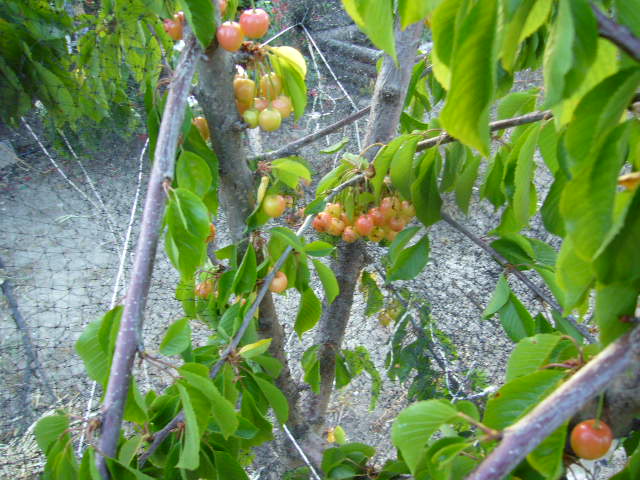
Royal Ranier Cherries-Two Weeks From Harvest
It was a child's delight "back in the day" to hoist myself halfway up one of those monster trees -- make myself comfortable on a couple of branches and eat cherries to the point where I was litterally sick of them. At that point I would jump down -- walk home -- only to return the very next day and repeat the same steps I had taken the day before.

There were always enough cherries.

I bring up this memory because it seems as if the timeline for actually growing cherries works a little like this:

Year 1: Plant cherry tree
Year 2: Cherry produces 1st small crop
Year 20: Finally get to enjoy your first cherry because it's the one cherry that hasn't been consumed by marauding neighborhood birds.

You see -- I'm a battle with the birds here in North Natomas. It's the Bird against the birds. The prize is a 3rd year crop of lip-smacking Royal Ranier Cherries. And the Bird is losing -- miserably.

The Royal Ranier Cherry Tree-Third Year
The wife that is Venus and I first learned that we would be going to battle every May after we saw a small 2nd year crop of Royal Ranier Cherries vanish overnight. We had just each tasted our first cherry from that 2nd year tree. We both agreed -- as good as those cherries were -- they needed another "day or two" of seasoning in the sunshine.

The birds didn't wait for seasoning. The next day our small crop was gone. I actually watched with chagrin as a robin popped into the tree -- and popped out with the final cherry -- stem and all. The look he gave me that particular day said it all. You can describe it with one word: SUCKER!!!

I had never done battle with the birds over cherry crops all those years ago in Modesto because the trees were so large and lush -- they produced more than enough cherries for an army of boys and birds to consume. It didn't matter if they got the crop at the top. There was more than enough on the lower branches to enjoy.

But that was a 30-year old tree. 30-year old cherry trees produce massively larger crops than three year old cherry trees do. And I'm not about to wait another 27-years to enjoy my first Royal Ranier Cherry. Neither is Venus. We'll both be using walkers by then.

A way to get rid of marauding birds?
So what is an enterprising North Natomas cherry tree grower to do then? I am reminded of a gorgeous young lady that I met one day last spring at a Sacramento Certified Farmer's market. This eye-catching, blue-eyed,  blonde cherry temptress was pushing a huge and wide variety of cherries freshly harvested from the family farm somewhere near Stockton.

When I asked this young lady for advice regarding marauding birds and cherry crops, those blue eyes flashed as she related a now famous line from Nazi Major Toht from a memorable bar fight scene in Indiana Jones and the Raiders of the Lost Ark: "Shoot Zem, Shoot Zem All."

Nice advice, but somehow I don't think the Bird neighbors surrounding the Back 40 ranch would appreciate it much if I started blazing away with a shotgun. I'm already pushing the envelope with the Hello Kitty colony of bees. Besides, shotguns and suburbs don't make for a good mix.

Scare Tape on the Royal Ranier Cherry Tree
So what is a frustrated cherry grower to do then? As this photo clearly illustrates -- I took the advice of a Kern County gardener and blogger by the name of Maybelline. "Scare tape," she advised. "Scare tape will keep them away." Sure enough -- I found said Scare Tape at Peaceful Valley Farm Supply in Nevada City -- and thought my problem to be solved.

Just one teensy-eeensy problem. Scare tape might "scare" the birds in Kern County. But here in Sacramento? Bird laugh at scare tape. In fact, they love it. They land right next to it -- and look at without nary a hint of alarm. In fact -- some of that "scare tape" has found it's way into bird nests around the neighborhood.

How do I know this? When you see a bird's next glistening in the sun? You just know. Scare tape that I dutifully tied to cherry and plum trees plus a thornless boysenberry bush that is now in tatters from some bird shredding it into pieces is yet another good sign.

Precious the Cat: Not a fan of Scare Tape
The scare tape did work on one creature. It scared the bird-killer cat of mine into the next yard. That was about the only defense I had against marauding birds anyway, and now Precious the Cat has flown the coop.

The next line of defense? The next line of defense is netting that I purchased out of frustration last year when marauding birds helped themselves to half of the June Pride peach crop that year. Now -- I'm not THAT stingy. I don't mind sharing a fresh fruit meal with my feathered friends. But when the feathered friends started helping themselves to EVERY peach on the June Pride tree? That meant war.

I must admit -- the netting did work wonders when I placed it on the O'Henry Peach tree later that summer. The wife and I enjoyed a late season harvest of beautiful -- un-bird molested -- O'Henry peaches. But I didn't like the effect the netting had on the tree itself. Branches were bent in a downward motion -- and never did straighten out. The tree still doesn't look quite right from a late summer netting -- and this year's terrible bout of peach leaf curl isn't helping matters much either.

Still -- the scare tape was doing everything BUT scare the marauding birds eyeing the Royal Ranier Cherry crop -- so on the netting went this weekend.

Bird after the Bird Cherry crop!
The response has been less than desired. Despite my efforts to tie up every loose nook and cranny -- one bird in particular continues to find his way inside. In fact -- he takes great delight in chattering how much of a fool I am. If he isn't locating holes in the netting at the bottom of the tree -- he's ripping this hole that I tied off with string in the top.

I've caught this one particular bird inside this netting three times today alone. Each time I dutifully locate and close off the hole I've left open -- or the hole he's managed to create. But somehow I think I'm fighting a losing battle.

I've had a weekend to battle this bird. Tomorrow? It's back to work and back to the workplace.

Somewhere a bird is waiting...

And laughing...

The Grape Ape

Sunday, March 27, 2011

Official/Unofficial Rain Gauge
That would be me -- aka -- The Grape Ape. Or as the wife that is Venus calls me -- APE (tis one of her nicer nicknames).

It's a waterlogged Sunday morning in North Natomas. Thankfully -- the skies are no longer pouring buckets of rain into an already oversaturated backyard. Although the Sacramento Bee bean counter is reporting just miniscule amounts of rainfall (is someone asleep at the switch downtown?) -- my official/unofficial rain gauge reports differently.

This wheelbarrow was last used during the construction of the Asparagus bed the weekend before last. It's the one "tool" that did not get put into its proper place -- and this is the end result of two solid weeks of non-stop stormy weather.

Memo to Sacramento Bee beancounters: That's a solid six inches by my count. Just thought you should know.

Ultimate Digging Machine at Play
I can't foray into the backyard much without putting on the special "mud shoes." The ground is far too saturated to work for any sort of gardening, but there are some minor tasks that can be taken care of. The Back 40 lawn ALWAYS needs attention thanks to the fertilizing efforts of the ultimate digging machine.

And -- oh - THOSE WEEDS! I see a bit of Monsanto in my future. Shhh! Yes, that's Bill Bird's dirty little secret. He is anything but organic. When a backyard screams for weed control such as mine does -- it gets a healthy shot of Roundup. It's either that, or invest in a goat.

Despite the heavy dose of wintry weather that we've been subjected too for the past several weeks -- I'm excited to report that things are not only doing great -- they're doing "swimmingly well." Sorry, lame joke alert. The Royal Ranier cherry tree is blossoming. Peaches are forming from the blossoms that appeared earlier on the June Pride and O'Henry Peach trees. And -- don't look now -- but we might even get a nectarine or two from our Backyard Orchard Culture experiment of last year.

Keep those fingers crossed kids!

Tablegrape Vines in 2010
But you know what really has my attention? It's the subject of this blog post (which I'm finally getting around too). The eight tablegrape vines that Venus and I planted last season are just now starting to emerge with new growth. Six of the eight vines will probably produce at least some fruit this year. The other two need a little more work.

You see -- I love grapes. I love grape juice. Grape soda was made for Bill Bird. Grape snowcones are a slice of heaven. Yet -- I hate wine. Figure that one out. Wine coolers? Those are good! Especially the old school California Cooler (which you can't find anymore, unfortunately). But wine? No thanks. I'll pass. I've never been able to explain this to myself. If I love grapes, I should have an equal love for wine, right? But it is the way it is.

I am most excited by the production that will be coming from the vine pictured to your left. That is the Crimson Red tablegrape -- one of my favorite varieties. It also happened to be the most productive last year in terms of growth. This was one of the two tablegrape varieties that actually survived the bare root planting season last year. The other six kicked the bucket and had to be replaced.

Crimson Red Seedless Tablegrape
But this one -- for some reason -- caught on. It grew like a weed. Although I did my best to keep it trimmed and focus on the growth of just one main vine (which will serve as the trunk) -- once that vine reached a height of six feet -- I let it grow in all sorts of crazy directions. The end result is a healthy and robust main vine (trunk) with three other vines protruding from the trunk itself.

I am told by others "in the know" that these vines will be my fruit producers this year. Although I've been told to "not expect much," other growers have seen photos of this vine and confirmed that I was the lucky recipient of outstanding vine growth last season. While other vines did reach out and grow beyond our 4.5 foot high trellis -- nothing performed like the Crimson Red.
Crimson Seedless in 2010

The other big producer? It should come as no suprise: Thompson Seedless. The Thompson is perhaps one of the best tablegrapes grown in the Sacramento/San Joaquin Valley. It is also the most productive. But while the Thompson also grew "like a weed" during its first year -- it did not develop the side shoots from the main trunk like the Crimson Red did. It will produce -- albeit not as much.

So what is the next step in growing tablegrapes in the Bird Back 40? Search me. I have no clue. I've never done this before. I'm relying on advice from friends (Farmer Fred Hoffman) plus a series of youtube videos that have been posted by the UC Cooperative Extension Service. Although those are helpful -- they don't necessarily deal with how second-year vines should be treated. The instructional videos -- instead -- focus on vines that have already reached full maturity. So -- the guessing game continues.

I did learn one hard lesson last season. Table and wine grapevines are susceptible to mold. I didn't notice the signs of mold until it had really taken hold on the two vines that did not top the grapvine trellis last season. Once I started treating the vines with the same Ortho Disease Control product that I use on my heirloom tomatoes -- our mold problems vanished. But it was too late for two of the vines. They grew a total of two to two-and-a-half feet.
From L-R: Thompson, Black Monukka, Fantasy, Suffolk Red

That's a far cry from the Thompson vine which eventually reached a height of ten feet. You can see that growth in the photos I took last September. The Thompson vine is that big, bushy vine closest to the camera. The two vines that did not produce well are to the far right.

Although first year growth produces a multitude of vines -- I did receive instruction to cut as many of the vines back and focus growth on one, main vine (the trunk). During my trimming efforts earlier this year -- I cut away excess vines and kept only the trunk -- and some vines that had developed off the main trunk. Again -- I'm told that these will be my fruit producers this year. The photos show that I've used green garden tape to tie these vines to the trellis.

Emerging fruit producer?
These vines are already starting to pop wide open -- despite our inclement weather. Fortunately -- due to the excess rainfall -- they haven't needed any additional irrigation. But that will change as the warmer weather sets in.

Is all the work of constructing the trellis and tending the vines worth the effort? I'll let you know later this summer, when the wife that is Venus and I are hopefully muching on a plate of tablegrapes fresh from our backyard-in-progress.

The Cruel Tease

Sunday, April 25, 2010

What's that song? Accentuate The Positive? Sung so brilliantly by Bing N' Bette in a 1977 television special?

I suppose I could talk about the show the roses are putting on in the backyard. The two giant artichokes we will harvest for dinner tonight? Maybe the monster garlic that is growing even more monstrous with every spring rainstorm or deep watering session on the weekends.

Nope. My "tale" this weekend is one of woe. It's one of those cruel jokes pulled by Mother Nature when I was least expecting it. There's no escaping this one. One of the fruit harvests that I most look forward to every spring and summer is no more -- stolen away -- by a dreaded disease called Brown Rot.

I just spent the better part of this afternoon pulling off every single diseased cherry from this Lapin Cherry tree located to your immediate right.

It wasn't easy -- but it had to be done. There will be no cherries from the Lapin this year -- which is the cruelest of hoaxes and "cherry jobs" that Mother Nature can deliver.

This was the ultimate tease. This tree produced its first crop during it's second year -- last spring. Yes -- it was a small crop. But it was a tasty one at that. The birds got a share. So did the bugs. But Venus and I got a nice taste of what was to come in Year 3. The Lapin -- also called a "self-fruitful Bing" -- is one sweet cherry.

So -- during the winter -- I dreamed of Lapin cherries. Not just one or two. But Lapin cherries by the bucket. Venus and I even planted a Royal Ranier Cherry tree nearby -- because we knew that one cherry tree just wasn't going to be enough.

Venus wanted enough cherries for cherry pies. I wanted to re-live the days of my Modesto youth -- where I could sit in a cherry tree and eat my fill. We took steps to baby the tree during the winter. I trimmed it for the first time. Venus mulched around the base of the tree. By the time spring rolled around -- we had those visions of cherries dancing in our heads.

Sadly -- something went terribly wrong.

Oh sure -- the first thing that took place this spring? The tree burst into a glory of white cherry blossoms. It is the moment I had been waiting for. Hundreds of blossoms covered every branch -- even the trunk of the tree got involved. Venus' two-year old Royal Ranier also got into the act with a few blossoms of its own.

But nothing was putting on a show quite like the Lapin. Venus and I began to make plans. I would need a mesh cover for the tree to fight off the birds. Venus -- meanwhile -- started researching cherry pie recipes.

But -- as time went by -- concern began to slip into that big cranium of mine. I wasn't sure what was wrong -- but something didn't seem right. Some of those white blossoms turned a light shade of brown before they could even fully open up.

This wasn't right -- was it? To be honest kids -- I really didn't know. I've never grown cherry trees before. This is a new experience for me. Perhaps this is normal? Perhaps not every blossom turns into a cherry? Perhaps it's fate that some die off before they can open?

As time went by -- my concern mounted. That light brown color turned darker. It covered entire sections of the tree. Worse yet -- some of that brown was beginning to move into the cherry blossoms that had already opened and developed a cherry husk.

I also noticed -- right about the same time -- that the leaves on Venus' cherry tree were developing at a much faster rate than the leaves on the Lapin. I reasoned -- at the time -- that this must be normal development since the Royal Ranier produces ripe cherries almost a full month before the Lapin. So -- it made sense that the leafsets would develop a little quicker.

Instead of taking action -- I waited. Two weeks later -- I knew that something was wrong. The young, still not quite developed leaves on the Lapin were turning brown. Some of the leafsets at the top of the tree had died back completely. That's when I knew something wasn't quite right in Dodge.

Where to turn? Facebook of course! The Social Media Pages are full of horticulturalists and nursery shop owners who could probably immediately diagnose the problem -- and better yet -- suggest a quick cure. So -- I snapped some photos -- the same photos that you see here -- posted them up on Facebook and asked for help.

It didn't take long. Redwood Barn Nursery Owner Don Shor diagnosed the problem less than eight hours later: Brown Rot. Farmer Fred Hoffman concurred. So did Sacramento Gardening's Angela Pratt. Brown Rot had taken hold of my Lapin Cherry tree -- and was delivering quite the knockout punch.

That's when I turned to the web for a little photo research. I started Googling phrases like "brown rot" and "Lapin Cherry brown rot" and some interesting and alarming photos popped up. Sure enough -- the infected brown rot branches that I found online were an exact match for what was taking place at home.

But even worse than that -- was a photo of a cherry tree that was exhibiting signs of Brown Rot in late summer. The fully developed leaves were turning a dark shade of brown and falling to the ground. It suddenly hit me that my Lapin Cherry had exhibited the exact same signs last fall. Although it should have raised red flags then -- I took the leaf die off and drop as the "sign of fall." The tree -- I reasoned -- would be back.

If only I had known.

The spores that cause Brown Rot overwintered and grew during the wet and cold rainy months. By the time spring hit? Every single branch was covered with disease. And I had no idea until it reared its ugly head with some early blossom die-off. By then? It was already too late. The entire tree was infected.

It didn't take long for the disease to progress. The green cherries that you see in the photos taken two weeks ago have since turned a shade of red and brown. Not a single cherry made it. And I just finished up today with picking the entire 2010 crop and dumping all of it -- every last cherry -- into the green waste bin.

The pie cherries? Gone. The eating cherries? Eaten by disease. The only cherries that Bill Bird will eat this year will come from the Farmer's Market.

Fortunately -- Brown Rot can be controlled. Unlike many diseases that force you to dig up a tree and start over -- regular applications of copper sulfate fungicides should be enough to knock out Brown Rot -- no matter how far it's progression. Other -- stronger -- fungicides are also available for home use. Those will be drafted into this battle at some point as well.

As for Venus' tree -- which is planted just 15 feet away -- so far so good. The tree isn't exhibiting any signs of disease yet. The few cherries on the tree will eventually ripen -- and hopefully Venus will get to one or two of them before our fine feathered friends start feasting away on them.

But if the leaves on this tree suddenly turn brown and begin to fall in late summer or early fall? Well -- at least I'll know what steps to take next.

What's Bloomin' at the Bird House?

Thursday, March 19, 2009

Ah spring, when a young man's fancy lightly turns to thoughts of love....

Or, in my case, heirloom tomatoes.

With all due respects to the great poet that is Alfred Lord Tennyson and my dear wife, that "young man" age went out with the 1963 Dodge Dart (starburst-neon green Dodge Dart I might add), my Foreigner casette tape of "Double Vision" (Hot Blooded, check it and see) and my acid-washed jeans.

Actually, I still have those jeans somewhere. Lord knows they don't fit anymore. Nor would anyone want them to fit.


I guess the point that I'm trying to make here is -- as you grow older -- you begin to appreciate what the spring season really means. There was a time in my life where winter -- and cold weather -- was "all that." Not anymore. I just don't like it when it's 33 and foggy outside. Give me sunshine. Give me warmth. And give me a show of daffodils and tulips blooming in the front yard.

Venus planted these daffodils during the first fall at the new home in North Natomas. And -- true to that lady's green thumb -- they came up again this year. As a matter of fact, every tulip and daffodil bulb she planted at the old home continues to sprout -- and each year those numbers grow as the bulbs grow, and then split into new bulbs.

But the most exciting part of spring -- to me that is -- is to watch the dormant, dead looking fruit trees suddenly spring to life. That happened about three weeks ago for this O'Henry Peach tree in the backyard. This is just the second year for this tree -- and you can barely see the bark on the branches through all of the pink peach blossoms. And the smell is -- well -- heavenly.

This is truly an exciting moment for me. This small tree produced perhaps ten to 12 blossoms last year -- its first in the backyard. And now? It's just covered with blossoms. This is one reason why Venus and I took the extra step of purchasing a hive of bees -- and one of my biggest concerns about the new yard.

Despite the number of blooms on just this one tree -- I haven't seen one single, solitary bee. Now, while it's true that peach trees don't necessarily need bees to pollinate, who are we kidding? Imagine this one tree full of bees. Then, imagine this one tree full of young peaches. It doesn't take much to take that next step. We will get peaches off this tree this year -- but not nearly as much as I was hoping for.

But the O'Henry peach isn't the only tree blooming in the front and backyard this pre-spring season. So is another peach variety called June Pride (Can you guess that perhaps I like peaches?). True to its name, the June Pride is designed to deliver a peach harvest in late June and early July. The O'Henry Peach will deliver its crop in late July and early August.

This means three solid months of peach harvests, which I can't argue with.

Venus and I purchased the June Pride and the O'Henry trees last February from Silverado Nursery. And although we planted before the spring bloom hit, the June Pride failed to deliver a single bloom -- which means it failed to deliver a single peach. As you can probably tell by the photo to your right, I'm hoping that won't be a problem this year. This photo is two weeks old and now the June Pride, much like the O'Henry, is covered with scads of pink blossoms.

But this isn't the only blooming thing taking place in our North Natomas backyard. This one single bloom (it's blurry -- I'm not great with a digital camera -- so sue me)? This belongs to the Lapin Cherry tree -- which the wife and I also purchased -- and planted -- last February. And this represents the very first cherry blossom this tree has produced. It will be the first of many, as I see shades of white about to burst out all over this tree.

Does this mean cherries are in our immediate backyard future? Tough to say. The Lapin is also known as a "self-fruiting Bing," which means it doesn't require another cherry tree to pollinate. It does have one nearby in the form of a Royal Ranier cherry tree (purchased this year), but it doesn't need it.

Still -- blossoms don't necessarily translate into fruit production. It's a good sign, of course, but I sure would feel better if some lonely beehive would discover our backyard.


Oh, give us pleasure in the flowers to-day;
And give us not to think so far away
As the uncertain harvest; keep us here
All simply in the springing of the year.

Oh, give us pleasure in the orchard white,
Like nothing else by day, like ghosts by night;
And make us happy in the happy bees,
The swarm dilating round the perfect trees.

And make us happy in the darting bird
That suddenly above the bees is heard,
The meteor that thrusts in with needle bill,
And off a blossom in mid air stands still.

For this is love and nothing else is love,
The which it is reserved for God above
To sanctify to what far ends He will,
But which it only needs that we fulfil.

A Prayer in Spring
Robert Frost (1915)