Showing posts with label Ken Menzer. Show all posts

Strawberries for the Soul

Sunday, March 30, 2014

Emerging Strawberries-Bird Back 40
And you thought Chicken soup was the only good thing for the soul? Guess again. Strawberries -- especially home grown berries -- are pretty darn good for the soul as well. I should know -- since fresh berry patches grace the Bird Back 40 -- providing us with a bounty of fresh berries from mid-spring through June.

Why plant strawberries? The most obvious answer is "why not?" Strawberries are a wonderful addition to any backyard -- and you can grow a lot of berry with a small bit of room. In this particular case? A raised bed holding fruit trees is also doing double-duty as a strawberry patch. As it turns out -- fruit trees and strawberries work quite well with one another.

Strawberry Plants in the Apple Patch
This is a tip that the wife that is Venus and I learned one adventurous Saturday afternoon during a class taught by Folsom City Arborist Ken Menzer. A lot of great ideas came out of that class -- some of which worked and others (blueberries) did not. But his advice to plant strawberries at the base of fruit tree plantings was spot on. Leaves of these trees help shelter tender berry plants from blazing afternoon sunshine, while the berries open up cracks in the soil allowing water and other nutrients to reach fruit tree roots.

The pairing just works. Another advantage to this tandem is strawberry plants choke out all weeds. I haven't been required to weed the berry bed for years.

Emerging Strawberries in the Pear Patch
It's done just fine for the apple trees we planted four years ago in a side yard of the Bird Back 40. This apple "patch" as I call it also holds the tastiest apple on the planet -- bar none: The Honeycrisp. The raised bed that the trees are planted in is dotted with a collection of Albion and Chandler strawberry plants.

Although they look productive -- this was yet another gardening mistake on my part. If you Google the terms of "popular strawberries to plant in California," up jumps a number of lists of strawberry plant recommendations. At the top of those lists? The number one plant for California gardens? The recommendation is the "Albion" strawberry.

Shuksan Strawberries
And so -- four years ago -- Bill Bird sat at his computer as he is now -- and made yet another gardening blunder. I ordered a set of ten Albion plants and ten Chandler plants from Sakuma Brothers Farms in Washington. Why was this an error on my part? Because I jumped before reading the fine print. As it turns out -- Albion is a GREAT strawberry for California -- but only for certain areas. Albion berries grow and produce best in gardening zones 3-8. The Bird Back 40 is located in Zone 9A.

Bummers. No wonder the strawberry plants weren't as productive as I hoped. Although they've set a nice crop here in Year 4 -- at some point I will pull them out and replace them with a strawberry plant that loves Zone 9A. There are plenty of varieties that do quite well in the Sacramento area. I just have to choose the right one.

Shuksan Strawberry Plant (bare root)
For this year's berry planting effort? I decided to read the fine print on the Sakuma Brothers website. In other words -- I found the berry for our backyard. It's called the Shuksan Strawberry -- and the bundle of 20 plants that arrived in the mail earlier this week have been planted here and there in the raised bed holding three pear trees.

Shuksan strawberries grow best in Zones 4-10 -- and are often found at those roadside strawberry stands that dot the Sacramento countryside during fresh strawberry season. They are good for fresh eating. They are good for jams and jellies. They are good for just about everything.

The Shuksan plants will grow through the spring and summer, sending out shoots and will take over every last inch of space in the raised bed holding our pear patch. Combine that with other strawberry patches dotting the Bird Back 40 -- and that's a lot of pie.

This is a bad thing?

I think not!

Instant Gratification and Gardening

Friday, February 1, 2013

Feed Your Citrus Trees! Feed Them!
Instant gratification and gardening do not mix. The words instant gratification and gardening, when used in the same sentence would represent an oxymoron. There are no quick results when it comes to digging in the dirt. There are only successes and failures.

If I had to compare gardening with anything, it would probably be a turn at a Las Vegas craps table. Sometimes you hit it big -- real big -- know what I mean? And then, at other times, you're informing the wife that is Venus that she'll be making the house payment this month. And perhaps the next...

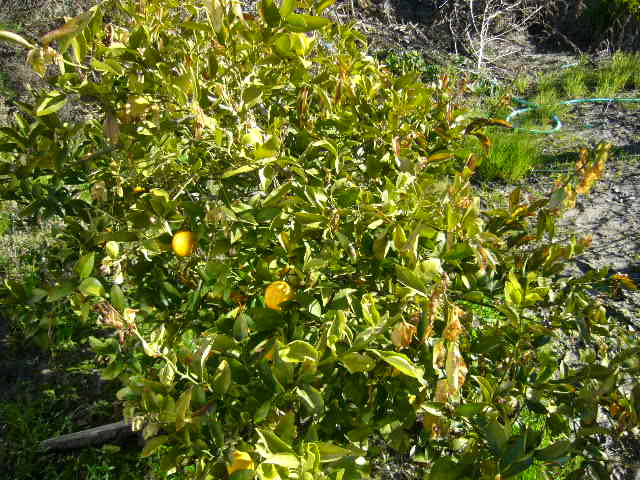
Owari Satsuma Mandarin-Bird Back 40
I bring this up because even an experienced gardening screwup like Bill Bird can still make some fairly basic mistakes by expecting to see too much in too little of a time. Case in point? Growth on the citrus and stone fruit plantings that currently dot the Bird Back 40.

I harken back at this point to some wonderful advice provided to us by Ken Menzer, the arborist employed by the City of Folsom. Ken is known to provide classes from time to time on various subjects that include fruit tree trimming and other tips and advice.

Long Gone Blueberry Planting-Bird Back 40
Yes, it is Ken Menzer who told the wife that is Venus and I to plant blueberry bushes beneath our fruit tree collections. Sadly, that experiment failed. I would later come to discover that both have different pH requirements and a couple of Southern Highbush plants would go on to kick the proverbial bucket.

But -- I must say that Ken's advice about planting strawberry plants beneath fruit tree groupings was spot on the money. His other advice that I took to heart and would later abandon? Fertilize fruit and citrus trees once a month -- every month -- without fail. "It doesn't take much," I recall him telling us. "Just a handful here and there every month."

Apple Trees and Strawberry Plants in Winter
At first? At first I followed his advice to the letter. I dutifully purchased bags of fertilizer for my many citrus and fruit tree plantings scattered across our North Natomas backyard. Every month -- without fail -- eight table grape vines got a little something. The same with those peach trees over there -- and the nectarines in the front yard -- they got the same treatment. Nobody got the cold shoulder.

But at some point in this journey -- I can't place exactly when -- I sort of fell out of this practice. I'm not sure why. Perhaps I got a little disappointed when the fruit trees failed to "take off" after six months of loving care? Perhaps it's when Capital Nursery went out of business, taking that supply of fruit tree fertilizer I loved so much.

Dancy Mandarins! Yum!
I can't remember when I did it. Point is? I did it. I stopped when I should have continued. Why? Because last year those fruit trees that I'd lovingly cared for suddenly sprang to life. One peach and one pluot tree doubled in size over the course of a summer. The three nectarine trees started acting like they had ingested some of Jack's "magic beans." The Dancy Mandarin delivered a whopper of a harvest this year -- the largest ever.

The same can pretty much be said for most fruit and citrus tree offerings scattered in and throughout the Bird Back 40. I had one of my best production years ever. I ate table grapes until I was sick of table grapes. Sick of table grapes? That's a crime!

Fruit Tree Fertilizer (now gone)
Even after one whopper harvest or growth spurt after another, I still failed to put two and two together. I never have been the best at math, I will admit. But this equation is fairly basic. As the Scotts Fertilizer pitchman once begged: "Feed Your Lawn! Feed it!"

It wasn't until just recently -- fairly recently I'm ashamed to admit -- did that proverbial light suddenly snap on in the rather darkened spot between my ears. This wasn't some mistake. Last summer's growth spurt and good harvest was probably due to Ken Menzer's good advice. And, unfortunately for me, I'd stopped following it at some point.

Improved Meyer Lemon After Frost Damage
I'm happy to report that I'm "back on the wagon" again. I'd committed the gardening sin of expecting instant gratification from my garden. Worse yet, I'd abandoned a practice that had served up some mighty fine peach cobbler desserts over the course of a summer.

The $64 question is -- did I wait too long to resume what had served me so well? I can tell you this much: I won't go expecting instant results...

Peachy Keen

Saturday, June 2, 2012

June Pride Peach Tree-Bird Back 40
There is only one thing that I can think of in this world that's better than a tree full of ripening peaches. It would have to be a peach tree, loaded with peaches, that is doubling in size.

Why is this such a good thing? DUH! More peaches next year! When it comes to growing fresh peaches in the backyard, one tree full of peaches is never enough. Two or three trees is just about right.

There is something rather strange and exciting taking place in the Bird Back 40 this 2012 spring season. The peach trees that the wife that is Venus and I planted some four years ago are -- for some reason -- both growing like weeds. It's enough to make a amateur peach grower wonder: Why didn't this happen last year? The year before? Why this year?

Exponential Peach Tree Growth
Both the June Pride and O'Henry peach trees are finally beginning to take off in terms of new growth. And while that may not mean much in terms of peach production this year, it almost certainly portends good things to come next year and in the years to follow.

I still haven't begun to figure out why certain fruit trees will grow an inch one year and then two feet the next. Does it have anything to do with fertilization? Water? Perhaps they're just in a really good mood? Those love songs I croon to them in the dead of night (sorry neighbors)?

Not that I'm complaining mind you. I'd always been somewhat distressed by the lack of growth in both Bird Back 40 peach selections. Don't peach trees get any bigger than this? Hey! Look at that Royal Rainier Cherry tree planted some 30 feet away! It grew ten feet last year! Why can't you do that June Pride?

Perhaps the shame worked.

Ripening O'Henry Peach
It also might be the fertilization schedule that I adopted last year at the advice of Folsom City Arborist Ken Menzer. His point was, why fertilize fruit trees once or twice and then stop? Why not fertilize them once a month? Why not try a cocktail of different fertilizers? If the liquid organic fertilizers are so successful with tomato crops, try feeding the same mixture to the fruit and citrus trees.

Menzer's message has largely been a blessing. It's not just the peach trees that are literally reaching for the sky this spring. The table grapes -- now entering their third year of growth -- are putting on a show I've never quite witnessed. Several of the citrus trees are reacting in the same manner. The Dancy Mandarin, for example, has now grown so large that I will need a ladder to harvest the production at the top of the tree.

New Fruit Bearing Branches-June Pride Peach
Although the mockingbirds that curse the Bird Back 40 are casting a hungry glance at the June Pride and O'Henry peaches that are slowly growing into maturity this season -- I dare not throw a net over these trees. While netting does preserve a crop for "humans only" it also tends to bend branches in a downward direction. What had been a ten foot tall tree loses a foot or three once the netting is removed.

Short and sweet? Those new branches that are green and pliable have been bent in a terrible direction for so long that they're not going to "straighten up and fly right" again. So -- the net stays off. The mockingbirds will probably knock half the crop off the tree -- a tragedy no doubt. But my "new growth" patience will pay off with larger harvests in the years to come.

What more could anyone ask? What's better than fresh peach pie? Two peach pies!

I'm such a glutton!

The BOMB!

Wednesday, November 30, 2011

Lime Beef Bomb
As in LIME BEEF BOMB! Gentle readers -- I am about to share a cheap n' easy recipe that will even make Poor Girl Eats Well drool on her keyboard. And she's a pretty good cook! That recipe -- once finished -- results in what you see to your right. And it can be made with any type of vegetable (including broccoli), stir fried or steamed -- it's all up to you.

The best part is? Some of the key ingredients come straight from the Bird Backyard and citrus orchard, including the bell peppers pictured above? Did you think that growing peppers was a summertime deal only? So did I! Funny thing is -- fall came and they kept right on going. They've come through rainy weather, frosty conditions and lots of fog and are still putting out some mighty tasty produce.

Who am I to complain?

Fresh Bearss Limes
This recipe originally appeared in the Sacramento Bee section for food lovers -- which Bill & Venus Bird are. If I'm not mistaken, the source the Bee used for this article was Tuk-Tuk Restaurant in North Natomas, just a hop, skip and jump from the Bird Back 40. If memory serves me correctly, this was originally a recipe for a beef salad  (Lam Nuea?) seasoned with fresh limes, hot peppers and other Thai ingredients. If you want to use this as a salad recipe, with your favorite greens, you most certainly can. This can be modified in so many different ways, which is why we make it often (also because we kind of love it).

If there is one absolute KEY ingredient to this recipe it would have to be the fresh limes that are now coming ripe by the dozens in the Bird Back 40. I realize that not everyone has a lime tree in the backyard or even the front yard. But if you can find a source for fresh Bearss Limes, I highly encourage that you take advantage of said source. I have tried a number of different lime varieties with this dish, including the Key or Mexican lime, but I keep coming back to the Bearss. It has a sweetness factor that serves this dish well.

Beef soaking in fresh lime juice and Thai herbs
Fresh limes also have another big advantage over limes purchased in your local supermarket: They are far juicier. The dish that we doubled to serve two people last night was made with just three fresh limes. In the past? When we were without fresh limes and had to settle for whatever the produce aisle offered? It took six to seven limes to accomplish the needed task. The end result wasn't nearly as good either. I cannot stress this enough: the better quality of lime that you have means a much better tasting meal.

And this is one good tasting meal.

It means a pretty good trek in cold weather to reach the Bird pepper patch these days. Much of the yard is still not landscaped in the way I would like. These vast stretches of open dirt are fine in the summer, but turn into a muddy, sticky, clay SLOP at the first hint of rain, fog or cold weather. I don't know if you've noticed or not, but it's pretty darn sloppy right now. This means the donning of mud shoes, a flashlight to find my way in the dark and a bowl to carry the harvest back inside.

Fresh bell pepper harvest
And what a harvest it was! I'm not sure why the peppers are still churning out product at this point in the season. But I'm not going to complain about it. If life gives us green peppers? We make meals with peppers, including this Lime Beef Bomb dish, fajitas or just plain raw peppers sliced and seasoned with salt, pepper and a drizzle of red wine vinegar. One other thing I've noticed? While the peppers are still growing and producing at a rather eye-popping rate, they do not offer the heat factor that summer peppers bring. That's fine by us because the wife that is Venus likes her bell peppers to be sweet, fresh and crunchy. That is exactly what she gets.

We've been blessed with a lot of production from our three-year old Bearss Lime tree this fall. It also seems to like its location. While not huge, it has grown well since we planted it. We've allowed this citrus tree to produce since the first season, and while last season's production of a single, solitary lime was a bit of a downer, this year's production of about 50 limes has us smiling from ear to ear. Fresh limes go well in cooking. They also go well in Pacifico, which is something we're just a tad familiar with.

A tad...

Chopped peppers ready for steaming
The monthly fertilization schedule that we adopted some years back for all fruit and citrus offerings in the Bird Back 40 also seems to have played a positive role in production. It's not all that difficult to be honest. The instructions from City of Folsom Arborist Ken Menzer were to throw a handful of pelleted fertilizer beneath each tree every month. It appears to be good advice. If the fertilizer regimen resulted in production like this, I highly encourage it. It also doesn't hurt to have a beehive in the backyard, as honeybees LOVE citrus flowers. Bees, as we all know, are essential pollinators. I don't know if we would have this kind of production without them.

As for the vegetables, you can use your favorite. We sometimes go the stir fry route. I happen to prefer vegetables that are lightly steamed rather than stir fried. Lightly steamed vegetables retain their crunch factor and don't contain the oil content that results from a stir fry. We do always try to use fresh vegetables for this dish because anything that comes out of a bag (frozen veggies) gets somewhat limp during the reheating process.

As the wife would say: limp is bad.

Sliced beef cooking in fresh lime juice and seasonings
We've used many different cuts of beef for this dish. Since the key to this recipe is the lime and the soak process, any cut of beef will work. Venus and I generally follow the sales and stock up on beef when it's on sale. For instance? Last night's dish featured two Harris Ranch New York steaks that we cut into strips. But we've also used Tri-Tip for this meal as well as London Broil. In other words? It's "whatever you got." Ground turkey also works with this dish, but I must admit, beef is just so much better.

And now -- without further adieu -- the recipe for LIME BEEF BOMB. Remember this one piece of advice: the key to this recipe is the quality of the lime used, and the soak factor. The longer the beef soaks in the lime mixture, the better.

Happy eating!

LIME BEEF BOMB
(note, we usually double this recipe for two people)


1/4 cup freshly squeezed lime juice (about two limes)
1 tablespoon soy sauce
1 tablespoon sugar (substitute honey if you want)
1/2 teaspoon red pepper flakes
1 tablespoon Sesame Seed Oil (any oil can be used, but Sesame Oil adds taste)
1/2 lb steak (tri-tip is good, we used NY Steak last night)

Steamed peppers
Directions: Cut beef into long, thin strips and layer into a wide, raised bowl. Once the first layer is complete, spinkle liberally with salt and pepper and press into meat. Add a second layer of beef and again sprinkle liberally with salt and pepper and again press into meat. Keep repeating this process depending on how much of this you make.

Mix lime juice, soy sauce, sugar, red pepper flakes and oil together. Mix well. Pour half to three quarters of this mixture over beef . Let soak at least 30 minutes before stir frying or just frying in a regular pan. Cook until most of the lime mixture has evaporated,. OR -- if you enjoy a raw beef, reduce cooking time.

The absolute KEY to this meal is the LIME and the SOAK process. Add the cooked beef to an already prepared salad or steamed or stir fry vegetables and rice and enjoy it in another way.

Snip, Snip, Snip!!!

Sunday, May 1, 2011

Smile! It's SPRING!
Let the record show -- on this day -- May 1st, 2011 -- Mother Nature finally delivered the most beautiful, warm, wonderful spring day of the year. It's been a long time coming. Yesterday's windy conditions down here in the North Natomas riverbottom frustrated me to no end. But today? Today my friends -- as the photo will show -- today is a day for wide, colorful smiles.

Let the record show that -- on this date -- Bill & Venus Bird will fire up the Mantis Rototiller and get to work on amending the test bed for the 2011 corn, melon and squash crops. But it's a little early yet. The Mantis makes quite the racket. I'll let the nearby neighbors enjoy a bit more Sunday stillness before I intrude upon their Sunday quiet.

In the meantime -- big things are literally jumping out of the ground in the Bird Back 40. If you're a fan of home grown fruit? It's a sight to behold. The fruit tree trimming practices that Venus and I learned from City of Folsom Arborist Ken Menzer last year have been put into practice. The resulting yield has been quite surprising to witness.

He was right.

Flavor Finale Pluot Tree
There are two things from Ken's class that stick out in my mind. The first? "Fruit trees grow very fast," he instructed. That surprised me because it seems like I've been waiting eons for my backyard fruit crops to produce in the eye-popping numbers that I desire. The second? The second tip he delivered, which Venus and I have also put into practice, is to fertilize fruit trees on a monthly basis.

This doesn't mean you're required to get on your hands and knees with hoe in hand and scrape fertilizer into the soil around a base of a tree either. Nope -- his instruction was to take a small handful of fertilizer and just toss it under a tree once a month. In my case? I use a set of measuring cups that I keep in the garage. Each tree gets a 1/4 cup of fertilzer or less once a month without fail.

Pluots on the Flavor Finale Pluot Tree-Year 2
The advice that he delivered -- to prune every fruit tree branch after it has developed five leafsets -- plus fertilize monthly -- has produced some impressive results as you might be able to tell from the photo to your upper left. That, my friends, is the Flavor Finale Pluot tree that wifey and I planted during the 2010 bare root planting season. It had exactly three branches on it.

Today? A little over a year later? The Flavor Finale Pluot has about 30 branches. There is fruit all over the tree. It is growing like a weed -- as are the nectarine trees that we have planted out in the front yard -- in a small corner tucked against the home. The next door neighbor -- a retired farm-hand who worked peach groves all his life in Yuba and Sutter Counties -- warned me that "it would never work."

Today -- those trees -- also planted about one year ago -- trimmed and fertilized faithfully -- are approaching seven feet in height. Each of the three trees is loaded with nectarines. Unlike the peach trees planted in the Bird Back 40 -- which are suffering from a terrible bout of peach-leaf curl this year (Farmer Fred Hoffman has an excellent and informative posting on peach-leaf curl here) -- the nectarines are healthy and loaded with new branch growth. The neighbor -- who worked commercial farms for most of his adult life -- is quite fascinated with the growth show that is taking place and is considering his own patch of home-grown fruit.

Nectarine Trees-Frontyard Orchard Culture
See? This insanity cannot be cured.

Although the pluot is not part of a grouped Backyard Orchard Culture concept planting -- I am still treating it as if it is. This means trimming the tip off each branch after five leaf-sets have emerged. The Flavor Finale Pluot has reacted to this trimming party by growing at least two-to-three new branches from each branch that has been pruned. Once the new branches have unfurled to five or six leafsets -- they too are pruned back -- resulting in a tidal wave of branch growth.

I have already started the process of pruning the pluot for the first time in 2011. The new branches that emerged with the onset of a cold spring earlier this year have already unfurled to five or six leafsets. The trick to this pruning method is to prune at least three or four times per spring, summer and fall season. It's not hard -- but it does require an hour or so of time to locate all of the new growth and prune it back. Since the new growth is green and pliable -- it doesn't take much effort. You don't even need gardening shears. Fingers and fingernails work quite nicely.

New branch (left) emerging from trimmed branch (right)
I am not quite sure if the pruning or fertilizing routines are the reason behind this rapid and sudden growth. Like everyone else who prefers home grown fruit -- I can tell you that some trees are doing well and others not-so-well (see: peaches). But I can tell you that every tree that has been subjected to this trimming and fertilization effort has resulted in rapid, eye-popping growth. There's not a failure among the bunch.

So -- if you love it? WHACK IT! Remember? With each new branch that emerges during a summer of pruning? That's just one more branch that will result in a boatload of fresh fruit the following year.

A Very Berry Experiment -- AKA: They Stay

Friday, February 19, 2010

A Word to the Wise.

Before heading out to your favorite nursery/big box store this weekend to fulfill your gardening duties or fantasies -- I post the following update in response to the previous posting of "A Very Berry Bird Backyard."

It is in this section where I detail the efforts that Venus and I made to increase our berry plantings around the yard. Following the advice of Folsom City Arborist Ken Menzer -- we completed a project by planting bare root blueberry bushes beneath our cherry and peach stone fruit trees.

We took this action after attending a Home Orchard class taught by Mr. Menzer last month. It was there where he offered the following advice of planting blueberries beneath stone fruit trees. To paraphrase: "Blueberry bushes and stone fruit trees have a symbiotic relationship. Blueberry bushes are shallow-rooted -- and help open fissures or pockets that benefit the fruit tree root systems located below. At the same time, the leaves of the stone fruit trees provide cover from the afternoon sun for blueberry bushes planted below."

The Folsom City Arborist offered the same advice with the planting of herbs like Spearmint underneath apple tree plantings. The symbiotic relationship -- he indicated -- was similar.

I want to advise my vast readership (all 2.5 of you) that Venus and I are not "experts" in the gardening field. We are not Arborists. We are not Certified Master Gardeners. We're not even close. We are just your normal, everyday, couple. We love to garden. We blog about gardening. But that is as far as it goes.

I offer this word of warning because it seems that we've set off a small firestorm of controversey regarding this planting of blueberry bushes beneath stone fruit trees. Please be advised that there ARE -- indeed -- Certified Master Gardeners who do NOT agree with what we have done here.

One of these Master Gardeners who I mention often on this blog -- and is probably the most popular and well-known gardener in all of Northern California is Farmer Fred Hoffman -- who hosts the Sunday gardening shows on NewsTalk 1530 KFBK and Talk 650 KSTE.

I refer to Fred often because he is perhaps one of my biggest gardening mentors. I've learned a lot from listening to his show -- and also learned a great deal when I was working with Fred at both stations. Although I didn't work directly with him -- I could hear him from my perch at the "News Update Desk."

It's safe to say that Mr. Hoffman was not at all pleased with the blueberry planting efforts highlighted in "A Very Berry Bird Backyard" -- but he's not the only one. Others in his corner include Redwood Barn Nursery Owner Don Shor, who holds a Bachelor of Science degree in Environmental Horticulture and Angela Pratt, who holds a similar degree in Horticulture and is also the creator and the brains behind Sacramento Gardening.

Let me tell you this much: These people know what they are talking about when it comes to any sort of landscaping effort around the front or backyard. They know far more than I'll ever know in five lifetimes of gardening. They know what works. They also know what doesn't work.

Planting blueberry bushes underneath fruit trees? According to all three? It's NOT GOING TO WORK.

Get that? Let me repeat: IT'S NOT GOING TO WORK.

Why? Well -- the first warning came from Fred Hoffman AFTER we had completed our planting efforts. In his words: "What is the pH of the soil where you planted the blueberries? If it is above 6, you may have poor production. This is why blueberry planting around here is recommended for containers, where you can control the pH."

Not only that -- he provided this link to the Dave Wilson Nursery website -- where the number one piece of advice was:

"To make growing Blueberries easier, Do NOT Plant them in the ground!!"

Oh boy. Oh joy. I could just imagine the look on my wife's face after she worked so hard to put these blueberry bushes underneath the fruit trees in question. And now we had to pull them out? But why would Ken Menzer indicate this was an acceptable pairing?

Fred's advice on the matter continued with the following link from the University of California Cooperative Extension. This helpful information also contained the highlighted words of advice:

"A major requirement, however, is that blueberries require an acidic soil with a pH of about 5.0 to 5.5. Blueberries are in the same family as azaleas and rhododendrons, and need similar growing conditions."

Fruit trees like peaches -- I was to later learn -- do best in a soil pH range of 6.0 to 7.0. Blueberry bushes require an even more acidic soil with a pH of 5.0 to 5.5. Yes -- while both pH readings are considered to be in the "acidic range," the requirements of both do not mix well together.

In other words -- if the following information and advice are true -- stone fruit trees and blueberry bushes make for poor cousins and should not share the same living quarters.

Yet -- at the same time -- both Venus and I keep reading the notes and advice we learned from Ken Menzer. He didn't just have "words of advice," he illustrated the pairing together in a series of slides from his home orchard.

And there it was: visual proof. Blueberry bushes planted directly beneath stone fruit trees. Not just any blueberry bush mind you -- but HIGHLY PRODUCTIVE bushes that were loaded with berries.

Pictures do not lie.

Now -- I offer this posting to you as a warning. It's not that I do not believe or reject the advice of well respected gardeners like Fred Hoffman, Don Shor or Angela Pratt. All three of them are on the same page when it comes to time-tested advice of where blueberry bushes should be planted -- and where they should not be planted.

I will also add that whenever I've ignored the good advice offered by one or all three -- I wind up regretting it a great deal. Not all of the time mind you -- but most of the time.

But as far as we're concerned? We're stubborn. We're going to leave the Southern Highbush Blueberry bushes right where they are planted. If gardening can be singled down to one word it would be EXPERIMENT.

As far as our little experiment is concerned: Time will tell. The blueberry bushes that we planted last weekend will either produce -- or not produce. We're taking a chance at this -- but it's a chance we're willing to take.

As for you? Well -- it's up to you. Consider yourself *informed.*

A Very Berry Bird Backyard

Tuesday, February 16, 2010

It's a backyard built for the Birds -- and those thieving robins will thank us with even more thievery in the coming years.

Why?

We've planted more "Bird food" as evidenced by the photo to your immediate right. That my friends -- is a bare root blueberry bush purchased not all that long ago from the endless garden aisles at Home Depot.

This Southern Highbush variety Blueberry known as "Misty" has two other friends planted nearby called "Sharp Blue." And they are the latest entrants into the Backyard of Bird.

Venus and I didn't let the past weekend go to waste. While snow has buried vast areas of the country -- Mother Nature blessed us with two days of abundant sunshine and moderately warm weather.

While it wasn't quite enough to completely dry out the mudpit that is our current backyard status -- it firmed up enough to get some much needed work done. The clock is ticking on bare root season folks. The new fruit and berry additions to the Back 40 go in now -- or you face the prospect of paying top dollar later this spring and summer or -- worse yet -- waiting for Bare Root Season 2011.

The first project? Find a home for the two Black Satin Thornless Blackberries and one Thornless Boysenberry that I ordered through Bay Laurel Nursery earlier this winter. I had the spot picked out -- but I needed to do more than just "dig and plant."

Nope -- it's got to look "the part." I'm snobby that way. Plus -- it's got to be irrigated. I can't be dragging a hose or watering can all over the yard this spring and summer. What does this mean? It means a small profit for the Man's Toy Store that is Home Depot -- lots of screws -- quite a bit of clay mud (a great leveling tool), straps to hold everything together, a big pile of drip tubing and some well amended compost for the bed itself.

I don't want just any old blackberry. I want Monster Berries. Since I've yet to fail with any gardening item planted in a raised bed -- I'm hopeful we'll have a mass of berries to harvest in another year or three. The hard work won't pay off with a harvest this summer, but next year and the year after? Time will tell.

I got hooked on the Black Satin Blackberries after spotting a blackberry bush in the backyard belonging to South Natomas Gardener Extraodinaire Nels Christenson. Did I say "spot?" Attack would be a more appropriate word here. After all -- it did take a crowbar and quite a bit of pressure for Nels to pry me off the thing.

My one memory of that event? Man -- those were some mighty good berries. The bruises from the crowbar have long since faded.

The berry culture has come quite a long way since I grew boysenberries as a kid growing up in Modesto. Back then? Blueberries didn't grow on the West Coast. That was an "East Coast thing," according my mom. Boysenberries did grow well here -- but I soon discovered they had thorns. Not just any thorns either -- but thorns that produced ear piercing screams of pain from a young boy who really didn't know any better.

It didn't take long before I avoided that bush like the plague. Hey, I liked boysenberries -- but nobody told me about those THORNS FROM HELL. I think I eventually took the thing out with a flamethrower. My first experience with the berry business was a bitter and painful disappointment. But -- I digress.

Fast foward from the Sluggish Seventies to the New Century -- and breeders have taken over with advanced versions of your favorite berries -- minus the thorns. Not only that -- but that "Blueberries only do well on the East Coast" argument -- has also gone by the wayside.

Suffice to say -- these are not your "mom's blueberries." The Southern Highbush varieties are a relatively new entry into the blueberry market. Derived from the Northern Highbush varieties that did not produce anywhere outside of the State of Maine (OK -- that's just a little joke) -- the Southern Highbush has been hybridized to where it will perform -- and perform well in Central California climates. Further hybridization has led to more than a handful of different types like "Sharp Blue" and "Misty." But there are many others.

Why are we planting Blueberries? Because we can. Where are we planting them? Underneath the stone fruit trees. What? Who said you can do that? Blame Ken Menzer. The Folsom City Arborist not only told us we could do it during a recent Orchard Management class -- he actually commented it was "beneficial" to both stonefruit and berry bush.

Well -- we have lots of room underneath our two peach trees and two cherry trees...And Ken Menzer not only said we could do it -- he all but reccommended it...

Nuff said. Berry madness has officially taken over...

Venus and I worked as a madcap team during the bare root planting effort this past weekend. I would mix together yards of compost and steer manure fertilizer -- drop them at the base of the fruit trees in question -- and Venus would shape those piles into half moons and plant bare root blueberry bushes and strawberry plant starters.

The last step? Irrigation. The new beds are irrigated. They are planted. The weekend planting effort resulted in the planting of four blueberry bushes -- two strawberry plant starters -- two thornless blackberry bushes -- one thornless boysenberry (thank God) -- a Flavor Finale Pluot tree and yet another Improved Meyer Lemon for our "citrus patch."

Are we done yet? Hardly kids. Scratch another item off the long list of "things to do." But there's still more adventure to come. Bare Root season is just getting started...

Orchard Insanity!

Monday, January 25, 2010

It's confirmed. I am certifiable. I'm more than ready now for a nice padded room with no sharp objects. Heck -- you might as well throw in a strait jacket for good measure.

The proof of this insanity? It's in the pudding. Clearly identifiable. When Reggie Bush was busy fumbling away a punt during the close of the first half of the Saints-Vikings NFC Championship Game -- what was I doing? Watching the game? No. Try digging holes in the front yard.

You see -- this just isn't the norm for most sane men. Not at all. Most normal men would be screaming at the top of their lungs or throwing the nearest cat/sharpened object at the TV screen after watching Reggie cough up a punt. This is what Bill Bird would have done -- the normal Bill Bird that is.

But Bill Bird is no longer normal. He's so eager to dig in the dirt now that a steady rain doesn't matter. The NFC Championship Game doesn't matter. Cleaning out the litterbox can come later. I've got nectarines on the brain instead of football.

Quick! Somebody call Bellvue!

I blame Ken Menzer. He's the responsible one Your Honor. The Folsom City Arborist filled my head with all sorts of funky ideas and plans during a recent Orchard Management class. Thanks to Ken's "you can do this" brainwashing techniques -- where I once saw "landscaping" -- I now see endless orchard opportunities.

Bare Root Season is now nearly over -- and quite frankly -- it's been a bust for a lot of people. Why? You can buy all the bare root trees or bushes that your heart desires -- but when it rains so hard that the backyard turns into a lake -- there's little you can do. Sure -- you can try to plant a tree. But you'll need a rowboat to reach the spot you've picked out in the backyard.

But -- as of yesterday -- I had just about had enough. You see this tangled mass of jungle to your left? This ladies and gentlemen -- is part of "$15,000 in free landscaping." Basically -- it's what you get when you buy into a cookie cutter subdivision like I have. Landscapers throw in a bush here and a plant there -- a few blades of grass and some lawn sprinklers -- and announce that you've just received: "$15,000 in free landscaping."

Actually, it's more akin to paying $15,000 for a well used, 1963 Dodge Dart with pushbutton transmission. There's nothing special there. It's just a rusted out car with an old slant six engine that leaks oil. Badly.

As of yesterday -- that "free landscaping" went where it belongs. Those confounded bushes were blocking the path of my nectarine orchard. They weren't just blocking the path -- but the actual orchard itself.

An orchard? In that small a space? Yes sir! The new term for this planting style is called "Backyard Orchard Culture." But -- basically -- it's throwing anywhere from three to four trees into a space the size of a coat closet and watching it grow.

Does it work? Ken Menzer says it does. Farmer Fred Hoffman -- a big advocate of Backyard Orchard Culture -- has been pleading with me to adopt this practice for years. I didn't listen then -- but I see the big picture now. Where some people see bushes? I see fruit trees that are trimmed into a well managed hedge.

The technical explanation for Backyard Orchard Culture -- as explained by Dave Wilson Nursery -- is... "the prolonged harvest of tree-ripe fruit from a small space. This means planting close together several or many fruit varieties which ripen at different times, and keeping the trees small by summer pruning."

So why have three bushes when I can have three nectarine trees? Make those FREE nectarine trees while you're at it. Ideally? You want to purchase your bare root trees at a nursery. They have a better selection of trees to start with. Plus -- overall -- the stock is also a tad better.

But when someone like Bill Bird is armed with a $100 gift card for FREE CRUD at Home Depot? The Big Box store wins. Nurseries lose (although I'm still looking for a white Nectarine to finish out the planting).

That photo to your left? Those are the tops of the two bare root Nectarine trees that I purchased just yesterday. They happen to be the "Flavor Top" and "Fantasia" varieties of nectarines -- which happen to be two of the most popular varieties grown in California today. That's why I found them at the Man's Toy Store (Home Depot).

Can you just imagine what those tree tops will look like this spring? Can't you just imagine now nice and leafy the growth pattern will look? Can't you just imagine what kind of fruit will come from the tops of these trees?

Don't imagine. Because -- the last step in the Backyard Orchard Culture planting process is perhaps the most criminal and perhaps the hardest thing to do. These two trees have just been sentenced by the Queen of Hearts from Alice in Wonderland. The verdict is in: OFF WITH THEIR HEADS!

That's right -- these two trees have (or had) a date with my Corona Loppers. That nice collection of branches you see in the photos? They are long gone -- into the Green Waste can they went.

This is how both trees look today -- in the here and now. This was the hardest part of my planting efforts on NFL Championship Sunday. Tearing out those old bushes? Piece of cake. Amending the wide hole with the right amount of soil, compost and fertilzer? A pleasure. Planting said trees with loving care? A snap.

Cutting off the tree at knee length? It's enough to bring tears to the eyes of your fruit tree sap. But there's a method to this madness. Soon -- spring will come. These trees -- if I haven't shocked them too much during the planting process -- will produce new shoots and new branches. And I can control where the tree grows and how high it grows through the Backyard Orchard Culture process.

All you need is a good pair of loppers and the determination to trim trees three to four times per year rather than just once.

The payoff? Different varieties of nectarines during the summer months -- without needing a ladder to reach them.

For more information about the Backyard Orchard Culture process -- visit the Dave Wilson Nursery information page here. Farmer Fred Hoffman also has similar instructions -- plus a few other handy tips -- here.

As for me? I'm hunting for a white nectarine to finish out my coat-closet orchard. Just don't tell her what's coming.