Showing posts with label grafting. Show all posts

Gold Nugget or Crazy Good Mandarin?

Saturday, April 25, 2015

Gold Nugget Mandarin-Bird Back 40
I'll be honest. This past winter restored my faith in citrus. I had one of the best citrus harvests ever on the Dancy Mandarin. And since Mr. Freeze steered clear of much of the Bird Back 40 this past winter, my citrus and avocado plantings sailed right through a mild winter and bloomed like something special this spring.

Know what that means? It means a record harvest later this fall for the Bearss Lime, aka Gin and Tonic, tree. That's what it means! Because when it comes to a mean Gin and Tonic or a mean Tom Collins, a juicy Bearss Lime or three is absolutely essential. That my friends, is fresh drink heaven.

Mister Snow Miser (Not Kind to Citrus)
Last winter was also a far cry from the devastating winter of 2013. Yes -- 2013 was just as dry, if not more so, than 2014. But what 2013 had that 2014 didn't was a long and extended stay by Mister Snow Miser. Do you remember him from your ABC Holiday specials? He's got a thing or two for icicles, and unfortunately he stuck around for far too long in December 2013. By the time he finally departed, the lemons had shriveled into unappetizing black lumps. Oh -- and half of the Gin and Tonic tree decided to take a dirt nap.

Good riddance to 2013!

Part of this past weekend was dedicated to restoring the damage that took place during 2013. The Clementine Mandarin that also checked out permanently that year was replaced this past weekend by something rather special. Say hello to the Gold Nugget Mandarin, plus a little something else extra special.

Yours Truly With Gold Nugget Prize
Do you know how difficult it is to find and purchase a standard sized mandarin tree in this day and age? Try this one on for size: Extremely Difficult. The primary supplier for all things citrus in California, Four Winds Growers, will provide you with plenty of dwarf citrus offerings. You want a dwarf lemon? No problem! Dwarf lime? Got them right here in spades! Dwarf mandarin? Take your pick! Standard size lemon, lime, orange or mandarin? Better luck next year, son.

Why is the primary supplier of citrus in California focusing on dwarf selections? Good question! Ask! I've tried. It's tough to get a straight answer. So what's the problem with dwarf citrus offerings? Dwarf sizes often result in small harvests. The days of that 30 foot tall and 30 foot wide citrus tree are quickly disappearing. Say hello to citrus trees that grow no larger than six or seven feet -- and like it.

Mandarin Trees-Green Acres Nursery
This past weekend just happened to be that very special weekend that the Sacramento Chapter of the California Rare Fruit Growers (CRFG) held its annual citrus scion exchange. You want something special when it comes to all things citrus? Visit the CRFG exchange. You won't find everything under the sun there -- but it's pretty darn close.

I'd heard some good feedback about the Gold Nugget Mandarin. A recently released mandarin developed within the University of California, Riverside citrus breeding program, the Gold Nugget holds up well against freezing conditions (a plus) and also ripens at a time (early March) when most mandarins in the Bird Back 40 have come and gone.

Gold Nugget Mandarins
I tried to find a standard sized Gold Nugget tree. I failed. Miserably. Although the Bird Back 40 is studded with standard sized citrus trees of every shape and variety -- finding a standard sized Gold Nugget was proving to be rather impossible. So, I settled for what was available that day at Green Acres Nursery: a Gold Nugget mandarin tree on dwarf root stock.

BUT -- obtaining that Gold Nugget mandarin tree was just the first part of the battle. You see, that tree would become the root stock that I would use for other varieties offered through the CRFG citrus exchange. I was particularly interested in obtaining scions for two different varieties: the Minneola Tangelo and another variety offered by the United States Department of Agriculture (USDA). It's so new that it doesn't even have a name yet -- and may never have one. It's known only by number: The 6-15-150.

6-15-150 Mandarin
As soon as the wife that is Venus spotted the scions marked with the number of "15-150," she broke into a wide grin and blurted out "the 5150 mandarin? That's crazy good stuff." That's all she had to say. Consider us sold. Before we departed Maddox Park on this particular weekend, the Gold Nugget Mandarin had been outfitted with a graft of what promises to be a "crazy good mandarin."

The newest mandarin tree to grace the Bird Back 40 has already found it's permanent home. It sits in the spot once occupied by the long-gone Clementine. It's not that I've given up on the Clementine. That's also a right fine mandarin. But all mandarins are not the same. Some have a little more trouble standing up to deep freezes. The Clementine, unfortunately, isn't as cold tolerant as I would like. And since Mr.Snow Miser does like to pay a visit every once in awhile, it's probably best to stick with mandarin varieties that can survive an icicle-challenged night or two.

Dwarf Mandarin Trees-Green Acres Nursery
The graft, which is completely wrapped in grafting tape to keep it safe from water intrusion, hasn't sprouted yet. It may never sprout. Grafting isn't 100 percent foolproof. I know this to be true because my success with citrus grafting is nothing to write home about, unless the piece appears in "Failure Magazine." That's why I had someone with a more experienced hand do the grafting work for me. That's the advantage of membership in a group like the CRFG. That's where you find the really special scion wood -- and someone who knows what they are doing.

Will it turn out to be our favorite mandarin, provided the graft sprouts to life? Good question. I can't tell you. As one CRFG member is fond of saying, "my favorite mandarin happens to be the one I'm eating at that particular moment."

Wise words indeed.

Five-Six-Pick Up Sticks!

Saturday, January 17, 2015

STICKS!
Fun in a January garden setting anyone? Can you have fun in a January garden setting? Of course you can -- provided you like working outside in cold weather. If that's not quite your cup of tea -- well -- a hot cup of tea does help take the winter sting away somewhat.

January in the garden is a busy time. There are things to prune back. There are things to plant. There's always an annoying patch of weeds to take care of. And January happens to be the perfect time to add to your fruit tree collections.

Flavor Supreme Pluot Scion
I've been planting fruit trees in the Bird Back 40 for seven plus years so far. Usually it's one or two trees. But sometimes -- like last year -- it was three pear trees in a Backyard Orchard Culture setting. Point is? I'm starting to run out of room. I'm not quite there yet -- but there will come a day when it will be awfully tough to cram yet another fruit or citrus tree in the Bird Back 40.

So what does a fruit fanatic do when he or she runs out of room? Plant them in the neighbor's yard without them knowing it!

Flavor Finale Pluot Tree-Bird Back 40
No -- that's never a good idea. Especially if you want to keep your good neighbors on a "good neighbor" basis. The best way to add fruit to a yard already full of delicious fruit offerings is to graft different varieties of fruit onto trees that are already growing.

I've been quite successful with the pluot tree -- as profiled last year with The Tree That Bethany Built. And -- true to her word -- my work-friend came through again this year with a selection of pluot offerings that had not been added to my rather Frankensteinish Flavor Finale Pluot Tree.

Last Year's Successful Grafting Results
Did you think the Tree of 40 Fruit was impressive? How about the Tree of 40 Pluots? Now -- I'll be honest. I'm not quite there yet. I may never be there. But thanks to Bethany's kind offering of scion wood -- the Flavor Finale now holds grafts for the Splash and Flavor Supreme pluots.

If there's one thing I can brag about, it's this: Bill Bird can graft pluots. It's idiot proof. I can't graft a peach, cherry, apple or nectarine worth a hoot. But when it comes to pluots? I am the Flavor King of grafters. That's because it's really hard to screw up a pluot tree graft.

Handy Dandy Grafting Tool
As the author of numerous grafting failures -- just trust me on this.

I will get more experience with other grafting efforts -- and soon I might add. As luck would have it, the Sacramento Chapter of the California Rare Fruit Growers (CRFG) holds its annual scion exchange tomorrow at a new location in Carmichael.

What are scions? Scions are essentially nothing more than sticks that have been harvested from various fruit trees around California. You like peaches? Nectarines? Are cherries your bag? How about apricots? Do plums tempt you? Does the letter A make you think of apples?

Sacramento CRFG Scion Exchange 2010
At the scion exchange you'll find hundreds of scion offerings featuring varieties that you've probably never heard of. Do you want a Tree of 40 Peaches? Tree of 40 Cherries? The scion exchange can make it happen.

The event has moved because it basically outgrew the old location on Branch Center Road. That room would get so crammed with fresh fruit enthusiasts that it could be a challenge to move from place to place. Although I haven't visited the new location yet, I'm told by "those in the know" that I'll like it.

Nectarines Anyone?
That said -- this years Sacramento CRFG scion exchange will be held Sunday (TOMORROW), January 18th at the La Sierra Community Center, Smith Hall. It's located at 5325 Engle Road in Carmichael. Anyone and everyone with an interest in growing fruit is welcome. Admission is $5. Doors open to the public at 10:30 sharp -- which should get you home just in time for the start of the NFL Championship Games. 

Hey, we've got to keep the important stuff in perspective here -- even if my beloved San Francisco 49ers missed out on the dance this year (so long Jim Harbaugh).

Nothing Could be Finer Than to Graft a 49er

Sunday, January 26, 2014

Black Tartarian Cherry Tree
It's spring-time, and the peach trees are showing signs of unfurling those long-awaited pink buds that signals the onset of fresh fruit season.

Uh...Check that...

It's January in California. It's dry. It's dang warm. And, yes, the peach trees that dot the Bird Back 40 are showing an unmistakable sign that they will soon be in bloom. I suppose this is what happens when winter truly never comes. Oh -- yes -- we got our signature freeze conditions in December that put the stone fruit trees to sleep and zapped the juice clean out of my citrus trees. But other than that? It's been downright mild to say the least.

But one look at Folsom Stream (aka Folsom Lake) tells you that "not all is well" in God's Country. I've been around long enough to experience dry years in California. But I don't think I've witnessed anything like this. Rainfall is a stubborn thing that refuses to fall. Winter ski enthusiasts are all dressed up with nowhere local to go. Many local reservoirs, like Folsom Lake, are darn near empty.

Folsom Lake
The most telling sight that things are not the way they should be is that you can walk clear across the Bird Back 40 and not track mud anywhere. One needs water to make mud. Other than a few drops and spritzes here and there, I haven't seen it.

The dry weather, however, does offer some advantages. I CAN walk across the Bird Back 40 without sinking into a foot of mud. This is a vicious mud that has claimed its share of well-worn tennis shoes. The lack of mud means I can access every fruit-bearing tree nearby and not worry about sinking into a bog. This means I can get busy with the work of grafting.

49er Peach Scion Grafted to June Pride Peach Tree
I thought it to be a stroke of good luck last Sunday, when I stumbled across scions for the 49er Peach Tree at the annual California Rare Fruit Growers scion exchange. The 49ers would later engage the hated Seattle SeaHags in an epic battle for the NFC Crown. Finding scions for the heirloom tree known as the 49er Peach, I thought, was a stroke of good luck that guaranteed victory.

See how well that went?

But enough about the end of football season for many of us in Northern California. We have work to do! And that work involved grafting scions for the 49er and Sun Crest peach varieties. Both are quite famous. The 49er peach is considered an heirloom variety -- closely related to the Hale Peach. An author by the name of David Mas Masumoto would shine a light on the Sun Crest variety with his tribute: Epitaph for a Peach.

Sun Crest Peach Scion Grafted to O'Henry Peach Tree
Both are old. Both are treasured. But more importantly, both scions were taken from the Emma Prusch Farm Park located in San Jose. This 43.5 acre park, donated by Emma Prusch to the City of San Jose in 1962 to demonstrate the valley's agricultural past, features a rare fruit orchard where legendary fruit trees of the past reside and are well cared for. It's safe to say then, that any scion taken from Prusch Park is going to offer some great tasting fruit. This is provided my grafting skills have improved, which I hope they have.

Otherwise -- no 49er peach for us!

And so -- by taking advantage of the dry weather and solid ground, peach trees in the Bird Back 40 hold promising scions for the 49er and Sun Crest Peaches. One of the cherry trees holds several grafts for the Bing Cherry. Golden Delicious apple scions has been attached to the Granny Smith apple tree. You get the idea. Where there's a fruit tree? There's a scion attached to it.

Bing Cherry Graft on Black Tartarian Cherry Tree
Will these grafting experiments bear fruit? That's still anyone's guess. I suppose I'll find out in another month or two when most of the fruit trees really do begin to flower following a long winter's nap. This is the third time I've attempted to graft Bing cherries, one of my favorites, to the two cherry trees growing in the Bird Back 40. Here's hoping the third time is the charm. One of my Sun Crest grafts did actually sprout new growth last year (success!), only to curl up and die a month later (bummer!). Grafting is not an exact science. In other words, it always doesn't work. But when it does? It's an accomplishment to treasure.

One would think that winter is a slow time for gardening efforts, but it's not. This is also bare root season -- which happens to be the best time to plant bare-root fruit trees in the Bird Back 40. I always endeavor to add at least one or two new varieties to the backyard collection. Last year's effort involved Dave Wilson Fruit Cocktail trees -- five varieties of peaches grafted to one tree and four varieties of apricots grafted to another, single tree. This collection also includes the all important Aprium, a cross between an apricot and a plum that more closely resembles an apricot I'm told (pluots are also plum-apricot hybrids, but closely resemble plums). It has yet to yield fruit, so I'm hopeful that this season will be the charm, provided I can keep the thieving mockingbirds at bay (they mock me).

Grafting Tool (left) plus Grafting Tape
So what's new for this year? Something scrumptious -- I can tell you that much! As long as there's an empty spot to fill? There's a tree or three that can fill it. Room for raised beds that can handle more heirloom tomato plants? By golly, you betcha! The Bird Back 40 is always a "work in progress."

As for the Forty Niner peach scion? It's found a spot in original 49er Gold Rush Country. Seems like a good fit to me.

The Tree That Bethany Built

Tuesday, January 14, 2014


The Tree That Bethany Built
If Aretha Franklin can belt out a tune like The House That Jack Built (and boy can she ever), then I can most certainly tell you about "The Tree That Bethany Built." That tree -- the Flavor Finale Pluot planted in one corner of the Bird Back 40 -- is now a multi-studded pluot tree thanks to a co-worker in the State Senate named Bethany and her love for all things pluots.

What? Write about a lady other than the wife that is Venus? Shameful! But I've got to give credit where credit is due. Thanks to Bethany's efforts and gifts, the Flavor Finale pluot tree will now produce Dapple Dandy and Flavor Grenade pluots, to go along with the Flavor King and Flavor Queen pluot scions that I grafted to the Flavor Finale tree during my first attempt at grafting exactly two years ago this month.

Flavor Finale Pluots (Delicious)
Ever tried a pluot or two? You should. They are perhaps the most famous of the interspecific plum breeding efforts introduced by biologist Floyd Zaiger. A cross between a plum an apricot, they more closely resemble a plum and they happen to be one of the easiest trees to graft. I discovered this, quite by accident, during my first baby-steps at grafting attempts two years ago. I'm still not the best grafter in the world, but I'm a whiz with pluot trees, as are many others.

In other words, grafting pluots is like falling off a log. You can't possibly fail. Oh sure, one or two grafting attempts may not make it. That's to be expected. But after documented success on grafting scions to our Flavor Finale pluot tree -- and tasting the results of that success last summer -- I can proclaim that grafting pluots is nearly foolproof.

Flavor Grenade Graft to Flavor Finale Tree
In other words? If I can do this, you can do it too.

And, as luck would have it, the "Mother of All Grafting Celebrations" (Thank you Saddam Hussein) takes place this Sunday in Sacramento, when the Sacramento Chapter of the California Rare Fruit Growers (CRFG) holds its annual "Scion Exchange." This yearly exchange takes place Sunday, January 19th at the Sacramento Cooperative Extension Center at 4145 Branch Center Road (near Highway 50 and Bradshaw Road exit). The fun starts at 10 AM and ends at 1 PM -- getting you home just in time for the start of Championship Football Sunday.

GO FRANK GO!!!
Not that I'm expecting my San Francisco 49ers to slap the Seattle SeaChickens upside the head silly. Because, I am. How can you not appreciate that Frank Gore run from the last meeting between these two? *Sniff* It brings a tear of joy to my eye.

Back to the point: The CRFG is open to all interested fruit enthusiasts. Never tried the process of grafting before? Well my friends -- now is the time to start. It's never too late to get busy. Because where there's a fruit tree -- there's a scion that fits it. And there's only one thing better than a tree full of fresh fruit: That would be a tree filled with two varieties of fresh fruit.

Sign Leading the Way to Scion Exchange
So, if you find yourself wild about walnuts, or plain nutty over nectarines, this is the weekend for you and every other fruit fanatic in the Sacramento area. It doesn't matter if you find yourself in a panic over plums or apricots make you anxious, because the scion exchange offers the cure to your ills.

And -- as for that very special Flavor Finale Pluot tree growing in the Bird Back 40? The Tree That Bethany Built finally holds a Flavor Grenade graft that promises to be the answers to all my ills. Why, you ask? You are the curious one, aren't you? Actually, pluots do just fine on their own, but they do even better with a second tree nearby. Not just any tree mind you, but a "pollinator" tree. In my case? The best pollinator for a Flavor Finale tree happens to be the Flavor Grenade Pluot. The best pollinator for the Flavor Grenade tree happens to be the Flavor Finale Pluot.

Handy Dandy Grafting Tool with Grafting Tape
So, what happens when you combine the two into one, plus offer other varieties like the Dapple Dandy, Flavor King and Flavor Queen? What happens is this: a summertime of fresh fruit ripening during all months and all phases. That's one tree and a summer's worth of different harvests.

Now you tell me: what could be better than that?

Baby Duke Finds a Home

Saturday, September 7, 2013

The Wife That is Venus and The Duke Avocado
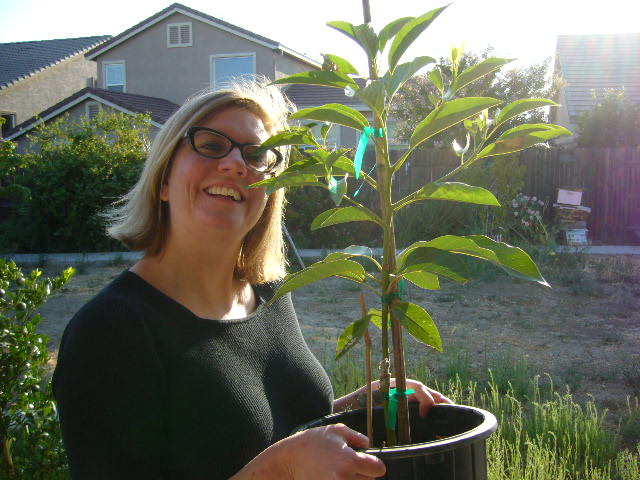
There are two things in the photo to the right that are very special to me. The first -- and most obvious I might add -- is the wife that is Venus. She's got a smile on her face. Why? Because I told her to smile! No, not really. That potted plant is behind the smile that the wife is wearing. Can you guess what it might be?

If you guessed an avocado tree -- points to you dear friend. By now you're probably wondering, "big deal, it's a fricken avocado tree!" Yes -- that may be true -- but it's not just any avocado tree. My friends -- this is the legendary Duke Avocado. What makes the Duke so special? You can't buy it at any store. No nursery carries the Duke. If you call around looking for a Duke, you're likely to be greeted with silence or even a blank stare. No store -- no supplier -- carries the Duke Avocado anymore.

Duke Avocado Tree
Why? Good question. I still don't quite understand why it was abandoned as a backyard tree. This isn't your dad's avocado tree -- this is what dear old grandaddy planted in his backyard. There is only one way to obtain a true, grafted, Duke. If you want a true Duke Avocado tree, you have to "make one."

Which is just what Bill Bird did -- with a little help from his friends at the California Rare Fruit Growers (CRFG). The tree that Venus is holding and again pictured to your left is probably the first true, grafted Duke tree that has been grown in decades. The scion attached to the root stock was taken from the spot where the Duke Avocado was born in 1912: Butte County.

This tree just isn't rare. The Duke Avocado is incredibly rare. And it has one incredible story behind it.

Oroville: Home of the Duke Avocado
This has been a rather long journey which I documented here last year and again here about six months later. The baby Duke Avocado tree now growing in the Bird Back 40 is the result of a quest to find an avocado variety that will laugh at freezing conditions, grow in terrible soils that have doomed other avocado varieties and, of course, produce boatloads of avocados.

The Duke is the result of a quest that started when I earned a none-too-stellar reputation of killing avocado trees. It didn't matter what variety I planted. It didn't matter where I planted it. Because, with each tree I planted, death arrived at its doorstep less than six months later. The tried-and-true standard nursery varieties of Bacon, Mexicola, Mexicola Grande, Zutano and Pinkerton all had a date with the Grim Reaper. They bit the dust, bought the farm, took a dirt nap, fed the worms, etc.

Duke Avocado Planted in Raised Bed
Avocado tree suppliers made bank on my misfortune. Because when one tree kicked the bucket, Bill Bird trotted out and dutifully shelled out another fifty bucks on another, supposed, "cold weather tolerant" avocado tree. Why keep kicking myself like this? Because the wife that is Venus DEMANDED an avocado tree for her backyard. That's why. Isn't that enough?

Since the definition of insanity is doing the same thing over and over again and expecting different results, I knew I had to try something different (I'm not that whacko, people. Not yet anyway). The links above detail the quest I started last year to find an avocado variety that could withstand the micro-climate cold freezes that cover the Bird Back 40 every December.

Duke Avocado Tree-Oroville Train Depot
The discovery of the Duke would then lead to the quest for a Duke -- the steps I took to find a supplier -- and finally -- the discovery of ancient Duke avocado trees planted in an old Introductory Garden located at the site of the old Oroville train Depot once served by the Western Pacific Rail Road. It was there where I would procure the scions from an ancient heirloom tree brought about by a crazy old man called "Benedict," who started planting avocado seed in Bangor in 1912.

Mr. Benedict may have failed in his quest to build an avocado nursery in one of the coldest interior regions of California. But his lasting success is the creation of the Duke line. The last major investigative report on the Duke, printed in the 1963 California Avocado Yearbook, not only failed to find the source of the avocado seed that Benedict was importing into Butte County, trees similar to the Duke couldn't be located anywhere.

Duke Avocado Leaves Are Shiny Yellow-Green
The Duke, like many avocado varieties that once graced California fields, was replaced by another variety at some point and then forgotten. There are a myriad of reasons as to why it was abandoned. Perhaps better tasting varieties were developed? The thin skins of the Duke fruit quickly fell out of favor with commercial growers and shippers. The fruit bruised far too easily during transport from farm to market. What happened to the Duke isn't unique. Many other avocado varieties have been tried, and then forgotten.

What makes the Duke unique, however, is this tree's ability to withstand frosty cold conditions. The Duke has survived major freezes that severely damaged other varieties planted nearby. I have witnessed the Duke's ability to laugh off a sustained frost with my own eyes. I have seen healthy Duke scions protruding from half dead root stock that nearly perished after a cold December freeze.

THE QUEST FOR THE DUKE AVOCADO

The quest for my own Duke Avocado tree didn't end with the discovery of original Duke trees in Oroville. That was just the start of our avocado adventure. One does not "plant" Duke Avocado seed to obtain a true Duke tree. The only way to get a true Duke is through the process of grafting.

Duke Avocado Tree-Bird Back 40
Since my grafting skills are still suspect (ie: BAD), I farmed out Duke cuttings (scions) taken from original Duke trees in Oroville to growers connected to the CRFG. Avocado root stock was procured from other CRFG suppliers in Northern and Central California. Two growers with marvelous grafting abilities volunteered to take on the project of creating new Duke trees.

Unfortunately, for reasons that I still don't understand, the Sacramento grower who volunteered for this effort allowed all of his Duke trees and his avocado root stock to die this summer. I'm not exactly sure what went wrong. I didn't get much of an explanation from him, other than that the three grafted Duke trees in his possession, and additional root stock, had died.

Heritage Duke Tree-Oroville, CA
Ever get socked in the stomach? That's kind of how I felt. I had visited this grower last May and witnessed the progress he had made with his grafting efforts. I saw, with my own eyes, healthy Duke shoots protruding from root stock that had nearly perished during the previous winter. Since the root stock was suspect, I agreed with his request. He wanted to break the half-dead root stock into pieces and bury it under the soil line, leaving only the healthy Duke shoot above.

He was the expert at this, right? So I agreed. And, after hearing that all of his trees had died from lack of care this summer, I began to regret this decision. A thought kept running through my mind: "Why didn't I grab one of those trees when I had a chance?"

Hindsight is 20-20.

LOVELY DOWNTOWN WATERFORD

A Waterford Backyard
If you have ever taken the opportunity to visit the downtown area of Waterford, "lovely" is probably the last adjective that comes to mind. Waterford is a small community that most people on Highway 120 zoom right through -- usually on their way to a nearby reservoir or even Yosemite National Park. It's not a place where one would normally stop, unless you need gas.

But there is a spot in downtown Waterford that is, indeed, quite lovely. It's the backyard of CRFG grower David Johnson. This is the second time I've had the pleasure of walking into David's backyard. It is a tribute to not just avocado trees of different shapes and sizes, but rare and unique citrus varieties and other fruit that isn't often found in the normal California backyard. Thanks to a canopy of shade from fruit and citrus trees planted long ago, David makes magic happen on the ground below.

Backyard of CRFG Member David Johnson
I like to think of it as a science lab for growing the rare and unique. Small trails lead from one discovery to another. And there's usually a friendly cat that steps out along the way, demanding a scratch or to be held and petted. On this particular day I had come to adopt an avocado tree. I nearly adopted another cat (something I do not need).

David is the other grower who had been enlisted with Duke scions taken from the Oroville trees. I hadn't given David nearly as much as I'd delivered to the Sacramento grower, but it was enough to create two or three grafted Duke trees. As I gazed upon those light green leaves tinged with yellow streaks, a signature of the Duke tree, I knew that my work on this venture had not been in vain.

Avocado Tree Nursery-Waterford
Unlike my Sacramento grower, David did not splice scions into existing root stock. He instead sliced into root stock at the base of the tree -- removing all previous growth -- and inserted a Duke scion. I had given him enough scion material last year for six trees. If the graft failed to take, it meant the entire root stock was also a goner. But David experienced a fifty percent success rate. Six grafts with six different root stocks resulted in three healthy trees.

Before you get too excited -- all three have found a home. But I did more than just drive to Waterford to pick up Venus' Duke Avocado tree. David also received a delivery of an ice chest packed with scion material taken from the Oroville trees that I had visited earlier that morning. David is now creating new Duke trees as this post is written.

Avocado Cat Says "Adopt Me!"
Yes -- you're right -- it was a long drive. From Sacramento north to Oroville -- then back south again to Sacramento and even further south to Waterford. Thanks to Google Maps, I was able to follow a lot of the original route that had been set aside for the never constructed Highway 65. These are old rural roads now that are rarely traveled, but offer a glimpse of the San Joaquin Valley one doesn't get from Highway 99 or Interstate 5.

Highway 65 was originally designed to take pressure off Highway 99. Like many highway building projects, it was shelved under the mistaken belief of: "If we don't built it, they (people) won't come." Lots of highway projects were abandoned in the 1970's under this mistaken belief. The people still came. Our population has nearly doubled since 1970.

But that's enough of politics. Back to avocados -- specifically -- The Duke Avocado.

THE END?

Emerging Duke Leaf Sets
Venus' Duke Avocado tree has found a home in a side yard of the Bird Back 40. Planted in a raised bed and sheltered from the freezing winds that blow in from the north during winter, I'm hopeful this avocado tree will meet with a better fate than most previous avocado tree efforts. The Duke is located near a Bearss Lime tree, which can also succumb to cold weather freezes, but has done quite well in the spot we placed it four years ago.

I'm pleased to report that this tree is experiencing a growth spurt in its new home and hope the incredible growth pattern that I've read about regarding the Duke tree also holds true. As to when this tree will produce its first real avocado, that's anyone's guess. It can take some trees five to seven years before they will produce.

I'm hoping for a little quicker production than that -- but have also learned the time honored rule when it comes to gardening or growing good things in the garden: Patience is a virtue.

POSTSCRIPT: DUKE TREES NO LONGER FOR SALE


Newly Grafted Duke Avocado Tree
Sorry folks -- demand exceeded supply. I mean, way, way, WAY exceeded supply. Our Duke Avocado operation is quite small. Once I announced several months ago that Duke trees were for sale? I was inundated with email requests from across the continental United States. I even discovered the location of another Duke tree -- growing in a USDA Agricultural Research Station located outside of Miami! Yes -- the Duke grows in Florida! And probably elsewhere.

So, I'm sorry to report that the window has closed shut. Heck, it's been nailed down. I have so many requests for Duke trees that it will take years to fulfill them all.

In the meantime? If you've got your heart and soul stuck on a Duke Avocado, as I did, you can always make one, as I did.

Find the details of how I did it here and here.

The Samad Method

Sunday, February 10, 2013

Open! Open! Open!
I can feel it. Can you? I shouldn't be inside typing. I should be outside, digging in the dirt. The weather is warming. Do you feel that sunshine on your back? Does the sun look just a tad brighter than the normal winter blah? Look closely. Is that daffodil about to pop open?

Spring is on its way. I should be outside amending the raised beds in anticipation of the onion starters that will arrive next week from Dixondale Farms. After last year's grand experiment produced some whopper and good tasting onions, the wife that is Venus and I doubled up on the order this year. We ordered one bunch each of red, yellow and white. One bunch equals about sixty onion starter plants. That's 180 onions. Think that's enough?

Bing Cherry Graft to Royal Rainier Cherry Tree
The onset of this February blast of spring-like conditions also tells me something else: I'd better get moving and finish off the projects on the grafting front. With the stone fruit trees in dormant stage, Bill Bird has been playing the role of "Johnny Appleseed" in one Frankensteinish grafting effort after another. Why be stuck with two or three peach varieties when you can have 20?

I documented last year's amateurish grafting efforts here. Using my handy-dandy 3T EZ grafting tool, I set about the yard grafting scion branch after scion branch to one fruit tree after another. The result? Amazing success on the pluot and plum trees! But I struck out on the peach, cherry and nectarine grafting efforts. Not a single branch took. So what went wrong?
3T EZ Grafting Tool
Nothing, really. I'm still learning at this craft. Greater success comes with experience. The more you graft? The better you'll get at it. Your success rate will go up. So, when you look at it from that angle? I did pretty good. But I can do better. This year I am employing a new method learned at the hands of an Iranian-born Sacramento resident who taught me a grafting technique I'd never seen performed before.

His name is Samad (or Sam) Jaufeshan. And his Sacramento backyard is loaded with testament after testament to his grafting skills. When you come across a grower that has 42 different varieties of table grapes that have been grafted to less than ten grapevine stumps, it might be a good idea to stop, look and listen. I first met Sam during my miserable and failed attempts to graft Duke avocado tree scions to avocado root stock.

Standard Grafts Using the 3T EZ Tool
The 3T EZ grafting tool I had employed that first year is a good tool for beginners and it's a tool I will continue to use. But this type of grafting does have it's drawbacks. The V-Graft, for example, requires you to find a branch on a tree that is about the same size of the scion itself, which isn't always easy to do via the naked eye. Secondly, both the V and Omega grafts require you to pick a branch that is the farthest away from the fruit tree trunk. As you get closer to the trunk, the fruit bearing branches get to be very large -- an inch or more in diameter.

I do not recommend hacking off a large branch to perform a graft like this. It's likely to fail and leave you with a gaping hole in the tree itself. This is not a good idea.

Samad Method: Skin Grafting
But the "Samad Method" as I've come to call it now (also known as t-budding) does not rely upon grafting one branch to another. It doesn't require you to "search out" and find the "perfect fit." It allows you to graft on any branch, or even the trunk of the fruit tree itself. The "Samad Method" is simple, yet successful. I say this because I have three grafted Duke avocado trees to prove it. At least one of them will find a home in the Bird Back 40 this spring.

Let me back up a moment and say the Samad Method "seems" to be simple when you see it performed. However, like any grafting attempt, experience counts. My first few grafts using this method were, in a word, bad. But practice makes perfect. The last few grafting attempts have been right on the money.

Common Box Cutter Turned Skin Grafting Tool
Another plus? This grafting technique does not require the grafter to hack off fruit bearing branches. It also allows the grafter to make ten grafts instead of one or two. Every inch of the fruit tree in question is open to this method. You're not limited to one small branch that is at the furthest point from the tree trunk itself.

The "Samad Method" involves taking skin from one fruit tree scion branch and grafting that bit of skin to the skin of a fruit tree. Rather than "branch to branch," it's the skin of one bud cut from the donor branch to the skin of the recipient tree. This requires a couple of things: a bit of practice and razor sharp grafting tool. There are some grafters who employ actual surgical tools for this type of procedure, so caution is a must.

T-Cut Into Cherry Tree Branch
Each scion branch contains anywhere from five to ten buds. This means one donor branch can provide five to ten grafting opportunities rather than the ONE that is offered with the V or Omega grafts. This is why Venus' Royal Rainier Cherry tree holds eight Bing Cherry grafts instead of one or two. I don't need all eight to be successful, although that would be a riot, wouldn't it? No -- as long as one survives and grows -- I will have accomplished the task at hand.

This grafting technique allowed me to graft four Loring Peach buds onto the trunk of my O'Henry fruit tree. It allowed me to place four Suncrest Peach buds on the strongest branches of the June Pride Peach tree. Four of the strong, fruit bearing, branches on the Fuji Apple tree hold Braeburn Apple grafts. There's more to list here, but I'm sure you get the idea.

Bud Inserted Into T-Cut
And now the $64 question: Will this method work? I've seen it work in another backyard, but Sam has a 40 year head start on my growing and grafting efforts. As with any gardening experiment? Only time and patience will tell. When the first buds of spring emerge I'll either have a large smile on my face, or it's "more practice needed."