Showing posts with label Venus. Show all posts

The Ballad of Frick and Frack

Thursday, August 26, 2021

Frick and Frack
Warning! Cuteness Overload! And, perhaps a bit of sadness.

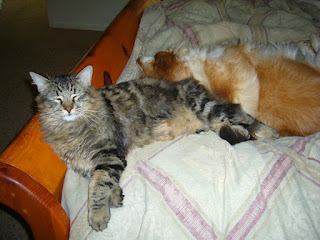
I write the following today to remember a great love and friendship before it has time to pass from my mind, as most things do as we move on in life. Pictured to the right are Frick and Frack. It really doesn't matter who "Frick" or "Frack" is. What is important is that tender, and rare, relationship between cat and dog who find each other at the right time.

Frick and Frack at rest. A rare moment.
We didn't do this by design. That would have been far too easy and somewhat impossible. This relationship was completely by chance. It just worked. Somehow, it just worked. The decade that followed was pure magic.

The dog, Bandana, a "Heinz 57" mix of herding breeds, was discovered on a working horse ranch in Southern Oregon. His owner, Tenaya Yager, made the painful decision to part with him during our 2010 visit. Lenny, the Maine Coon cat, was a gift from Mary Beth Barber. She discovered a litter of feral kittens in the sub-basment beneath her Sacramento home in 2011. She rescued them and bottle-fed and cared for each one before presenting Lenny as a gift.

The Kiss
The cats that my ex-wife, Venus, and I had at home never did care for Bandana after we brought her home. That is a kind way of describing it. Outright revolt, revulsion and disowning us as cat owners would be a more correct description. But all of that changed a year after adopting Bandana when we opened our home to Lenny. One lick from Bandana was all it took, and the legend of Frick and Frack was born. The two immediately fell in love with one another and were constant companions and partners in crime. They never left each other's side.

I thank the Good Lord that digital photography came into vogue by 2011. Otherwise, we would have enriched the makers of Kodak or Polaroid film by another million bucks or two. Frick and Frack would come to dominate photos and social media postings over the next decade. Who could possibly ignore that cuteness overload? The two would get into one adorable pose after another, usually around dinner or snack time. Or, if they wanted something we were eating at the dinner table. Which is usually what Frick and Frack did at dinner time 365 days a year. These two had discovered a couple of human SUCKERS, and took full advantage of it.

Frack on Frick
Here is a photo of Frick and Frack on the couch. Or a photo of Frick and Frack on the floor. Oh look! Frick and Frack are curled up on the bed together! Here are Frick and Frack outside, checking out the garden. "Is that dog lying on top of that cat???" This is a common question we received on Facebook, Twitter, Google or any other place we deposited multitudes of pet photos. "Why yes she is," came our response. "Pay no mind," we would respond. "They just want snacks." What we didn't say is that most of the time Frick and Frack were rewarded with any snack they wanted.

Did You Say Snacks?
If these two partners in pet crime weren't in one adorable pose or another, they were usually putting on one of their typical Battle Royale rumbles in the living or dining room. It would start when Frack would chomp on Frick's fuzzy tail and pull on it like a tug toy, which ultimately resulted in a massive, full-claw return swat from Frick. The battle was on. Or, sometimes it was Frick who put on his best Tiger Tank Surprise Attack from the rear, hitting Frack full-force when she wasn't looking or was peacefully sleeping. The battle, which never really ended between the two, was on again. The two proceeded to roll around on the floor for the next 5-10 minutes, usually knocking over whatever was in their path. Many chairs and even one Christmas tree met its demise when these two decided it was time for non-stop action.

Wandering the Garden
The battle took on a new form whenever we took Frack (the dog) for a walk. Frick would follow for awhile, but never lose sight of his home. It wasn't that he was scared, he just preferred to stay behind and plan his attack after Frack returned 30 minutes later. Frack always suspected that Frick would be up to something, waiting to unleash a surprise attack. Frick would never disappoint Frack, launching himself from underneath a bush, a parked car, from behind a pillar of bricks and, at least one time, with a flying leap from the roof. I have to admit, I was surprised with that mode of attack myself.

No matter how brutal the previous play session had been, Frick and Frack always made sure to position themselves into the most ridiculous and adorable pose possible after play time subsided and dinner time arrived. That's just who they were. They spent a lifetime irritating and loving one another. They were never apart. They were always by each other's side.

Chairs are for Frick and Frack
Did I mention how carefully they planned an assault on the vegetable garden AFTER Venus and I had carefully planted tomato plant starters on top of smelly fish heads? On the best garden advice available at the time? We came home the next day to find 16-tomato plants dug out of raised beds and a few paltry bits of those fish heads that we thought we had buried deeply enough to guard against theft. The culprits had dirty paws and full bellies. Frick and Frack had struck again. It was a team effort.

Stop here. Don't read any further. Because all good things do eventually come to a tragic end. I will keep this as short as I can.

Your bed? Not anymore!
As the years flew by, the play and antics subsided somewhat. Play time morphed into a lot of nap time for the both of them. But, they were still together. There came a point, however, where Bandana, the Frack, grew tired. A limp that developed after she had stumbled into a gopher hole worsened. Herding dogs like Border Collies, McNab Shepherds and Aussie Shepherds are very hyperactive as young adults. But when they begin to slide downhill, the end seems to take place very quickly. Bandana was no different. Frack passed in February of this year. I held her close as she took her last breath. I promised I would never forget the "Blonde Bombshell." The neighborhood children simply adored her.

Although I gave Frick all the love and attention I possibly could after losing his Frack, he followed a short time later. His last act was to crawl underneath my bed, where Frack had spent part of her final year. It's where he drew his last breath. That was yesterday. I'm a still a bit emotional at the moment, so please forgive me. I'm not going to bore you with all the visits to the veterinarian that took place and all the solutions that were prescribed over the last six months. Needless to say, none of them worked. It's tough to heal a broken heart.

Frick with his new Frack
I can only say that I tried my best to engage Frick. At one point I even adopted another Frack from the Bradshaw Animal Shelter in Sacramento County. It stopped Frick's slide. For a little while. But it wasn't enough. It wasn't the answer. I don't know if there was a solution. If there was one, I didn't find it.

We never forgot the kindness of both Tenaya and Mary Beth. They were reminded of the gifts they had bestowed every time a picture was posted on any social media account, which must have numbered in the hundreds through the years. We made sure that both saw each ridiculous Frick and Frack pose and moment.

"I talk about Bandana a lot," Tenaya admitted after calling to console me following Frack's passing last February. "The decision I made to give her to you was a validation of what I would become. I unite pets with people."

Marybeth also checked in to thank me for being a good cat "papa."

This relationship between dog and cat is not unique. Perhaps  you have been graced by a Frick and Frack in your lifetime. It is my sincere hope that you have. I have had no greather joy in life than to witness the love and joy that Frick and Frack demonstrated time and again. They are just memories now. Memories that I will never forget. I have to move on now. I will move on. But I will never forget.

Berries Are for the Birds!

Saturday, May 23, 2015

Arapaho Thornless Blackberry Vine
You bet they are! And Bill and the wife that is Venus Bird like it that way! Welcome to May 2015 -- and one of the coolest spring weather patterns I think I've ever experienced in the Sacramento area. That doesn't help much when it comes to summer producing vegetable plants like tomatoes and cucumbers, but the Bird berry patch likes it just fine.

The big winner in this year's berry battle in the Bird Back 40? It should come as no surprise by now. For the second straight year and the fourth year since I brought it home and planted it, the Arapaho Thornless Blackberry is sporting a massive crop of berries that are, in some cases, three inches long and an inch thick. I wrote about this particular variety last year.

Arapaho Blackberries
The Arapaho continues to defy zone logic. The plant professionals claim it's not supposed to do well in this climate. It's more suited for cooler climates not found in my Zone 9A. It's supposed to do better on the coast and up north where it doesn't get quite as hot. But berry plants are funny customers. Arapaho berries grown on a commercial basis on the coast, where it is cooler, suffer from tip dieback. But here in the more inland, hotter, area? The Arapaho does just fine.

Time and study will determine just how well the Arapaho will do in California. Although it's not the most recent introduction from the University of Arkansas breeding program, it's still fairly new to our area and climate. Although it may eventually prove to be a bust on a commercial basis, it seems to do just fine in your ordinary home backyard setting.

Shuksan Strawberry Patch
If there is one big difference in the Bird Back 40 berry battle -- it's that the Arapaho isn't the only berry sporting a fat crop this year. Nope -- it's a tie. For in 2015 there are 20 second-year Shuksan strawberry plants putting on a big show in what will eventually prove to be the largest and most luscious strawberry harvest we've ever experienced in these parts.

The introduction of the Shuksan strawberry has been a years long, trial and (mostly) error, attempt to grow strawberries in the Bird Back 40. I wasn't interested in those small, sweet berries that emerge from most backyard settings. Nope -- I wanted in on the action that comes out of our local strawberry fields: strawberries the size of a golf ball or larger.

Shuksan Strawberries
At first I thought the answer to my berry wishes would be the Chandler Strawberry. The production was, in a word: Meh. Then I thought a combination of Albion and Gaviota strawberries would be the answer. They should do well here, right? That's what the experts told me. It's the recommendation I found online here. In fact, they advised the following: Recommended strawberry varieties for CaliforniaAlbionAromasCamarosaCamino RealChandlerDiamanteGaviota, Oso Grande, Pacific, Seascape, Selva, Ventana.  (According to the California Strawberry Commission)

But guess what kids? Don't believe everything you read online. Yes -- these might be great strawberry selections for some regions of California. But not here in the heat of inland California. It wasn't until I started checking each and every strawberry plant selection offered here, and checking the recommended zones very closely, did I stumble upon the Shuksan Strawberry. Recommended for Zones 4-10. That was my "Eureka" moment.

Bird Back 40 Berry Patch
If this is the kind of production I can expect from 20 second year plants, what happens next year when the additional 40 plants I ordered and planted this year swing into full production? 60 plants instead of 20? How about 80-100 plants? Strawberry overload anyone?

I'll take it.

Despite the very berry success this year -- I'm just getting started. For where there is a bare patch of dirt in the Bird Back 40 -- there's room for another small raised bed and perhaps another berry plant or two. I've got my eye on another recent introduction from the University of Arkansas breeding program. This is one is also thornless. It is called the Ouachita Blackberry -- which does well in gardening zones 5-9.

Because man does not live on blackberries alone. But, personally, I would if I could.

Gold Nugget or Crazy Good Mandarin?

Saturday, April 25, 2015

Gold Nugget Mandarin-Bird Back 40
I'll be honest. This past winter restored my faith in citrus. I had one of the best citrus harvests ever on the Dancy Mandarin. And since Mr. Freeze steered clear of much of the Bird Back 40 this past winter, my citrus and avocado plantings sailed right through a mild winter and bloomed like something special this spring.

Know what that means? It means a record harvest later this fall for the Bearss Lime, aka Gin and Tonic, tree. That's what it means! Because when it comes to a mean Gin and Tonic or a mean Tom Collins, a juicy Bearss Lime or three is absolutely essential. That my friends, is fresh drink heaven.

Mister Snow Miser (Not Kind to Citrus)
Last winter was also a far cry from the devastating winter of 2013. Yes -- 2013 was just as dry, if not more so, than 2014. But what 2013 had that 2014 didn't was a long and extended stay by Mister Snow Miser. Do you remember him from your ABC Holiday specials? He's got a thing or two for icicles, and unfortunately he stuck around for far too long in December 2013. By the time he finally departed, the lemons had shriveled into unappetizing black lumps. Oh -- and half of the Gin and Tonic tree decided to take a dirt nap.

Good riddance to 2013!

Part of this past weekend was dedicated to restoring the damage that took place during 2013. The Clementine Mandarin that also checked out permanently that year was replaced this past weekend by something rather special. Say hello to the Gold Nugget Mandarin, plus a little something else extra special.

Yours Truly With Gold Nugget Prize
Do you know how difficult it is to find and purchase a standard sized mandarin tree in this day and age? Try this one on for size: Extremely Difficult. The primary supplier for all things citrus in California, Four Winds Growers, will provide you with plenty of dwarf citrus offerings. You want a dwarf lemon? No problem! Dwarf lime? Got them right here in spades! Dwarf mandarin? Take your pick! Standard size lemon, lime, orange or mandarin? Better luck next year, son.

Why is the primary supplier of citrus in California focusing on dwarf selections? Good question! Ask! I've tried. It's tough to get a straight answer. So what's the problem with dwarf citrus offerings? Dwarf sizes often result in small harvests. The days of that 30 foot tall and 30 foot wide citrus tree are quickly disappearing. Say hello to citrus trees that grow no larger than six or seven feet -- and like it.

Mandarin Trees-Green Acres Nursery
This past weekend just happened to be that very special weekend that the Sacramento Chapter of the California Rare Fruit Growers (CRFG) held its annual citrus scion exchange. You want something special when it comes to all things citrus? Visit the CRFG exchange. You won't find everything under the sun there -- but it's pretty darn close.

I'd heard some good feedback about the Gold Nugget Mandarin. A recently released mandarin developed within the University of California, Riverside citrus breeding program, the Gold Nugget holds up well against freezing conditions (a plus) and also ripens at a time (early March) when most mandarins in the Bird Back 40 have come and gone.

Gold Nugget Mandarins
I tried to find a standard sized Gold Nugget tree. I failed. Miserably. Although the Bird Back 40 is studded with standard sized citrus trees of every shape and variety -- finding a standard sized Gold Nugget was proving to be rather impossible. So, I settled for what was available that day at Green Acres Nursery: a Gold Nugget mandarin tree on dwarf root stock.

BUT -- obtaining that Gold Nugget mandarin tree was just the first part of the battle. You see, that tree would become the root stock that I would use for other varieties offered through the CRFG citrus exchange. I was particularly interested in obtaining scions for two different varieties: the Minneola Tangelo and another variety offered by the United States Department of Agriculture (USDA). It's so new that it doesn't even have a name yet -- and may never have one. It's known only by number: The 6-15-150.

6-15-150 Mandarin
As soon as the wife that is Venus spotted the scions marked with the number of "15-150," she broke into a wide grin and blurted out "the 5150 mandarin? That's crazy good stuff." That's all she had to say. Consider us sold. Before we departed Maddox Park on this particular weekend, the Gold Nugget Mandarin had been outfitted with a graft of what promises to be a "crazy good mandarin."

The newest mandarin tree to grace the Bird Back 40 has already found it's permanent home. It sits in the spot once occupied by the long-gone Clementine. It's not that I've given up on the Clementine. That's also a right fine mandarin. But all mandarins are not the same. Some have a little more trouble standing up to deep freezes. The Clementine, unfortunately, isn't as cold tolerant as I would like. And since Mr.Snow Miser does like to pay a visit every once in awhile, it's probably best to stick with mandarin varieties that can survive an icicle-challenged night or two.

Dwarf Mandarin Trees-Green Acres Nursery
The graft, which is completely wrapped in grafting tape to keep it safe from water intrusion, hasn't sprouted yet. It may never sprout. Grafting isn't 100 percent foolproof. I know this to be true because my success with citrus grafting is nothing to write home about, unless the piece appears in "Failure Magazine." That's why I had someone with a more experienced hand do the grafting work for me. That's the advantage of membership in a group like the CRFG. That's where you find the really special scion wood -- and someone who knows what they are doing.

Will it turn out to be our favorite mandarin, provided the graft sprouts to life? Good question. I can't tell you. As one CRFG member is fond of saying, "my favorite mandarin happens to be the one I'm eating at that particular moment."

Wise words indeed.

GOLD! Gold in the Bird Back 40!

Sunday, March 1, 2015

Twenty Ounce Apple Tree-Bird Back 40
Well -- not really gold per se. Sorry to get you excited. I did not unearth golden nuggets during the latest "Big Dig" in the Bird Back 40. But -- I will tell you this much. I brought some gold rush history back home and planted it. Soon, provided the wife that is Venus and I are lucky, we'll be munching on what the Gold Rush 49ers munched on more than a century ago.

This is prime bare root fruit tree season in California and across the rest of the country. It's warming up fast outside in California, but there's still a little time left to head out to your favorite nursery and purchase the fruit tree of your choice. This happens to be a very good time for it! The nurseries are stocked to the gills with every fruit tree variety under the sun. Peaches, nectarines, plums, apricots, apples, you name it.

Flavor Finale Pluots (Delicious)
Do you like fruit cocktail trees? One tree with three or four different varieties of fruit grafted to it? You'll find that as well. How about the new and exciting introductions from Dave Wilson Nursery? The Pluot? Plumcot? Aprium? The Pride Peach Collection? Yes sir! You'll find that your local nursery has plenty of them in stock as well.

The Bird Back 40 is stocked with DWN specialty trees -- from the Honey Crisp Apple to the Flavor Finale Pluot. Look closely enough and you'll spot the Pride Peach Collection (five Pride Peach selections grafted to one tree). You might even spot an Aprium. Maybe...

"Amigo" Bob Cantisano
But this year we decided to do something a little differently. For, it was last year when I read a wonderful story in the Home and Garden section of the Sacramento Bee about a man by the name of "Amigo" Bob Cantisano. Bob is a Nevada County native who helped start the Heaven and Earth Nursery in North San Juan (Felix Gillet Institute), a magical place designed to preserve and protect the gold rush fruit tree history of a one Felix Gillet.

Who is Felix Gillet and why have you and I never heard of him? I could bore you with volumes of details that I've learned about this legendary character and his rightful place in California fruit and nut tree history, but I won't. Suffice to say, Felix was an original California pioneer. He immigrated to the United States from France, and some years later made his way out to the gold fields in California.

Felix Gillet
Felix, however, didn't come here to pan gold. Although he did have some mining claims, nobody is quite sure what Felix did with them. Nope -- Felix was a barber by trade. He owned and operated a barbershop in Nevada City, where he also sold "French Finery" such as pens, stationary and toys. But his biggest contribution to California agricultural history was yet to come.

Gillet returned to France in 1864 to learn the nursery trade, and upon his return to Nevada City, he purchased 16 acres of land that had been stripped clean and timbered by gold miners. He would name this his Barren Hill Nursery. And, it's on this tiny plot of land where Gillet helped jump start not only the California fruit and nut tree industry, but the nut tree industries in neighboring Oregon and Washington State as well.

Bigarreau de Mai Cherry (Gillet Introduction)
Gillet spent thousands of dollars on importing fruit and nut trees from France via ship and then rail to Northern California, where he helped adapt his French offerings to the California climate. He is directly responsible for many of the fruit trees grown in California today, in not just backyards like ours but commercial orchards as well.

Cantisano, who has been promoting Gillet's groundbreaking work for decades, has managed to find thousands of Gillet fruit trees in old gold rush mining camps and in gold rush communities like Nevada City. Surprisingly, these trees, which are more than 150 years old, are still alive and still very productive.

Heaven and Earth Farm-North San Juan
During a recent presentation to the Nevada County Historical Society, Cantisano pointed out just one of dozens of cherry varieties that Gillet introduced to California. It's called the Bigarreau Gross de Mezel. Please don't ask me to pronounce that, because I'll fail miserably. Did you know this is still widely grown in California and elsewhere? It is, but the name of it has changed. Today we call it the Bing Cherry.

Have you ever eaten a Bing Cherry before? Then Cantisano says "you've tasted Felix Gillet." But it didn't stop with fruit and nut trees. Gillet was also responsible for importing French wine grapes into California. Have you heard of varieties called Cabernet Sauvignon, Chardonnay, Merlot, Sirah and Petite Sirah?

Twenty Ounce Apple
If you've ever had a glass of any of these wines, Cantisano will tell you that "you've tasted Felix Gillet."

As I began to learn more about Gillet and his work, it struck me that he laid the foundation for modern agriculture in California. Short and sweet, there would be no Dave Wilson Nursery without Gillet and his introductions. There would be no Floyd Zaiger and Zaiger Genetics, the family that brought us the Pluot and many other recent introductions.

Gillet wasn't the only breeder introducing fruit trees to California during the Gold Rush. There were others. But he was the only large provider located in old gold rush territory. Today, if you find a fruit tree growing at an old mining camp somewhere in Butte, Nevada, Placer, Sierra, Plumas, El Dorado, Amador or Calaveras Counties, chances are it came from Gillet's Barren Hill Nursery. And, if you ask Cantisano, he will tell you that he's literally stumbled onto thousands of them. Yet, at the same time, he'll also admit that he's barely scratched the surface of how many Gillet fruit introductions are still out there -- waiting to discovered -- just as the gold nuggets were waiting for gold rush miners that flocked to California.

Barren Hill Nursery Property
So -- in honor of this man's unique history and Amigo Cantisano's work to preserve Gillet's contributions, Venus and I ordered two fruit tree selections from the Heaven and Earth Farm: the Twenty Ounce Apple and the Birchville Beauty (Update: I've recently learned the Birchville Beauty may, in fact, be the Bigarreau de Maia cherry. Roughly translated, that's May Sweet Cherry). Both mother trees were discovered at long-abandoned mining camps in Nevada County. Both are more than 150 years old. Both are still very productive.

The drive to this nursery was an adventure in itself. Heaven and Earth Farm is located off Highway 49 above Nevada City. Highway 49 is in good enough shape, as are most of the connecting roads. But it's that second, third and fourth turns that are a little interesting.

Soon, you find yourself turning left on something that should be called "You Call This a Road?" And then there's that right on "This Looks More Like a Game Trail Than a Road." It's one of them "white knuckle" type drives that you're not going forget anytime soon.

Venus with Adam Nuber-Heaven and Earth Farm
Both apple and cherry tree have found a home in the Bird Back 40, but that's not the end of this story. No, it's really just beginning. It would seem to me that someone who contributed as much as Gillet did to California agriculture would not only be remembered, but celebrated.

But he's not. I'd never heard of Felix Gillet until I read Debbie Arrington's story about Amigo Cantisano and his Heaven and Earth Farm. Why isn't there a statue of this man in front of the headquarters of the California Department of Food and Agriculture? Why has Felix Gillet been forgotten? Pushed off the history pages of Horticulture?

I have my feelings and suspicions as to why. It's a subject that I will tackle with my next blog posting. Until then, dear readers, I've got two new fruit trees to water and care for.

The Treasure of "Ima Wiener"

Saturday, February 14, 2015

X-Rated Radish
And now -- just in time for Valentine's Day -- a little pornographic love from the vegetable garden adventures springing from the Bird Back 40. Because nothing spells "love" quite like the "treasure" that the wife unveiled from the Bird Back 40 raised gardening beds some days back. There it is -- pictured to the right -- a schlong sized radish. It's the Treasure of Ima Wiener.

I can't even take credit for the title of this blog posting. Those readers who are fans of "The Simpsons" must now realize that I ripped it off from one of the funniest parts of The Simpson's Movie. The lines from that movie go a little like this -- when antagonist Russ Cargill confronts Homer Simpson holding a shotgun:

The Simpsons
Bart: Wait! If you kill my dad, we'll never know where the treasure is buried!
Cargill: What treasure?
Bart: The treasure of... Ima Wiener.
Cargill: "Ima Weiner"?
[Homer and Bart laugh]

Homer: Classic!

It would be Maggie who saved her father in that particular scene, by throwing a rather hefty sized stone that struck Cargill in the head. A development that left Homer to proclaim: "Maggie! What a great little accident you turned out to be."

It's bathroom humor at it's best -- which makes it a classic Simpsons moment in time.

WHOA!
To be brutally honest -- gardeners aren't supposed to let radishes get quite this big. If they reach a size like this they tend to taste a bit (I kid you not) "woody." However, for some strange reason this one tasted just fine. It tasted just like -- well -- a French Breakfast radish is supposed to taste like: a radish.

And what a radish it was!

Fortunately, for us, the night that the wife pulled this monster out of the ground we were making the perfect meal: chicken salad. This is one of those quick "work night" meals when you don't have a whole lot of time to throw everything together. It involved grilled chicken breasts, some bagged salad to mix with what's left of the fall salad greens, a spare green onion or two from the leftover summer garden and -- oh -- did I mention the x-rated sized radish?

Grilled Chicken
Cut up the chicken -- throw it all together -- add in some dressing quickly prepared by my most excellent wife and you have a dinner like no other. Oh -- and a conversation piece that I can bring to you, dear readers.

There's not much left of the fall garden these days. And with the sudden onset of warm, almost spring-like weather -- the mind turns to spring and summer gardening opportunities. Unfortunately, the one arctic blast of cold weather we received in December managed to kill off most of the pea plants we started in October. And although it doesn't seem like it could possibly happen, a freeze in February and March isn't out of the question.

The Radish Meets its End
It's happened before. It can happen again. But the one item that we can plant in abundance right about now? That's right -- the radish. Which might lead to another treasured discovery sometime soon.

Happy Valentine's Day! And remember -- it's not all about wieners. It's about radishes.

Choppin' Broccoli

Tuesday, December 30, 2014

Dana Carvey Performs The Lady I Know
It is one of my most favorite skits from Saturday Night Live past. Comedian Dana Carvey performs the timeless classic of "The Lady I Know," otherwise known by its second and more popular name: Choppin' Broccoli. That skit -- which he still performs during his live shows -- is guaranteed to bring a bundle of laughs. Even though the song is nothing more than a repeat of the lines: "Choppin' Broccoli."

I guess it's the genius of Dana Carvey. See him perform his timeless classic -- with a full band behind him no less -- here on the Tonight Show with fellow SNL alum Jimmy Fallon.

Broccoli From the Bird Back 40
I'm reminded of this timeless classic every time I pull out a head of broccoli for one of our favorite meals or side dishes. This is broccoli season in California. You can find it for dirt cheap in most grocery stores -- and you can find it growing in the dirt that comprises the Bird Back 40. We're not just growing broccoli, the wife that is Venus and I have been gifted with the greatest of broccoli harvests in Bird Back 40 history. I've never grown broccoli like this before -- even though I've tried before (and failed somewhat miserably I might add).

So what am I doing different this year as compared to past years in the garden? Good question. I'm not really sure. Perhaps we just planted seeds and starter plants at the right time this year. Perhaps waiting until early spring to start our broccoli crops wasn't the best of ideas. Perhaps we should have started our broccoli growing efforts in the early fall -- as we did this year.

Bird Back 40 Broccoli Patch
I must admit -- I had my doubts. Although I did "cheat" somewhat this year and purchased a six pack of broccoli plant starters from Emigh's ACE Hardware in Carmichael -- Venus also scattered broccoli seed over a wide swath in one of the 4X8 gardening beds. The end result is we have about 10-15 broccoli plants that are sporting the best looking heads of broccoli I've ever seen. There's no bug damage on the crowns either -- which is another big plus.

The first doubts surfaced just after planting our starter plants in early October. Those small plants were immediately attacked by an invading horde of ravenously hungry slugs and snails. Spreading out some pet-safe slug and snail bait helped minimize the damage somewhat, but it wasn't totally foolproof. The leaves on the broccoli plants are peppered with slug and snail damaged holes. But those broccoli crowns -- that tasty meal we yearn for -- haven't been touched.

Freshly Harvested From the Bird Back 40
Why? I have no idea. I do not profess to be a Zen-Garden master. I only plant, irrigate, spread out some slug bait and wait. Whatever happens -- happens. I might also add that the gardening cat known as Lenny -- the wife's ultra spoiled Maine Coon furball of a cat -- also loved digging up those starter plants at the first opportunity. And you thought gardening was easy? Perish the thought. Between the slugs, snails and Lenny's incessant garden attacks, it's a wonder that any of the starter plants or plants grown from seed survived.

Broccoli was one of the first vegetables that I actually consumed as a child. Mom didn't grow it. She didn't buy it fresh either. Nope -- our broccoli in 1970's Modesto came from the blocks of frozen broccoli chunks that are still sold in stores today. That was an easy vegetable fix for a single mother of four children who had been forced into the world of full-time employment. At first -- as I recall -- I wouldn't touch the stuff. However -- when mother resorted to sprinkling this broccoli with processed lemon juice -- well, it was heaven at first bite. I couldn't get enough.

A New Wok for Christmas
It's been a long journey -- from frozen blocks of broccoli chunks to freshly grown broccoli from the backyard. I'll still douse the end result with lemon in some cases -- but I'm also partial to an herbed broccoli recipe that I stumbled across one day in one of the original Betty Crocker cookbooks (this is before Betty sold out to commercial interests). Broccoli Beef -- which we made just the other night from scratch using freshly harvested broccoli heads and grass-fed beef (flank steak) from Chaffin Family Orchards north of Oroville -- was a gastrointestinal delight to be sure.

Short and sweet? There are one million and one uses for broccoli. And given that we appear to have an unlimited supply in the Bird Back 40 (I am a tad concerned about how freezing temperatures will affect these plants) -- the end result will hopefully be a winter full of meals featuring freshly grown broccoli and other greens.

Which means I'll be chopping a lot of broccoli to the tune of "The Lady I Know."

Recipe for Herbed Broccoli:

Author's note: We always double, triple or even quadruple the amount of garlic in this recipe because, well, you can never get enough garlic in my humble opinion! We also double up on the spices.

1 lb. steamed broccoli
2 tablespoons olive oil
1 teaspoon dried basil leaves
1 teaspoon dried oregano leaves
1 teaspoon dried marjoram leaves
1/2 teaspoon salt (do not double)
2 cloves of garlic, crushed
2 Roma type tomatoes, chopped

Directions: Mix oil, herbs, salt, garlic and chopped tomatoes and set aside. Steam fresh broccoli on high heat for four minutes and remove to a serving dish immediately. Add tomato-herb mixture, mix well and enjoy!

Time for Some Shameless Self-Promotion

Tuesday, September 16, 2014

Sacramento Magazine
I suppose a little promotion every once in a great while is a good thing, right? Tooting your own horn, so to speak? Blow a little smoke? Pat myself on the back? Bluster? Boast? Crow?

OK -- enough already.

My friends, for some reason the fine people at Sacramento Magazine have chosen to profile the wife that is Venus (and perhaps yours truly) in this September's issue. I wouldn't say it's a "well deserved" honor. In fact, after an injury filled year like this one, I almost told the writer to "find someone else."

But I couldn't do that to Joan. She wanted an up close and personal tour of the Bird Back 40. She wanted to see how Venus and I turned a patch of bare dirt seven years ago into a thriving vegetable and fruit garden. She wanted to see what we grew. She wanted to see what we failed to grow.

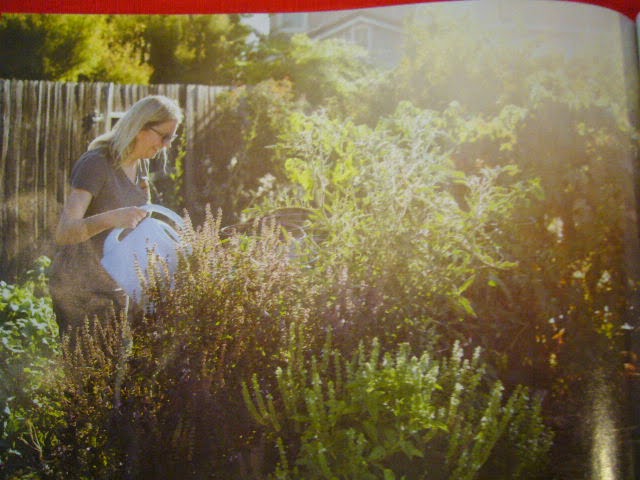
Wife That is Venus in her Element
And so -- with my foot still in a cast from a previous bout of bad luck -- we invited Joan out for a tour of our expansive North Natomas acreage, plus all the weeds that managed to spring up during my time on the gardening "Physically Unable to Perform (PUP)" list.

But that was just the first part of my summer in the medical trauma ward. Later, after I'd pinched my sciatic nerve to the point where I just wanted to be shot (really people! It's painful!), a photographer asked permission to visit this fantastic garden that Joan had written about.

Just Peachy Eh?
Guess what greeted the photographer? More weeds! An overgrown garden! Lots of garden bugs. And one cranky gardener with a problematic back that wouldn't stop belting out the tune of that long ago Police hit: "King of Pain."

I'm so glad he didn't ask to take my photo. I feared I might tell him to go kiss my petunias -- or something worse. Fortunately, the wife that is Venus was there to save me from myself (again).

But you know what? I guess there were some good shots in that yard. I guess Joan saw a few things too. Because they both managed to capture the spirit of what we do here and what we enjoy so much.

Thanks Joan. Thanks to you Sacramento Magazine. It's been an interesting summer.