Showing posts with label Wife That is Venus. Show all posts

Come On Baby Light My Fire!

Wednesday, February 25, 2015

Playing With Fire
That great British poet once intoned: "Don't Play With Me, Cause You're Playing With Fire." And that's good advice. But what does Mick Jagger know about hot peppers anyhow? Hot women? Yeah, I guess he knows about them. He should. But hot peppers? Please, Mr. Jagger, move aside. Because Bill and the wife that is Venus are ready to "roll those tumblin' dice."

That picture to your immediate right is our latest foray into "playing with fire." This represents the really hot stuff that will be growing in the Bird Back 40 come this summer. We got an early start on these seeds -- mid January to be exact. Because if you want hot peppers in a summer garden? You need to start them in the dead of winter.

Roasted Garlic, Pepper and Heirloom Tomato Salsa
Provided everything goes hunky dory in the summer garden, these seedlings should start delivering a bounty of the "fire hot" stuff by mid July. That's right about when the main crop of heirloom tomatoes will begin to ripen up. So what's the big deal? I'll tell you what the "big deal" is. Hot peppers and heirloom tomatoes are the essential ingredients in the moderately famous and always in demand Roasted Garlic, Pepper and Heirloom Tomato Salsa.

You've got to have a bounty of fresh tomatoes for salsa making in the summertime. And you can't go without a bounty of hotter than hot, burning hot peppers. Because salsa that rocks like Mick Jagger demands fire. And in the Bird Back 40, we play with that stuff (we also wear gloves).

Mick Jagger-Salsa Fanatic
The varieties you see planted under our special grow lights in our home-office-turned-greenhouse include the following: The always popular Bhut Jolokia, also known as the "Ghost Pepper." If you guess that a Trinidad Moruga Scorpion Pepper might be a part of this year's mix -- that would be one fine guess. Other varieties popping to the surface include the Caribbean Red Habanero and the Assam Hot Pepper.

There's also a Pasillo Bajio thrown into this year's mix, which isn't really hot, but that smoky flavor adds a lot to the moderately famous and always in demand Roasted Garlic, Pepper and Heirloom Tomato Salsa.

Bhut Jolokia Peppers
This will represent the third year of usage for the Ghost Pepper. These were originally a gift from South Natomas Gardening Zen Master Nels Christensen. Last year we graduated to growing our own, but made the mistake of starting seeds at the same time as the sweet peppers. But this year we followed the advice of hot pepper fanatic Dave Jessee up in Brownsville. Start those seeds early, son.

This photo below, to the right, is from his seed starting setup in early January. Notice the hot stove to provide heat? One of the first things I noticed is the cat located under the hot stove, boiling his brains. Any normal cat would have socked Dave's hot pepper starter plants to the moon and back. But Dave assured us that kitty was at that tender age where all he cared about was lying under the hot stove and boiling his brains.

Dave Jessee Hot Pepper Seed Starting Setup (plus cat)
Mental note: Cats are not the smartest of creatures. But they sure do like hot stoves.

A big test still awaits. Will the Scorpion pepper hold up to the processing time our salsa demands? That processing time includes a steady boil for at least one hour, followed up by 30-35 minutes of time in a pressure canner. Many so-called "hot peppers" turn into absolute wimps when exposed to this kind of abuse -- and that includes the mighty Habanero. The Ghost Pepper held up well to this abuse, which is why we are growing the Ghost Pepper again. But will the Scorpion?

The owner of these Scorpion Pepper seeds assures us that his Scorpion pepper acts like a Timex Watch: It takes a licking and keeps on ticking. The seeds for this pepper came from Joseph Brophy, an attorney and gardening fanatic located in the great state of New York. How did I come into contact with someone like Joseph Brophy? It's called the internet children, and forums dedicated to all things related to growing heirloom tomatoes.

Scorpion Pepper in a New York Garden
I traded Mr. Brophy some seeds for a champion Black Cherry tomato plant and in return he shipped over his special Scorpion seeds. And if Mr. Brophy can get the Scorpion to not only grow and produce in a place with a shorter than short growing season like New York, can you imagine what this pepper might do in California? The land of nine month summer growing seasons?

OK, so I'm being a tad facetious. But you get the idea. It's not like Sacramento gets covered with a blanket of snow in November. Not hardly. If the Scorpion can produce a bundle of hot peppers in some place like New York, it should absolutely go to town in gardening-friendly Sacramento.

Time will tell.

It might still be a touch cold outside -- but be assured of this: It's hot pepper season in Sacramento. Let the summer growing season commence!

Tastes Like Christmas!

Tuesday, December 16, 2014

Dancy Mandarins-Bird Back 40
That's the line I heard uttered from one of my co-workers earlier this month when I handed per a portion of a freshly harvested and just peeled Dancy Mandarin. Her eyes opened wide as she proclaimed: "Tastes like Christmas!" And you know what? She was right on the money. Because the Dancy Mandarin does indeed taste like Christmas. It's just one reason why the Dancy is known as the "Christmas Tangerine."

That's the old girl, pictured to the right. And when I say "old," I am being just a tad facetious. True -- the Dancy was the first tree I ever planted in the Bird Back 40. But that was way, way, way, way back in 2007. That's right. The Dancy Mandarin officially turns eight years old this month. I found it, tucked away, in a lonely Home Depot garden section corner. It was love at first sight.

Owari Satsuma Mandarin-Bird Back 40
We've added much more since then. Take -- for example -- this tasty mandarin offering to your immediate left. That, my friends, is the Owari Satsuma. It is "allegedly" the best tasting mandarin on the planet. That's what the commercial growers are selling at the moment at all the mandarin farms scattered about Placer and Sutter Counties. You can also find them in your local grocery stores -- but don't mistake them for "Cuties" (that's a different type of mandarin called Clementine).

The Owari Satsuma is in demand for a couple of different reasons. First, it's probably the sweetest mandarin to be found anywhere. Most citrus has a sweet and sour combination. But not the Owari Satsuma. It's just sweet. That's not a bad thing -- but if you like that sour punch in your citrus -- the Owari is not your cup of tea. Another reason why it's highly desired is that it's mostly seedless. Sure -- you're going to run across one of two them in each piece of fruit. But two is better than twenty -- if you're into the seedless type of citrus.

Murcott Mandarin-Bird Back 40
Another thing the Owari Satsuma has going for it is that it can take the knockout punch of sustained freezing weather and keep right on ticking. This isn't true for many types of citrus trees. But, as it turns out, the Owari Satsuma and the Dancy can handle that icy punch and not succumb to the elements. That's a plus, as I discovered last year, when Mister Snow Miser moved into the Bird Back 40 and set up an icicle factory for the masses.

Another citrus offering to be found in the Bird Back 40 is the Murcott Mandarin. While it isn't quite as cold resistant as the Owari Satsuma or the Dancy -- it offers one big advantage. The Murcott produces tasty, delicious, mostly seedless mandarins AFTER the Owari Satsuma and Dancy have played out. That's a big plus if you enjoy picking fresh citrus from the backyard offerings. And there's nothing I like more than stepping out into the yard in the morning and falling into a deep hole the dog has dug right next to the Murcott Mandarin tree.

Dancy Mandarin, Left-Owari Satsuma Mandarin, Right
Not that I've ever done that. Stupid dog.

For some odd reason, despite the drought, this is turning out to be a record year for citrus production in California. Some Owari Satsuma growers opened their roadside stands two weeks ahead of schedule. The trees are packed with fruit. The heavy rains we've received this month have also been a blessing in disguise, as my Dancy mandarins are packed with a juicy sweetness that's been missing in previous years.

Dancy mandarins are the original "Christmas tangerine." They are the fruit that mother packed into Christmas stockings for my brother and sisters a very long time ago. We didn't get this kind of treat often as we foraged for most of our fresh fruit and citrus. But tangerines were hard to come by and not at all cheap in the late 1960's-early 1970's. They didn't last long on Christmas morning. That much I can attest too.

Christmas Day Mimosas Anyone?
This is why I always make sure that the wife that is Venus always gets two or three Dancy mandarins packed into her stocking for Christmas Day. It's a tribute to my family of the past. And then, of course, we juice those plus another 100 of them for Christmas Day mimosas featuring Spanish Cava and freshly squeezed Dancy mandarin juice.

Hey! So I started our own Christmas tradition! Something wrong with that?

Venus and The Duke

Sunday, November 2, 2014

Venus and The Duke Avocado Tree
Yeah, yeah, I know. It's not quite as snappy as "Bennie and The Jets," but give it a few years. Pretty soon it will just roll right off the tongue. Because Venus and The Duke are going to be telling their story for a very long time. At some point -- in the very near future I hope -- I will be posting photos of the fabulous guacamole that Venus will whip up from a very rare crop of Duke Avocados.

There's my fine lady to the right standing next to her favorite fruit-bearing tree in the Bird Back 40. It hasn't yielded a single fruit yet. But with avocado trees you need a little bit of luck and an awful lot of patience. I've come to learn a little of both following a near lifetime of killing avocado tree varieties right and left.

The Duke: October 2013
The Duke Avocado, which was barely two feet tall when I first planted it in it's permanent spot in a protected side yard exactly one year ago last October, laughed at the December frosts that coated the Bird Back 40 last year. While other citrus trees either gave up the ghost completely or died back by half, the Duke sailed through the freezing conditions with nary a scratch on it. In fact -- I'll make the point that it actually grew a full leaf set during last winter's colder than cold conditions. These conditions I might add, have doomed other avocado plantings in the past.

While I wouldn't consider myself the absolute authority on the Duke Avocado tree -- I have discovered a lot of information about it that is not contained in previous blog posts about this incredibly rare, freeze tolerant, avocado tree. Yes -- you're eyes did not fool you. This is one of the few tropical fruits that not only withstands sustained freezing conditions, it appears to prefer them. There is no other avocado variety on this planet, as far as I can tell, that offers this wonderful advantage. While most avocado varieties can be very touchy about climatic conditions, the Duke appears to be bullet and idiot proof.

Armstrong Nursery Catalog: 1929
This is a good thing -- as my idiot meter seems to spin out of control from time to time.

How do I know that the Duke is nearly bullet proof? From experience and lots and lots of research. The most recent discoveries about this ancient variety came only recently thanks to an inquisitive librarian by the name of Kelly Zackmann who toils for the public library system in the Southern California city of Ontario. This city was, at one time, home to one of the most groundbreaking and innovative nurseries in California: The Armstrong Nursery.

The nursery business closed up shop in 1970 following the death of founder John Armstrong, who lived to be nearly 100 years old. Although it continues today under the brand of Armstrong Garden Centers, with locations scattered about Southern California, there is no family connection anymore. And when the Armstrong family decided to finally sell the business following John Armstrong's passing, they had 70 years worth of records and other information that needed to be hauled away.

1929 Catalog Contains First Mention of The Duke
Thank goodness it didn't wind up in some landfill. Instead, it was donated to the City of Ontario public library system. The contents inside 80 boxes filled with horticultural history was carefully cataloged, stored and then largely forgotten. I knew about this history and where it was stored, but I figured out fairly early on that I wasn't going to make a special trip all the way to Ontario to dig through 80 boxes of Armstrong Nursery history. I'm nuts people -- but not that nuts.

Why the interest in old horticulture history? Because it was John Armstrong who saw the great promise that the Duke Avocado offered. It was Armstrong who would receive cuttings from the Mother Duke tree that grew from seed at the Sunnyslope Nursery located near Bangor in Butte County in 1924. It was Armstrong who attempted the very first grafting attempts of this unique tree. And it was Armstrong who, for decades, exclusively offered the Duke Avocado through his extensive and profitable catalog business.

1937 Armstrong Nursery Catalog
Short and simple? Without Armstrong's work, this avocado variety probably wouldn't exist. He saw its potential and for years he marketed the Duke Avocado as the ideal tree for planting in "cold interior districts." Although Armstrong would discontinue his catalog business at some point, he would continue to offer the tree on a wholesale basis to California nurseries up until 1971. That was right about the time the Armstrong family sold the business.

Meticulous research notes kept on the Duke tree from the late thirties and into the forties confirm that the tree, for some reason, does not bear well on the coast of California. However, the further inland it is planted, the better it does. The research tells the story of a ten year old Duke tree in Pomona that produced 3,000 fruits in one year. Groves of Duke trees in Arizona were reported to do even better.

Armstrong Nursery Research Notes on The Duke Avocado
Groves of Duke Avocado trees in Arizona? Yes, at one time they were grown there. Unfortunately, the passage of this thing called "time" tends to change the topography somewhat. The ranch where these groves once grew in abundance in Tucson, AZ was sold, subdivided and now contains nothing more than housing subdivisions. It happens to the best of us I suppose.

The Duke tree I have growing in the side yard of the Bird Back 40 grew five feet in one year. It is green, lush and very healthy. It now stands close to seven feet tall. According to further research notes obtained from Armstrong Nursery, Duke trees begin to bear fruit four or five years after planting. While I'm hopeful that my healthy Duke tree will begin to bear something next year, it probably isn't going to happen.

Venus and her Duke Avocado Tree
Patience, young man. Patience.

If you want to learn more about my quest to discover and grow a freeze tolerant avocado variety in North Natomas, I suppose it's best to start from the beginning. You can find followup reports here, here and even here.

Let Us Plant Lettuce

Sunday, October 5, 2014

Lettuce Starter Plants
Oh boy...

Somewhere, Henny Youngman just groaned. Loudly. The king of the puns and one liners -- Henny's "take my wife, please" jokes had late night king Johnny Carson guffawing loudly on more than one occasion. You knew it was going to be a good show with Henny on the stage -- and he never once disappointed.

Although, he might be a tad disappointed with the title of this blog posting.

My friends -- the season of fall has fallen. It's here. Yes -- the afternoons are still quite warm. But that won't last much longer. There's a kiss of frost in the mornings. It's cold. Summer is just about at an end. And what an interesting summer it has been! But -- it's time to move on.

Garden Beds Ready for Planting
The wife that is Venus and I are expanding upon our fall plantings this year -- and there's a very good reason as to why. Have you purchased any type of green in the grocery store lately? I have. And this ultra spoiled Californian is not happy. Shelling our four bucks for two puny heads of celery is highway robbery in my opinion. Yet -- thanks to our wonderful drought -- this is the cross we are forced to bear.

As I headed unhappily home last week with my prize of two extremely small heads of celery -- the following thought crossed my mind. It went something like this: "You IDIOT! You've turned the Bird Back 40 into a shrine for everything gardening. Why aren't you growing your own lettuce? Why aren't you growing your own greens? Why are you shelling out cash for something you can easily grow in the backyard?"

Fall Greens for the Garden
My inner self is usually right. I shouldn't be running out to the store for lettuce and other greens. I should be running outside to the expansive Bird Back 40. And, in about another month, I will be.

We've never dedicated three 4X8 beds to the fall gardening effort. At most it's two -- but in some years it's just one. I'm usually loathe to tear out the heirloom tomato plants. I hold onto the summer garden for as long as I can -- and usually that's one or two months too long. I won't be making that mistake this year.

Though we could have easily started our plantings of lettuce and other greens indoors -- that tricky thing called the sciatic nerve wasn't really up to the challenge just yet. It's tough to think about future gardening challenges when the sciatic is sending "I love you" jolts into your right leg and testicle (back injuries are such fun!). But, fortunately for me, the pain has subsided to just about nothing other than the occasional ache and, better yet, the strength has returned.

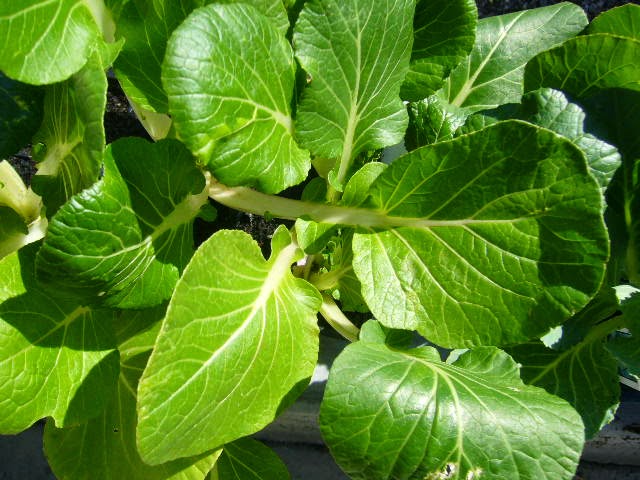
Baby Bok Choi
Hey, I used the handy-dandy Mantis rototiller to churn up two 4X8 beds yesterday AFTER I'd removed a green waste can packed with weeds and heirloom tomato plants still loaded down with green tomatoes. How do I feel today? Not bad actually. Thanks for asking. It's a clear sign that the back has largely returned to normal. But I'm still not going to do anything stupid. I don't want to go through that pain again.

This year we are dedicating one entire bed to nothing but lettuce and spinach. A separate bed will hold other items such as kale, carrots and a healthy amount of pea seeds for the spring pea crop. It's important to get the peas planted during the fall. They don't grow incredibly fast as the weather cools and the days grow shorter, but those root systems sure do get established. By the time spring rolls around? Those pea plants suddenly take off and deliver a bounty of fresh, spring greens.

Planted and Ready for Fall
The wife that is Venus and I have tried a number of varieties -- but we're partial to two of them. The varieties of "Tall Telephone" and "Mister Big Pea" not only deliver the largest peas we've ever harvested, but the tough shells stand up to slugs, snails and other garden pests who are just as interested in peas as we are. Plus -- those tough shells are good in spring stir fry dishes.

But there's going to be far more this fall than just lettuce plants, seed and peas. How about a little broccoli? Cabbage, chard and broccoli rabe? Sure! Dandelion greens? Bring it on!

Fall is here. Bring on the greens! This spoiled Californian is tired of buying what he can easily grow at home.

The Big Tomato Payoff

Friday, September 19, 2014

Heirloom Tomatoes-Bird Back 40
Break it Down! Stop! Tomato Time!

Is your garden like mine? Heirloom tomatoes coming out of your ears? It is that time of year for us heirloom aficionados. Long after the hybrids have played out and stopped producing, the heirlooms move in and take over -- delivering harvest after harvest after harvest.

And if the weather holds? Yet another harvest!

What does one do when nature delivers a boatload of heirloom tomato goodness? A couple like yours truly and the wife that is Venus drags out the canning equipment and starts preparing for some very big canning projects. We can't eat 50 tomatoes in one or two sittings. But we'll make darn sure that each one of them finds it's way into a canning jar of whole tomatoes, tomato sauces or salsa.

First Steps: Wash and Core Tomatoes
There's nothing quite like a warm bite of salsa on a Monday Night Football game played in a snowstorm. That's the payoff, my friends, the big tomato payoff.

This most recent project pays homage to a home-canning professional by the name of Sharon Howard, who plied her trade during decades of gardening in the Alberta, Canada area. I first became aware of Sharon many moons ago when I grabbed one of her recipes for canning dill pickles. She was kind enough to share many tomato sauce and stewed tomato canning recipes that were decades old, resulting in some of the most ridiculously delicious sauces we have ever created.

But on this particular day last August -- the job facing us was fairly simple. My back had healed up to the point where I could actually bend and pick a bounty of a harvest without a nerve or a disc flying off the handle and into the next backyard. The job on this day would be placing as many whole tomatoes into one-quart canning jars and processing the haul through a pressure canning process.

Skinned Tomatoes
The most tedious part of this process would be removing the skins from the actual tomatoes. That's job I leave up to the wife that is Venus. My job is to boil said tomatoes first, in a pot of water. Then place those tomatoes I've stuck in boiling water for one minute into an ice water bath.

With perfect red, round and smooth tomatoes -- those skins will slip off quite easily. But heirloom tomatoes aren't red. They aren't round either. And they are anything but smooth. Heirloom tomatoes are rather unwieldy, cat-faced beasts. It makes the job of peeling off the skins a little tougher, but it's still well worth the effort when those cold winter months roll into town.

Pack Each Jar Full!
As you might be able to guess, this process takes a little time with 50-100 freshly harvested tomatoes. But as we've come to learn in previous years, anything less than 20 one-quart jars of whole tomatoes is going to leave us short when we need them. And I cannot tell you how much I detest the assignment of driving to the store (in cold weather no less) to pick up a can or two of whole or sliced tomatoes.

And do you think our sauces are going to taste as good with something that came out of a common cannery? Perish the thought! Yep -- we're spoiled alright. Mighty spoiled. But it's also spoiled in a good way.

Summer Goodness in a Jar
After the skins are off -- the task gets fairly simple. Once those one-quart jars are washed and sterilized through the boiling water bath process, it's time to add a tablespoon or two of processed lemon juice to each jar, cram them with as many peeled tomatoes as possible, wipe the rims of each jar, seal and process through a 30-minute pressure canning process.

Then end result on this day? 18 quarts of whole tomatoes. Add those 18 quarts to five others that we had put through the canning process earlier this summer, and the Bird household is stocked with whole tomatoes for winter use.

Under Pressure
Ah -- but that's just part of the canning process. Because you can't make a tomato-good pizza sauce without adding a little finished tomato SAUCE to those whole tomatoes. Know what that means? It means another harvest is three weeks off.

You think sauce is important? Well, don't ask me! Rob Schneider of Saturday Night Live fame made sauce famous with his signature lines from skit involving a restaurant called "Hub's Gyros: "You like a de sauce, eh? De sauce is good, eh? I get you more sauce!" Three simple lines. Non-stop laughter.

Simple instructions for canning whole tomatoes can be found here and here.

Can't You Just Taste That???

Saturday, March 29, 2014

Table Grape Cluster-Thompson Vine
I know I can! Know what that is pictured to the right peeps? That, my friends, is a cluster. Not just any cluster mind you. And not the kind of cluster that Gunny Highway (Clint Eastwood) popularized in "Heartbreak Ridge." Nope! The picture to the right represents a big, fat CLUSTER of Thompson Table Grapes. And clusters just like this one are now emerging on every shoot emerging from the Thompson Table Grape vine.

Know what that means? It means a boatload of Thompson Table Grapes come this summer. And boatloads of table grapes are not a bad thing -- at least not in my book anyway.

Haircut Needed!
The table grape clusters now emerging by the hundreds it seems from the Venus, Fantasy, Black Monukka and Diamond Muscat vines, to name a few, follow on the heels of a haircut party held several weeks ago in the Bird Back 40. These vines, which emerged last year, managed to grow and cover the sidewalk you see pictured here and there. They also managed to grow right into the nearby pluot tree. Not only did they grow into it -- tendrils from these vines wrapped themselves around pluot tree branches and grew clear to the other side of the tree.

It wasn't all that unusual then -- to see a cluster of table grapes growing inside the pluot tree. And it did make for nice conversation.

Vines Before Pruning
Properly maintained? One single table grape vine will produce anywhere from 50 to 60 lbs. of table grapes. That's more than you and I can eat in any one sitting or two or three sittings for that matter. Now -- multiply that kind of production with nine table grape vines. There comes a point in the season where it's open season on table grape production, and I can't give them away or juice them fast enough.

The trick is to make sure the vines are properly maintained. The mass of vines you see pictured above looks like a really bad haircut, or someone just got up from a hard night's sleep. Most of these vines will not survive the pruning process that takes place when you're getting your mini-vineyard ready for spring and summer production. The wood that produced last years crop gets pruned away first -- along with any vines that emerged from that wood.

Vines After Pruning
The wood that you keep are the strongest vines or runners that emerged from the top of the vine, or the runners that emerged from the trunk itself. Those are the vines you keep -- and you won't keep all of them either. Some grape growers practice spur pruning -- keeping the strongest two vines that grew from the top or "cordon." Other growers practice the cane pruning method -- keeping the strongest vines that emerged from the trunks.

In my case? I practice both. Some varieties do better with spur pruning. Still others do better with cane pruning. Through the years I've discovered that the Thompson performs best with the spur pruning method, while the Black Monukka produces best through the method of cane pruning. And, as for the Fantasy vine, it really doesn't matter. The Fantasy is going to churn out ping-pong sized grapes no matter no matter what method of pruning that I use.

Piles of Discarded Vines
The vines that I choose to keep -- those that will be this year's fruit producers -- are then tied to the cattle pen fencing that we installed some years ago for our table grape vineyard efforts. It's been one of our better gardening investments. Cattle pen fencing can hold cows in place -- and can also support several hundred lbs. of table grape production.

It takes the better part of a weekend to properly prune and tie up nine table grape vines -- plus dispose of the piles of discarded vines piled nearby. That's a big investment of time and energy -- but well worth it when table grape season arrives -- which comes in late June for the Venus vine and continues right into July and August when most of the other varieties ripen up.

Cattle Pen Fencing
These vines will be sprayed to protect against mildew and other damage. Gibberellic acid, or GA-3, an organic growth hormone that promotes cell growth, will also be used at some point. Although there has been some previous research that suggests the use of GA-3 limits production on the Fantasy vine, I have not found this to be readily apparent in the Bird Back 40. And GA-3 results in large grapes that are packed with lip-smacking natural sugars. Fantasy grapes are not only the best eating -- they make the finest table grape juice.

The crop is ready when the mockingbirds who mock me begin to raid the vines with impunity. But it really doesn't matter all that much. These vines produce so much fruit now that I can share some with our fine-feathered friends. Besides -- they're taking a risk by coming in this close. Because somewhere in those vines -- hiding beneath the leaves -- is our garden patrol cat: Lenny. And when a 25 lb. Maine Coon snags a mockingbird? It's game over -- at least as far as the mockingbird is concerned.

As the wife that is Venus would say, "that's nature." Cats chase birds. It's the natural order of things. Yes -- and we can add one more rule to that list: Bill Bird likes table grapes.

Hot Fun in the Summertime

Monday, November 18, 2013

Melon Fruit Salad? Yes Please!
Yes -- I do understand. I get it. Our summer is as distant a memory as Sly and the Family Stone. Yet I am reminded of those "Summer Days" when I begin to clean up and clean out of the last of the summer garden. The last to go was the melon patch. It's so very hard to let go of something that was so good to us during those days in the country sun.

Actually, I'd be telling a bit of a fib to you if I proclaimed 2013 as the "perfect" melon year. It wasn't. In fact, for the second straight year, I'm sad to proclaim that my attempt to grow the Georgia Rattlesnake watermelon to be a big, fat failure. Instead of "fat melons" I got lots of melons that grew to a size of two to three inches, and then developed a dead blotch of skin at the end.

Georgia Rattlesnake Melon
It didn't take long for that dead spot at the end to cover the entire melon either. I can't tell you how many times I watched so many promising starts on the vine go haywire on us. Like avocado trees, I've got some sort of "complex" when it comes to the Georgia Rattlesnake. No matter how many times I've tried to grow this variety -- no matter how many different things I've tried -- each attempt has come up a big, fat zero.

Fortunately? Not all melons act in this matter.

The Sangria variety -- for example -- did quite well for me this year. Do you know what the really funny part of this equation is? I didn't plant any Sangria watermelon seeds. Nope -- the seeds that germinated in one corner of a raised gardening bed this year were left over from last year. It didn't matter much that I ran them over once or twice with the injustice of a Mantis Rototiller. They seemed to like it just fine. So -- while my watermelon desires may not have been satisfied with a Georgia Rattlesnake -- the Sangria made for an acceptable substitute.

Cantaloupe and Crenshaw Melon Combo
I find myself thinking about melons now because -- well -- because melon season is long gone. Like many fruit varieties to come out of the garden this year -- they all managed to ripen up for a two-week to 10-day period in late August. During this golden, luscious period in time, it was melons for breakfast, melons for lunch and melons for dinner.

As the picture top right shows -- it was a fruit salad bonanza. Grapes, melons, peaches, you name it. Everything gave a little or a lot. And guess what? Even after all that -- it still wasn't enough. Because Bill Bird finds himself craving a home-grown, vine-ripened melon here in the month of November.

Sangria Melon Right, Crenshaw Melon Left
Except -- you can't get vine-ripened melons in November. Not in this part of the country anyway. Therefore, I do the next best thing: Post pictures and dream till next year.

Once again -- the clear winner in this year's melon patch -- just as it was last year -- is the Crenshaw Melon. I'm beginning to believe that the Crenshaw is just so darn easy to grow that one would have to be named Bill Bird to possibly screw up something this simple. So far? I haven't managed to screw it up. Therefore, I must be doing something right.

What the bugs didn't get -- the wife that is Venus would squeeze into fresh Crenshaw melon juice. Unlike past years, we didn't allow one melon to go to waste this year. What we didn't consume fresh -- the wife cut into pieces and ran it through the juicer.

Sliced Crenshaw Melon
It's during melon season where I am reminded of the Kingsburg Watermelon Festival. Sponsored by the Kingsburg Lions Club chapter, the watermelon festival was a place where you could get your fill of vine-ripened watermelon. If one quarter-slice wasn't enough, here, have two! And while you're at it? Enjoy a third! Heck, there was enough there to bathe in.

Sadly, the Kingsburg Watermelon Festival is an event that can now only be found in local memories. I'm not sure why it went away, but like most good things it did. The radio station I worked for at the time in Fresno sent me south to cover the Kingsburg event every year it seemed. Why I kept on drawing repeat coverage duty, I'll never know. It wasn't one of those events that was very hard to report on. I suppose my report went a little like this:

"There are people here... They are consuming watermelon and lots of it... Reporting live from Kingsburg...."

My love for watermelon wasn't born there -- but it's one of those little events that will always stay with me. And it's one reason why the mighty melon will always have room in the Backyard of Bird...

Baby Duke Finds a Home

Saturday, September 7, 2013

The Wife That is Venus and The Duke Avocado
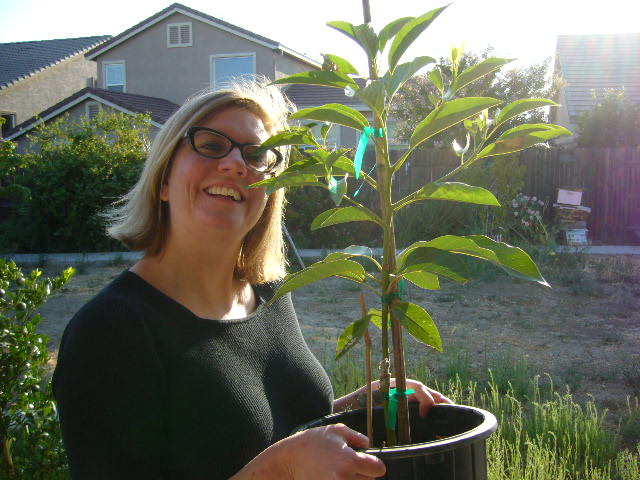
There are two things in the photo to the right that are very special to me. The first -- and most obvious I might add -- is the wife that is Venus. She's got a smile on her face. Why? Because I told her to smile! No, not really. That potted plant is behind the smile that the wife is wearing. Can you guess what it might be?

If you guessed an avocado tree -- points to you dear friend. By now you're probably wondering, "big deal, it's a fricken avocado tree!" Yes -- that may be true -- but it's not just any avocado tree. My friends -- this is the legendary Duke Avocado. What makes the Duke so special? You can't buy it at any store. No nursery carries the Duke. If you call around looking for a Duke, you're likely to be greeted with silence or even a blank stare. No store -- no supplier -- carries the Duke Avocado anymore.

Duke Avocado Tree
Why? Good question. I still don't quite understand why it was abandoned as a backyard tree. This isn't your dad's avocado tree -- this is what dear old grandaddy planted in his backyard. There is only one way to obtain a true, grafted, Duke. If you want a true Duke Avocado tree, you have to "make one."

Which is just what Bill Bird did -- with a little help from his friends at the California Rare Fruit Growers (CRFG). The tree that Venus is holding and again pictured to your left is probably the first true, grafted Duke tree that has been grown in decades. The scion attached to the root stock was taken from the spot where the Duke Avocado was born in 1912: Butte County.

This tree just isn't rare. The Duke Avocado is incredibly rare. And it has one incredible story behind it.

Oroville: Home of the Duke Avocado
This has been a rather long journey which I documented here last year and again here about six months later. The baby Duke Avocado tree now growing in the Bird Back 40 is the result of a quest to find an avocado variety that will laugh at freezing conditions, grow in terrible soils that have doomed other avocado varieties and, of course, produce boatloads of avocados.

The Duke is the result of a quest that started when I earned a none-too-stellar reputation of killing avocado trees. It didn't matter what variety I planted. It didn't matter where I planted it. Because, with each tree I planted, death arrived at its doorstep less than six months later. The tried-and-true standard nursery varieties of Bacon, Mexicola, Mexicola Grande, Zutano and Pinkerton all had a date with the Grim Reaper. They bit the dust, bought the farm, took a dirt nap, fed the worms, etc.

Duke Avocado Planted in Raised Bed
Avocado tree suppliers made bank on my misfortune. Because when one tree kicked the bucket, Bill Bird trotted out and dutifully shelled out another fifty bucks on another, supposed, "cold weather tolerant" avocado tree. Why keep kicking myself like this? Because the wife that is Venus DEMANDED an avocado tree for her backyard. That's why. Isn't that enough?

Since the definition of insanity is doing the same thing over and over again and expecting different results, I knew I had to try something different (I'm not that whacko, people. Not yet anyway). The links above detail the quest I started last year to find an avocado variety that could withstand the micro-climate cold freezes that cover the Bird Back 40 every December.

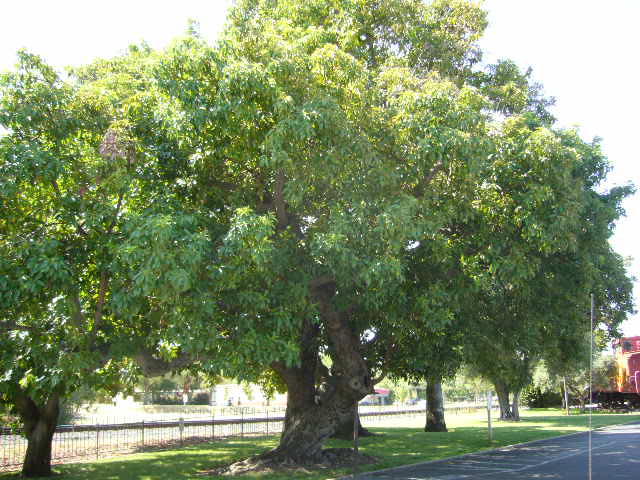
Duke Avocado Tree-Oroville Train Depot
The discovery of the Duke would then lead to the quest for a Duke -- the steps I took to find a supplier -- and finally -- the discovery of ancient Duke avocado trees planted in an old Introductory Garden located at the site of the old Oroville train Depot once served by the Western Pacific Rail Road. It was there where I would procure the scions from an ancient heirloom tree brought about by a crazy old man called "Benedict," who started planting avocado seed in Bangor in 1912.

Mr. Benedict may have failed in his quest to build an avocado nursery in one of the coldest interior regions of California. But his lasting success is the creation of the Duke line. The last major investigative report on the Duke, printed in the 1963 California Avocado Yearbook, not only failed to find the source of the avocado seed that Benedict was importing into Butte County, trees similar to the Duke couldn't be located anywhere.

Duke Avocado Leaves Are Shiny Yellow-Green
The Duke, like many avocado varieties that once graced California fields, was replaced by another variety at some point and then forgotten. There are a myriad of reasons as to why it was abandoned. Perhaps better tasting varieties were developed? The thin skins of the Duke fruit quickly fell out of favor with commercial growers and shippers. The fruit bruised far too easily during transport from farm to market. What happened to the Duke isn't unique. Many other avocado varieties have been tried, and then forgotten.

What makes the Duke unique, however, is this tree's ability to withstand frosty cold conditions. The Duke has survived major freezes that severely damaged other varieties planted nearby. I have witnessed the Duke's ability to laugh off a sustained frost with my own eyes. I have seen healthy Duke scions protruding from half dead root stock that nearly perished after a cold December freeze.

THE QUEST FOR THE DUKE AVOCADO

The quest for my own Duke Avocado tree didn't end with the discovery of original Duke trees in Oroville. That was just the start of our avocado adventure. One does not "plant" Duke Avocado seed to obtain a true Duke tree. The only way to get a true Duke is through the process of grafting.

Duke Avocado Tree-Bird Back 40
Since my grafting skills are still suspect (ie: BAD), I farmed out Duke cuttings (scions) taken from original Duke trees in Oroville to growers connected to the CRFG. Avocado root stock was procured from other CRFG suppliers in Northern and Central California. Two growers with marvelous grafting abilities volunteered to take on the project of creating new Duke trees.

Unfortunately, for reasons that I still don't understand, the Sacramento grower who volunteered for this effort allowed all of his Duke trees and his avocado root stock to die this summer. I'm not exactly sure what went wrong. I didn't get much of an explanation from him, other than that the three grafted Duke trees in his possession, and additional root stock, had died.

Heritage Duke Tree-Oroville, CA
Ever get socked in the stomach? That's kind of how I felt. I had visited this grower last May and witnessed the progress he had made with his grafting efforts. I saw, with my own eyes, healthy Duke shoots protruding from root stock that had nearly perished during the previous winter. Since the root stock was suspect, I agreed with his request. He wanted to break the half-dead root stock into pieces and bury it under the soil line, leaving only the healthy Duke shoot above.

He was the expert at this, right? So I agreed. And, after hearing that all of his trees had died from lack of care this summer, I began to regret this decision. A thought kept running through my mind: "Why didn't I grab one of those trees when I had a chance?"

Hindsight is 20-20.

LOVELY DOWNTOWN WATERFORD

A Waterford Backyard
If you have ever taken the opportunity to visit the downtown area of Waterford, "lovely" is probably the last adjective that comes to mind. Waterford is a small community that most people on Highway 120 zoom right through -- usually on their way to a nearby reservoir or even Yosemite National Park. It's not a place where one would normally stop, unless you need gas.

But there is a spot in downtown Waterford that is, indeed, quite lovely. It's the backyard of CRFG grower David Johnson. This is the second time I've had the pleasure of walking into David's backyard. It is a tribute to not just avocado trees of different shapes and sizes, but rare and unique citrus varieties and other fruit that isn't often found in the normal California backyard. Thanks to a canopy of shade from fruit and citrus trees planted long ago, David makes magic happen on the ground below.

Backyard of CRFG Member David Johnson
I like to think of it as a science lab for growing the rare and unique. Small trails lead from one discovery to another. And there's usually a friendly cat that steps out along the way, demanding a scratch or to be held and petted. On this particular day I had come to adopt an avocado tree. I nearly adopted another cat (something I do not need).

David is the other grower who had been enlisted with Duke scions taken from the Oroville trees. I hadn't given David nearly as much as I'd delivered to the Sacramento grower, but it was enough to create two or three grafted Duke trees. As I gazed upon those light green leaves tinged with yellow streaks, a signature of the Duke tree, I knew that my work on this venture had not been in vain.

Avocado Tree Nursery-Waterford
Unlike my Sacramento grower, David did not splice scions into existing root stock. He instead sliced into root stock at the base of the tree -- removing all previous growth -- and inserted a Duke scion. I had given him enough scion material last year for six trees. If the graft failed to take, it meant the entire root stock was also a goner. But David experienced a fifty percent success rate. Six grafts with six different root stocks resulted in three healthy trees.

Before you get too excited -- all three have found a home. But I did more than just drive to Waterford to pick up Venus' Duke Avocado tree. David also received a delivery of an ice chest packed with scion material taken from the Oroville trees that I had visited earlier that morning. David is now creating new Duke trees as this post is written.

Avocado Cat Says "Adopt Me!"
Yes -- you're right -- it was a long drive. From Sacramento north to Oroville -- then back south again to Sacramento and even further south to Waterford. Thanks to Google Maps, I was able to follow a lot of the original route that had been set aside for the never constructed Highway 65. These are old rural roads now that are rarely traveled, but offer a glimpse of the San Joaquin Valley one doesn't get from Highway 99 or Interstate 5.

Highway 65 was originally designed to take pressure off Highway 99. Like many highway building projects, it was shelved under the mistaken belief of: "If we don't built it, they (people) won't come." Lots of highway projects were abandoned in the 1970's under this mistaken belief. The people still came. Our population has nearly doubled since 1970.

But that's enough of politics. Back to avocados -- specifically -- The Duke Avocado.

THE END?

Emerging Duke Leaf Sets
Venus' Duke Avocado tree has found a home in a side yard of the Bird Back 40. Planted in a raised bed and sheltered from the freezing winds that blow in from the north during winter, I'm hopeful this avocado tree will meet with a better fate than most previous avocado tree efforts. The Duke is located near a Bearss Lime tree, which can also succumb to cold weather freezes, but has done quite well in the spot we placed it four years ago.

I'm pleased to report that this tree is experiencing a growth spurt in its new home and hope the incredible growth pattern that I've read about regarding the Duke tree also holds true. As to when this tree will produce its first real avocado, that's anyone's guess. It can take some trees five to seven years before they will produce.

I'm hoping for a little quicker production than that -- but have also learned the time honored rule when it comes to gardening or growing good things in the garden: Patience is a virtue.

POSTSCRIPT: DUKE TREES NO LONGER FOR SALE


Newly Grafted Duke Avocado Tree
Sorry folks -- demand exceeded supply. I mean, way, way, WAY exceeded supply. Our Duke Avocado operation is quite small. Once I announced several months ago that Duke trees were for sale? I was inundated with email requests from across the continental United States. I even discovered the location of another Duke tree -- growing in a USDA Agricultural Research Station located outside of Miami! Yes -- the Duke grows in Florida! And probably elsewhere.

So, I'm sorry to report that the window has closed shut. Heck, it's been nailed down. I have so many requests for Duke trees that it will take years to fulfill them all.

In the meantime? If you've got your heart and soul stuck on a Duke Avocado, as I did, you can always make one, as I did.

Find the details of how I did it here and here.