Showing posts with label CRFG. Show all posts

Five-Six-Pick Up Sticks!

Saturday, January 17, 2015

STICKS!
Fun in a January garden setting anyone? Can you have fun in a January garden setting? Of course you can -- provided you like working outside in cold weather. If that's not quite your cup of tea -- well -- a hot cup of tea does help take the winter sting away somewhat.

January in the garden is a busy time. There are things to prune back. There are things to plant. There's always an annoying patch of weeds to take care of. And January happens to be the perfect time to add to your fruit tree collections.

Flavor Supreme Pluot Scion
I've been planting fruit trees in the Bird Back 40 for seven plus years so far. Usually it's one or two trees. But sometimes -- like last year -- it was three pear trees in a Backyard Orchard Culture setting. Point is? I'm starting to run out of room. I'm not quite there yet -- but there will come a day when it will be awfully tough to cram yet another fruit or citrus tree in the Bird Back 40.

So what does a fruit fanatic do when he or she runs out of room? Plant them in the neighbor's yard without them knowing it!

Flavor Finale Pluot Tree-Bird Back 40
No -- that's never a good idea. Especially if you want to keep your good neighbors on a "good neighbor" basis. The best way to add fruit to a yard already full of delicious fruit offerings is to graft different varieties of fruit onto trees that are already growing.

I've been quite successful with the pluot tree -- as profiled last year with The Tree That Bethany Built. And -- true to her word -- my work-friend came through again this year with a selection of pluot offerings that had not been added to my rather Frankensteinish Flavor Finale Pluot Tree.

Last Year's Successful Grafting Results
Did you think the Tree of 40 Fruit was impressive? How about the Tree of 40 Pluots? Now -- I'll be honest. I'm not quite there yet. I may never be there. But thanks to Bethany's kind offering of scion wood -- the Flavor Finale now holds grafts for the Splash and Flavor Supreme pluots.

If there's one thing I can brag about, it's this: Bill Bird can graft pluots. It's idiot proof. I can't graft a peach, cherry, apple or nectarine worth a hoot. But when it comes to pluots? I am the Flavor King of grafters. That's because it's really hard to screw up a pluot tree graft.

Handy Dandy Grafting Tool
As the author of numerous grafting failures -- just trust me on this.

I will get more experience with other grafting efforts -- and soon I might add. As luck would have it, the Sacramento Chapter of the California Rare Fruit Growers (CRFG) holds its annual scion exchange tomorrow at a new location in Carmichael.

What are scions? Scions are essentially nothing more than sticks that have been harvested from various fruit trees around California. You like peaches? Nectarines? Are cherries your bag? How about apricots? Do plums tempt you? Does the letter A make you think of apples?

Sacramento CRFG Scion Exchange 2010
At the scion exchange you'll find hundreds of scion offerings featuring varieties that you've probably never heard of. Do you want a Tree of 40 Peaches? Tree of 40 Cherries? The scion exchange can make it happen.

The event has moved because it basically outgrew the old location on Branch Center Road. That room would get so crammed with fresh fruit enthusiasts that it could be a challenge to move from place to place. Although I haven't visited the new location yet, I'm told by "those in the know" that I'll like it.

Nectarines Anyone?
That said -- this years Sacramento CRFG scion exchange will be held Sunday (TOMORROW), January 18th at the La Sierra Community Center, Smith Hall. It's located at 5325 Engle Road in Carmichael. Anyone and everyone with an interest in growing fruit is welcome. Admission is $5. Doors open to the public at 10:30 sharp -- which should get you home just in time for the start of the NFL Championship Games. 

Hey, we've got to keep the important stuff in perspective here -- even if my beloved San Francisco 49ers missed out on the dance this year (so long Jim Harbaugh).

Happy Gardening New Year!

Thursday, January 1, 2015

Good morning and welcome to 2015! Wait, the clock says 12:12 PM! Did I really sleep that long? I've got to stop watching those New Year's Eve broadcasts on Univision. That's right, I said Univision. Even though most of the programming flies right over my head (I don't speak the best Spanish), I do like the fact that they put live crews at Disneyland in Southern California to ring in the New Year.

That's much better than watching one of the major networks repeat a New York City ball drop that took place three hours earlier, don't you think? Univision also isn't afraid to highlight singers who are over the age of 30. Jeez, when did I get so old and crotchedy?

Disneyland Rings in 2015
The new year means a new start to gardening efforts. And you thought time slowed down for gardeners during those winter months? Perish the thought! Winter time is planning time. If you're into serious gardening like me and the wife that is Venus (plus countless others) -- winter is just as important as spring, summer and fall. For it's the steps we take right now that either assure our success, or spell our doom, come summertime.

So what is on Bill Bird's gardening agenda for the first day of 2015? More than one or two items actually. Here is just a smattering of some of garden planning that takes place during this non-slow period of the year.

Seeds from Lockhart Seed
SEEDS, SEEDS, SEEDS: If you grow your garden from seeds, as we do, now is the time to start ordering seeds for the coming spring and summer. My work on this front actually started weeks ago. Our first stop was to the Mother of all seed stores in the San Joaquin Valley: Lockhart Seed in Stockton. There you will find most of everything you need for a full scale garden -- but not everything.

Seed catalogs that arrive by the dozens during this time of year plus seed websites offer the selection you can't find at seed stores. Most of my heirloom tomato seed -- for example -- comes from two or three different sources. Tomato Grower's Supply offers a warehouse selection of many major heirloom and hybrid tomato offerings. I'm also a fan of the breeding efforts of Bradley Gates, who runs Wild Boar Farms in the heart of the Napa Valley.

Tomato Selections from Wild Boar Farms
The Gates operation doesn't offer heirlooms. But he does offer selections that he's created on his own -- such as the Pink Berkeley Tie Dye and Cascade Lava. Other seeds come from other gardeners who save seed from the particular plants they liked in 2014. This is how I obtained seeds for the Ukrainian Heart tomato. They came as a trade that I engineered with Davis gardener and California Rare Fruit Grower (CRFG) member Marta Matvienko. Marta send me seeds for Ukrainian Heart. In return, I sent her seeds for Black Cherry -- a volunteer that sprang from the garden last year.

I also owe Marta a smattering of Blue Lake Pole Bean Seeds. Why? Because I was dumb enough to buy a pound of these seeds from Lockhart Seed. And I won't be planting a pound of pole bean seeds. Ever.

Ordering seeds is also the first step in the process. Tomato fanatics like me and the wife that is Venus will start planting these seeds indoors starting in February. Seed starting efforts for hot peppers, like the Ghost pepper for example, start even earlier. Some people have already started seeds for the Ghost and Scorpion peppers. This is because these types of varieties demand long growing seasons. Starting hot peppers in January means a nice harvest in July or August -- right when the tomatoes ripen.

Salsa anyone?

FRUIT TREES: The next two months are premium months for bare root fruit tree season. Major fruit tree suppliers like Dave Wilson Nursery in Hickman are already in the process of shipping tens of thousands of every fruit tree variety you can possible imagine to nurseries all over the West Coast and elsewhere. I'm not sure how big the DWN footprint actually is (I've never asked). But since they are the primary supplier for all things pluot, plumcot and other recent fruit tree introductions, I can imagine they get a lot of business.

And you thought Christmas season was busy?

One of my favorite activities is to browse the fruit tree selections on the DWN website. There you will find photos and entries about every fruit tree they offer. Not sure if you want a plum or a pluot? Torn between apples and apricots? Should it be a pear or a pomegranate? The DWN website, plus planting recommendations might answer some of those nagging doubts.

And there's nothing like a bit of fresh fruit pulled from a backyard or front yard tree during the summer. Bare root season is also the best time for planting because there's not as much stress placed on the tree as it's hauled from nursery site to that premium spot you've picked out for it in your yard.

Flavor Finale Pluot Tree in Winter
FRUIT TREE CARE: Now that the leaves are off the multitude of fruit trees I have scattered about the Bird Back 40 -- it's time to start thinking about winter care to prevent spring problems. There's a lot to worry about -- from peach leaf curl to the dreaded fire blight. Spraying early for insect control might erase or even lessen the expected bug invasion during the spring and summer.

I've come to discover that there's a particular bug that enjoys my Flavor Finale pluot tree as much as I do. If I fail to do anything to control it -- this invading army will infect and destroy every leaf on the tree. The most effective control I've found against this bug is to treat the tree once in the winter and again in the spring -- AFTER it has stopped flowering (we don't want to be spraying the helpful pollinators -- now do we?).

Grapevines in Need of a Haircut
Winter time is also pruning time -- especially for items such as wine or table grapes or fruit trees planted together in a Backyard Orchard Culture setting. Some fruit trees -- like the Granny Smith apple for example -- need a little "convincing" to enter that needed winter slumber. While many apple tree selections gladly shed every last leaf during the first blast of arctic weather -- the Granny stubbornly holds out like a petulant child who isn't quite ready for bedtime.

So how does one "convince" a Granny Smith apple tree to shed every last leaf? Yell at it? Call it bad names? Insult it? No, nothing that dire. Simply put on your winter gardening gloves and pick every last leaf off. Granny will get the message.

Finally -- winter time is a perfect time for fruit tree GRAFTING. This is why many CRFG Chapters hold scion exchanges during the months of January and February. The Sacramento Chapter is no different. This year's scion exchange will take place on Sunday, January 18 from 10:00 to 1:00 at La Sierra Community Center (5325 Engle Rd., Carmichael 95608).

And here you thought winter time was a "slow time" for us gardening fanatics. I'm tired already!

Baby Duke Finds a Home

Saturday, September 7, 2013

The Wife That is Venus and The Duke Avocado
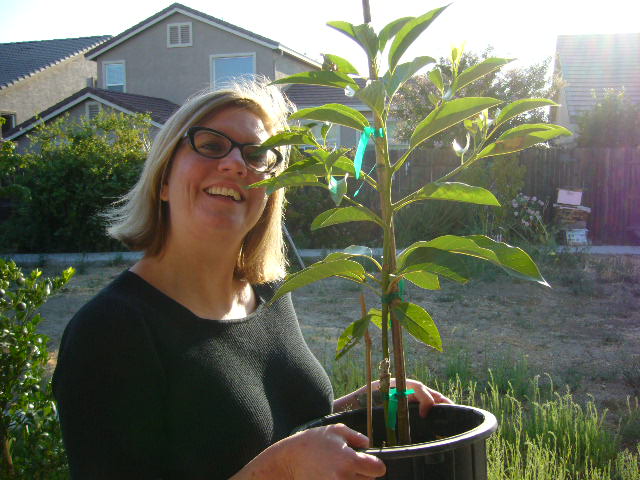
There are two things in the photo to the right that are very special to me. The first -- and most obvious I might add -- is the wife that is Venus. She's got a smile on her face. Why? Because I told her to smile! No, not really. That potted plant is behind the smile that the wife is wearing. Can you guess what it might be?

If you guessed an avocado tree -- points to you dear friend. By now you're probably wondering, "big deal, it's a fricken avocado tree!" Yes -- that may be true -- but it's not just any avocado tree. My friends -- this is the legendary Duke Avocado. What makes the Duke so special? You can't buy it at any store. No nursery carries the Duke. If you call around looking for a Duke, you're likely to be greeted with silence or even a blank stare. No store -- no supplier -- carries the Duke Avocado anymore.

Duke Avocado Tree
Why? Good question. I still don't quite understand why it was abandoned as a backyard tree. This isn't your dad's avocado tree -- this is what dear old grandaddy planted in his backyard. There is only one way to obtain a true, grafted, Duke. If you want a true Duke Avocado tree, you have to "make one."

Which is just what Bill Bird did -- with a little help from his friends at the California Rare Fruit Growers (CRFG). The tree that Venus is holding and again pictured to your left is probably the first true, grafted Duke tree that has been grown in decades. The scion attached to the root stock was taken from the spot where the Duke Avocado was born in 1912: Butte County.

This tree just isn't rare. The Duke Avocado is incredibly rare. And it has one incredible story behind it.

Oroville: Home of the Duke Avocado
This has been a rather long journey which I documented here last year and again here about six months later. The baby Duke Avocado tree now growing in the Bird Back 40 is the result of a quest to find an avocado variety that will laugh at freezing conditions, grow in terrible soils that have doomed other avocado varieties and, of course, produce boatloads of avocados.

The Duke is the result of a quest that started when I earned a none-too-stellar reputation of killing avocado trees. It didn't matter what variety I planted. It didn't matter where I planted it. Because, with each tree I planted, death arrived at its doorstep less than six months later. The tried-and-true standard nursery varieties of Bacon, Mexicola, Mexicola Grande, Zutano and Pinkerton all had a date with the Grim Reaper. They bit the dust, bought the farm, took a dirt nap, fed the worms, etc.

Duke Avocado Planted in Raised Bed
Avocado tree suppliers made bank on my misfortune. Because when one tree kicked the bucket, Bill Bird trotted out and dutifully shelled out another fifty bucks on another, supposed, "cold weather tolerant" avocado tree. Why keep kicking myself like this? Because the wife that is Venus DEMANDED an avocado tree for her backyard. That's why. Isn't that enough?

Since the definition of insanity is doing the same thing over and over again and expecting different results, I knew I had to try something different (I'm not that whacko, people. Not yet anyway). The links above detail the quest I started last year to find an avocado variety that could withstand the micro-climate cold freezes that cover the Bird Back 40 every December.

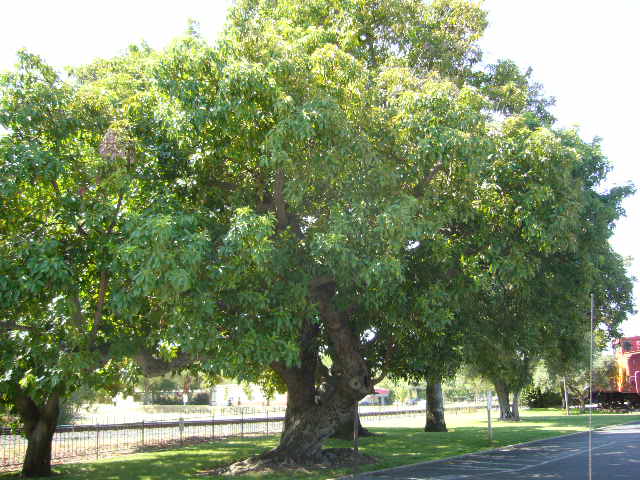
Duke Avocado Tree-Oroville Train Depot
The discovery of the Duke would then lead to the quest for a Duke -- the steps I took to find a supplier -- and finally -- the discovery of ancient Duke avocado trees planted in an old Introductory Garden located at the site of the old Oroville train Depot once served by the Western Pacific Rail Road. It was there where I would procure the scions from an ancient heirloom tree brought about by a crazy old man called "Benedict," who started planting avocado seed in Bangor in 1912.

Mr. Benedict may have failed in his quest to build an avocado nursery in one of the coldest interior regions of California. But his lasting success is the creation of the Duke line. The last major investigative report on the Duke, printed in the 1963 California Avocado Yearbook, not only failed to find the source of the avocado seed that Benedict was importing into Butte County, trees similar to the Duke couldn't be located anywhere.

Duke Avocado Leaves Are Shiny Yellow-Green
The Duke, like many avocado varieties that once graced California fields, was replaced by another variety at some point and then forgotten. There are a myriad of reasons as to why it was abandoned. Perhaps better tasting varieties were developed? The thin skins of the Duke fruit quickly fell out of favor with commercial growers and shippers. The fruit bruised far too easily during transport from farm to market. What happened to the Duke isn't unique. Many other avocado varieties have been tried, and then forgotten.

What makes the Duke unique, however, is this tree's ability to withstand frosty cold conditions. The Duke has survived major freezes that severely damaged other varieties planted nearby. I have witnessed the Duke's ability to laugh off a sustained frost with my own eyes. I have seen healthy Duke scions protruding from half dead root stock that nearly perished after a cold December freeze.

THE QUEST FOR THE DUKE AVOCADO

The quest for my own Duke Avocado tree didn't end with the discovery of original Duke trees in Oroville. That was just the start of our avocado adventure. One does not "plant" Duke Avocado seed to obtain a true Duke tree. The only way to get a true Duke is through the process of grafting.

Duke Avocado Tree-Bird Back 40
Since my grafting skills are still suspect (ie: BAD), I farmed out Duke cuttings (scions) taken from original Duke trees in Oroville to growers connected to the CRFG. Avocado root stock was procured from other CRFG suppliers in Northern and Central California. Two growers with marvelous grafting abilities volunteered to take on the project of creating new Duke trees.

Unfortunately, for reasons that I still don't understand, the Sacramento grower who volunteered for this effort allowed all of his Duke trees and his avocado root stock to die this summer. I'm not exactly sure what went wrong. I didn't get much of an explanation from him, other than that the three grafted Duke trees in his possession, and additional root stock, had died.

Heritage Duke Tree-Oroville, CA
Ever get socked in the stomach? That's kind of how I felt. I had visited this grower last May and witnessed the progress he had made with his grafting efforts. I saw, with my own eyes, healthy Duke shoots protruding from root stock that had nearly perished during the previous winter. Since the root stock was suspect, I agreed with his request. He wanted to break the half-dead root stock into pieces and bury it under the soil line, leaving only the healthy Duke shoot above.

He was the expert at this, right? So I agreed. And, after hearing that all of his trees had died from lack of care this summer, I began to regret this decision. A thought kept running through my mind: "Why didn't I grab one of those trees when I had a chance?"

Hindsight is 20-20.

LOVELY DOWNTOWN WATERFORD

A Waterford Backyard
If you have ever taken the opportunity to visit the downtown area of Waterford, "lovely" is probably the last adjective that comes to mind. Waterford is a small community that most people on Highway 120 zoom right through -- usually on their way to a nearby reservoir or even Yosemite National Park. It's not a place where one would normally stop, unless you need gas.

But there is a spot in downtown Waterford that is, indeed, quite lovely. It's the backyard of CRFG grower David Johnson. This is the second time I've had the pleasure of walking into David's backyard. It is a tribute to not just avocado trees of different shapes and sizes, but rare and unique citrus varieties and other fruit that isn't often found in the normal California backyard. Thanks to a canopy of shade from fruit and citrus trees planted long ago, David makes magic happen on the ground below.

Backyard of CRFG Member David Johnson
I like to think of it as a science lab for growing the rare and unique. Small trails lead from one discovery to another. And there's usually a friendly cat that steps out along the way, demanding a scratch or to be held and petted. On this particular day I had come to adopt an avocado tree. I nearly adopted another cat (something I do not need).

David is the other grower who had been enlisted with Duke scions taken from the Oroville trees. I hadn't given David nearly as much as I'd delivered to the Sacramento grower, but it was enough to create two or three grafted Duke trees. As I gazed upon those light green leaves tinged with yellow streaks, a signature of the Duke tree, I knew that my work on this venture had not been in vain.

Avocado Tree Nursery-Waterford
Unlike my Sacramento grower, David did not splice scions into existing root stock. He instead sliced into root stock at the base of the tree -- removing all previous growth -- and inserted a Duke scion. I had given him enough scion material last year for six trees. If the graft failed to take, it meant the entire root stock was also a goner. But David experienced a fifty percent success rate. Six grafts with six different root stocks resulted in three healthy trees.

Before you get too excited -- all three have found a home. But I did more than just drive to Waterford to pick up Venus' Duke Avocado tree. David also received a delivery of an ice chest packed with scion material taken from the Oroville trees that I had visited earlier that morning. David is now creating new Duke trees as this post is written.

Avocado Cat Says "Adopt Me!"
Yes -- you're right -- it was a long drive. From Sacramento north to Oroville -- then back south again to Sacramento and even further south to Waterford. Thanks to Google Maps, I was able to follow a lot of the original route that had been set aside for the never constructed Highway 65. These are old rural roads now that are rarely traveled, but offer a glimpse of the San Joaquin Valley one doesn't get from Highway 99 or Interstate 5.

Highway 65 was originally designed to take pressure off Highway 99. Like many highway building projects, it was shelved under the mistaken belief of: "If we don't built it, they (people) won't come." Lots of highway projects were abandoned in the 1970's under this mistaken belief. The people still came. Our population has nearly doubled since 1970.

But that's enough of politics. Back to avocados -- specifically -- The Duke Avocado.

THE END?

Emerging Duke Leaf Sets
Venus' Duke Avocado tree has found a home in a side yard of the Bird Back 40. Planted in a raised bed and sheltered from the freezing winds that blow in from the north during winter, I'm hopeful this avocado tree will meet with a better fate than most previous avocado tree efforts. The Duke is located near a Bearss Lime tree, which can also succumb to cold weather freezes, but has done quite well in the spot we placed it four years ago.

I'm pleased to report that this tree is experiencing a growth spurt in its new home and hope the incredible growth pattern that I've read about regarding the Duke tree also holds true. As to when this tree will produce its first real avocado, that's anyone's guess. It can take some trees five to seven years before they will produce.

I'm hoping for a little quicker production than that -- but have also learned the time honored rule when it comes to gardening or growing good things in the garden: Patience is a virtue.

POSTSCRIPT: DUKE TREES NO LONGER FOR SALE


Newly Grafted Duke Avocado Tree
Sorry folks -- demand exceeded supply. I mean, way, way, WAY exceeded supply. Our Duke Avocado operation is quite small. Once I announced several months ago that Duke trees were for sale? I was inundated with email requests from across the continental United States. I even discovered the location of another Duke tree -- growing in a USDA Agricultural Research Station located outside of Miami! Yes -- the Duke grows in Florida! And probably elsewhere.

So, I'm sorry to report that the window has closed shut. Heck, it's been nailed down. I have so many requests for Duke trees that it will take years to fulfill them all.

In the meantime? If you've got your heart and soul stuck on a Duke Avocado, as I did, you can always make one, as I did.

Find the details of how I did it here and here.

The Duke Rides Again

Saturday, June 23, 2012

Wrong Duke!
It was that night where I could not sleep when I first discovered you. I remember it almost as if it were yesterday. Nels Christenson had once again provided us with a gift of four avocados from the Bacon Avocado tree growing in his side yard. The wife that is Venus once again remarked how much she would like an avocado tree for our yard.

It was that night -- or very early that morning. Do you recall? Frustrated by years of attempting to grow avocados in the Bird Back 40, and watching all slowly turn black and die from the December frosts that coated our backyard, I sat at the computer as I am now and started this journey.

This is how I found "The Duke."

As I sat at my computer that morning, I entered the familiar Google search terms of "avocado" and "cold weather variety." Up popped the same results. The Bacon Avocado, the Mexicola, Mexicola Grande and Fuerte. I was disappointed. This wasn't what I wanted. I've tried all four of these varieties. All four aren't as "cold weather tolerant" as advertised. They kick off at the first hint of frost. Wasn't there anything else out there? Anything at all?

Venus Under "The Duke" Avocado Tree
It was -- at that point -- frustrated by years of searching and failure that I decided to change my search terms. Instead of "cold weather varieties," I entered the terms of "avocado" and "freeze." That did it. Up popped a bevy of new entries and results about avocados that I'd never seen before. And, in each entry, a name kept repeating itself. Over and over again.

THE DUKE AVOCADO

"The Duke Avocado," I wondered? "I've never heard of The Duke." Curiosity got the best of me. I clicked on the first search term result, a 1963 report from the Avocado Yearbook. 1963 was the year I was born. This was one very old report. I was surprised to find it online. I was even more enchanted by the story that was about to unfold.

The Duke Avocado is one of the oldest varieties to be grown extensively on the West Coast. It's ancestral home is near Bangor, located in Butte County, on the grounds of the old Sunnyslope Nursery. It was there, in the middle of nowhere, where a crazy old man by the name of "Mr. Benedict" began planting avocado seeds by the hundreds in 1912. Not much is known about this man, not even his first name, but the nursery appeared to be a big, fat failure.

The Duke
It would soon fall into disrepair and be abandoned. The old nursery site and the land around it would later be purchased by a "Mr. Hornung," who used the land for pasture purposes. But Mr. Hornung, who was known around the parts as "Duke," noticed several avocado trees growing in one corner of his property. He could have cut them down. Cows and avocados don't mix. However, he was intrigued enough to clear the land around the trees, and then took the next step of notifying Dr. J. Eliot Coit.

"Coit," I wondered. I'd heard of him. He is known as the Father of the Avocado Industry in California for his work in this particular field. He earned a Masters Degree in Horticulture from Cornell University in 1907 and would later serve as professor at UC Berkeley and Farm Advisor in Los Angeles County. What was Coit doing in Bangor?

What was he doing? He was collecting budwood from the now mature trees on Mr. Hornung's ranch. Budwood that would later become the Duke was sent to nurseries around California. This is how the Duke was born.

Duke Avocados: Shiny Green and Thin Skinned
I could bore you with more details from this 1963 report, which you can find here, but I'll spare the details. What really jumped out at me is this passage on Page 3:

"In the Alta Loma area Duke trees withstood temperatures of 21 °F during the 1937 freeze and bloomed that spring, while Fuerte trees in the same locations were severely damaged."

So the Duke survived freezes that knocked other groves flat? This suddenly got very interesting. Slowly, as I read more about the Duke, I knew that this was the avocado tree for our frosty Northern California backyard. It gets cold in the Bird Back 40, but we've never had any type of cold snap that can compare to the 1937 freeze, which decimated not just avocado groves, but citrus as well.

The next step was obvious. I immediately started searching for a source where I could buy the Duke Avocado tree. Try as you might, you cannot kill these trees from freezing conditions. The Duke rootstock, I would later learn, is also resistant to a scourge called Phytophthora root rot, which develops in areas with clay soils that offer poor drainage.

Green-Yellow Leaves of the Duke Avocado
This happens to describe much of the Bird Back 40.

Everything I read about the Duke screamed "THIS IS THE TREE YOU'VE BEEN LOOKING FOR!" I had to find a source! This was it! The avocado tree that I couldn't possibly kill! The perfect birthday gift for the wife that is Venus! "She'll be thrilled," I thought.

WHERE DID THAT BRICK WALL COME FROM?

It was -- right about that point -- where I would run into that good, ol' proverbial brick wall. This wonderful tree, which is the heirloom of all heirloom avocado trees on the Left Coast, is no longer propagated commercially. Duke trees haven't been grown for decades. They were abandoned long before I was born, long before the 1963 Avocado Yearbook report was written.

Talk about letting the air out of that proverbial balloon. The balloon just didn't deflate. It popped in my face. Not only did the major citrus suppliers, like Four Winds Growers, not carry the Duke, they'd never heard of it before. Weeks of searching, emails and phone calls yielded the same results: "No Dukes here, would you like a Bacon Avocado instead?"

Original Duke Avocado Trees
I wasn't interested in watching another Bacon Avocado tree slowly turn black and die, so, no thanks. The customer service department at Four Winds Growers got so annoyed with my constant pestering that they fired off a non-flattering email which I will not share with you here. Needless to say, I won't be purchasing anything from Four Winds anymore.

Why was the Duke abandoned and why was it abandoned so long ago? That search would lead me back to the 1963 Avocado Yearbook report and other scraps and pieces about the Duke variety that I could find online. This particular passage, from the Yearbook report, stood out:

"The quality of the Duke fruit is listed in the checklist as excellent, but this is a point on which there has been considerable difference of opinion. Many people connected with the industry believe the fruit to be of only fair quality. Because of the thin skin the Duke fruit has proven to be a poor shipper; consequently it must be sold on the local market."

Duke Avocado in June-Ripens in September
So, that was it. The Duke did not ship well. It did not package well. I would learn elsewhere that Duke fruit was also prone to cracking, forming concentric circles at the bottom. The trees, as I would later discover, were "alternate bearing." That means in some years you get a good crop, and in some years you get squat. It is for these reasons, that the Duke was abandoned so very long ago.

That is when the first beam of light would hit me. These terms sounded very familiar. They are the same things I've read about heirloom tomato varieties like Brandywine, Kelloggs Breakfast, Campbells 1327, Pruden's Purple and so many others. Heirloom tomatoes were often abandoned by growers because they didn't ship well, or they were prone to cracking or prone to disease. Commercial growers want fruit that can withstand bumpy rides on a truck through dusty, pothole filled, country roads.

Now ask yourself: What tastes better? A vine-ripened Brandywine tomato or that rock disguised as a tomato in the produce section of your local supermarket? Argument over. There was nothing wrong with the Duke Avocado. I would later learn that it's one of the best tasting avocados you can find, provided you can find it. The Duke was abandoned simply because it didn't provide the profit margin that commercial growers wanted.

CRFG TO THE RESCUE

Sacramento Chapter: CRFG
I joined the Sacramento Chapter of the California Rare Fruit Growers (CRFG) last year because I was interested in grafting onto fruit trees that are already growing and growing well in the Bird Back 40. It was there where I would find the budwood I wanted, plus kinship with others who are just as crazy as I am when it comes to fruit produced in your own backyard. These people know fruit. They also know citrus and avocados.

David Johnson heads up the CRFG Chapter in Central California. This man has been growing avocados and other citrus for decades. Entering the backyard of his Waterford home is akin to entering a rainforest. Not only did David know about the Duke, he shared locations of old avocado trees in the San Joaquin Valley that could possibly be related to the Duke tree. Since the Duke hasn't been propagated commercially for decades, word-of-mouth has it that the old, giant avocado trees sprinkled here and there in the countryside are, in fact, Dukes.

But, there's a problem with word-of-mouth. Word-of-mouth can sometimes be wrong. That massive, 50 foot tall and 50 foot wide avocado tree that outlived the person who planted it eons ago might be a Duke. Then again, it might not. There are many of these trees scattered throughout the San Joaquin and Sacramento Valleys as I would come to find. Long ago abandoned, the fruit is often stripped from the trees at harvest and sold at local flea markets.

Avocado Root Stock
While David couldn't provide an exact location for a tree -- he did have something that I very much needed: avocado root stock. I had long ago come to the conclusion that I was not going to find a Duke tree to purchase. I would have to find an old Duke, somewhere, take budwood from it, and graft said budwood to root stock. David has been collecting avocado seeds from different trees for decades. Since the origin of the trees he had collected from are long since gone, he has given them "valley specific" names such as the "Newman No Freeze."

With root stock procured, one problem was solved. But it wasn't the biggest problem I would face. Where could I find an original Duke? The 1963 Avocado Yearbook report indicated the parent tree on the Hornung property was dead. But many cuttings had been taken from this tree. Successful grafting had taken place. I wasn't about to go hunting around on the grounds of the old Sunnyslope Nursery. That area is still fairly rural, and one just doesn't "wander" onto private ranch land without the risk of receiving a keester full of buckshot.

There had to be a better way.

BACK TO BUTTE COUNTY

Old Oroville Train Depot
My search for an original Duke tree would lead me in a circle back to the home range of the Duke Avocado: Butte County. Thanks to my years of service in the 4th Senate District, under Senator Sam Aanestad, I do have some connections and friends there. None are quite as insane as I am when it comes to fruit trees, but they did promise to help in my quest. I knew that the Duke could not have died out. I strongly suspected that several still existed. They do.

Help would come from a rather surprising source. Many phone calls and emails that I made in my quest for the Duke were never returned. While I had been advised to check with the Chico Farmers Market, I quickly discovered that the people who run these affairs don't return phone calls or emails. Unless you're a grower with something to sell, getting someone to call you back can be quite difficult.

Out of frustration one night I ran across the name of Joseph "Joe" Connell, Farm Advisor and County Director of the University of California Cooperative Extension in Butte County. I shared the link of the 1963 Avocado Yearbook report and requested his help. Had he heard of the Duke?

Paydirt! Eureka! It's a DUKE!
It is, at this point, where I must thank Joseph profusely for his assistance. Not only had he heard of the Duke, he also knew of its storied history. One of the Farm Advisors pictured in the 1963 Yearbook report, Clem Meith, had been his mentor. He not only shared his passion for the Duke, he also shared something much more important.

A PICTURE TELLS A THOUSAND STORIES

Mr. Connell's reply to my email contained a color photograph of a very old avocado tree located in downtown Oroville. It was a photo he had taken many years earlier, and it was based upon an old black and white photo contained in the archives of the UC Riverside Department of Botany and Plant Sciences. The old photo, taken in 1956, identified the tree in question as an original Duke Avocado. Mr. Connell would later duplicate the photo with a digital camera.

Introduction Garden at the Oroville Depot
There it was. There was no question this time. Everything matched. Leaves on the Duke Avocado tree are unlike any other avocado. They are a shiny yellow green in color, thinner than most avocado leaves and Duke trees grow to a massive size. As I gazed upon the photo that Joseph provided, I knew that I'd finally found what I'd been searching for: an original Duke avocado tree.

I would soon come to discover that the Duke tree, plus another planted nearby, was in an old Introductory Garden planted near the old Oroville Depot. The railroad giants that once served our area planted these gardens next to depots like the Oroville Depot, to give visitors from the east an introduction to California and the agricultural promise the Left Coast offered.

Although passenger rail service died out long ago in Oroville, someone made a brilliant decision to keep and preserve the Depot as well as the original Introductory Garden. Though not as big as it once was, more than the Duke Avocado grows on this plot of land. There are figs here, olive trees, persimmons plus a few others that I could not identify. The Depot was long ago converted into a restaurant and banquet facility. It is now home to the Western Pacific Brewing Company, where they make a mean nachos served with freshly baked Indian Fry Bread chips. The beer is just as tasty and ice cold, a perfect treat after examining and procuring budwood from an original Duke avocado tree.

Now the Western Pacific Brewery
The trip proved even more worthwhile after we greeted a visitor in the Oroville Depot who related stories about the avocado tree we were so interested in. "The fruit ripens in September," he told us. "It produces long, green avocados with skin so thin, some people enjoy them with the skin still on." Although he could not remember the actual name of the tree, everything he told us fell right into place with what I've discovered about the Duke so far. The thin skins of the Duke are the tipoff. It's why the fruit bruises easily during transport from farm to market.

Venus and I departed Oroville with just enough budwood for three grafts. The Duke has been meticulously cared for through the years, from metal struts that keep massive limbs from collapsing to Plaster of Paris to repair massive gaps and holes that have developed over time. A tree like this deserves to be treated with respect. It was.

Cleft Graft-Duke Avocado
The avocado seedlings that I have under a shaded porch in the Bird Back 40 now hold three grafts -- which include two cleft grafts and one veneer graft. It is the first time I have ever tried a veneer graft. I'm hopeful that the grafts will take. But, if there's one thing I've learned about grafting it's this: It takes time and patience. These grafts, if they do grow, will not grow overnight. I've been told it can take anywhere from two weeks to two months before a graft can be proven successful. 

As with any venture, time will tell. But this is my story. With a little luck and time, the Duke will ride again.


POSTSCRIPT: Help and knowledge in this crazy little endeavor of mine also came from the owner and operator of Chaffin Family Orchards located just north of Oroville. A.L. Chaffin is also mentioned in the 1963 Avocado Yearbook report. Chaffin Family Orchards has the only known grove of Duke trees, which are related to the original Duke. The farm sells freshly harvested Dukes at farmers markets in Chico, Oroville and elsewhere during the months of September and October. The farm will also fulfill special shipment orders and also offers family tours.

Find a followup to the Duke Avocado adventure posted here.