Showing posts with label Bartlett Pear. Show all posts

And Now for Something Completely Ugly

Saturday, April 19, 2014

BOC Apple Orchard-Bird Back 40
Mother Nature can be viciously cruel at times, especially for those of us who yearn to dig in the dirt and plant good things to eat. Pictured to your right, my friends, is the Bird Back 40 Apple Orchard. It consists of three trees: Granny Smith, Fuji and Honey Crisp. I know this photo doesn't necessarily look all that ugly, but a closer inspection reveals the kinds of troubles that drive backyard growers crazy.

Short and sweet? Although those trees look healthy, they're not. In fact, the wife that is Venus and I will be lucky if we get a single apple this year. That's right! Three trees! One apple -- and we'll be lucky to get it. Worse yet -- there will no Honeycrisp Apple harvest this fall. That's worse than bad. It's tragic. The Honey Crisp is the best dang apple on the planet -- offering a taste explosion that cannot be missed.
Granny Smith Apple Tree-Bird Back 40
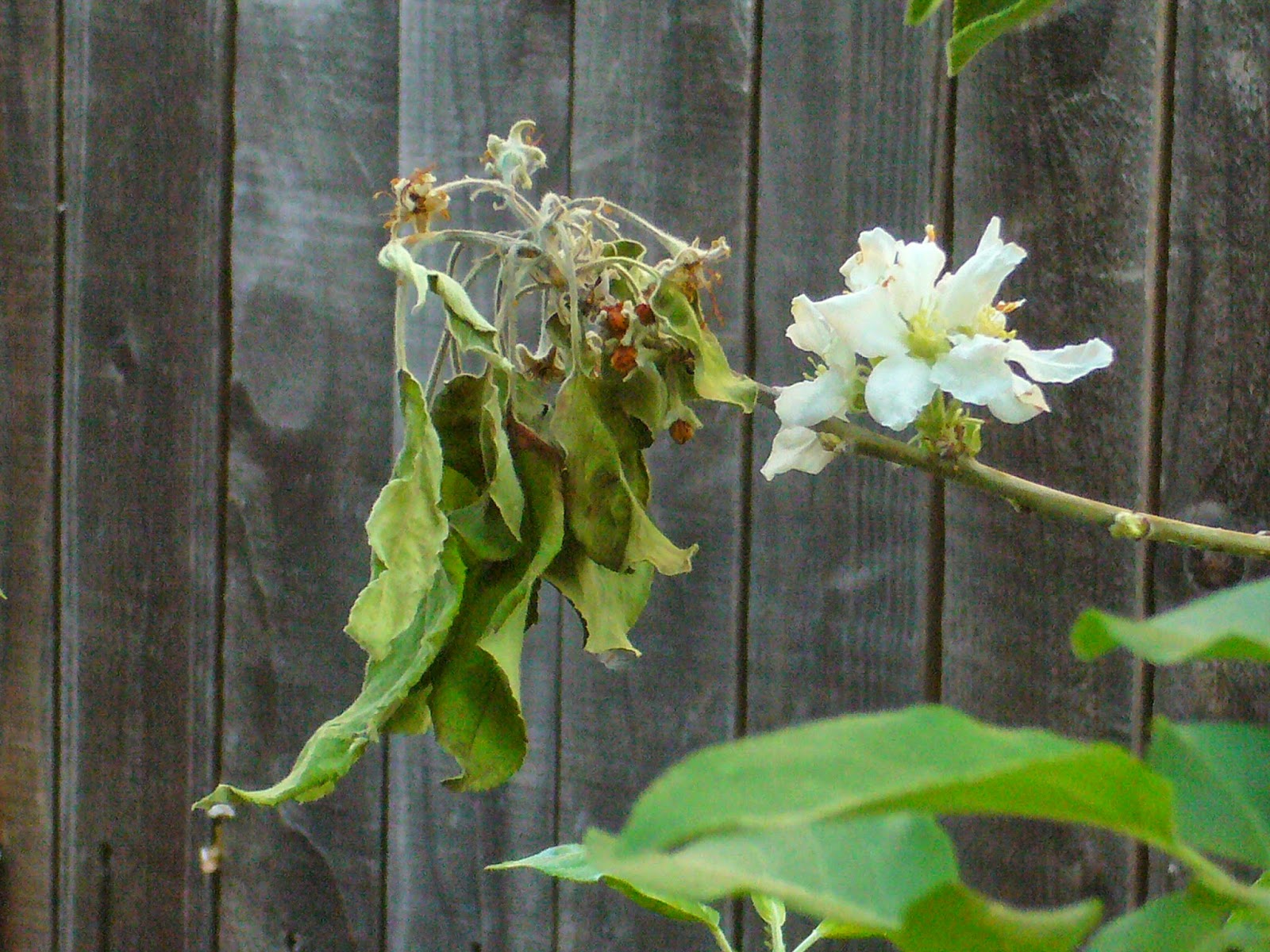
Yet -- I will miss it this year. And the photo to your left explains why. Those drooping leaves coming out at the end of one branch of the Granny Smith spell big time trouble. I first noticed this problem last week. It has since spread, slowly, to other parts of the Granny Smith and to the Honey Crisp.

This trouble is called Fire Blight. It's the first time its reared its ugly head in the Bird Back 40. I had this mistaken belief, perhaps call it a prayer, that backyard growers like myself would be spared from this scourge. Hah! Fat chance kid! The Blight is here and it's here to stay. Fire Blight means big trouble. Not only do the apple trees have it -- but the pear orchard I installed earlier this year has it as well.

Bartlett Pear-Bitten by Blight
I know what you're thinking. Why didn't you spray your trees to protect them from this bad boy over the winter? Oh, but I did. You see -- although Fire Blight has been around for a very long time -- there's still no active control for it. There is no spray, no dust, no treatment, organic or otherwise, that fights the dreaded blight. There is only one, proven method of control. And that method can result in a total crop loss, which is exactly what I'm facing.

This disease is called Fire Blight because it looks like leaves and fruit have been hit with a blow torch. The first sign of a problem is wilt. The leaves then turn a none-too-pleasant shade of brown, before fading to black. Fire Blight also spreads like wildfire.

Blackened Leaves-Granny Smith Apple Tree
I bet that you didn't know that, at one time in our not so distant past, pears and apples were kind of a big deal in Sacramento, Placer and the surrounding counties. Long before Sacramento adopted the nickname of SackofTomatoes, this was prime pear country. It still is in the southern part of Sacramento County, near the Sacramento River, but at one time tens of thousands of pear trees covered Sacramento fields from one of the county to the other.

And then, one day without warning, Fire Blight showed up. The damage was minimal at first -- but it spread like an out-of-control wildfire. Numerous controls were attempted. They all failed. Entire orchards were snuffed out in the space of a year or three. The main crop that powered the economic engine of Sacramento and the surrounding counties was dying a slow death, and nobody knew how it got here, how it spread from tree to tree and worse yet, how to stop it.

Dying Honey Crisp Apple-Bird Back 40
The answer of how the disease spread would come from horticulturists sent from UC Berkeley. It was believed that field workers were spreading the disease as they used pruning tools again and again as they moved from tree to tree, without washing them first. Today, that thinking has changed somewhat, at least in the opinion of some horticulturists who I contacted regarding my little problem. While the cleaning of pruning tools is still recommended, the belief is pollinators are spreading the pathogen as they move from tree to tree and flower to flower.

That's right -- the ordinary bee. This is where the infection starts -- when pear or apple tree bursts into bloom after a long winter's nap.

Fire Blight Strikes the Granny Smith Apple Tree
The good news? If there is any good news out of this, the "window of infection" is a short one. Once spring moves into summer, it's done. If there is any fruit on the tree that didn't get infected during the "window of infection," it's safe. But as for the branches, apples and pears that are infected? There is only one answer. That answer is pruning the infected branch back to a point where the dreaded blight can spread no further. It means the trees I've dutifully tended to a height of seven feet are about to get a rather severe haircut.

But that is my only option. Do nothing in the face of this scourge and the blight will show up again next year, stronger than the first year and left uncontrolled, will spread into the root system, killing the tree.

Honey Crisp Apple Blight Damage
I can't let that happen. I don't care how severe the cutting will have to be -- it's my only option. Do it, and I might save the tree. Do nothing, and that prized Honey Crisp will never deliver another tasty apple.

And so, those dreams I had over the winter of apple crisps, apple pie, apple juice and applesauce using our own home-grown apples will remain just that -- a dream. For this year -- Bill and the wife that is Venus are singing the farmer's lament: "There's Always Next Year."

Mr. Harrow Finds a Home

Saturday, February 15, 2014

BOC Pear Orchard-Bird Back 40
Mr. Harrow is home at last. And I find this to be just DEEE-lightful. Who is Mr. Harrow, you ask? Well -- let me explain. Mr. Harrow isn't really a "who." Mr. Harrow is more of a "what" than anything else. So, what is Mr. Harrow, you ask? Well -- I'm glad you stopped by to ask!
 
Mr. Harrow is pictured above right. That, children, represents the latest planting endeavor in the Bird Back 40. For you are casting your eyes on the Bird Back 40 Pear Orchard -- planted via Backyard Orchard Culture (BOC) techniques. Didn't think you could cram three fruit trees into a small spot? Think again, because you can, and quite successfully I might add.
 
BOC Apple Orchard-Bird Back 40
This is our third BOC planting effort. The nectarine trees we stuck in the ground some four years ago delivered a whopper of a harvest last year. And the BOC apple planting effort? Well, you may have heard my praise about the Honeycrisp Apple variety somewhat. It's only the best darn apple on the planet, bar none.
 
But our latest effort is something very special. Because this effort involves a one Mr. Harrow -- aka -- Mr. Harrow Delight. Mr. Harrow isn't a person, but rather a fruit tree. Not just any fruit tree mind you. The Harrow Delight Pear Tree is simply the best darn pear I've ever tasted. Yes -- it beats the Bartlett Pear in taste and consistency. This includes a home-grown, tree-ripened Bartlett, which for years has been the best in the business.
 
Harrow Delight Pear-DWN Fruit Tasting-2010
However, you know what they say about mousetraps, right? Someone is always trying to build a better one. And in the world of pears, someone hit the jackpot with the Harrow Delight pear tree. I'm not sure why this variety isn't propagated commercially, because it's been around for long enough. There might be some drawbacks from commercial production that I'm unaware of. But I can tell you that Harrow Delight is simply the best backyard pear tree ever.
 
Isn't that enough?
 
I've been hooked on the Harrow Delight since I first attended a fruit tasting event held at the Fair Oaks Horticulture Center some years back. If you want to know what grows, and grows well in the Sacramento area, I would suggest a visit to the horticulture center soon. The best time to visit? That would be the annual Harvest Season celebration, because that's usually when the fine folks from Dave Wilson Nursery show up with all sorts of good things to sample.
 
DWN Fruit Tasting-Fair Oaks-2010
It was there where I got my first extraordinary taste of the Harrow Delight pear. You must keep in mind that I had a plateful of pluots, bowls of blackberries and platters of peaches to munch on to my heart's delight. A Dave Wilson Nursery fruit tasting extravaganza is a fruit lover's ultimate dream. Yet, the one piece of tree-ripened fruit that beat everything to the punch on that particular day was the Harrow Delight pear.
 
Surely -- I must have received that special piece of pear that was better than the rest, right? That pear couldn't be THAT good, could it? But, as I returned to fill up that fruit pail again and again, each bite of that Harrow Delight got better and better. It was then when the wife that is Venus and I realized that THIS was the pear tree for our backyard.
 
Lonely Bartlett Pear Tree
But like most weekend warrior projects, the BOC pear planting effort would have to wait. There were some years when the Harrow Delight simply wasn't in stock, or I would wait too long only to find out that most of the trees had been snapped up by fruit lovers who were quicker on the trigger than I was. I would acquire the first part of the BOC pear project, the  Bartlett pear, last year. It would sit in a pot and wait for the addition of the Harrow Delight and one other variety this year.
 
That other variety -- by the way -- is the Blake's Pride. Why this particular variety? There are a couple of reasons. First -- one builds a BOC pear orchard to experience a pear harvest that lasts six to eight weeks rather than just three. The Harrow Delight, Blake's Pride and Bartlett all ripen at different periods during the summer. Secondly? These varieties all pollinate one another. More pollinators mean more fruit on the branch come harvest -- which is never a bad thing.
 
Return of the V for Venus Planter Bed
And so -- the Bird Pear Orchard is now installed and complete. One variety will ripen up two weeks before the Bartlett. Still another will ripen up two weeks AFTER the Bartlett. That's a solid month of pears, people. Try as you might, this is not a bad thing.
 
But the best part about the Harrow Delight pear tree was yet to be discovered. As I gazed at the tag attached to the tree to drink in the details of what will be Bill and Venus Bird's favorite pear tree -- two words jumped out at us. What were those two very special words? HEAVY BEARER.
 
That means lots of pears, baby. Isn't that just a crime?

It's February 2 -- Where are Your Buds?

Sunday, February 2, 2014

Eva's Pride Peach Tree In Bloom-Bird Back 40
My dearest friends and neighbors -- on this day -- the day of the WEED BOWL (aka "Stoner Bowl") -- I give you BUDS. Not just any buds mind you -- but real, actual, true BUDS. No -- this isn't some Bill Bird lunatic posting about Bud Light. Though that isn't a half bad idea, mind you. This is about BUDS.

But -- eh -- it may not be the type of buds that some people in the states of Washington and Colorado have become accustomed to purchasing lately.

Eva's Pride Peach in February Bloom
The buds I offer are a tad better in my fair opinion. Those buds -- pictured above -- are blooms from the Eva's Pride Peach tree -- part of a Dave Wilson Nursery Multi-budded classic. Why are these buds so special? What makes them so much better than the buds in Colorado or Washington?

They are unique in that they really shouldn't be here yet. It's a might too early for peach bud season in California -- and early for any other type of bud for that matter. But if there's one thing I've learned in my short experience of growing multiple fruit trees in the Bird Back 40, it's this: You can't tell a fruit tree what to do or when to bud. Because it's going to do it whether you like it or not.

Eva's Pride Peach-Courtesy Dave Wilson Nursery
I'd like to tell you that's Eva's Pride is an "early" peach. And that might be the truth. But, I've never tasted an Eva's Pride peach to be honest, and if these February buds actually result in true fruit formation, I'll probably be pulling most of them off. I prefer this tree focus on GROWTH this year rather than PRODUCTION. Why? Simple! Bill Bird is a GLUTTON for fresh, tree-ripened peaches. Bigger trees equal more peaches! That's just fine for a glutton like me.

The fine print tells me that Eva's Pride ripens a good three weeks before July Elberta, one of the finest tasting peaches on the planet. Since the July Elberta normally ripens toward the end of July and a bit into August, my thought is the Eva's Pride probably ripens in late June or early July. This is the normal ripening time for another variety that is growing in the Bird Back 40 -- and growing well mind you -- the June Pride.

Katy Apricot Early Bloom
This means -- one day -- Bill Bird and the wife that is Venus will celebrate a glut of peaches. Bring it on!

But as the wife that is Venus flitted about with the hummingbirds in the Bird Back 40 yesterday, she discovered that the Eva's Pride isn't the only fruit variety to be going through an early bloom stage. Nope, a close look at another Dave Wilson Multi-Studded (also known as "fruit cocktail) variety, revealed that the Katy Apricot is also unfurling blooms a tad early.

Again -- this is strange. Most fruit trees are in a deep slumber during this time of year, which is know as "bare root season." This is the best time to transplant fruit trees into your backyard, for a couple of reasons. First, area nurseries are STOCKED to the gills with every variety of fruit tree under the sun. Secondly, transplanting a fruit tree that is still technically celebrating a winter's nap is the best way to reduce or avoid transplant shock.

Bartlett Pear (Not in Bloom)
So -- to get blooms from one tree in February is rare indeed. Blooms from a second tree? This is somewhat worrisome. The calendar on the office wall tells me that winter ain't quite done yet. We haven't had nearly enough rain or snow yet to quench California's thirst -- nor are we out of frost danger just quite yet. A cold snap or heavy rain then could knock those blooms into next year. Know what that means? No peaches for you!

And that's a sad development to be sure.

So, this may be one reason why the wife that is Venus rose a tad early this morning to attend Catholic services. This is a special day for Catholics. For, on this day, they celebrate the feast of St. Blaise (pronounced: BLAZE).

Peach and apricot buds on a day when Catholics celebrate St. Blaise? On the day of the long awaited Weed Bowl? You can't make this stuff up, people.