Showing posts with label Granny Smith Apple. Show all posts

The Flowers of Spring

Sunday, April 3, 2016

Honey Crisp Apple Tree in Full Bloom
"April Showers Bring May Flowers," my mother once crooned. She usually started screeching after a surprise rain storm wiped out whatever her youngest boy had planned for the day -- an event that was usually outside. Because, what boy wants to be stuck inside when the sun is shining outside?

Thank God our house had some thick walls -- because mom's singing was pretty brutal. Brutal enough to drive a boy into a garage in an attempt to find some auditory relief. Perhaps that's the way she wanted it. Perhaps I'm not giving mom enough credit...

Granny Smith Apple in Bloom
Spring is special because it brings a bounty of flowers to the Bird Back 40. And, in our case, every single tiny flower brings the promise of a fruit payoff later this summer. I've come to that age (OLD), where I appreciate the finer things in life. And nothing brings greater joy than a Honey Crisp Apple tree doing it's best Granny Smith Apple imitation.

This is year five for the Honey Crisp. It's delivered exactly one eye-popping crop so far -- and that came in year two. The dreaded Fire Blight would strike in year three, wiping out an entire crop. And last year? Last year the Honey Crisp bloomed in exactly one spot. That's a crime, because the Honey Crisp Apple is that good.

Duke Avocado Tree in Bloom
But this year is somewhat different. This year is somewhat exciting. The temperamental Honey Crisp is covered with blooms and honey bees. The Fuji Apple is also blooming heavily -- a first for this tree as well. And the Granny? The Granny Smith apple was meant to bloom. It always blooms. When doesn't a Granny bloom? If you're looking for a good pollinator tree, look no further than the Granny. That tree is rather ridiculous. It blooms early. It blooms mid-season. It blooms late. Even after you think the Granny is done blooming, surprise! There's another set of buttery pink blossoms.

The story is pretty much the same across the Bird Back 40. The blossom period for the peaches and nectarines is just about over. The thorn less blackberry vines are in full bloom. The Shuksan strawberry plants are going to town. Even the Duke Avocado tree is covered with more blooms and bees than I can possibly count. Step anywhere near that tree and you'd swear there was a beehive hidden somewhere in there.

Duke Avocado Blooms
But the most surprising development isn't the surprisingly heavy crop of Royal Rainier Cherries. It's not the myriad of mandarins that are covered with a carpet of white. No -- the most surprising development was the number of blooms on the Harrow Delight Pear tree. I planted this tree three years ago. I dutifully chopped it in half to knee level to encourage low branch development. And I was told it could take 4-5 years before the Harrow Delight produced its first crop.

Instead, the Harrow Delight bloomed in year three and set a nice crop of pears. This is important because I fell in love with the Harrow Delight at a Dave Wilson Nursery fruit tasting event held several years ago at the Fair Oaks Horticulture Center. Even though the wife that is Venus were sampling a bevy of different fruits on this particular day, one item stood out among all the others. I kept going back for more. It was the Harrow Delight Pear.

Harrow Delight Pear in Bloom
The Harrow Delight is one of two varieties planted in a raised bed that are supposedly resistant to the scourge upon fruit kind known as Fire Blight. It was introduced in 1982 from the Harrow Agricultural station in Ontario, Canada. The Blake's Pride Pear, which is also billed as Fire Blight resistant, was developed by Richard Bell with the ARS Appalachian Fruit Research Station in Kearneysville, West Virginia in 1998.

Unfortunately, I will have to wait on the Blake's Pride as it did now flower this spring. The old-fashioned Bartlett Pear, which is not resistant to blight and is planted in the same raised bed as the other two varieties, flowered heavily this year.

Harrow Delight Pears
No sign of the dreaded blight yet this year. I'm keeping my fingers crossed and trying a new organic solution of water and apple cider vinegar to keep the blight at bay. I do have something stronger, BUT, I really don't like what this particular chemical did to the fruit composition last year. So it stays on the sideline.

Half the work of growing home-grown fruit takes place in the spring. Is the area clear of weeds (weeds steal water)? Has the appropriate fertilizer been applied? Is it getting enough water? Are the fruit trees protected from various ills, like blight, that can strike in the spring?

If the answer to all four questions is "YES," congratulations. You should have a tree full of fruit. Of course, a million and one things could happen between now and harvest time that could spoil that tempting looking crop. As backyard fruit growers, this is the cross we bear.

So -- congratulations. Springtime has arrived. The fruit trees are in full bloom. The honey bees are out in force. And, so far, mom hasn't been tempted to start crooning "April Showers Bring May Flowers."

And Now for Something Completely Ugly

Saturday, April 19, 2014

BOC Apple Orchard-Bird Back 40
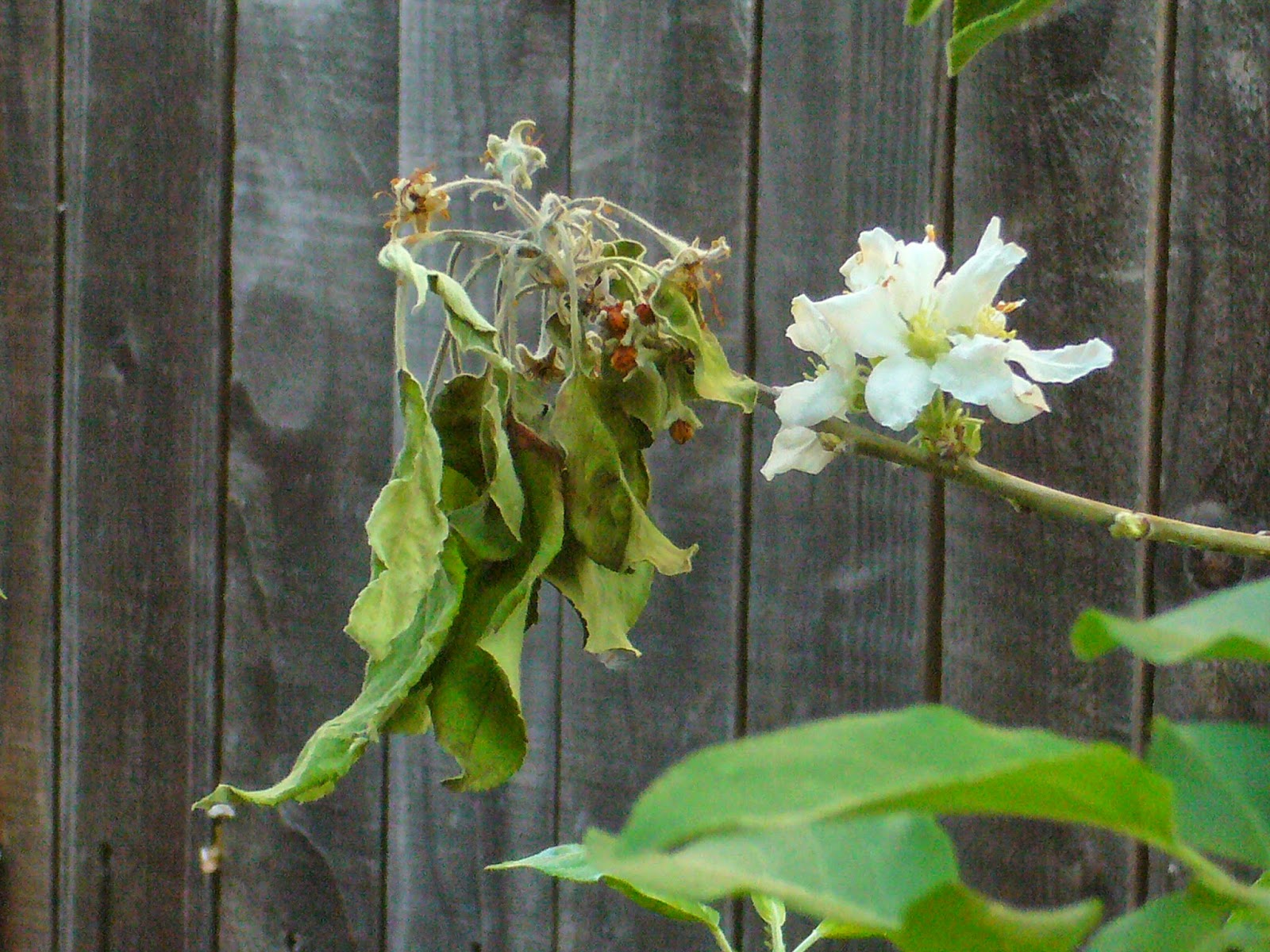
Mother Nature can be viciously cruel at times, especially for those of us who yearn to dig in the dirt and plant good things to eat. Pictured to your right, my friends, is the Bird Back 40 Apple Orchard. It consists of three trees: Granny Smith, Fuji and Honey Crisp. I know this photo doesn't necessarily look all that ugly, but a closer inspection reveals the kinds of troubles that drive backyard growers crazy.

Short and sweet? Although those trees look healthy, they're not. In fact, the wife that is Venus and I will be lucky if we get a single apple this year. That's right! Three trees! One apple -- and we'll be lucky to get it. Worse yet -- there will no Honeycrisp Apple harvest this fall. That's worse than bad. It's tragic. The Honey Crisp is the best dang apple on the planet -- offering a taste explosion that cannot be missed.

Granny Smith Apple Tree-Bird Back 40
Yet -- I will miss it this year. And the photo to your left explains why. Those drooping leaves coming out at the end of one branch of the Granny Smith spell big time trouble. I first noticed this problem last week. It has since spread, slowly, to other parts of the Granny Smith and to the Honey Crisp.

This trouble is called Fire Blight. It's the first time its reared its ugly head in the Bird Back 40. I had this mistaken belief, perhaps call it a prayer, that backyard growers like myself would be spared from this scourge. Hah! Fat chance kid! The Blight is here and it's here to stay. Fire Blight means big trouble. Not only do the apple trees have it -- but the pear orchard I installed earlier this year has it as well.

Bartlett Pear-Bitten by Blight
I know what you're thinking. Why didn't you spray your trees to protect them from this bad boy over the winter? Oh, but I did. You see -- although Fire Blight has been around for a very long time -- there's still no active control for it. There is no spray, no dust, no treatment, organic or otherwise, that fights the dreaded blight. There is only one, proven method of control. And that method can result in a total crop loss, which is exactly what I'm facing.

This disease is called Fire Blight because it looks like leaves and fruit have been hit with a blow torch. The first sign of a problem is wilt. The leaves then turn a none-too-pleasant shade of brown, before fading to black. Fire Blight also spreads like wildfire.

Blackened Leaves-Granny Smith Apple Tree
I bet that you didn't know that, at one time in our not so distant past, pears and apples were kind of a big deal in Sacramento, Placer and the surrounding counties. Long before Sacramento adopted the nickname of SackofTomatoes, this was prime pear country. It still is in the southern part of Sacramento County, near the Sacramento River, but at one time tens of thousands of pear trees covered Sacramento fields from one of the county to the other.

And then, one day without warning, Fire Blight showed up. The damage was minimal at first -- but it spread like an out-of-control wildfire. Numerous controls were attempted. They all failed. Entire orchards were snuffed out in the space of a year or three. The main crop that powered the economic engine of Sacramento and the surrounding counties was dying a slow death, and nobody knew how it got here, how it spread from tree to tree and worse yet, how to stop it.

Dying Honey Crisp Apple-Bird Back 40
The answer of how the disease spread would come from horticulturists sent from UC Berkeley. It was believed that field workers were spreading the disease as they used pruning tools again and again as they moved from tree to tree, without washing them first. Today, that thinking has changed somewhat, at least in the opinion of some horticulturists who I contacted regarding my little problem. While the cleaning of pruning tools is still recommended, the belief is pollinators are spreading the pathogen as they move from tree to tree and flower to flower.

That's right -- the ordinary bee. This is where the infection starts -- when pear or apple tree bursts into bloom after a long winter's nap.

Fire Blight Strikes the Granny Smith Apple Tree
The good news? If there is any good news out of this, the "window of infection" is a short one. Once spring moves into summer, it's done. If there is any fruit on the tree that didn't get infected during the "window of infection," it's safe. But as for the branches, apples and pears that are infected? There is only one answer. That answer is pruning the infected branch back to a point where the dreaded blight can spread no further. It means the trees I've dutifully tended to a height of seven feet are about to get a rather severe haircut.

But that is my only option. Do nothing in the face of this scourge and the blight will show up again next year, stronger than the first year and left uncontrolled, will spread into the root system, killing the tree.

Honey Crisp Apple Blight Damage
I can't let that happen. I don't care how severe the cutting will have to be -- it's my only option. Do it, and I might save the tree. Do nothing, and that prized Honey Crisp will never deliver another tasty apple.

And so, those dreams I had over the winter of apple crisps, apple pie, apple juice and applesauce using our own home-grown apples will remain just that -- a dream. For this year -- Bill and the wife that is Venus are singing the farmer's lament: "There's Always Next Year."

Color Me Spring

Monday, March 25, 2013

Granny Smith Apple Tree in Blossom
Backyard fruit trees and a whole lot more are literally "springing" to life in the Bird Back 40. The brightest color so far? That would have to be my neck and arms: now a deep shade of red and quite tender to the touch. You may have guessed by now that I'm Irish. People of Irish descent do not tan. We burn. It's enough to drive the wife that is Venus downright crazy.

Wife: "And did you put sunscreen on?"

Me: "Uh, no."

Wife: "Did you at least wear a hat for the last six hours?"

Hungry Ladybug at Work
Me: "I was too busy to wear a hat."

Wife: "You're a moron."

Spring means it's time to get ready for summer. The yard is mostly clear of mud, but now it's weeds that are the big problem. Time to get that fallen citrus away from the base of the many citrus trees that grace the Bird Back 40 -- and while you're at it -- clear away those pesky weeds as well.

Spring is also the time to fix and repair those nagging leaks that inevitably appear in the drip irrigation system. And that's when you come to discover, after plugging the first leak, that you failed to spot that second leak. And then there's going to be a third that will shoot up from nowhere and strike you right in the eye. And just about the time you're done? There's a major league blowout on the other side of the yard.

Repaired Drip Irrigation Line with Brick to Block Dog
Point is, when you keep this many garden areas, fruit trees and citrus trees in the yard? One needs to practice drip irrigation to not only conserve precious water supplies (which is important), but to make sure that every last plant and every last tree gets a nice drink in the morning. I always believed running drip lines against the fence line was a master stroke of genius. That is until the neighbor's dog discovered that he could easily dig them up from the other side of the fence and shred them into itty bitty pieces.

Stupid dog.

June Pride Peach Blossoms
But as I use my weekend time to move here and there about the Bird Back 40, the yard pays me back with one dazzling show after another. The Granny Smith apple tree, now in Year 3, in full bloom for the very first time. This tree bloomed in exactly two places last year and delivered a whopper harvest of exactly two apples. Worse yet? The Honey Crisp and Fuji apple trees planted in the same raised bed failed to even flower.

But that's not the case this year. The old Granny is a mass of pink buds and white flowers. The Honey Crisp is about to flower for the very first time. The Fuji is slowly springing back to life, but I'm quite confident it will flower as well. Though the three trees are still relatively small and don't grow quite as fast when planted together in a confined area like a raised bed, they have developed strong trunk and branch supports. This is a nice sign.

Royal Rainier Cherry Blossoms
The Royal Rainier Cherry tree is now in full blossom as is the Black Tartarian, putting on a dazzling display of  white and yellow bloom clusters that honeybees simply cannot ignore. Hornets also race from one side of the yard to the next, sharing space with the carpenter bees that have taken a liking to a wisteria bush that is now in full bloom for the very first time. Ladybugs, meanwhile, feast on the bad bugs of spring. The yard is alive and buzzing after a winter that was far too long, but could have yielded more rainfall.

First to flower on the Flavor Finale pluot tree were actually the branches that I successfully grafted to this tree last spring. The Flavor Finale is the last pluot variety offered by Dave Wilson Nursery to ripen, so it makes sense that the varieties I successfully grafted would fire up first with multiple blooms.

Pluot Graft
Why graft? Pluots, like many of the newer introductions from the mind of Floyd Zaiger require pollinator trees. I had always believed that the Santa Rosa plum planted nearby in the front yard would be that pollinator. But as the years went by, and with less than impressive harvest results from the Flavor Finale, it dawned upon me that the marriage that I'd hoped for just wasn't going to work.

The next step then? Graft. Find a donor tree that will pollinate the Flavor Finale and graft, graft, graft and graft one more time. Those grafts hold varieties (which I've lost track of) that ripen earlier than the Flavor Finale which is why some branches flowered earlier than others. As the tree buzzed with the hum of pollinators moving from one tasty blossom to another, I hoped and prayed that those grafted branches would provide the spark that the Flavor Finale needed.

Flavor Finale Pluot Tree in Full Bloom
No need for prayer. The tree is loaded -- for the very first time I might add. The pollinator branches -- or grafts -- also hold fruit. This means the pollinator branches will also produce a tasty treat or five. Hey! Why do one pluot when you have can three or five?

As I move from here and there, much like the pollinators who do the same, the story is always the same. The growth is green. The growth is lush. Winter is over. The bright colors of spring are here to stay.

Ciderman, Ciderman

Saturday, February 5, 2011

Bare Root Fruit Trees-Capital Nursery
Ciderman, Ciderman,
Will Drink Cider From a Can,
Cranks a Press -- Any Size,
Hard Cider From Bill Should be No Surprise,
For He is You're Friendly CIDERMAN!!!

Yes, yes, I know -- stick to writing. But I'm excited you see! The smell of SPRING is in the air! Those long days and dreary nights of winter show a promise of ending soon. What does this mean? It means I'm running out of time! That's what it means!

Case in point? BARE ROOT SEASON. If it gets much warmer over the next week or two those slumbering root systems are suddenly going to wake up and declare an early start to the spring growth season. It doesn't matter what the calendar on the wall says. Yes, I know it's early February. I know there's several more months of cold weather and possible rain to endure.

But once those roots wake up? They're up!

The wonderful wife that is Venus and I are moving a bit slower this year when it comes to adding addtional fruit trees and vines to the backyard. We rushed it a bit last bare root season and our impatience resulted in several dead Blueberry bushes.

No such mistake this year.

Fruit Salad Anyone?
However, we are adding, albeit at a slower rate. This isn't easy for me. Do you know why? Did you notice the photo above? The photo to your left? This is what most Sacramento nurseries look like these days. They're stocked with every available fruit tree under the sun. You want peaches? They got peaches? Cherries? By the bucket!

You see -- when I come across a lovely scene like this -- the first impulse is to reach out and buy everything in sight. That might make the operator of Capital Nursery very happy -- but I would be digging holes from now until next Christmas.

But this is a GREAT time indeed to visit your local nursery for fruit tree selections. Everything you could possibly want in a backyard fruit garden is within your fingertips. And -- on this day -- Bill Bird was after something special: apples.

The Honey Crisp Apple
We've given up on growing avocados. Four dead trees in the space of three years will do that to you. Oh -- we tried all sorts of tricks. Planting in the best soil? Check! Planting in a raised bed for drainage purposes? Check! Christmas lights on the tree during winter to keep Jack Frost away? Check, check and check again.

They still died. Each and every one. It sort of sends a message. It's time to try something else. The wife mentioned that she wanted apple trees for baking purposes. I like apples for snacking and cider. So why not try APPLES?

The wife's selection in this particular case was the Granny Smith apple. It's not necessarily the best apple to snack on (although some do love its rather tart taste) -- but it is the best selection for baked items like apple pie, apple crisp and that apple cake (with caramel drizzle) that Venus whipped together from scratch just this past weekend.

Yes, I know, I'm very lucky. I have the stomach to prove it.

Pink Lady Apple Trees
The second selection? The Fuji Apple. Although its introduction to this country is rather recent -- it's probably the hottest selling apple in California now. The Fuji is the perfect apple for snacking and it's a good juicing apple as well.

As for the third selection (yes, I'm a glutton), I employed an old nursery trick. I wasn't the first customer to slowly walk up aisle after aisle of delicious fruit trees. Others had been there before me. You could see the telltale signs -- open holes where fruit trees had once been placed. Usually? The best trees go first -- either the hottest new variety or the best variety.

As I stared at the many varieties of apple trees standing in front of me, it became quite obvious what the "hot apple tree of the day" was. It was the Honey Crisp Apple. "Honey Crisp," I questioned? "Never heard of it." Others apparently had, however. There were more empty holes than trees, so I plucked the best looking of the lot the Capital Nursery still had left.

Future Apple Garden Home
I was told -- on my way out of the nursery -- that Honey Crisp was a past Dave Wilson Nursery taste-test winner. But the website doesn't mention that, so I suppose I'll have to trust the prowess of others.

The next step? Getting the trees home and determining exactly where I was going to plant them. I already knew that I was going to employ the Backyard Orchard Culture concept to these plantings. That concept is the grouped planting of three or more trees in a shared hole or raised bed.

Farmer Fred Hoffman reccommends a raised 4X4 bed that is at least a foot high for group plantings like this. In my case? The bed is 5X3 feet -- with trees staggered from back to front to give them as much breathing room as possible. This bed -- built with standard "Lincoln Log" stackable logs purchased from Home Depot is also outfitted with drip irrigation and filled with a planter mix purchased last summer from Hastie's Sand and Gravel in West Sacramento.

Apple Trees Planted-Ready for Whacking!
The hardest part about Backyard Orchard Culture plantings? It's not building the bed -- that was easy. Moving planter mix the consistency of wet concrete (it was quite soaked from all the rain activity we've had) -- wasn't exactly thrilling. The sprained foot that resulted from this project also wasn't fun -- but it wasn't the hard part either.

No -- the hard part is whacking these full grown apple trees down to knee length. You're cutting a tree like this to a third of its original size. The goal is to encourage branch production near the base of the tree -- and never let it get beyond six to seven feet in height (standing on ladders to pick apples can also result in sprained feet or broken legs -- especially if you've been drinking cider).

This project is now complete. Let the cider-making, commence.