Showing posts with label Bees. Show all posts

Fear the Beard!

Wednesday, July 9, 2014

Beard of Honeybees (A Swarm)
Sometimes -- even vegetable garden bloggers can hit mental subject roadblocks. It happens to the best of us. And, in my case, it happens to the worst of us. I knew I wanted to write about bees. But you just can't put pen to paper without having some sort of interesting subject matter in mind.

As it turns out -- the bees did all the work for me -- clearing that mental roadblock with one swift buzz.

While I had intended to write about the return of the bright pink Hello Kitty themed hive box -- I needed more than that. I wrote about Hello Kitty years ago. It's old news. Yeah -- I keep bees in a box painted bright pink with a Hello Kitty character stenciled on the side. What's so weird about that? Doesn't everybody do that?

The Return of the Hello Kitty Hive Box
As it turns out -- the honeybees I keep in two brightly painted hive boxes (pink and yellow) did all the hard work for me. They did what bees naturally do. The queen inside one of those colonies did such a fantastic job at laying eggs that the colony grew far too large for the multiple boxes I had assembled. And when a colony grows too large for the space it occupies: it swarms. That swarm is pictured above, right. And, yes, that's a closeup on my part. Bees that swarm rarely sting, and the swarm came from one of the most gentle colonies I've ever had the pleasure of keeping.

This is how new colonies are born or created in the wild. Normally, bees swarm in the spring or early summer. While it's not uncommon for colonies to swarm in the summer, it is rare. In most cases the queen stopped laying eggs weeks ago. I just hope she gets started up again to rebuild colony strength. Because, the unfortunate thing about swarms is this: about half the colony vanishes in the space of a day or two.

Second Hive Box with Bees "Bearding" in Front
That equals into a dramatic loss in honey production -- if you're keeping honeybees for such a thing.

I literally had to start over this year. The colony I'd nursed for the better part of two years, gifted to me by another beekeeper who got out of the business, up and vanished on me last winter. I didn't see much activity out of that hive in December after freezing weather set in. That got me worried. When spring finally rolled around and the weather warmed, a hive check revealed the worst of news. The colony was long gone.

I'll be honest, I missed them. A yard without an active box of pollinators around is an empty yard. It's a quiet yard. Once you've kept bees for a year or two, you're hooked. It's tough to live without them. One would think a beekeeper would get tired of excited bees whizzing to and fro and thonking into the back of one's head. Not so. They are like children. And when children leave, it gets quiet. Too quiet.

Hive Boxes-Face to Face-Shaded by Wisteria
I would come to discover that last year was a particularly nasty year for beekeepers -- and not just hobbyists like myself. When I discovered that one of the most experienced members of the Sacramento Area Beekeepers Association (SABA) reported the loss of 100 colonies, I suddenly didn't feel so bad about losing my single, solitary hive. Honeybee loss hits everyone equally -- from the very experienced to the novice bonehead like myself.

I could have taken several actions to acquire new colonies. I could have purchased a package of bees plus a queen -- but I'm not a fan of that approach. There's no guarantee that the queen you're purchasing is a strong one, and the process of introducing a new queen to a colony is tricky. If you don't know what you're doing (SEE: BILL BIRD), the queen can get killed during the introduction process.

Swarm in a Nearby Pluot Tree
The second approach, which is the cheapest one I might add, is waiting for an established, wild colony to swarm. Colonies that swarm in the spring often come from strong hives that feature strong queens, which means there's a good chance that the swarm will contain a nice young, strong queen as well. The problem with this approach is waiting for the phone to ring. Sometimes it does. Sometimes it doesn't. You've also got to be prepared for a swarm call 24/7. Since I work full-time, bee hunting availability is at a premium.

The third option, which I chose this spring after getting a very nice offer from a very nice SABA member, is called a "Nuc Transfer." This involves the transfer of a queen, several frames of bees and several frames of honey to an existing hive box. The attractive offer came from SABA Treasurer Kate Morton, after I'd moaned about the loss of my colony the previous winter.

Honeybees "Bearding" in Front of Hive Box
"You want bees," she asked? "I have bees." When she quoted me a price so ridiculously low, I couldn't shout "SOLD" fast enough. I probably shouldn't be telling her this. She'll probably try to sell me another colony or three.

Sure enough -- her assurances of strong hives and strong queens were not empty promises. The swarm pictures included in this blog posting are proof of that. What initially started as three frames of bees in a small box -- something we call a "honey super" -- turned into three boxes stacked on top of one another overnight. Both queens were laying eggs at record rates. While I thought there was a chance one or both colonies might swarm, I also believed the addition of a true hive box at the bottom would prevent it.

Hah! Fat chance! Another boneheaded beekeeping move on my part. Add another one to a very long list.

Honeybee Collecting Siam Queen Basil Pollen
While I'd like to tell you that I kept and hived that swarm for myself, I'm not the best liar in the country. First and foremost, I've already tested the patience of nearby neighbors more than enough. Two colonies are fine. A third would be a little much. And while the City of Sacramento does encourage hobbyist beekeeping efforts, they also want beekeepers to limit the number of hives to just two. Two is exactly what I have. Adding a third, no matter how badly I wanted them, wouldn't have been the best of ideas.

Besides -- there's a popular poem regarding swarms that take place during the month of July. I didn't invent this. I'm not sure who did. But to beekeepers across the country -- and the world for that matter -- it's almost like a passage from the bible:

“A Swarm in May is worth a load of hay
A Swarm in June is worth a silver spoon
A Swarm in July ain’t worth a fly.”

Fear The Beard!
Why are swarms that take place in May or June more desirable than those in July? It has to do with pollen production, and the ability of a colony to gather enough pollen to produce enough honey stores for the winter months. In many areas of the country, pollen production begins to dry up in July. The harder pollen is to find -- the harder it is for the bees to make honey. And if a colony can't produce honey -- it's doomed. It will not survive the winter.

But that didn't stop a beekeeper from Loomis from making the trip down to our North Natomas farm to take a chance on this swarm. Like many beekeepers, this particular gentleman had retired from the rat race that is full-time work to take on the full-time hobby of beekeeping. My swarm, which sprang from Kate's bees, are now his colony.

Best of luck to the little buggers. I will miss them.

POSTSCRIPT:

If you're thinking the hobbyist beekeeper route might be the life for you -- I cannot stress the importance of belonging to a member organization like the Sacramento Area Beekeepers Association. Here you will find the meetings and helpful people who are essential to getting started. And they will more than welcome you to the club as there's always room for more. Please feel free to drop by the SABA booth at the upcoming State Fair! You just might run into the wife that is Venus and her kook of a husband. Sample free honey! See honeybees in a glass enclosed demonstration hive! The SABA booth is always a top draw for kids and parents alike.

And Now for Something Completely Ugly

Saturday, April 19, 2014

BOC Apple Orchard-Bird Back 40
Mother Nature can be viciously cruel at times, especially for those of us who yearn to dig in the dirt and plant good things to eat. Pictured to your right, my friends, is the Bird Back 40 Apple Orchard. It consists of three trees: Granny Smith, Fuji and Honey Crisp. I know this photo doesn't necessarily look all that ugly, but a closer inspection reveals the kinds of troubles that drive backyard growers crazy.

Short and sweet? Although those trees look healthy, they're not. In fact, the wife that is Venus and I will be lucky if we get a single apple this year. That's right! Three trees! One apple -- and we'll be lucky to get it. Worse yet -- there will no Honeycrisp Apple harvest this fall. That's worse than bad. It's tragic. The Honey Crisp is the best dang apple on the planet -- offering a taste explosion that cannot be missed.

Granny Smith Apple Tree-Bird Back 40
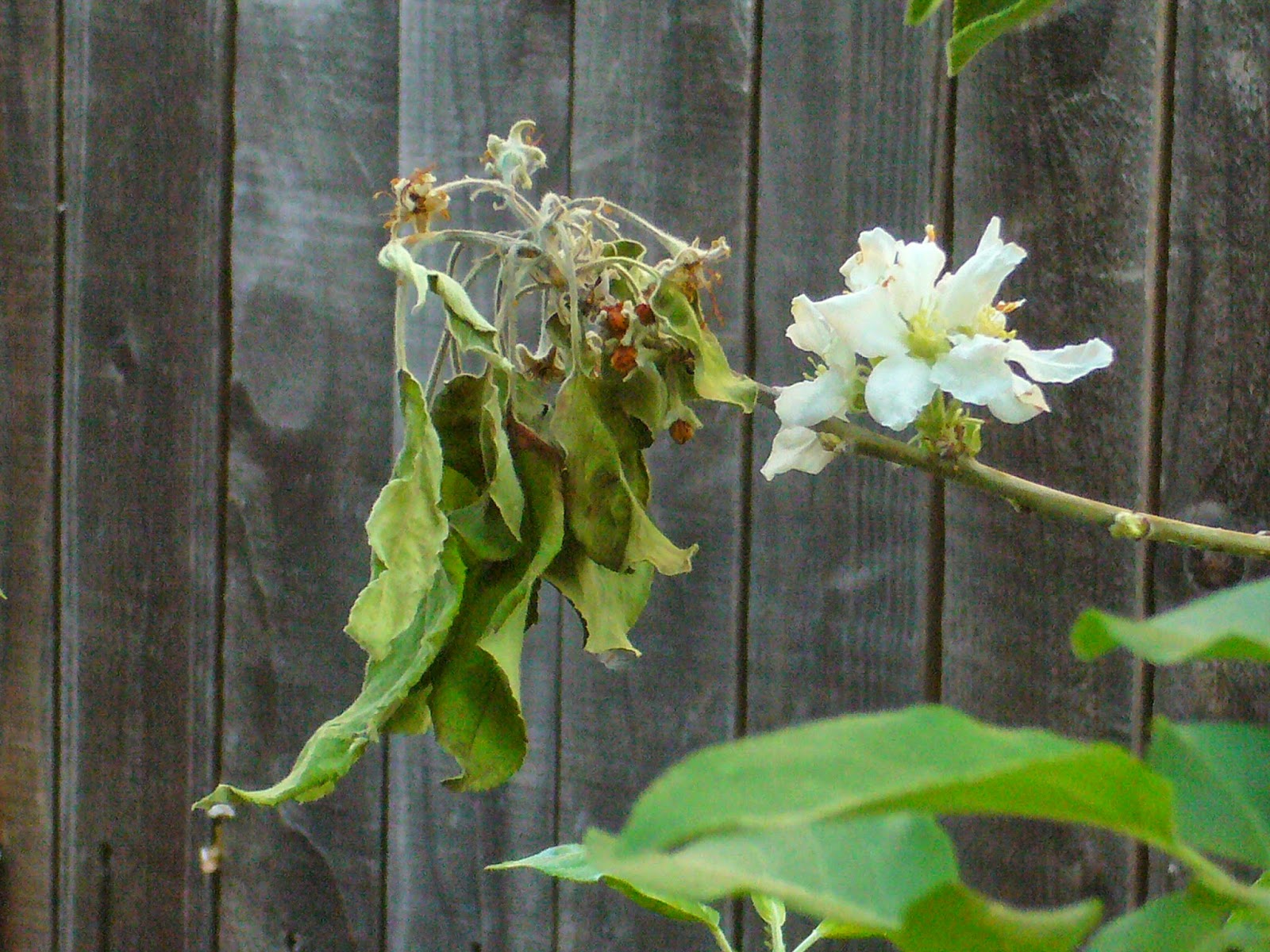
Yet -- I will miss it this year. And the photo to your left explains why. Those drooping leaves coming out at the end of one branch of the Granny Smith spell big time trouble. I first noticed this problem last week. It has since spread, slowly, to other parts of the Granny Smith and to the Honey Crisp.

This trouble is called Fire Blight. It's the first time its reared its ugly head in the Bird Back 40. I had this mistaken belief, perhaps call it a prayer, that backyard growers like myself would be spared from this scourge. Hah! Fat chance kid! The Blight is here and it's here to stay. Fire Blight means big trouble. Not only do the apple trees have it -- but the pear orchard I installed earlier this year has it as well.

Bartlett Pear-Bitten by Blight
I know what you're thinking. Why didn't you spray your trees to protect them from this bad boy over the winter? Oh, but I did. You see -- although Fire Blight has been around for a very long time -- there's still no active control for it. There is no spray, no dust, no treatment, organic or otherwise, that fights the dreaded blight. There is only one, proven method of control. And that method can result in a total crop loss, which is exactly what I'm facing.

This disease is called Fire Blight because it looks like leaves and fruit have been hit with a blow torch. The first sign of a problem is wilt. The leaves then turn a none-too-pleasant shade of brown, before fading to black. Fire Blight also spreads like wildfire.

Blackened Leaves-Granny Smith Apple Tree
I bet that you didn't know that, at one time in our not so distant past, pears and apples were kind of a big deal in Sacramento, Placer and the surrounding counties. Long before Sacramento adopted the nickname of SackofTomatoes, this was prime pear country. It still is in the southern part of Sacramento County, near the Sacramento River, but at one time tens of thousands of pear trees covered Sacramento fields from one of the county to the other.

And then, one day without warning, Fire Blight showed up. The damage was minimal at first -- but it spread like an out-of-control wildfire. Numerous controls were attempted. They all failed. Entire orchards were snuffed out in the space of a year or three. The main crop that powered the economic engine of Sacramento and the surrounding counties was dying a slow death, and nobody knew how it got here, how it spread from tree to tree and worse yet, how to stop it.

Dying Honey Crisp Apple-Bird Back 40
The answer of how the disease spread would come from horticulturists sent from UC Berkeley. It was believed that field workers were spreading the disease as they used pruning tools again and again as they moved from tree to tree, without washing them first. Today, that thinking has changed somewhat, at least in the opinion of some horticulturists who I contacted regarding my little problem. While the cleaning of pruning tools is still recommended, the belief is pollinators are spreading the pathogen as they move from tree to tree and flower to flower.

That's right -- the ordinary bee. This is where the infection starts -- when pear or apple tree bursts into bloom after a long winter's nap.

Fire Blight Strikes the Granny Smith Apple Tree
The good news? If there is any good news out of this, the "window of infection" is a short one. Once spring moves into summer, it's done. If there is any fruit on the tree that didn't get infected during the "window of infection," it's safe. But as for the branches, apples and pears that are infected? There is only one answer. That answer is pruning the infected branch back to a point where the dreaded blight can spread no further. It means the trees I've dutifully tended to a height of seven feet are about to get a rather severe haircut.

But that is my only option. Do nothing in the face of this scourge and the blight will show up again next year, stronger than the first year and left uncontrolled, will spread into the root system, killing the tree.

Honey Crisp Apple Blight Damage
I can't let that happen. I don't care how severe the cutting will have to be -- it's my only option. Do it, and I might save the tree. Do nothing, and that prized Honey Crisp will never deliver another tasty apple.

And so, those dreams I had over the winter of apple crisps, apple pie, apple juice and applesauce using our own home-grown apples will remain just that -- a dream. For this year -- Bill and the wife that is Venus are singing the farmer's lament: "There's Always Next Year."

Goodnight Sweet Darling

Monday, December 31, 2012

Trimmed Tree Roses: Bird Back 40
When the lure of the yard becomes too much -- even in cold weather -- you know that one is progressing nicely from gall bladder removal surgery. After the first week at home after surgery? I couldn't even look at the yard. Now? A month and a half later? I can't wait to get out in the mud with a pair of chompers!

Now, that's progress!

It's that time of year again where we must say "goodnight" to the many tree and rose bushes that grace the Bird Back 40. This is always been a rather tough job for me because these roses have provided the wife that is Venus with multiple vases of flowers during the spring and summer months. A vase of home grown roses earns "points." Purchasing said roses does not. Remember this lesson boys: Grow Your Own.

Pruned St. Patrick's Tree Rose
Now -- before we go any further here -- let me issue this warning. I am not a professional Rosarian. I am a professional screwup -- but we'll save that post for another day. My "experience" with trimming rose bushes comes from watching others do it, plus a few online tips and tricks. There are going to be some experienced folks (Fred) who will shudder at the sight of this whack job, but I can tell you this much.

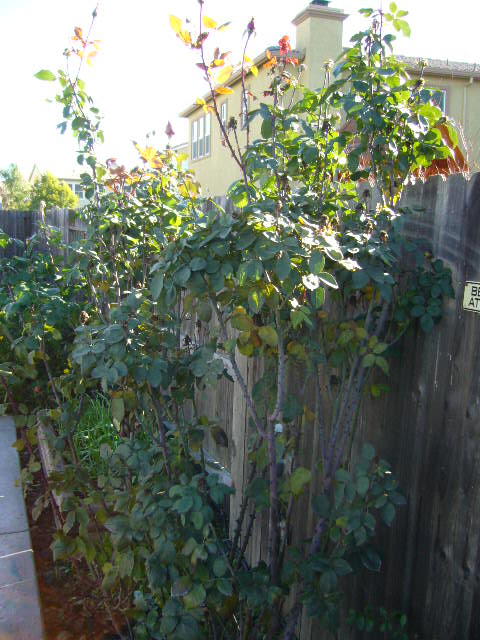
I've come to learn that it really doesn't matter HOW I cut these roses back. What matters is that I DO cut them back. After three or four years of solid growth, the roses have always jumped back to life in the spring. And some, like the Stinkin Lincoln (aka Mister Lincoln), are now large enough to grow right over the fence line and keep right on growing.

Mister Lincoln in Winter
By the way, does anyone know why the favorite known as Mister Lincoln is sometimes referred to as the Stinkin Lincoln? The answer is at the bottom -- but if you've already guessed -- I'm sorry but you don't win a prize. You have earned my respect, however. But, again, this is no prize.

There are two basic things that I keep in mind when trimming a rose bush. The first is locating and identifying the strongest and largest of the newest "canes" that developed during the previous spring and summer. The second thing that I watch out for is trimming said bush so it doesn't grow out and block off a walkway, as some of them have in recent years. This doesn't always result in a perfect, round cut. But my madness works in other ways.

Trust me, this is a madness.

Fat Purple Cane: Save Him!
This purple colored cane on the Mister Lincoln is exactly the kind of growth that I'm looking to preserve. Older canes are black and somewhat woody and easy to distinguish from the newer canes that emerged earlier this year. This happens to be one of the nicest, fattest canes that emerged from the Mister Lincoln this year. This is a cane that I will want to preserve for newer growth that will emerge next spring.

Another plus: The cane is growing in a direction next to the fence line. Roses against fence lines make for the perfect show. Roses growing out and covering a sidewalk can be problematic, especially if the rose has thorns. And the Mister Lincoln has thorns. They are big, FAT thorns that tend to rip and shred clothing and skin if you're not careful. This isn't something you want growing into a walkway that was installed the previous spring.

Unlike previous years, when I didn't have to worry about sidewalk protection, I would keep and preserve the strongest canes no matter which direction they grew in. I can't do that anymore. So -- any cane jutting out near a walkway, no matter how nice or strong, gets pruned back completely. Harsh? Mebbe. But a rose bush like the Stinkin Lincoln will eventually get the message and grow in areas you want growth to occur in.

A "Must Have" When Trimming Rose Bushes
The number one rule to remember when cutting back roses is this: Wear gloves. Wear heavy gloves. Wear gloves heavy enough to protect your hands against thorn abuse because no matter how careful you are, you're going to get nicked and pricked. The second rule to remember? Carry Bactine. Carry lots of Bactine and maybe a Hello Kitty brand First Aid kit.

Unlike previous years, I can no longer fit cuttings from eight rose and tree rose bushes into one green waste can, no matter now many small pieces I chomp the cuttings into or how much I jump up and down on the green waste can. It just doesn't work anymore. The rose bushes that Venus and I transferred over from the old North Natomas spread five years ago are now firmly established. And all of them have responded with so much growth that it usually takes two packing sessions and two days of cutting before the job of a winter nap is done.

No More Room at The Inn!
Another important step to remember is removing leaves from around the base of a freshly whacked rose bush. This isn't always easy (remember: THORNS). However, this job can be accomplished with a strong broom or a blast from a blower. Removing leaves means non-beneficial bugs don't have a place to overwinter and gives new spring shoots a chance to grow unimpeded.

Finally? The hardest part about cutting back a rose bush? It's not the thorns, as I may have led you to believe. It's not the job of chomping canes into small bits so one can pack a green waste can. No -- the hardest part of cutting back a rose bush is cutting back a rose bush that has been placed next to a yellow beehive. Make that an "active" yellow beehive.

Curious Bees
This is actually a nice sign if you're into the business of keeping bees as a hobby. An active beehive in late December means the colony inside that yellow colored hive has survived the summer and fall months and is overwintering well. It means there is a strong queen somewhere inside that yellow box. And it brings the promise of swarms in the spring for additional hives and honey production next year.

Yes, it does also mean you get the occasional visit from a curious bee or five. But I've come to find out that if you don't bother them, most of the time, they won't bother you.

Mister Lincoln Rose Bush
MISTER LINCOLN: Introduced by Swim and Weeks in 1964, the Mister Lincoln is one of the most enduring red hybrid tea roses ever developed. While other red roses have come and gone, the Mister Lincoln has endured the test of time and is a favorite of many growers. It is also the most fragrant of all hybrid tea (long-stemmed) roses, earning it the well-deserved nickname of "Stinkin Lincoln."

Why is This Man Smiling?

Sunday, December 11, 2011

Happy Honey Extractor at Work
His incredible weight loss secrets perchance? Mmmm....NO!

The wife that is Venus is rewarding me with a back rub? No again, since she's taking the picture.

The 49ers are winning? That very well could be, but again, no.

But there is a reason for this grin. I'm rich! I'm fabulously rich and wealthy! Not in money mind you, but in fresh, tasty, straight-from-the-backyard Hello Kitty Beehive, HONEY.

As for the picture above? Yes, that is me. Yes, I could stand to lose more than just a few pounds. But I am seated in front of a strange contraption known as an extractor. I had never heard of an extractor, and never had a use for an extractor until I got this crazy idea in my head some three years ago to manage a beehive.

Pure Honey is a Pretty Sight
How does one procure honey from a hive? One needs an "extractor." What is an extractor? If you combine the mental pictures of a large metal trash can and a ten-speed bike -- that's kind of what it's like. And it's the perfect way to remove large amounts of honey from honey-laden combs like the one pictured to your left in a very short period of time.

That honey capped frame, by the way, comes from the part of the beehive called the "honey super." Why do they call it a "honey super?" Why are you asking these questions? My short and sweet answer is: I have no clue why they call it that. Perhaps because it results in a lot of honey -- and such a development is just "super?"

Probably not.

Scraping Wax Capped Frames of Honey for Extraction
My hand was literally shaking with excitement, by the way, as I used a hard-wire brush to break into the white wax caps that held back a massive flow of golden-rich honey. This was a first for me. I'd never done anything like it before. But the time to procure honey from backyard hives had come and gone. It was late October. The weather had turned cold. Cold temperatures turn honey into the consistency and weight of a wet and sticky cement.

Have you ever tried pouring cement? I have. It ain't easy. It also takes a skill level that I never acquired and probably never will. This is why I don't pour wet cement anymore, unless I'm going to bury it in the form of a fence post for a grape arbor. You'll never see my shoddy cement work. It's buried. You'll only notice it when the fence falls over. Hah!

Neon Pink Hello Kitty Hive
Breaking into the Hello Kitty Hive also contained a surprise that I had not been expecting. Since the weather was cold -- I knew the colony must have clustered. I had not seen nary a bee fly in or out of the hive for about a week. This is normal activity during colder months. Bees cluster in a hive to protect the queen and keep her warm. My hope was that the bees had clustered near the bottom of the hive, which would make retrieval of the honey super that much easier.

That particular super is located at the top of the hive. My hope was I could dart in and out without the colony flying up to meet me, retrieve the super and the queen excluder and quickly make my exit.

WARNING! This box is HEAVY!
I'll never forget the rush I felt upon opening the top of that hive to look into the super for the first time since I'd placed it on top of the hive last spring. What had been nothing more than a simple box with ten empty frames had been transformed into a box containing ten white-capped frames of honey that weighed a good 50-60 lbs. It took all of my effort to lug that box off the hive and move it a good twenty feet away. So far, so good. The bees had not come up to greet the wife and I.

Removal of the queen excluder and the second hive body (which contained two year old honey) also went without a hitch. But that's when the first feelings of doubt began to wash over me. I should have seen at least one bee by now. Bees normally react with annoyance when a beekeeper disturbs the hive body. It's a natural reaction. Remember that bees are insects. They do not have individual minds or individual wills. Insects react instinctively. The first instinct of any honeybee is to protect the queen and hive. I should have at least encountered an angry buzz by now.

Frame of Wax-Capped Honey
We didn't hear a thing. That's bad news. If you don't hear bees buzzing, it means it's time to inspect the hive. This is something I hadn't done since last spring, when our very healthy and productive colony swarmed on four different occasions. Although beekeepers do their level best to keep a hive from swarming, it's part of the natural reproductive process. This is how new colonies form. If a colony swarms, it usually means you've got a champion queen inside that hive and she has produced so much new brood -- that it's time to split.

So what happened? I'm not really sure. But an inspection of the bottom hive body revealed a rather distressing sight. There was nary a bee to be found. There wasn't one single, solitary honeybee in that hive. There wasn't so much as a carcass. Short and sweet? They were gone. Why would a queen and colony leave a hive that they had packed with honey stores during the spring and summer? It's a vexing question and problem that affects commercial and hobbyist beekeepers. Successful colonies can collapse and vanish in the space of a month.

Frames Inside Extractor. Notice Honey at the Bottom?
This one vanished. But before vanishing -- they sure did leave behind a boatload of honey.

The first step in claiming this honey from the super was to warm it up. You can't extract honey that is the consistency of wet cement -- even with the powerful force of an extractor. Honey extracts easily when it is thin and pours easily. But it needs heat to reach this consistency -- and sustained heat at that.

The Bird family garage does double-duty for many things. It's not just a garage. It's a party room. It's a bar, complete with kegerator. It's a place to watch football on a flat-screen TV. It's a place for tools and garden implements AND neon signs for Red Stripe, Coors Light, Corona and the like. Short and sweet? It's not just a garage. It's a "GarageMahal."

By turning up the heat and letting the super sit in one place overnight, inside a well heated GarageMahal, the honey inside those white, wax-capped frames took on the kind of consistency that I wanted. It was soft, pliable and easy to work with. It also leaves behind a sticky mess, necessitating the use of a tarp normally reserved for paint jobs inside the house.

Three Frame Extractor With Spigot at Bottom
The extractor is a simple device that uses the force of gravity to remove honey from frames very quickly. The frames are first scraped with a wire brush to remove the wax cappings, then placed inside slots located inside the drum of the extractor. The top of the extractor is then covered, and at that point, it's muscle over matter. The operator cranks the handle at the top of the extractor, the frames inside whip round and round at high speeds, and the force of gravity sends the honey, wax and bits of pollen slinging to the sides of this modified trash can.

Here's a short, one-minute demo here.

The honey that collects at the bottom of this can drains through a spigot into anything you have available (a five gallon bucket works best) and the end result looks a lot like what is pictured above. You get a lot of honey mixed with bits of wax and pollen that also dislodged during the extraction process. Those bits wax and pollen are lighter than the honey, and will rise to the top of a bucket or one gallon container over a day or two. This makes it easier to dig out, but the honey still must be strained a second time. And even then, tiny particles of wax and pollen remain.

Extracted Honey Before Straining
My friends, I can tell you this much. There is nothing quite like honey freshly harvested from your own backyard hive. The taste is dramatically different from what is purchased in a store (many commercial honey products are mixed with corn syrup or other products). It also contains enzymes and pollens that are considered to be medicinal.

Honey that is allowed to stay in a comb stage for two years is far darker and far sweeter. I am not sure if this can be purchased commercially, I've never come across it before. It is truly something special and will make for some nice gifts during the Christmas season.

The Finished Product: Pure 100% Raw Honey
The bees inside that Hello Kitty Hive were extraordinarily productive. The extractor yielded about 60 lbs. of honey -- enough to fill a number of half gallon and one gallon jugs. I have never seen so much honey in my life and consider myself to be very fortunate indeed. While I am saddened that Sudden Colony Collapse Disorder (CCD) appears to have struck again, Venus and I will start with a new swarm again next spring.

Beekeeping is like a madness. Once it strikes, it never lets go.

The Muse

Sunday, July 10, 2011

Seignac Guillame: The Muse
It's no secret that bloggers sometimes get tired of blogging. The blog becomes a drag, man. When the wife starts referring to herself as a "Blog Widow," to a newspaper reporter no less? Houston, we have a problem!

Sometimes, we just plain run out of ideas. I mean, how many times can I write about the subject of garlic before it gets a little plain and a little dull? I've written so much about heirloom tomatoes that nothing comes as a surprise anymore. Suddenly, blogging becomes a chore.

That's when things go south. While most bloggers try to make it work with advertising, and some do a pretty good job at making a living, most of us do this for the joy of "putting pen to paper." This is nothing more than our journal -- a cyber journal at that. "Dear Diary, today that little girl with red hair threw a tomato at me..."

For some bloggers, even the good writers, the stress is just too much. They up and quit. They don't come back. The blogging landscape is littered with "dead blogs" that haven't been updated for years. One of the latest bloggers to put down the pen is Prudence Pennywise, a wonderful writer with a sharp wit.

Prudence Pennywise
Guess what? She got tired. I don't hear from Prudy anymore. I miss hearing from her. Prudy came up with some fantastic recipes and the blog earned her a spot on a local cooking show. It earned awards. It earned a faithful readership. It earned well-deserved attention. But not anymore.

Does this mean Bill Bird is going away? Hah! Fat chance Fredo! Dream on dude! This is still a lot of fun for me, although I don't have the time I once had to pay attention to it. I don't update it as often as I would like. Sometimes I lose focus. Sometimes I run out of ideas -- or I don't know how to frame a particular subject or post. Call it "Blogger Block." It's like writer's block. Yes, we get it too.

And then -- that "moment" comes. It always does. It's a seminal moment. Something happens -- somewhere -- and you are literally struck with inspiration. The block that frustrated you time and again is suddenly gone. You can't type fast enough.

Artichoke in Bloom
Sometimes that inspiration will come from the wife that is Venus. Sometimes? It comes from a different blog posting -- perhaps something that Farmer Fred Hoffman wrote about earlier in his blog. In this particular case -- my inspiration stemmed from one, simple, solitary line: BLOOMING ARTICHOKES: BEE CRACK.

It's the title of a post written by Sacramento garden blogger Carri Stokes and it brought a smile to my face as soon as I read it. Carri has a rather unique and wonderful way of communication in her blog. Not only is the posting true -- it's laugh out loud funny. And -- I may not have been the only blogger inspired by this posting. Some days later, Farmer Fred would write about "following a friend in the garden."

Hello Kitty Hive
The posting also made me think about what my colony has been feeding on this spring and summer. The bees inside that neon-pink Hello Kitty hive have been literally humming with activity. The numbers inside that hive have increased exponentially and the hive is now back to pre-swarm levels. I have once again been blessed with a strong queen. A strong queen means a strong hive.

But a strong hive also requires a strong food or pollen source. The Bird Back 40 will never contain enough blooming plants to fill that need -- but I've come to discover (happily I might add) that the colony has found numerous and abundant pollen sources in the yards and parks that dot North Natomas. In other words, they're doing just fine.

If there is one side benefit to budget cutbacks in the Sacramento City Parks and Recreation Program, it would have to be the state of numerous parks in North Natomas. The acres of grass set aside for family fun and gatherings are no longer bright green and tightly manicured as they once were. Although this might sound bad, it's actually been a benefit to all things bee.

Typical North Natomas Park: Covered in Clover
Without the constant maintenance and upkeep, clover has proliferated throughout park settings. Clover does not react well to many modern lawn fertilizers. In many cases, clover has been classified as a "nuisance weed," and the lawn fertilizers are specially formulated to knock it out. This is especially vexing to bee colonies. For if blooming artichokes are indeed "bee crack," then clover would represent the Surf n' Turf restaurant special. Bees can't get enough of it.

No matter how hard I try -- I haven't been able to track colony flights out of the Bird Back 40. I can tell which general direction they're heading. But once a bee picks up speed, it's very easy to lose sight of them. There is no doubt in my mind, however, that they found nearby parks inviting. A close check of those fields of clover revealed hundreds if not thousands of them, collecting as much pollen as possible before flying back home.

Honeybee Raiding Clover: North Natomas
Were they bees that belonged to the Hello Kitty Hive? That's somewhat impossible to tell. But the nice thing about pollen sources is this: they are plentiful and usually multiply in abundance. Plants that produce the kinds of pollen that bees can't resist are often the cheapest forms of landscaping found anywhere. And the new subdivisions that have sprouted out near Sacramento International Airport are planted with acres of pollen producers. There is no shortage of pollen out north.

Intentional? I think not. Cost is usually the determining factor in the growth of new subdivisions -- that and housing demand (which there hasn't been much of lately). But some how, some way, it works. Nature has found a way.

Bee Crack indeed.

From BUST to BOOM in Nine Months

Tuesday, April 12, 2011

Bees Swarming to Meet You!
BOOM!

So -- is this what it feels like? To be a successful home beekeeper hobbyist? Folks -- I was an utter and complete FAILURE at this exercise when decided to adopt this hobby out of pure frustration a few years back. I too -- knew what it was like -- to have the shape of an "L" on my forehead.

I was "expert" at losing hives. I was an even bigger "expert" at losing queens. No matter what I tried -- no matter what I did -- I FAILED and failed MISERABLY.

But all of that seems so long ago now. Because -- today? I'm a successful beekeeper hobbyist as the photo to the upper right will attest. That is the current state of the neon pink Hello Kitty Hive. To put it short and sweet? It's loaded -- both deeps are packed solid with bees so thick that they fall out of the hive like a graceful curtain blowing in the wind.

One-Half of the Hello Kitty Hive
Much to my chagrin -- and the chagrin of others in the neighborhood -- the hive has now swarmed three times this spring. While many beekeepers are proud of swarms -- because it is the sign of a massively reproductive hive -- they do their level best to prevent it. A swarm happens when a hive becomes jam packed and overcrowded. But it also means you lose precious numbers of beekeeping friends that could have been better put to work making fresh honey for the wife that is Venus.

Beekeeper Keith Scott took these amazing photographs last week while collecting Swarm #2 -- that had come to rest behind the Dinner Plate Honeysuckle Vine. What he witnessed and photographed surprised even the most experienced of beekeepers. Tens of thousands of bees were still packed tightly into the hive even after the second swarm. Tens of thousands remain after Swarm #3 took place this past weekend.

I was surprised to find out that the activity gained the interest of a none-too pleased neighbor. I can't blame him for his dismay -- nor the note he left behind on the blog. If you do not have any experience with watching a hive suddenly swarm into the open on a bright and sunny day -- it can be one of the most terrifying and fascinating events to watch unfold.

Nobody ever said nature was pretty.

Bee Swarm #II in the Dinner Plate Honeysuckle Vine
To protect the innocent -- we'll call this neighbor "Mr. Neighbor." He left this note in the comments section of the blog: "As one of your nearby neighbors, I am a little less than amused by a swarming of bees. It seems to be happening again today (Apr 9th)...might have been nice if we had been warned or even given a choice as to whether or not we wanted this influx of bees."

Some of my more hardened beekeeping friends came to my defense by suggesting that I leave the next swarm in his bed. As much as I chuckled at the "Godfatherly" suggestion -- I was also concerned. I want to be a good neighbor. I like my neighbors. Sure -- Venus and I could have moved out to acreage from North Natomas into Rio Linda -- but that also meant isolation.

I've done that. I've been there. I had my two acres. I couldn't stand the quiet. I hated the privacy that acreage brings. I didn't know my neighbors from Jack. Bill Bird is a product of the Modesto, CA suburbs. I like waving to neighbors as I drive down the street. 4th of July Block Parties shared with family and neighbors are the bomb. Nothing is better -- in my opinion -- that a boatload of children screaming out TRICK OR TREAT on Halloween night.

Nephew Marquitos Stromberg With Yellow Carrot Harvest
Mr. Neighbor would later add that he had a grandaughter that very much enjoyed visting the home and backyard of her grandparents -- which I also identified with. Venus and I have not been blessed with the gift of children. We instead smother our love and affection on nephew Marquitos and niece Celina -- who reward us with "most favored destination" status. Can you imagine then -- how we would feel if Marquitos and Celina were suddenly too scared to visit "Tío and Tía?"

We would be crushed. Mr. Neighbor and his wife would feel equally crushed if their grandaughter reacted in the same manner. I can understand and identify with that concern. I can also identify with the fact that -- while bees are legal to keep in Sacramento City limits -- they can also be classified as nuisance problems. Therefore, it's best to reach out and react before problems are allowed to fester into something larger.

Promising "Mr. Neighbor" a jar of honey for his troubles also helped smooth things over a bit, as did a message of understanding. When the bees swarmed for the first time nearly two weeks ago, leaving a resulting mass of bees on a nearby peach tree, I wasn't sure what to do. I certainly did not approach them. Were they agitated? Would they reach out and "touch me" with a stinging party? I didn't know -- and I surely didn't want to find out.

Honeybees Preparing to Swarm
But the nice thing about beekeeping is this: you learn the basics from others. You find out that swarms are just a part of nature and nothing more. Better yet -- swarms of Italian honeybees are as harmless as any bee colony will ever be. You can reach out and run your hand over the top of one -- provided you have the nerve -- and they will not instinctively react with a stinging party. They have no hive to protect -- therefore -- no reason to sting.

And so -- much to the delight -- and chagrin -- of some -- Bill Bird is now a successful beekeeper with a strong colony inside that bright pink Hello Kitty Hive. What is my secret? How did this failure of a hobbyist beekeeper go from BUST to BOOM overnight? How did three frames worth of bees delivered last June result in a massive hive nine months later that is so healthy it's splitting at a record rate?

I wish I could tell you the secret. I'd like to know myself. While Venus and I did make every effort to keep the hive in sugar water during the first few months -- once the bees turned aggressive last October -- and our pathway to the hive turned into a mudpit -- we ended our feeding efforts. To be brutally honest? We didn't do a darn thing. We stayed away.

As it turns out? They didn't need our help. As it turns out? I have far more pollen sources around this North Natomas home than I ever dreamed possible. A colony this strong -- this large and this lush doesn't get this way overnight without a steady source of pollen from a variety of sources.

A Keith Scott Photo
Obviously? The bees found that source. I find that the colony is also very adept at "planting" its own sources of pollen around the hive. Am I trying to tell you that I have bees that farm? I can only tell you that the clover that is springing up in every corner of the Bird Back 40 is coming from somewhere -- seeds of which that have no doubt been deposited by a passing bee. I certainly didn't put it there.

The end result is this: Bill and Venus Bird have the pollinators that they desperately sought in 2007. Roseville area beekeeper Keith Scott is getting fat in the beekeeping hobbyist business with three new colonies catpured from the Bird Back 40. Neighbors like "Mr. Neighbor" and Greg and Dara DiBiase and many others are getting treated to a swarm show that many people never get to witness in person.

Interesting? Without a doubt. A learning experience? Of course! And the show is now just begining. Act II of the beekeeping experience moves from pollination to honey collection later this summer.

Stay tuned...