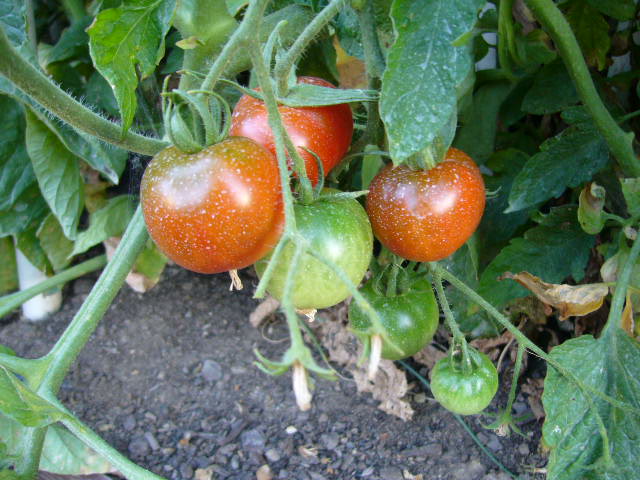
Showing posts with label marianna's peace. Show all posts

A Bite of a Vine-Ripened Tomato...

Saturday, November 26, 2011

Remains of the Bird 2011 Heirloom Tomato Garden
It's a slice of heaven. It sure is. That taste. That texture. That wonderful, tangy surprise of a summer fruit is all but a distant memory now. This is the current state of the Bird tomato garden in late November. Fairly sad isn't it? They are still producing here and there, which is one reason why I haven't torn them out yet and moved on.

It's hard for me to admit that the season is over. What is coming off the vine now cannot compare, in any shape or form, to the tasty treats that the wife that is Venus and I enjoyed earlier this summer. But it's also loads better than the tomato shaped rocks you'll find in your local produce department these days.

At some point -- the 2011 summer garden will be removed and I will be forced to admit that it's all done.

I'm just not quite there yet. If you live for backyard gardening like I do, winter is a lonely time indeed. But, before this garden is indeed removed and plowed under, it's high time we look back to the summer favorites from 2011. There are some new entries on this list. As with any summer tomato garden, some varieties did well and others -- well -- better luck next year!

OUTSTANDING:

Eva Purple Ball Tomatoes
1. Eva Purple Ball: This was a new entry to the Bird Back 40 home for wayward heirloom tomatoes. I'd heard about this variety from other growers across the country, but again, what does well in New England or Arkansas doesn't necessarily translate into guaranteed success on the Left Coast. Growing heirloom tomatoes is a crap shoot anyway. Some do well, some not. Put this one in the "Did Very Well" category. A single bush yielded 50-80 gorgeous slightly pinkish, slightly purplish large tomatoes, some very close to the 1 lb. range. You'll find this tomato in our salsa, tomato sauce and whole tomato canning efforts from this summer.
2. Marianna's Peace: After a rather poor showing last season, MP bounced back in a rather eye-popping fashion this year. Our plant was susceptible to some early Blossom End Rot (BER) problems during the spring, but those vanished as the weather warmed. MP is one of the best tasting heirlooms I've ever tasted, and it wasn't unusual for this vigorous plant to set four new tomatoes at once. That's always a good sign.
3. Black Krim: One of the tastiest offerings in the field of black (or purple) tomatoes. When a single Black Krim bush delivers a bushel of 40-50 tomatoes? It's a good year.
Stupice Tomato
4. Stupice: If you can describe Stupice with one word? It would have to be WOW! Outstanding production from a variety that wins in backyard gardens from East to West and all points in between. Stupice sets tomatoes in large clusters, much like small cherry-sized tomatoes. They grow to about the size of a golf ball or larger. Not the best processing tomato due to size, but perfect for salads, snacking in the yard, or fresh salsa creations (fresh Rooster's Beak?). If you have room for just a few plants in your yard, I highly reccommend this productive variety.
5. Campbell's 1327: I don't know if I'll ever be able to thank the person who saved this variety from the brink of extinction, but they deserve some sort of recognition. Once the standard-bearer of processing tomatoes used in Campbell's Soups, it was tossed aside and abandoned for those hard-as-a-rock processing tomatoes that can withstand bruising on bumpy trips down long country roads from farm to processing plant. Campbell's 1327 is one of my "Reliable Reds," and produces bushel after bushel of round, red and ripe tomatoes that are blemish free and tart on the tastebuds.

GOOD:

1884 Tomato
1. 1884: Seeds for this variety were provided at the last moment by Sacramento gardener Nels Christensen. I can see why he's partial to it. 1884 delivers large, meaty red tomatoes that reveal a surprising orange-colored flesh once they've been sliced open in the kitchen. A wonderful processing tomato and perfect slicing tomato for those big barbequed turkey burgers that deserve a big slice of tomato on top. Originally discovered in 1884 by a Mr. Williamson in the debris after the big flood in Friendly, West Virginia, this variety will find home in the Bird Back 40 again.
2. Green Zebra: It's been a few years since I've been happy to report a large haul of green zebra tomatoes, and this was just one of those years. My former boss at the workplace, who is rather partial to this variety, received his fair share of the crop. It wasn't unusual to pick anywhere from 10-15 tomatoes during weekly harvests, which makes for a pretty darn good year.
Thessaloniki Tomato
3. Thessaloniki: It doesn't roll off the tongue easily, but this was one productive plant in the Bird Back 40. Thessaloniki is a rare Greek heirloom, introduced to the USA in the 1950's by Glecklers Seedsmen, Ohio. Nice production, nice size, outstanding old world tomato taste. The only reason this particular variety didn't make it to the outstanding list is that it is just a common red tomato.
4. Celebrity: It's the only non-heirloom that found it's way into the Bird tomato crop this year, and for good reason. You can depend upon a bushel of round, red, ripe and mostly disease free tomatoes from Celebrity. While other varieties susceptible to disease battled Blossom End Rot, Celebrity stepped up to the plate in a big way with some nice production.
5: Evil Seed: A big, beautiful black beefsteak type tomato that I will never the true origin of. The original plant was delivered to my desk several years ago with the name "Rainbow" attached to the side. The funny thing is, there is no Rainbow tomato that I know of -- especially a black tomato variety. The gentleman who produced this offering wound up doing some none too kind things to his wife and children, thus the wife stuck it with this unfortunate name. It's an unfortunate story for a great tasting tomato.

JUST PLAIN BAD:

No Brandywines in This Bunch!
1. Brandywine: It kills me to put this variety on my list because I absolutely LOVE Brandywine tomatoes. Although I was encouraged by some early season production, most developed BER and the plant just petered out on me by the time July rolled around. When the backyard garden produces one or two Brandywine tomatoes? It's generally not a good year. I hope for better luck next year.
2. Yellow Brandywine: Jeez -- what a Debbie Downer I am. Two varieties of Brandywine in the Bird Back 40 and I get squat. Yellow Brandywine was an absolute bust. Several seed sources do note that this variety can be "finicky to grow," and I can confirm as much. I will not attempt to grow this variety out again.
3. Mortgage Lifter: I either can't find a reliable seed supplier for this variety, or I'm just having the worst of luck. This marks my third year for growing this treasured heirloom, and while I do receive a few of them, it's not enough to warrant that much space in the Bird tomato garden.
4. Azoychka: This is one of my favorite Russian heirlooms, and after some rather encouraging early season production, Azoychka started to produce golf-ball sized tomatoes that were really nothing to write home about.
Processed Tomatoes Ready for Winter Storage
5. Bloody Butcher: I'm surprised this one landed on this list because Bloody Butcher is normally a wonderful, early-season producer. Not this year. It didn't produce early. It didn't produce late. It didn't produce much at all, and BER took most of them.

And there you have it. Although these 15 varieties represent half of what we grew in the Bird Back 40 this year -- these are the varieties that stood out the most in terms of production or disappointment. Other varieties that at least deserve an honorable mention include Caspian Pink, which grew well in the in-ground test bed and produced some very tasty tomatoes late in the season. Cherokee Purple is yet another treasured variety that did moderately well, as did Kelloggs Breakfast, Beefsteak, Druzba, Lemon Boy and Jubilee.

As 2011 begins that slow slide into 2012 -- all that's left are the memories of last year and the promise of what is to come.

Stupice is as Stupice Does

Wednesday, July 13, 2011

Bird Tomato Garden-One of Three Beds
Greetings from the Frankensteinish North Natomas tomato farm that is the Bird Back 40 -- a place we lovingly refer to as "Disneyland for Drunks." Things are right fine in the hood as you can attest from the photo to your immediate right. Our heirloom plantings are now approaching a height of six feet and are green -- lush -- healthy and productive.

A quick check of the garden reveals the following tomato count: Campbell's 1327? LOADED. Eva Purple Ball? LOADED. Black Krim? LOADED! The notoriously cranky and sometimes unproductive Marianna's Peace? LOADED FOR BEAR!

Celebrity and Eva Purple Ball Production
Getting old yet? You know things are going well when you spot a bit of color behind a green tomato leaf -- and pulling that leaf aside reveals the wonder that is a ripening Azoychka. You know things are going REALLY WELL when you pull aside said leaf and are struck with the sight of five ripe Azoychka tomatoes.

Where in Hades did they come from and how come I didn't notice this before? Did someone put those there?

Safe to say -- the wife that is Venus and I are somewhat blessed with tomato production this year. We're off to a rather outstanding start. I've never experienced a year in the garden where there wasn't at least one loser among the bunch. Usually? There's more than one.

But not this year. Not yet anyway.

Ripening Stupice Tomatoes
The big heirloom tomato winner so far this year? No doubt in my mind. It's the heirloom offering known as Stupice. And despite my rather "stupice" play on words in the title of this blog posting -- Stupice isn't pronounced "Stoo-Piss."

This variety, one of four sent to the United States from Czechoslovakia by Milan Sodomka (source: Seed Savers), is actually pronounced "Stoo-Pee-Chay" from what I've been told. Still others have related the pronunciation of "Stu-Pick."

Pick your poison -- because this variety is anything but (poison).

Stupice is one of those rare potato-leaf tomato plants that does not produce beefsteak tomatoes. In my short experience with growing heirlooms? If you're growing out a potato leaf -- it usually means you're growing out any version of Brandywine (there are several), Marianna's Peace or numerous others that feature large and crazy looking tomatoes.

Stupice here, Stupice there, Stupice everywhere!
But not Stupice. This one is different. And that makes it special.

The first clue that I'd decided to grow something special is when every seed I planted not only germinated -- but was the first to germinate. It was the fastest growing tomato starter in the Bird bedroom-converted-tomato-nursery. It's one of several varieties that received a "haircut" before plant out. Every cutting from that plant would yield new plants that I eagerly gave away to family and friends at work.

Since I had not grown this variety before -- I did not know what to expect. I had heard from many tomato growers on the Yahoo Forum TomatoMania that Stupice was an absolute winner in many a backyard garden. But what does well back east in New England or somewhere in the Midwest doesn't necessarily transfer into great success on the Left Coast.

Crazy Stupice Production
However -- the Stupice is one of those plants that ignores all rules. It appears to do well in just about every region it's been planted -- and I can personally attest that list includes Zone 9A -- the Sacramento Territory. Although the raised bed that holds the Stupice also holds seven other tomato plants -- the Stupice has grown up and through nearly the entire bed. I'm discovering new branches that are anywhere from four to six feet away from the main stem -- held aloft by other plants in the bed (which are also doing well I might add).

My first indication that this plant was going to be a winner in the garden is when it unfurled a blossom set normally reserved for cherry tomatoes like SunGold or Sweet 100. When each blossom set resulted in a setting of four to seven young tomatoes? I knew I had something special. Stupice continues to proliferate throughout its garden setting -- putting out blossoms in every square corner of the 4X8 foot raised bed. It was also the first to ripen in abundance, beating early producers like Bloody Butcher and Early Girl.

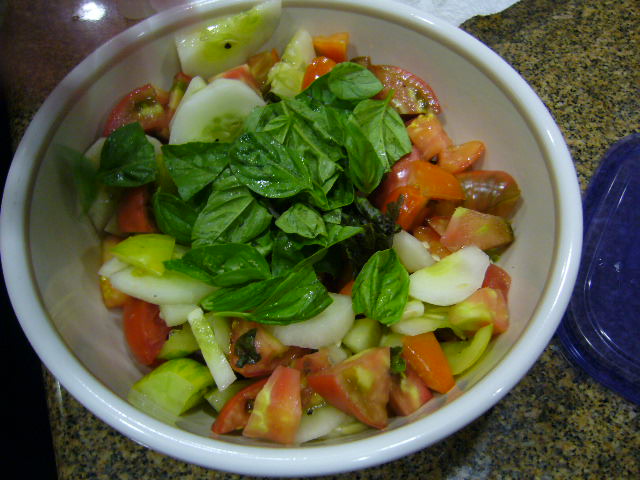
Stupice tomatoes with cucumber and basil anyone?
There will come a time -- not all that far away I might add -- when a singular harvest of Stupice will result in a bowl of 30-40 ripe tomatoes -- with hundreds more yet to ripen. Consider Stupice to be your classic garden tomato -- in that it will produce enough tomatoes to fill every salad bowl with a bounty of production or will serve as your "snacking" tomato while you harvest others from the yard during the peak season of production.

As far as the taste is concerned -- rank Stupice with some of the best tasting heirloom tomatoes. It still can't hold a candle to the taste explosion and surprise that is a vine-ripened Cherokee Purple, Brandywine or Kelloggs' Breakfast -- but a bowl full of Stupice is a bowl full of summer heaven just the same. The one and only knock against Stupice? It's not a good processing tomato. It's about the size of a golf ball or a bit larger. That makes it a tad larger than a large cherry tomato, but it's still not large enough to be canned as a whole tomato.

But that shouldn't stop you from making a gallon or ten of fresh Stupice tomato sauce!

A Haircut That HURT!

Sunday, April 10, 2011

Leggy Heirloom Starter Plants Flopping Over
It was time. I just couldn't bear to look at them anymore. "Them" is pictured to your right. This is how my heirloom tomato starter plants look at the moment as I put them through the "hardening off" process by introducing them to the harsh sunlight of outdoor life.

I was hoping that the introduction to outside conditions would be the kind of "tough love" my heirloom tomato starter plants would need to develop tough stems at the base. And while the "tough love" approach of direct sunlight, cool spring temperatures and breezy days is having the desired effect -- it's not going to result in the kind of stem growth we need that will allow these plants to stand upright.

Leggy starters like these aren't a problem if you've finally arrived at the magic "plant out" date. You can take a variety of actions when faced with the problem of "leggy" starter plants. You can either dig a deep hole and plant the root system and most of the stem deep into soil. Or -- you can dig a long trench and bury most of the plant in soil except for the top four or five inches.

There's just one problem. We're not at "plant out" date yet. In fact, as much as I hoped for an early plant out date -- it ain't gonna happen children. It's still too cold outside. Oh -- sure -- the afternoons (like this afternoon) are wonderful. But our nights are still cold. There's also a chance of another cold rainstorm or two in the long-range forecast. To plant out now? That's like rolling the dice at a craps table. And I don't want to come up snake eyes -- not after caring for these starter plants for as long as I have.

A Leggy Stupice Heirloom Starter
So -- what's the alternative? Continue to let them flop over like they have been? That's a three foot long Stupice starter plant that I'm holding in my fat paw in that photo to the left! Do you know what happens to starter plants that flop over like that? Eventually -- they break in two. Or worse yet -- they snap at the base of the plant. Know what that means? GAME OVER!

No thanks.

The second option? Transplant into larger pots. In my case? I would need much LARGER pots that would allow me to plant these leggy starters deeply. Stems that are planted into soil WILL develop a secondary set of roots. That's one of the nice things about tomato plants -- you can bury them deeply and not hurt them. But -- there's just one problem. I didn't have that many half-gallon pots. I certainly did not have the extra soil on hand. Finally, transplanting into that large of a new pot could possibly delay plant out which should come at the end of this month.

Time for a haircut? Mebbe!
Transplanting is only half the battle. Once transplanted, you've got to allow the starters to expand and grow a new set of roots -- otherwise you can shock them by removing the plants from starter cups during plant out. Even worse -- you can snap a tender starter in half. Know what that means? GAME OVER!

So -- what's a tomato nutcase like Bill Bird to do? I suddenly remembered that I had rooted several varieties of basil in a glass of water during the last growing season. Sacramento area gardener Carri Stokes assured me it would work. And -- it did work. Rooting those basil starters brought back an even more distant memory where Venus and I had taken the same steps with a cutting of lemon thyme that Venus received from a colleague at work. The cutting developed root systems while placed in a cup of water before we transplanted it into the herb bed. Today, it's one of the most prolific herbs in the backyard bed (it's also a good pollen source for the bees -- but more on that later).

And so the inevitable thought crossed my mind. If you can root herbs like basil and thyme by placing cuttings in a glass of water -- can you do the same with tomato plant cuttings? Will they take root in a glass of water? Can they successfully transplanted into starter cups after rooting in water?

Snip, Snip!
For questions like these and more -- I usually turn to the TomatoMania forum or Group on Yahoo. It's a community of like-minded heirloom tomato nutcases like myself -- where you can ask questions and get quick answers. Sure enough -- they all answered in the affirmative -- so the haircut activity took place in earnest earlier today.

Trust me when I tell you: this was anything but EASY. Venus and I have babied these starters from seed for months. We've made every effort to provide them with good soil, light, water, heat -- all the elements one needs for producing starter plants indoors. To suddenly WHACK them back by several feet seemed a little inhuman -- but it had to be done.

And if the action resulted in additional starter plants for family and friends???? Well -- there could be an upside to this endeavour. At least 300 people at work have asked me to "put them on the list" for starter plants. This is one impressive list -- and no I won't be able to fill every last order or desire -- even if every plant roots.

Will They Take Root?
So today -- the three-foot long Stupice got a nice "haircut." So did the two-foot Brandywine. Tigerella also offered up a nice top stem -- as did Bradley, Kelloggs Breakfast, Marianna's Peace and a few others.

The cuttings from each starter plant have been placed in clear plastic cups -- as pictured -- filled with cool water -- labeled and placed on a bright and sunny location on a windowsill. A number of things could happen in the next two weeks. They could root. A marauding cat could knock them into next week (always a possibility in the home for wayward and bratty cats). Or, they could simply shrivel up and die.

As with every gardening experiment? Time will tell!

The Good, The Bad, The Lip-Smackers...

Tuesday, October 27, 2009

I'll be honest -- there are a lot of favorites that came out of Tomato 2009. I normally describe these postings as "the best" and "the worst." But I can't do that this year.

To be perfectly honest -- there are no entries for "the worst" because I really didn't have any.

Well -- on second thought -- if you count those horrid starter plants that I purchased this spring from Whole Foods . . . . Yeah -- those plants. The starter plants that grew two inches? Yeah -- those.

Other than that -- it was a barnstorming year in the Backyard of Bird. We have the saved products to prove it. Venus always wanted a pantry in the kitchen. Little did she know that she would fill up half of it with home grown produce.

We have enough to keep us and the entire neighborhood in salsa -- tomato sauce -- whole tomatoes -- etc.

Enough of that. On with the favorites already!

Before we get started -- a small point about the ratings system. I will give the names of the favorites that performed exceptionally well this summer -- the source of the seed -- and then a little bit about each variety.

For the most part? The starter plants provided by Farmer Fred Hoffman tended to do the best. This is a blanket statement so to speak. Some did exceptionally well. Others did OK. But his starter plants did better than mine for the most part -- although I did get a few winners and you'll hear about those.

Just because I like to brag.

OK then? Onward and upward to Bill & Venus' favorite tomatoes from 2009!

FAVORITE TOMATOES: By "favorite tomatoes" I mean the "most productive" and the "best tasting" from the garden. Ranked in order of "lip-smacking goodness."

1. MARIANNA'S PEACE: Hands down, this is a clear winner from the Back 40 in North Natomas. Seed Source: Totally Tomatoes. Starter plants grown by Fred Hoffman. This is my third year for growing this wonderful, potato-leaf variety. And we must have done something right this year. This was by far the tastiest, and most productive, variety to come out of the garden this summer. Marianna's Peace produced pink, saucer-sized tomatoes in the 1 and 1.5 lb. range all summer long and it's still producing ripened tomatoes in October. One bite of this time-honored treasure is a trip to a tomato lover's paradise. This is a must-have for any garden. It will get a prime spot in the garden next year.

2. ARKANSAS TRAVELER: Seed Source: Seeds of Change. Starter plants grown by Fred Hoffman. This was a new and unique introduction to the garden this year. Impulse seed packet purchase from Capital Nursery -- and a real winner in the garden this year in terms of TASTE and production. Arkansas Traveler produces a BRIGHT RED tomato -- an almost neon-red color that is brighter than any red tomato I've seen. Unlike many heirlooms -- Arkansas Traveler tomatoes are round -- red -- pleasing to the eye and resist cracking or concentric circles around the top and bottom. It's also resistant to Blossom End Rot. The taste is unique. It's not quite as good as Marianna's Peace -- but a treat just the same.

3. LEMON BOY: Seed Source: Fred Hoffman. Starter plants grown by Fred Hoffman. Lemon Boy was probably the most prolific tomato in the garden in terms of outright production. It wasn't unusual to harvest 30-t0-40 tomatoes at a time during peak production. This is Venus' favorite tomato variety for the Heirloom Tomato Martini thanks to a rich -- sweet taste and aroma. Known for producing medium sized tomatoes -- our starter plant delivered more than a few in the 1 lb. range. This was a highly desired tomato that wound up in jars of canned tomatoes and sauce mixes for salsa and other creations. This was my second or third year for growing Lemon Boy. I will grow it again.

4. COSMONAUT VOLKOV: Seed Source: Pinetree Garden Seeds. Starter plants grown by Fred Hoffman. This is another red variety that knocked our socks off in terms of early season production and incredibly rich taste. The Cosmonaut Volkov is yet another Russian introduction to the American fascination with heirloom tomatoes -- and is yet more proof that Eastern Europe has something special going on with the creation of special tomato plant hybrids. The Cosmonaut Volkov grew and produced at an exponential rate throughout the spring and summer before petering out a bit in September. Still -- I will not hesitate to grow this fantastic variety again.

5. BRANDYWINE: Seed Source: Totally Tomatoes. Starter plants grown by Fred Hoffman. I just knew it was going to be a special year for tomatoes in the garden when I watched a single vine from this one plant set eight tomatoes. I don't think I picked eight tomatoes from last year's Brandywine plant alone last year. Vines were just loaded with production and a few weighed in at just over 1 lb. While not quite as productive as the other potato-leaf variety in the garden -- Marianna's Peace -- I have no complaints. This is the most productive Brandywine tomato plant I've seen come out of the garden since 2004. That was a long time ago folks -- and I've spent the past five years trying to duplicate that 2004 success. This year? I finally did. Brandywine gets a deserved home in next year's tomato garden.

GREAT TOMATOES: It's tough to pick a top five or six plants when you've got ten to 15 that fit into that category. That was my problem this year. These varieties didn't make the Top 5 for whatever reason -- but they were darn close.

1. AZOYCHKA: Seed Source: Totally Tomatoes. Starter plants grown by Fred Hoffman. This is yet another Russian variety that delivered a knockout punch of early production -- fell off a bit during mid-season -- then rebounded with a nice harvest of late season tomatoes. Production fell off so much in late July and early August that I thought the plant had died. Azoychka looks a lot like Lemon Boy in that it's yellow in color -- but that's the only comparison. To me? Azoychka tastes like BACON! It has a wonderful, smoky taste that is perfect for one of my favorite sandwiches: Grilled Turkey Bird. Mmmmmm....BACON!

2. BEEFSTEAK: Seed Source: American Seed. Impulse purchase at a Dollar Tree for ten cents. Starter plants grown by Bill & Venus Bird. Beefsteak is a hands down winner in terms of outright production -- coming very close to hanging with Lemon Boy and Marianna's Peace in terms of plant production and size. One Beefsteak plant produced nearly 100 perfectly round, red tomatoes with no hint of Blossom End Rot or disease. However, the one drawback that puts Beefsteak into this category is: TASTE. Don't get me wrong! It's wonderful! But -- it just does not compare to the eyeball-roll-back-into-the-head moment that other heirlooms provide. However -- it gets a well-deserved home in the garden again next summer.

3. KELLOGG'S BREAKFAST: Seed Source: Gary Ibsen's Tomatofest. Starter plants grown by Fred Hoffman. Some make the argument -- and a good one at that -- that the Kellogg's Breakfast is the most outstanding heirloom tomato every hybridized in terms of taste. This year's entry was good -- no doubt -- but it just didn't have the production that the other plants delivered. Blossom End Rot was another problem that seemed to affect this tomato -- but did not affect the Brandywine planted just two feet away. This is how good a year it was in the Backyard of Bird. I have NEVER had a Kellogg's Breakfast this productive. I've never harvested the number of KB tomatoes that I harvested this year. But -- other plants simply did better. In most years? This would get a top five rating. Not this year.

4. DRUZBA: Seed Source: Totally Tomatoes. Starter plants grown by Fred Hoffman. In a word? Druzba DELIVERS. It is one of the most reliable and productive heirlooms that I've ever planted -- yet unlike some heirlooms -- you can always count on Druzba to deliver a large and tasty crop of round, red tomatoes. The plant is somewhat susceptible to blight and blossom end rot problems, and I battled both this year. But it wasn't unusual to harvest ten to 15 ripened tomatoes during the peak harvest months of July and October.

5. CAMPBELL'S 1327: Seed Source: Totally Tomatoes. Starter plants grown by Fred Hoffman and Bill & Venus Bird. Campbell's 1327 was last year's favorite out of the garden in terms of outright production and taste. Not a thing changed this year. So why isn't it in the Top 5 or closer to the top of this list? I told you that I had an outstanding year. This is how far it dropped. When everything goes right in the garden -- the old processing tomato from Campbell's Soups just cannot compare with the time-honored and time-treasured heirloom varieties. That's what happened this year. There's nothing wrong with this variety. I will plant it again next year.

GOOD TOMATOES: These varieties were good -- no doubt about it. They just could not crack the Top Ten this year.

1. OPALKA: Seed Source: Gary Ibsen's Tomatofest. Starter plants grown by Bill & Venus Bird. We didn't have room for this red tomato variety in the raised beds -- but it produced well enough in the direct clay soil "test bed." This was one of the better producers out of the test bed, although BER was problematic. I was probably to blame for the BER problems that cropped up often in the test bed -- because I failed to amend with lime.

2. BLOODY BUTCHER: Seed Source: Totally Tomatoes. Starter plants grown by Fred Hoffman. A tomato grower can always rely upon the Bloody Butcher to produce some of the earliest tomatoes, and this year was no different. The big change this year, however, was the heirlooms started to produce right about the same time. Long time growers say you're not supposed to get ripe tomatoes before May. The Bloody Butcher will make them think twice. Perfect for snacking on in the garden while you go about the main harvest.

3. DR. WYCHE'S YELLOW: Seed Source: Totally Tomatoes. Starter plants grown by Fred Hoffman. I've been wanting to try this ever since Dr. Carolyn Male highlighted this variety in her book "100 Heirloom Tomatoes for the American Garden." This is a true bible for heirloom growers -- a good starting point -- but not the be all-end all in the world of heirloom tomatoes. Blossom End Rot was a constant concern -- but the yellow-orange tomatoes that we did get were interesting to say the least. I will plant again and hope for better luck!

4. EVIL SEED: Seed Source: Unknown. Starter plants grown by Mother Nature. Evil Seed is a black tomato with fantastic taste and an even more fantastic story. Grown by a gardener who later made the rather unwise decision to leave his wife and children for another woman, I never did find out the true name of this tomato or where it came from. I thought I had lost it completely, until one popped out of the ground in an unlikely spot this year and grew like a weed. The plant receives its name courtesy of the jilted ex-wife. I seeded this tomato. I will grow it again.

5. JUBILEE: Seed Source: Lockhart Seed. Starter plants grown by Bill & Venus Bird. This barely made the list -- and only because of its incredible taste. I will try again, but the production off one plant in a raised bed was average at best. The second plant, located in the test bed, was a little more productive but Blossom End Rot was a real problem. I lost most of them.

FAVORITE CHERRY TOMATOES: Cherry tomatoes get their own category this year because we really went to town on them this year. Venus searched high and low for the cherry tomato for the highest brix content so she could enter it in the Tomato Taste Challenge sponsored by NatureSweet. She would later find out, much to her chagrin, that the nearest "challenge" was held in Chicago, IL this year. Maybe next year Venus.

1. BLACK CHERRY: Seed Source: Pinetree Garden Seeds. Starter plants grown by Fred Hoffman, Bill & Venus Bird and Mother Nature. Black Cherry is simply the most outstanding cherry tomato ever developed in terms of taste and production in my humble opinion. Once you plant it -- you'll have them for years to come. We put one plant in a raised bed. About four or five more plants came up on their own in a bed we used the previous year from cherry tomatoes that had dropped to the ground (you never get them all). This will always have a home in our garden.

2. HYBRID RED GRAPE: Seed Source: Lockhart Seed. Starter plants grown by Bill & Venus Bird. Billed as the "cherry tomato with the highest brix content ever recorded," this was a Venus impulse purchase during our first visit to Lockhart Seed in Stockton. There's no denying it was sweet -- but it was also tough to get a ripe tomato. Why? Turns out this tomato was a favorite among birds who raided the garden non-stop. Birds of all feathers would pick these by the hundreds and fly off before returning for another "snack." Excellent producer. We will plant this again.

3. JELLY BEAN GRAPE: Seed Source: Pinetree Garden Seeds. Starter plants grown by Bill & Venus Bird. This cherry was similar to Hybrid Red Grape, although the fruits were smaller. Very productive.

"MEH" TOMATOES: What does "Meh" mean? The first instance of "Meh" popped up in an episode of The Simpsons when Bart Simpson was asked for his opinion. His response? "Meh" -- along with a shrug of his shoulders. To put it short and sweet -- "meh" means "I don't care," or "I'm not really excited by this." In the words of Bart Simpson, "Don't Have a Cow, Homer."

1. CLINT EASTWOOD'S ROWDY RED: Seed Source: Gary Ibsen's Tomatofest. Stater plants grown by Fred Hoffman. I had really high hopes for this tomato. It was hybridized not all that far away, by a former UC Davis plant scientist. It started out with a few great tomatoes -- and then not much. Many of the tomatoes were small -- about two to three ounces and production was nothing to write home about. I will not plant this again.

2. GREEN ZEBRA: Seed Source: Totally Tomatoes. Starter plants grown by Bill & Venus Bird. Due to space limitations, we were not able to put a Green Zebra in the raised beds, and production suffered in the test bed. The few that came off the vine were small -- Blossom End Rot was a problem -- and I have to give this one two thumbs down this year. May not plant again.

3. REIF RED HEART: Seed Source: Gary Ibsen's Tomatofest. Starter plants grown by Bill & Venus Bird. Some heirloom afficiandos swear by heart-shaped tomatoes. I don't understand why. This was average at best and production was limited. Will not plant again.

4. PINK PING PONG: Seed Source: Gary Ibsen's Tomatofest. Starter plants grown by Bill & Venus Bird. This was another "test bed" plant that did not perform well. Will not plant again.

5. COSTALUTO GENOVESE: Seed Source: Seeds of Change. Starter plants grown by Fred Hoffman. This was a favorite from the garden two seasons ago. Despite the introduction of new seed this past spring -- and a spot in one of the raised beds -- I simply was not impressed. The tomatoes were small -- in the one ounce range. Not good for anything other than snacking. Tomatoes were too small for processing. Not sure if I will try again.

Other tomatoes to note are Zapotec Pleated (not good for processing -- but good taste), Dixie's Golden Giant (they must have been referring to a small giant) and Delicious (disease took this one early).

SEED SOURCES FOR HEIRLOOM TOMATOES:

These are just a few that I've used in past years. There are many others. Try typing the term "heirloom tomatoes" or "heirloom tomato seeds" on Google and see what springs up.

In the Sacramento area, Capital Nursery and Peaceful Valley Farm and Garden Supply have a very good selection of packaged seeds, as does the mother of all seed stores, Lockhart Seed in Stockton.

Lockhart Seed (no website -- you gotta go look for yourself)

An Ode to the Beefsteak Tomato

Tuesday, August 11, 2009

It isn't pink. It's not yellow. It certainly isn't orange.

It doesn't rival the taste of a Brandywine. It doesn't provide the tastebud heaven that is the Black Cherry.

It's not warped like an heirloom. It doesn't come in different shapes and sizes like the Cosmonaut Volkov, Marianna's Peace or Druzba. You won't find it growing at a crazy 90 degree angle like a Zapotec Pleated

It just is. It's round. It's red. It doesn't crack. It's a tomato's tomato. It is your standard, non-fancy, hard-working, Beefsteak tomato. What type of Beefsteak you ask?

Nothing. Just Beefsteak.

Venus and I have the Beefsteak growing in the far right-hand corner of an 8X8 foot raised bed that is on the opposite side of the yard containing our six main 4X8 planter beds. We thought long and hard about what should go in this location, before the answer hit us like a bolt from the blue: "Why not another planter bed?" Boom! Done!

I'll be honest, there's nothing fancy about this tomato. It has a wonderful flavor to it -- but what vine-ripened tomato isn't wonderful tasting? It grows perfectly smooth round, red tomatoes. So -- how is this any different from a hybrid like Better Boy?

It's somewhat different in that this is an open-pollinated Beefsteak tomato. Unlike hybrids, which will fruit one main crop and then just sort of sit there and look pretty for another month or two, the Beefsteak keeps on truckin.' And, unlike a hybrid, this Beefsteak can be seeded and saved for next year's crop.

As you can tell -- this plant is simply loaded with bear. New fruit -- meanwhile -- continues to form at the bottom -- middle and top of this continiously growing plant. It's a simple tomato really. No cracks. No funny lines. No whoppers. No small fries.

It's just your standard tomato.

What's special about the Beefsteak then? Why write such prose? To some tomato afficiandos -- the world starts and ends with the Beefsteak tomato. My father-in-law is one such person. Oh sure -- he enjoys the colors that the tomato garden produces. But he dreams about tomato sandwiches and burgers topped with round, red, vine-ripened slices of the standard Beefsteak tomato. It's what he had as a boy. It's what he grew on "the ranch" in San Jose for years.

This is for you Gale Stromberg.

What else is amazing about this tomato? The cost. Quite simply, it cost us next to nothing to grow -- other than our time -- water and efforts. The seeds for this wonderful variety were discovered two years ago in a Dollar Store not all that far away from our North Natomas home.

It was there that Venus and I stumbled upon a garden rack of seeds -- ten packets for one dollar. We bought all we could -- including the packet of seeds contained the Beefsteak Tomato. That one dime will equal into about fifty-to-sixty pounds of production by the time this growing season is over.

Call it one of our "better" investments.

SEEDS, SEEDS AND MORE SEEDS!!!!

Wednesday, January 28, 2009


The first step in the gardening process is now arriving in bunches in the mailbox of Bill and Venus Bird. Yep -- I'm talking seeds, seeds and more seeds. And lots of them too. This batch pictured to your left came from Pine Tree Seeds, but we're also getting deliveries from other places around the country.

I like Pine Tree seeds. I've ordered from them before and they have a couple of things going for them. One, the seed packages are CHEAP (always a good sign), and secondly, I've found that they are very productive. Some of the best vegetables grown in the backyard last summer came via Pine Tree seeds, including the Sweet Diane Watermelon that I wrote about in this blog just last summer.

That was one delicious melon. I can only dream about that taste now, but I'll never forget it. There's nothing quite like pulling a vine-ripened melon -- any melon -- from the backyard. You haven't tasted sweet, until you've grown it by seed in your very own backyard.

The arrival of the seed orders doesn't mean "ready, set, PLANT!" I sure wish that were the case, but we're still a couple of months off. What it does allow Venus and I to do is lay out the garden. Since we rotate crops to ward off harmful bugs, we know the tomatoes will be in a different bed next spring, as will the bush beans, corn, lettuce, radishes, green onions, etc. Once the seeds packets are in hand, we can divide them between the six main beds and the 10-15 smaller planter beds.

Of course, it should come as no big surprise that my personal favorite are the tomato seeds. They're arriving in big numbers now. Some of the seeds, like Delicious for example, were gifts from other growers. Still others were ordered from TomatoFest, Pine Tree Seeds, Seeds of Change, Totally Tomatoes -- you name it. Some varieties are new to the garden. Some are old favorites.

For instance, I had to re-order a particular variety of seed from Seeds of Change. And I'm very hopeful that this package of Costaluto Genovese seed will produce a bumper crop of Genovese tomatoes, which was an absolute favorite out of the garden in 2007. Not only was it a favorite, it was the "outstanding producer" in our garden that year. The wife and I froze 15-20 bags of Genovese tomatoes and used them through the 2007-2008 winter on a variety of dishes.

Unfortunately, last year, I made a serious mistake. When volunteer Genovese plants began popping up in the garden beds last spring, I mistakingly believed I would not have to start from seed again. After all, why plant a seed when you've got a perfectly good starter plant that popped up out of nowhere, right?

Wrong. Bad idea. The tomatoes that came off those starter plants last summer were nothing like the tomatoes that came off the Genovese plant vine in 2007. The plant may have looked the same, or similar, but the production was not good and that fabulous Genovese taste just wasn't there.

In short, it was a major disappointment in the Bird garden last year. But, thanks to the new seed, that won't happen this year (I hope!).

And yes, there are some varieties I simply cannot do without. Campbell's 1327, for example, will have a home in the garden this summer. So will Kellogg's Breakfast. You can't count out Marianna's Peace, and never give up on the Brandywine. There are a few others that will also make a return trip.

And then there are still others to try. I've heard a lot about the variety called Cosmonaut Volkov, which is named after Vladislav Nikolayevich Volkov, who was a Soviet cosmonaut who flew on the Soyuz 7 and Soyuz 11 missions (he unfortunately died during the Soyuz 11 mission).

Another interesting addition to the garden this year is Dr. Wyche's Yellow, which was was developed by the late Dr. John Wyche who owned the Cole Brothers Circus. Rumor has it that the good Dr. Wyche, as a Circus owner, had access to lots of different "fertilizers."

And that's the really interesting thing about growing heirloom tomatoes and other heirloom vegetables. You're not just growing a tomato. You're not just growing a watermelon, or a radish, or ordinary cauliflower.

You're growing a piece of history. It's got a name behind it. There's a reason why it survived all these years. Sometimes the story is just as good as the crop.

Seeds are in -- time to start planning!


A followup to this posting -- as I forgot to mention a very important seed source that has served us well in the past. How could I?

Don't roll your eyes or put your nose up at seedracks located in Dollar Stores or other bargain stores in your town. Those can be a great deal in some cases. Some of the best basil I have ever grown came right out of the Dollar Tree store located near Elkhorn and Watt in North Highlands.

We already had more than enough seed for the garden as I remember, but were immediately drawn to the rack that offered a deal too good to pass up: TEN PACKS OF SEED FOR $1!

Who can pass up a deal like that? We couldn't. We didn't. And those ten packets of spinach, basil, carrots, radishes and green onions kept producing all summer long.

It just goes to show that good gardening bargains can be found just about anywhere you look.