Baby Duke Finds a Home

Saturday, September 7, 2013

The Wife That is Venus and The Duke Avocado
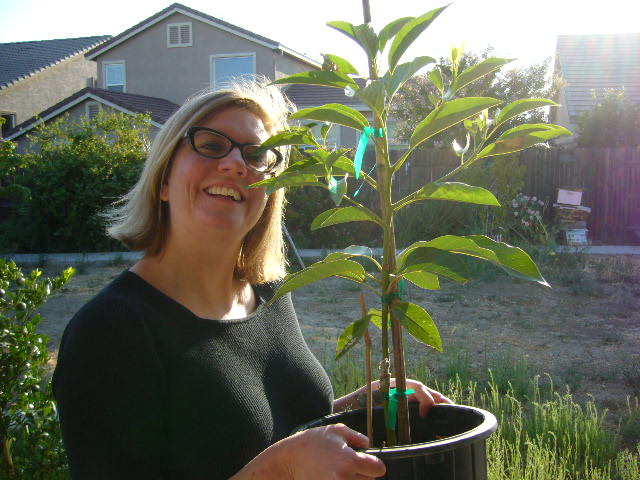
There are two things in the photo to the right that are very special to me. The first -- and most obvious I might add -- is the wife that is Venus. She's got a smile on her face. Why? Because I told her to smile! No, not really. That potted plant is behind the smile that the wife is wearing. Can you guess what it might be?

If you guessed an avocado tree -- points to you dear friend. By now you're probably wondering, "big deal, it's a fricken avocado tree!" Yes -- that may be true -- but it's not just any avocado tree. My friends -- this is the legendary Duke Avocado. What makes the Duke so special? You can't buy it at any store. No nursery carries the Duke. If you call around looking for a Duke, you're likely to be greeted with silence or even a blank stare. No store -- no supplier -- carries the Duke Avocado anymore.

Duke Avocado Tree
Why? Good question. I still don't quite understand why it was abandoned as a backyard tree. This isn't your dad's avocado tree -- this is what dear old grandaddy planted in his backyard. There is only one way to obtain a true, grafted, Duke. If you want a true Duke Avocado tree, you have to "make one."

Which is just what Bill Bird did -- with a little help from his friends at the California Rare Fruit Growers (CRFG). The tree that Venus is holding and again pictured to your left is probably the first true, grafted Duke tree that has been grown in decades. The scion attached to the root stock was taken from the spot where the Duke Avocado was born in 1912: Butte County.

This tree just isn't rare. The Duke Avocado is incredibly rare. And it has one incredible story behind it.

Oroville: Home of the Duke Avocado
This has been a rather long journey which I documented here last year and again here about six months later. The baby Duke Avocado tree now growing in the Bird Back 40 is the result of a quest to find an avocado variety that will laugh at freezing conditions, grow in terrible soils that have doomed other avocado varieties and, of course, produce boatloads of avocados.

The Duke is the result of a quest that started when I earned a none-too-stellar reputation of killing avocado trees. It didn't matter what variety I planted. It didn't matter where I planted it. Because, with each tree I planted, death arrived at its doorstep less than six months later. The tried-and-true standard nursery varieties of Bacon, Mexicola, Mexicola Grande, Zutano and Pinkerton all had a date with the Grim Reaper. They bit the dust, bought the farm, took a dirt nap, fed the worms, etc.

Duke Avocado Planted in Raised Bed
Avocado tree suppliers made bank on my misfortune. Because when one tree kicked the bucket, Bill Bird trotted out and dutifully shelled out another fifty bucks on another, supposed, "cold weather tolerant" avocado tree. Why keep kicking myself like this? Because the wife that is Venus DEMANDED an avocado tree for her backyard. That's why. Isn't that enough?

Since the definition of insanity is doing the same thing over and over again and expecting different results, I knew I had to try something different (I'm not that whacko, people. Not yet anyway). The links above detail the quest I started last year to find an avocado variety that could withstand the micro-climate cold freezes that cover the Bird Back 40 every December.
Duke Avocado Tree-Oroville Train Depot
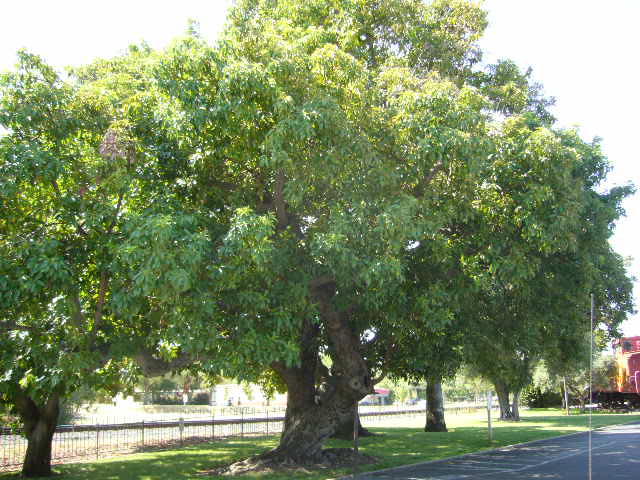
The discovery of the Duke would then lead to the quest for a Duke -- the steps I took to find a supplier -- and finally -- the discovery of ancient Duke avocado trees planted in an old Introductory Garden located at the site of the old Oroville train Depot once served by the Western Pacific Rail Road. It was there where I would procure the scions from an ancient heirloom tree brought about by a crazy old man called "Benedict," who started planting avocado seed in Bangor in 1912.

Mr. Benedict may have failed in his quest to build an avocado nursery in one of the coldest interior regions of California. But his lasting success is the creation of the Duke line. The last major investigative report on the Duke, printed in the 1963 California Avocado Yearbook, not only failed to find the source of the avocado seed that Benedict was importing into Butte County, trees similar to the Duke couldn't be located anywhere.

Duke Avocado Leaves Are Shiny Yellow-Green
The Duke, like many avocado varieties that once graced California fields, was replaced by another variety at some point and then forgotten. There are a myriad of reasons as to why it was abandoned. Perhaps better tasting varieties were developed? The thin skins of the Duke fruit quickly fell out of favor with commercial growers and shippers. The fruit bruised far too easily during transport from farm to market. What happened to the Duke isn't unique. Many other avocado varieties have been tried, and then forgotten.

What makes the Duke unique, however, is this tree's ability to withstand frosty cold conditions. The Duke has survived major freezes that severely damaged other varieties planted nearby. I have witnessed the Duke's ability to laugh off a sustained frost with my own eyes. I have seen healthy Duke scions protruding from half dead root stock that nearly perished after a cold December freeze.

THE QUEST FOR THE DUKE AVOCADO

The quest for my own Duke Avocado tree didn't end with the discovery of original Duke trees in Oroville. That was just the start of our avocado adventure. One does not "plant" Duke Avocado seed to obtain a true Duke tree. The only way to get a true Duke is through the process of grafting.

Duke Avocado Tree-Bird Back 40
Since my grafting skills are still suspect (ie: BAD), I farmed out Duke cuttings (scions) taken from original Duke trees in Oroville to growers connected to the CRFG. Avocado root stock was procured from other CRFG suppliers in Northern and Central California. Two growers with marvelous grafting abilities volunteered to take on the project of creating new Duke trees.

Unfortunately, for reasons that I still don't understand, the Sacramento grower who volunteered for this effort allowed all of his Duke trees and his avocado root stock to die this summer. I'm not exactly sure what went wrong. I didn't get much of an explanation from him, other than that the three grafted Duke trees in his possession, and additional root stock, had died.

Heritage Duke Tree-Oroville, CA
Ever get socked in the stomach? That's kind of how I felt. I had visited this grower last May and witnessed the progress he had made with his grafting efforts. I saw, with my own eyes, healthy Duke shoots protruding from root stock that had nearly perished during the previous winter. Since the root stock was suspect, I agreed with his request. He wanted to break the half-dead root stock into pieces and bury it under the soil line, leaving only the healthy Duke shoot above.

He was the expert at this, right? So I agreed. And, after hearing that all of his trees had died from lack of care this summer, I began to regret this decision. A thought kept running through my mind: "Why didn't I grab one of those trees when I had a chance?"

Hindsight is 20-20.

LOVELY DOWNTOWN WATERFORD

A Waterford Backyard
If you have ever taken the opportunity to visit the downtown area of Waterford, "lovely" is probably the last adjective that comes to mind. Waterford is a small community that most people on Highway 120 zoom right through -- usually on their way to a nearby reservoir or even Yosemite National Park. It's not a place where one would normally stop, unless you need gas.

But there is a spot in downtown Waterford that is, indeed, quite lovely. It's the backyard of CRFG grower David Johnson. This is the second time I've had the pleasure of walking into David's backyard. It is a tribute to not just avocado trees of different shapes and sizes, but rare and unique citrus varieties and other fruit that isn't often found in the normal California backyard. Thanks to a canopy of shade from fruit and citrus trees planted long ago, David makes magic happen on the ground below.

Backyard of CRFG Member David Johnson
I like to think of it as a science lab for growing the rare and unique. Small trails lead from one discovery to another. And there's usually a friendly cat that steps out along the way, demanding a scratch or to be held and petted. On this particular day I had come to adopt an avocado tree. I nearly adopted another cat (something I do not need).

David is the other grower who had been enlisted with Duke scions taken from the Oroville trees. I hadn't given David nearly as much as I'd delivered to the Sacramento grower, but it was enough to create two or three grafted Duke trees. As I gazed upon those light green leaves tinged with yellow streaks, a signature of the Duke tree, I knew that my work on this venture had not been in vain.

Avocado Tree Nursery-Waterford
Unlike my Sacramento grower, David did not splice scions into existing root stock. He instead sliced into root stock at the base of the tree -- removing all previous growth -- and inserted a Duke scion. I had given him enough scion material last year for six trees. If the graft failed to take, it meant the entire root stock was also a goner. But David experienced a fifty percent success rate. Six grafts with six different root stocks resulted in three healthy trees.

Before you get too excited -- all three have found a home. But I did more than just drive to Waterford to pick up Venus' Duke Avocado tree. David also received a delivery of an ice chest packed with scion material taken from the Oroville trees that I had visited earlier that morning. David is now creating new Duke trees as this post is written.

Avocado Cat Says "Adopt Me!"
Yes -- you're right -- it was a long drive. From Sacramento north to Oroville -- then back south again to Sacramento and even further south to Waterford. Thanks to Google Maps, I was able to follow a lot of the original route that had been set aside for the never constructed Highway 65. These are old rural roads now that are rarely traveled, but offer a glimpse of the San Joaquin Valley one doesn't get from Highway 99 or Interstate 5.

Highway 65 was originally designed to take pressure off Highway 99. Like many highway building projects, it was shelved under the mistaken belief of: "If we don't built it, they (people) won't come." Lots of highway projects were abandoned in the 1970's under this mistaken belief. The people still came. Our population has nearly doubled since 1970.

But that's enough of politics. Back to avocados -- specifically -- The Duke Avocado.

THE END?

Emerging Duke Leaf Sets
Venus' Duke Avocado tree has found a home in a side yard of the Bird Back 40. Planted in a raised bed and sheltered from the freezing winds that blow in from the north during winter, I'm hopeful this avocado tree will meet with a better fate than most previous avocado tree efforts. The Duke is located near a Bearss Lime tree, which can also succumb to cold weather freezes, but has done quite well in the spot we placed it four years ago.

I'm pleased to report that this tree is experiencing a growth spurt in its new home and hope the incredible growth pattern that I've read about regarding the Duke tree also holds true. As to when this tree will produce its first real avocado, that's anyone's guess. It can take some trees five to seven years before they will produce.

I'm hoping for a little quicker production than that -- but have also learned the time honored rule when it comes to gardening or growing good things in the garden: Patience is a virtue.

POSTSCRIPT: DUKE TREES NO LONGER FOR SALE


Newly Grafted Duke Avocado Tree
Sorry folks -- demand exceeded supply. I mean, way, way, WAY exceeded supply. Our Duke Avocado operation is quite small. Once I announced several months ago that Duke trees were for sale? I was inundated with email requests from across the continental United States. I even discovered the location of another Duke tree -- growing in a USDA Agricultural Research Station located outside of Miami! Yes -- the Duke grows in Florida! And probably elsewhere.

So, I'm sorry to report that the window has closed shut. Heck, it's been nailed down. I have so many requests for Duke trees that it will take years to fulfill them all.

In the meantime? If you've got your heart and soul stuck on a Duke Avocado, as I did, you can always make one, as I did.

Find the details of how I did it here and here.

A Place for Linus

Sunday, September 1, 2013

Pumpkin Squash Flowers-Bird Back 40
I can feel it, can you? There's a shade of darkness in my morning sunshine. The days are getting shorter. There's still no identifiable "chill" in the air, but still I get that idea that things are changing. Fall is marching forward, and pushing out my old friend summer.

What does fall bring? Fall brings football! College football! Pro football! High school football! If you consider yourself a fanatic of the San Francisco Giants baseball team -- well -- fall can't come soon enough. 

Bird Back 40 Pumpkin Patch
In the garden -- fall brings something else. The corn stalks turn white and those green globe squash that we call pumpkins slowly begin to turn a familiar shade of orange. This is our fourth or fifth year growing pumpkins in a side yard of the Bird Back 40 -- and it may be the most successful year yet.

Squash bugs claimed and destroyed most of last year's crop. Determined to not allow that to happen again -- the wife that is Venus and I went on "squash bug alert" very early this past spring. Every bug we saw got squashed or sprayed with something it didn't like. For the most part, our vigilance has paid off. But new bugs pop up from time to time -- leading to yet another "squash party."

Pumpkin Ready for Harvest-Bird Back 40
I was always a big fan of the Charles Schultz comic "Peanuts" while growing up. Who wasn't? I bought every book offered through scholastic book sale programs at Standiford Elementary School in Modesto. I read ever comic panel in the Modesto Bee. I watched every special on CBS, and dutifully bought Dolly Madison doughnuts. Later, as the airing of these specials grew more sporadic and less trustworthy, I bought them on VHS and then DVD.

Charles Schultz will always have a place in the Bird Household.

It's the Great Pumpkin Charlie Brown
Although there are many productions featuring the Peanuts gang, I suppose I am most drawn to the top three: Halloween, Thanksgiving and Christmas. It is the Halloween tale (It's the Great Pumpkin Charlie Brown!) that retells some of the most famous recurring tales out of the Schultz comic strip. You can always count on Charlie Brown to get a rock while trick or treating, and Linus van Pelt invariably misses out on all the fun while waiting for the "Great Pumpkin" to make his yearly appearance.

I got to thinking about that recently. Linus wasn't looking for the best pumpkin patch or even the largest. He was looking for the most "sincere" of pumpkin patches. Then, and only then, would the Great Pumpkin make his storied appearance.

I suppose, after all these years, I got to wondering what "sincere" actually meant. I was surprised to find out that others have wondered the same thing. More people like Bill Bird? Nerd Alert!

A lot has been written about Linus' fascination with the Great Pumpkin. Some have theorized that Linus' belief in the Great Pumpkin as symbolic of the struggles faced by anyone with beliefs or practices that are not shared by the majority (Wikipedia). Still others have postulated that, "...if Linus is cultivating his pumpkin patch not merely for the pumpkins themselves, but as a means to the end of luring the Great Pumpkin, then he has an ulterior motive and his patch can never be truly sincere (Christopher L. Bennett)."

Pumpkin Patch-Bird Back 40
As for Charles Schultz? The man who dreamed up the Peanuts gang and gave us the Great Pumpkin? He found the entire debate to be rather humorous. He claimed no motivation beyond the humor of having one of his young characters confuse Halloween with Christmas (Wikipedia). Further evidence of this can be found in a comic panel where Schultz has Linus trying to convince other members of the Peanuts gang to go out and sing "pumpkin carols."

I am not sure if the pumpkin patch in the Bird Back 40 is "sincere" enough to draw someone as famous as the Great Pumpkin, nor do I know if it would interest Linus van Pelt. The blockhead in me would like to think so. But when I sit and gaze at the patch the wife that is Venus has cultivated this year, I am drawn to the memory of the Great Pumpkin, who never did make an appearance.

Now Ripening-A Pumpkin
Left to wander, the pumpkin vines have gobbled up a side yard and grown into numerous citrus trees, grape vines and the general garden area. It's not all that unusual to see a pumpkin protruding from the center of a lemon tree. I thought our modest patch would produce maybe a dozen pumpkins, which I was quite happy with. But then, about a month ago, the vines suddenly burped a dozen more pumpkins. The same event repeated itself two weeks later -- and may even happen again.

Will they ripen in time for the time-honored holiday known as Halloween? I would certainly think so. Pumpkins are, after all, part of the squash family. Anyone with experience knows that a tender, four inch squash can turn into the size of a baseball bat overnight if you're not paying attention. Pumpkins tend to grow very quickly. Many are showing a bright shade of orange this onset of fall. Still others are a greenish-yellow. And, everywhere I look during our daily bug inspections, there's another green pumpkin that just emerged.

Baby Pumpkin
The wife that is Venus will use these pumpkins to prepare pumpkin soup, pumpkin bread, roasted pumpkin seeds and, yes, pumpkin pie for the Thanksgiving holiday. Bill Bird will use the orbs to carve Jack O' Lanterns. Still others will find homes around our neighborhood. Why buy pumpkins when you can have the kids come over and hunt them for free?

Perhaps this is what sincerity is all about.

What a Bonanza!

Saturday, August 17, 2013

Joe Starkey
You know it's getting close to football season when I title a post: "What a Bonanza!" The signature call of play-by-play broadcaster Joe Starkey, it's something I get to hear a lot of thanks to my Cal Bear grad wife and the fact that DirecTV is in a contract dispute with the PAC 12 television network. That dispute means not a lot of Cal Bear Football games show up on the local TV channel, so KGO Radio and Joe Starkey it is on those fall afternoons.

But I truly believe that Starkey would utter the same line if he could cast a Golden Bear eye at the fresh fruit production currently coming out of the Bird Back 40. From peaches to pluots and grapes to apples -- it's all beginning to ripen up at the same time. Call it the "Bonanza" of fruit producing backyards. But, this is what I envisioned six years ago when I set out to transform a backyard that contained nothing more than a level sheet of stark, dusty clay.

Peaches and Pluots: Bird Back 40 Orchards
Yes, Virginia, you can get tired of eating peaches.

But I'm not quite there yet.

I've come to discover that peaches and pluots make for nice cousins when it comes to a morning snack at work. Twenty minutes of slicing and dicing in the morning, plus a little fresh lemon juice, leads to a couple of Tupperware containers that are jammed with fresh, tree-ripened fruit. Add in some slices of Honeycrisp apples and a smattering of Fiesta or Diamond Muscat table grapes, and it's a fruit salad.

We have so many options this summer!

Flavor Finale Pluots
I am perhaps most excited by the production out of the Flavor Finale Pluot tree. Planted four years ago in the Bird Back 40, it produced its first really big harvest this year. As expected, the mockingbirds attacked the fruit on this tree with impunity. But it really didn't matter much this year -- as there was more than enough fruit for the annoying birds and Bill and Venus Bird.

I've also come to discover that this variety of pluot is one of the few fruit varieties that I like to pull from the tree before they soften. The Flavor Finale pluot is one of the sweetest varieties of pluots to hit the market, and it's a sweetness that develops in the fruit long before it actually turns soft to the touch. That crisp bite and sweet taste is quite a combination, and I've discovered that the fruit doesn't grow any sweeter if allowed to stay on the tree until it softens.

Sliced Flavor Finale Pluots
And so? It gets harvested early this year.

Why did we get such a big year out of the Flavor Finale this year? Why not last year or the year before last? I'm not sure. I know that I lacked a pollinator for this tree. The Santa Rosa plum tree planted in the front yard was just too far away, or so I believed at the time. It might have been the grafting work that I performed on this tree two years ago. These grafts actually yielded a small harvest of different kinds of pluots this summer, but more importantly, may have also provided the kickstart kind of pollen needed to produce a lot of Flavor Finale fruit.

Whatever the answer? I'm blessed. Pluots are the bomb. Thank you Floyd Zaiger.

O'Henry Peach Tree: Bird Back 40
But no fruit salad from the Bird Back 40 would be complete without the addition of tree-ripened O'Henry Peaches. My friends, I've tried many peaches in my lifetime. Call me a "peach snob" if you will. From the early ripening varieties, to the new additions to hit the peach market in recent years, I've tasted them all. Yet, I keep coming back to the old, reliable, O'Henry Peach. It has a sweetness and consistency that ranks as my all time peach favorite.

It also might be the fact that I literally grew up with this variety on the old Modesto homestead all those years ago. Perhaps it's that taste of long-gone youth that brings me back to the O'Henry year after year? Perhaps...

Sliced O'Henry Peaches
The wife that is Venus and I were fortunate enough to add a third peach variety to the Bird Back 40 collection this year. This is a mult-budded tree that will offer far more harvest possibilities in the years to come -- as this one single tree offers five different peach varieties that have been grafted onto standard rootstock. This particular tree is called the Pride Collection, and contains peach varieties that ripen from May to September.

My friends -- that's five solid months of peach production. There's a word for that. It's called "heaven."

In the words of Joe Starkey: "What a Bonanza!"

America's First Designer Apple?

Sunday, August 11, 2013

Honeycrisp Apple-Bird Back 40
Hey now! Don't blame me for the name. This time? I'm innocent. I didn't stick it with this name. The apple world is literally buzzing about the best darn apple in the world, and no, the name isn't Fuji. However, this variety may be causing the biggest buzz since Fuji apples first hit the marketplace.

Apple lovers are writing flowery prose about this variety. Enter the search term "Honeycrisp Apple" on Twitter and you will find year after year of tributes from thousands of apple enthusiasts all over the United States. At farmer's markets in the Midwest and the East Coast, where Red Delicious and other apple varieties sell for a buck a pound -- the Honeycrisp Apple commands a price of five bucks per pound.

Honeycrisp Apple Fallen from the Tree
Worse yet -- the variety is so new to the apple world -- that not many acres have been planted. In fact, according to the comprehensive resource about apples and apple orchards, Orange Pippen, there are no groves of Honeycrisp apples to be found anywhere in California. At most you will find a single tree here or there.

And you just might find one of those trees hidden deep in the Bird Back 40. Count Bill Bird as thanking his lucky stars. Because this year he's got a small crop of Honeycrisp apples that are now beginning to show plenty of color. And Bill Bird -- plus the wife that is Venus -- are licking their chops in anticipation of biting into an apple that is like no other.

Twitter Tributes: Honeycrisp Apple

How did I come to choose the Honeycrisp Apple three years ago when I put my Backyard Orchard Culture (BOC) skills to work? My friends -- even a a squirrel sometimes finds a nut. The Bird Back 40 is littered with one garden mistake after another. But we can call this decision a grand slam in the world of horticultural endeavors.

BOC Apple Orchard: Bird Back 40
The line of thinking, three years ago during bare root planting season, went a little like this. As I walked the rows of young apple trees at the now-closed Capital Nursery in Land Park, I knew what I was looking for. The BOC apple orchard would hold three trees. The wife that is Venus had requested a Granny Smith. As for myself? I was looking for the Fuji apple.

But what about that elusive third tree? What variety should I pick? Capital Nursery had so many selections on that dark, gray February afternoon that it was tough to choose. Should I pick the Gala? The Golden Delicious? What about the Pink Pearl or the Pink Lady? That picture of the Liberty Apple at the Liberty row of trees sure did look good. What about that?

Honeycrisp Apples
In a sense, I was torn. There were so many varieties to choose from. But I could choose only one. Which one?

It was, at that point, where this rather brilliant thought crossed my tequila soaked brain. Why not buy the apple that every other apple buyer was choosing? You see -- each row of apple tree varieties contained anywhere from ten to 12 trees. If I came to a row that still held 10 trees or more -- I moved on. Nobody was buying this apple. If I happened upon a row that contained six to seven trees from the original 12, it would get serious consideration.

As it turned out, serious consideration wasn't needed. I came across one variety that held just two trees. Only two were left from the original 12, and bare root season had barely started. This was the apple tree that people were snapping up. The decision was easy. I reached out and grabbed the best bare root tree remaining. This is how the Honeycrisp Apple found a home in the Bird Back 40.

Honeycrisp Apple
Flash forward three years later -- the year 2013 -- and Bill Bird finds himself at a computer trying to find out when the Honeycrisp ripened. And that is when I stumbled across these glowing tributes to the Honeycrisp Apple. People are going absolutely BONKERS over this variety. Thousands of apple lovers from across the globe are willing to pay top dollar for a variety that has captured the heart of the apple-loving public.

Why are people going nutso over the Honeycrisp? Well, I must admit, we haven't had a taste of a true, tree-ripened Honeycrisp just yet. However, enough of them have fallen from the tree, early I might add, to get an idea of the excitement behind the Honeycrisp. This is the poprocks of apple varieties. Honeycrisp apples literally explode when you crunch into them. They are juicy, sweet, tart, and contain a consistency that is unlike the Braeburn or any other apple variety. It's tough to describe, but it's darn good.

Honeycrisp Tree in Raised Bed
This may also be the most studied of apple varieties in the history of the United States, despite it's young age. The Honeycrisp was born 20-years ago at the Minnesota Agricultural Experiment Station's Horticultural Research Center at the University of Minnesota. Scientist David Bedford, who created the Honeycrisp through the old-fashioned method of cross-breeding one variety to another, claims it's a cross of the apple cultivars Macoun and Honeygold.

Ah -- but here's the rub. Old fashioned cross-breeding isn't always 100 percent reliable. Pollen is a funny thing. Invisible to the naked eye, pollen floats on gentle air currents for hundreds and even thousands of miles. Genetic testing has discovered that the Honeycrisp isn't a cross of either the Macoun or Honeygold. The genetic fingerprinting found that one of the parents was the Keepsake cultivar, which is found at the University of Minnesota Research Center. And the other parent? Unknown. The pollen could have floated in from a backyard tree somewhere in Minnesota, or could have been a test variety that has since been abandoned. UPDATE: Another genetic study, published in 2017, revealed that Honeycrisp’s true parents were ‘Keepsake’ and an unnamed apple tree referred to as ‘MN1627’. 

The short and sweet answer is we may never know the other parent. There are literally thousands of apple varieties in the United States and across the world for that matter. We know the DNA markers for some, but not all.

But I suppose all of this really doesn't matter. The craze behind the Honeycrisp continues to grow at an exponential rate. Budweiser put it in a beer. They can't brew the Shock Top Honeycrisp Apple Wheat fast enough to meet demand. Who knows where it will wind up next?

Pollinated by the Granny Smith, the Honeycrisp variety set a nice crop of apples this year. It is the smallest of the three trees in our BOC orchard, but no matter. It seems to like where it's planted and we've been rewarded with our first crop ever.

America's first designer apple. In the Bird Back 40. Nice

Muscat Love

Wednesday, August 7, 2013

Diamond Muscat Seedless Table Grape
If you've come here expecting a little Captain and Tennille action, you're going to be sadly disappointed. If you have absolutely no idea of what I'm talking about -- congratulations on that thing called "youth." Enjoy it while you can. If you are old enough to remember the good Captain and his partner, Toni Tennille, welcome to Geezerdom. We've been waiting for you to arrive. Bedpans are to your left.

I write today, not about Muskrats, but rather Muscats. What's the difference? One is an animal -- the other is a grape. Captain and Tennille wrote and sang about Muskrats, not Muscats. I'm here to sing (croon actually) about Muscats. And Muscats just happen to be growing in my backyard. It is called the Diamond Muscat, pictured above right, and is now literally ripe for the picking in the Bird Back 40.

Monster Table Grape Vines-Bird Back 40
It is also probably the most unique kind of table grape that I planted some four years ago in the Backyard of Bird. Most table grapes are sweet -- some more so than others. Indeed -- the higher the brix content -- the more desirable the grape. The Diamond Muscat is sweet -- no doubt about it -- but also offers a different kind of taste not found in most table grapes. While I'm not a big fan of wine (how can I like grapes but not like wine?), there is that subtle hint of wine grape in every bite of a Diamond Muscat. This is one special table grape.

How special? I'm so very glad you asked. According to our good friends at the University of California Integrated Viticulture website: "Diamond Muscat was released by the USDA Agricultural Research Service in 2000 as an early season white seedless with muscat flavor. The muscat flavor is pleasant and mild though it is more intense than that of ‘Summer Muscat’. It has the potential for wine or concentrate production..."

Fantasy Seedless Table Grape Cluster
It's also one good tasting table grape -- and may soon be offered through the Bird Back 40 Kitchens as a grape jelly, grape soda, grape snowcone, grape.... you get the idea.

Unfortunately, or fortunately, it happens to be one of five or six varieties of table grapes that have suddenly ripened, weeks before they were supposed to ripen. This has been one strange summer in terms of weather patterns. The early onset of summer heat brought on a bountiful stone fruit crop -- and also paid the same dividends when it comes to table grapes it appears. The nine varieties that I have planted in the Bird Back 40 are not all designed to ripen at once. That would be a grape disaster instead of grape season.

But, obviously, this year Mother Nature had something else planned entirely.

Fantasy Table Grapes (partial harvest)
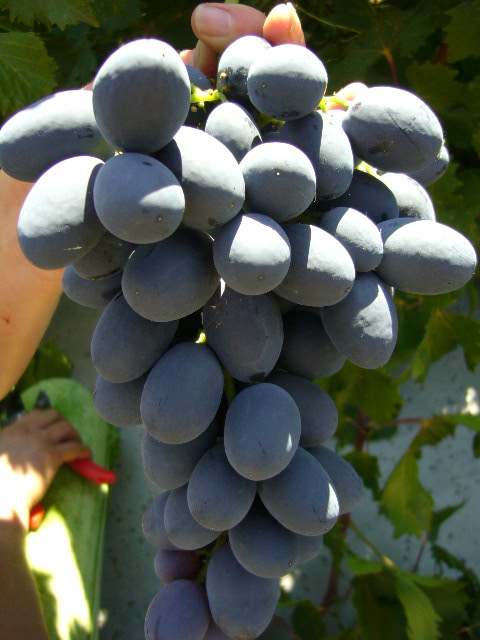
That big batch of blue table grapes pictured upper right (and immediate left), for example? That is the Fantasy Table Grape. As I write this, Fantasy Table Grape season has come and gone as we juiced the last of a 50 lb. harvest just last night. Instead of 50 lbs. of Fantasy Table Grapes, the wife that is Venus and I have about three gallons of fresh, pure, 100 percent fresh-squeezed Fantasy table grape juice.

Thank goodness the wife had the right mind to fire up that Jack Lalanne juicer.

What a Cluster!
Had our neighbors and some of our friends at work not helped out by taking many pounds off our hands, I fear there would be a lot more. We should be right smack dab in the middle of Fantasy table grape season. Instead, this batch of grapes, resembling plums with some clusters, ripened up about two weeks early. Why? Other than the wacky summer weather we've had, I have no idea why. I only know that when the mockingbirds begin to raid the table grape crop? The table grape crop is ready for picking.

Venus and I installed our table grape vines in the Bird Back 40 four years ago. Though the vines produced a nice crop in the second and third years, nothing could really prepare us for what is now taking place this year. And our friends who grow grapes for a living claim we "ain't seen nothing yet." Peak production for our table grape plantings won't come for another season or three.

Freshly Squeezed Table Grape Juice
As I keep a sharp eye on the Black Monukka, Suffolk Red, Flame and other varieties of grapes, I can believe that. The Flame is probably the strangest producer of this bunch. Most table grape varieties set clusters of flowers in the spring, and those flowers eventually turn into small grapes. At that point? Small grapes grow through the summer and turn into big grapes.

But not the Flame seedless table grape. Oh sure, the Flame set clusters of flowers early in the season just like every other seedless table grape vine did. And, oh, sure, those flowers turned into small grapes. And those small grapes have since turned into big grapes. Some have even changed color!

Mockingbird Hunter "Lenny" on Patrol
But what the Flame has done throughout the summer, which other vines have not, is continue to set new clusters. The vine flowered into July -- setting new clusters every four or five days. This means some clusters are now getting ready to ripen, while others are still green and small.

Can you say: "What a Cluster?" I know! I know...

My thanks to Sacramento area gardener Carri Stokes who first set me on this table grape adventure four years ago. I owe her a table grape -- or two.

The Ghostly White Nectarine

Thursday, August 1, 2013

Arctic Jay White Nectarines-Bird Back 40
If you've followed this blog for any length of time, you've probably come to realize that I'm just a tad fanatic about fresh fruit from the backyard. Some might say I'm just a tad off my rocker. Still others might suggest a little white jacket and some time in a padded room.

You see -- a normal backyard fruit enthusiast will select a perfect spot in the backyard and plant one (1) fruit tree and be done with that. Someone who loves citrus, for example, might even take it a bit further and plant one (1) lemon tree and one (1) lime tree together. Still others -- again on the normal side of the ledger -- will search for that perfect lemon tree that yields a special kind of lemon juice.

Fantasia Nectarines: Delicious
And then, there's someone like Bill Bird. He's anything but normal. He is the "anti-normal." The "what the heck are you doing," normal. My line of thinking goes like this: One fruit tree is just that, one. As Three Dog Night once crooned, "One is the Loneliest Number." One is also boring. Why have one when you can five or six. And why stop with just one variety of fruit when you have so many to choose from?

You can see how this thing called "reality" can easily slip from your grasp.

My evidence in this case questioning my sanity? Easy. It's that Backyard Orchard Culture adventure that I set out on several years ago in a quest to bring fresh nectarines to the Bird Back 40. Ever heard of Backyard Orchard Culture? It's a practice of the mildly insane. The thinking goes somewhat like this: why stop with one fruit tree when you can have three? Think of a harvest season lasting a solid month rather than just a week or two. Go ahead -- make my day -- and plant three fruit trees in that hole you just dug for one and see what happens.

Tree Ripened Nectarines Sweet with Juice
This sickness is fed by horticulturists who tinker with this and that -- call it the "natural order of things" -- when it comes to fruit trees. At one time in our recent past? You couldn't grow blueberries west of the Mississippi River. Blackberries without thorns was an oxymoron. And who had heard of a pluot 15 years ago? Get my drift? Thanks to our friends at Dave Wilson Nursery and others, there's so much new stuff to experience that it's tough to stop at "just one."

When you catch a sickness like this, that "perfect spot in the yard" for a fruit tree is snapped up fairly quickly. Oh, sure, you might find another "perfect spot" or two over time, but conventional backyards in conventional subdivisions only offer so much room. Pretty soon you'll find yourself tearing out shrubs against a lonely wall of your house because "shrubs are boring."

Our Nectarine Jungle
That's what I found myself doing some four years ago -- during an NFL Playoff football game no less. There are times in my life where it would have taken a loaded gun to drag me away from an NFL playoff football game. Instead -- on this day -- my life was consumed not with football, but rather, Flavortop and Fantasia. Those happen to be the first two nectarines I planted against that side wall. I would add the Arctic Jay, the world's best white nectarine, a few days later.

Why nectarines? If you get afflicted with this "grow your own" disease, the answer is "why not." People will question your sanity at the time, but will eventually come round to your way of thinking. They'll tell you: "It will never work." But, in reality, who can ignore that white nectarine tree in the front yard? Suddenly, and without warning mind you, the people who either laughed or questioned your moves, are stealing fruit from right under your nose.

Flavortop Nectarines
This is why I've chosen to rename my white nectarine tree from "Arctic Jay" to "Ghostly White." Do you recall what Casper the Friendly Ghost was most famous for? If your guess is "vanish," you're right on the money but you don't win a white nectarine. You see -- I don't have any left to give. I didn't get any myself. Over the space of ten days this month every last white nectarine on the "Ghostly White" tree up and VANISHED. I mean GONE.

Where did they go? Good question. Did a bird invade and take them all? That would have been one big bird, and no, this was no thieving bird. I have a strong suspicion that this was a thief of the two-legged and no wings variety. Someone in the neighborhood developed a taste for tree-ripened nectarines.

This is your reward for planting those nectarine trees in the FRONT yard. On this fine morning I am singing the farmer's lament: There's always next year...