Showing posts with label Table Grapes. Show all posts

Can't You Just Taste That???

Saturday, March 29, 2014

Table Grape Cluster-Thompson Vine
I know I can! Know what that is pictured to the right peeps? That, my friends, is a cluster. Not just any cluster mind you. And not the kind of cluster that Gunny Highway (Clint Eastwood) popularized in "Heartbreak Ridge." Nope! The picture to the right represents a big, fat CLUSTER of Thompson Table Grapes. And clusters just like this one are now emerging on every shoot emerging from the Thompson Table Grape vine.

Know what that means? It means a boatload of Thompson Table Grapes come this summer. And boatloads of table grapes are not a bad thing -- at least not in my book anyway.

Haircut Needed!
The table grape clusters now emerging by the hundreds it seems from the Venus, Fantasy, Black Monukka and Diamond Muscat vines, to name a few, follow on the heels of a haircut party held several weeks ago in the Bird Back 40. These vines, which emerged last year, managed to grow and cover the sidewalk you see pictured here and there. They also managed to grow right into the nearby pluot tree. Not only did they grow into it -- tendrils from these vines wrapped themselves around pluot tree branches and grew clear to the other side of the tree.

It wasn't all that unusual then -- to see a cluster of table grapes growing inside the pluot tree. And it did make for nice conversation.

Vines Before Pruning
Properly maintained? One single table grape vine will produce anywhere from 50 to 60 lbs. of table grapes. That's more than you and I can eat in any one sitting or two or three sittings for that matter. Now -- multiply that kind of production with nine table grape vines. There comes a point in the season where it's open season on table grape production, and I can't give them away or juice them fast enough.

The trick is to make sure the vines are properly maintained. The mass of vines you see pictured above looks like a really bad haircut, or someone just got up from a hard night's sleep. Most of these vines will not survive the pruning process that takes place when you're getting your mini-vineyard ready for spring and summer production. The wood that produced last years crop gets pruned away first -- along with any vines that emerged from that wood.

Vines After Pruning
The wood that you keep are the strongest vines or runners that emerged from the top of the vine, or the runners that emerged from the trunk itself. Those are the vines you keep -- and you won't keep all of them either. Some grape growers practice spur pruning -- keeping the strongest two vines that grew from the top or "cordon." Other growers practice the cane pruning method -- keeping the strongest vines that emerged from the trunks.

In my case? I practice both. Some varieties do better with spur pruning. Still others do better with cane pruning. Through the years I've discovered that the Thompson performs best with the spur pruning method, while the Black Monukka produces best through the method of cane pruning. And, as for the Fantasy vine, it really doesn't matter. The Fantasy is going to churn out ping-pong sized grapes no matter no matter what method of pruning that I use.

Piles of Discarded Vines
The vines that I choose to keep -- those that will be this year's fruit producers -- are then tied to the cattle pen fencing that we installed some years ago for our table grape vineyard efforts. It's been one of our better gardening investments. Cattle pen fencing can hold cows in place -- and can also support several hundred lbs. of table grape production.

It takes the better part of a weekend to properly prune and tie up nine table grape vines -- plus dispose of the piles of discarded vines piled nearby. That's a big investment of time and energy -- but well worth it when table grape season arrives -- which comes in late June for the Venus vine and continues right into July and August when most of the other varieties ripen up.

Cattle Pen Fencing
These vines will be sprayed to protect against mildew and other damage. Gibberellic acid, or GA-3, an organic growth hormone that promotes cell growth, will also be used at some point. Although there has been some previous research that suggests the use of GA-3 limits production on the Fantasy vine, I have not found this to be readily apparent in the Bird Back 40. And GA-3 results in large grapes that are packed with lip-smacking natural sugars. Fantasy grapes are not only the best eating -- they make the finest table grape juice.

The crop is ready when the mockingbirds who mock me begin to raid the vines with impunity. But it really doesn't matter all that much. These vines produce so much fruit now that I can share some with our fine-feathered friends. Besides -- they're taking a risk by coming in this close. Because somewhere in those vines -- hiding beneath the leaves -- is our garden patrol cat: Lenny. And when a 25 lb. Maine Coon snags a mockingbird? It's game over -- at least as far as the mockingbird is concerned.

As the wife that is Venus would say, "that's nature." Cats chase birds. It's the natural order of things. Yes -- and we can add one more rule to that list: Bill Bird likes table grapes.

Muscat Love

Wednesday, August 7, 2013

Diamond Muscat Seedless Table Grape
If you've come here expecting a little Captain and Tennille action, you're going to be sadly disappointed. If you have absolutely no idea of what I'm talking about -- congratulations on that thing called "youth." Enjoy it while you can. If you are old enough to remember the good Captain and his partner, Toni Tennille, welcome to Geezerdom. We've been waiting for you to arrive. Bedpans are to your left.

I write today, not about Muskrats, but rather Muscats. What's the difference? One is an animal -- the other is a grape. Captain and Tennille wrote and sang about Muskrats, not Muscats. I'm here to sing (croon actually) about Muscats. And Muscats just happen to be growing in my backyard. It is called the Diamond Muscat, pictured above right, and is now literally ripe for the picking in the Bird Back 40.

Monster Table Grape Vines-Bird Back 40
It is also probably the most unique kind of table grape that I planted some four years ago in the Backyard of Bird. Most table grapes are sweet -- some more so than others. Indeed -- the higher the brix content -- the more desirable the grape. The Diamond Muscat is sweet -- no doubt about it -- but also offers a different kind of taste not found in most table grapes. While I'm not a big fan of wine (how can I like grapes but not like wine?), there is that subtle hint of wine grape in every bite of a Diamond Muscat. This is one special table grape.

How special? I'm so very glad you asked. According to our good friends at the University of California Integrated Viticulture website: "Diamond Muscat was released by the USDA Agricultural Research Service in 2000 as an early season white seedless with muscat flavor. The muscat flavor is pleasant and mild though it is more intense than that of ‘Summer Muscat’. It has the potential for wine or concentrate production..."

Fantasy Seedless Table Grape Cluster
It's also one good tasting table grape -- and may soon be offered through the Bird Back 40 Kitchens as a grape jelly, grape soda, grape snowcone, grape.... you get the idea.

Unfortunately, or fortunately, it happens to be one of five or six varieties of table grapes that have suddenly ripened, weeks before they were supposed to ripen. This has been one strange summer in terms of weather patterns. The early onset of summer heat brought on a bountiful stone fruit crop -- and also paid the same dividends when it comes to table grapes it appears. The nine varieties that I have planted in the Bird Back 40 are not all designed to ripen at once. That would be a grape disaster instead of grape season.

But, obviously, this year Mother Nature had something else planned entirely.

Fantasy Table Grapes (partial harvest)
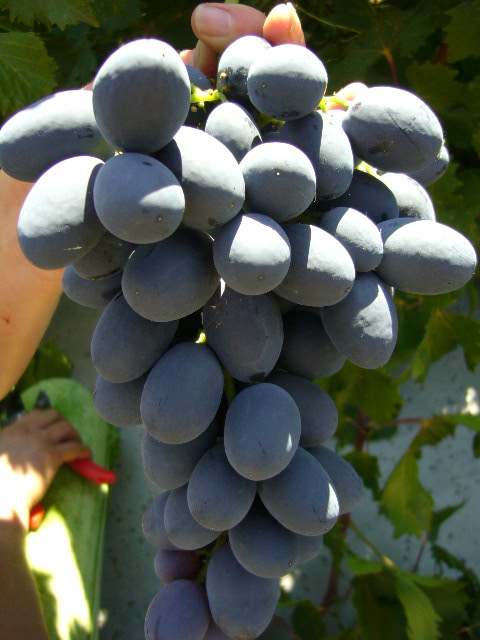
That big batch of blue table grapes pictured upper right (and immediate left), for example? That is the Fantasy Table Grape. As I write this, Fantasy Table Grape season has come and gone as we juiced the last of a 50 lb. harvest just last night. Instead of 50 lbs. of Fantasy Table Grapes, the wife that is Venus and I have about three gallons of fresh, pure, 100 percent fresh-squeezed Fantasy table grape juice.

Thank goodness the wife had the right mind to fire up that Jack Lalanne juicer.

What a Cluster!
Had our neighbors and some of our friends at work not helped out by taking many pounds off our hands, I fear there would be a lot more. We should be right smack dab in the middle of Fantasy table grape season. Instead, this batch of grapes, resembling plums with some clusters, ripened up about two weeks early. Why? Other than the wacky summer weather we've had, I have no idea why. I only know that when the mockingbirds begin to raid the table grape crop? The table grape crop is ready for picking.

Venus and I installed our table grape vines in the Bird Back 40 four years ago. Though the vines produced a nice crop in the second and third years, nothing could really prepare us for what is now taking place this year. And our friends who grow grapes for a living claim we "ain't seen nothing yet." Peak production for our table grape plantings won't come for another season or three.

Freshly Squeezed Table Grape Juice
As I keep a sharp eye on the Black Monukka, Suffolk Red, Flame and other varieties of grapes, I can believe that. The Flame is probably the strangest producer of this bunch. Most table grape varieties set clusters of flowers in the spring, and those flowers eventually turn into small grapes. At that point? Small grapes grow through the summer and turn into big grapes.

But not the Flame seedless table grape. Oh sure, the Flame set clusters of flowers early in the season just like every other seedless table grape vine did. And, oh, sure, those flowers turned into small grapes. And those small grapes have since turned into big grapes. Some have even changed color!

Mockingbird Hunter "Lenny" on Patrol
But what the Flame has done throughout the summer, which other vines have not, is continue to set new clusters. The vine flowered into July -- setting new clusters every four or five days. This means some clusters are now getting ready to ripen, while others are still green and small.

Can you say: "What a Cluster?" I know! I know...

My thanks to Sacramento area gardener Carri Stokes who first set me on this table grape adventure four years ago. I owe her a table grape -- or two.

MY Venus Shows Off THE Venus

Friday, June 21, 2013

MY Venus with THE Venus
So? Guess which is which? Oh great, she's going to KILL me for that line. I kind of like this picture. I really do. I snapped it just the other day. Yes, that raving beauty to the right is MY Venus -- the Wife That Is (and will always be) MY Venus.

I think Facebook friend Dave Jessee, upon seeing this picture, gave it justice when he proceeded to comment the following: "Very nice!.....and the grapes aren't too bad either!"

He doesn't know it yet, but Dave Jessee earned all important "points" for that response. And when it comes to the Wife that is Venus, you can never have too many "points."

Venus Table Grapes
I write this post because MY Venus is holding up something rather important and amazing. I've been waiting for this moment for the better part of four years. No, the moment is not sex. Though, she did make me wait entirely too long for that. Never mind. Wait? What was I writing about again?

Oh yes, table grapes. Forgive me. My mind wandered. It's still wandering...

What MY Venus is holding top right -- and also pictured upper left -- is the Venus Table Grape. After four years of waiting, the Venus vine is finally producing the very first crop of juicy table grapes. This is a rather seminal moment. If you've ever grown seedless table grapes in California, the first rule of thumb is table grapes do not ripen in June.

Venus Table Grapes on the Vine
Most don't ripen in July. By August you have plenty of local table grapes. But JUNE? Yes, June, apparently. We have the evidence. The evidence is tasty. And there's more than one or two tasty table grape clusters hanging on the Venus vine. It's not a whopper 40 lb. harvest mind you, but that's fine. There's always next year.

There is some interesting history here. It's is the Wife who is Venus who bargained for the Venus Table Grape. It's why this rare vine can be found growing in the Bird Back 40. There aren't many of them here. This variety simply isn't grown much here. Why? Good question. Wish I had the answer. It might be the fact that there are so many delicious California selections already grown here, why do we need this one?

Lip-Smacking Venus Table Grapes Ready for Consumption
The Venus Table Grape harkens from the University of Arkansas, where it was developed and marketed as a seedless vine in 1977. How it got from Arkansas to California is a question that I cannot answer. But what I can tell you is this: When I first approached MY Venus to ask permission to plant table grapes in the Bird Back 40 some five or six years ago, she was initially skeptical. "Why grapes," she asked?

"Because I like them," I questioned in a somewhat timidly voice in response. "What varieties do you want," she continued. I handed her a list from Bay Laurel Nursery. And that is why MY Venus spotted THE Venus Table Grape. "As long as you plant the table grape named after me," she proclaimed, "I'm fine with it."

And that, my friends, is how THE Venus found a home in the Back 40 belonging to MY Venus.

Venus Cluster on the Vine
But it doesn't end there. Not even close. This was just the beginning.

The bare root season that preceded the spring season four years ago was a rather wet and miserable season indeed. It was cold. It was clammy. Short and sweet? It sucked. It wasn't anything like last year's bare root season, which offered mostly warm temperatures and sunny skies. Although bare root season is often the best time to plant things like fruit trees and vines, the bare root season that we got four years ago was an exception.

About half of the selections that I ordered from Bay Laurel Nursery died. From vines to trees -- fifty percent is not a good number. One of the first vines to die that year? You guessed it: the Venus Table Grape.

MY Venus was anything but pleased. She has the green thumb in the family. She thought mine had turned black -- as in black with death. I would have to wait another year before a replacement plant arrived from Bay Laurel so I could give it the "old college try" again. By this time the spot I'd set aside for THE Venus and other table grapes had already been taken up with replacement selections. I had to find another spot for it.

Venus Cluster
And so, across the yard it went. That small corner would suffice -- or so I thought. THE Venus didn't do much that first year. It grew about six inches. That ain't much in the world of table grapes. In fact, that's downright pathetic. Some first year vines will send out a stalk that can grow 10-12 feet! Six inches in comparison is fairly depressing.

The second year -- when I could expect the first fruits of my labor -- offered the same results. Oh -- it was a little better. This time THE Venus table grape vine produced TWO new vines. Each one grew about two feet in length and then stopped. Hey! That's better than the first year. But still not as nice as the other vines that were really starting to produce a boatload of table grapes.

What went wrong? I'm not sure. Perhaps the vine just didn't acclimate well to California? Perhaps it wasn't getting enough fertilizer, or perhaps I was under-fertilizing it? Was it the water? Too much? Too little? The weather? Too hot? Not muggy enough? I couldn't understand why eight other vines were growing like champions, while THE Venus, planted just mere feet away, wasn't doing as well.

Venus Vine Growth in 2013: BOOM!
Perhaps all it needed was time. This year? THE Venus sprang to life while the other table grape vines were still getting a winter's slumber. Suddenly, before I knew it, it had grown to the point where it was too late to install any sort of arbor for it. More importantly, it was fruiting for the very first time. And I didn't dare risk the chance of knocking first year fruit loose for arbor installation duties. That would have to wait. In the meantime? THE Venus vine that had grown a total of two and a half feet in the previous two years quickly grew over a six foot high fence and into the neighbor's yard.

MY Venus was pleased. She was even more pleased to taste the very first fruits of our labor. A garden is a labor of love after all. How does THE Venus taste? I'll admit, the brix content is nothing to write home about. It's not the sweetest grape in the world. However, it's got an intense taste just the same. As one writer puts it: "The Venus Table Grape is a cross between the European Vitis vinifera and the North American Vitis labrusca. It has the foxy flavor of a Concord, with some of the lusciousness of a Black Monukka."

I guess that means it's darn good. And wouldn't you know it? MY Venus would have to agree.

Shave and a Haircut! Two Bits!

Friday, March 29, 2013

Table Grape Vines in Need of a Haircut
Springtime means big time projects in the Bird Back 40. Yes -- it also means gardening -- but it can also involve prepping for the upcoming summer fresh fruit season. If you had the pleasure of growing up in the Central San Joaquin Valley, you've had the pleasure of tasting some of the best fruit that our hot, dry summers have to offer. I am sometimes amazed by the bounty of fruit and produce that this valley produces, from southern Kern County to northern Shasta County.

Short and sweet? We can grow just about everything here. We help feed the entire nation when it comes to some crops. We're spoiled. And I like it that way!

Warning! Pruning Job Ahead!
One crop that grows particularly well in this valley? Grapes! Not just any grapes mind you -- but my favorite: The Table Grape. California leads the nation in both wine and table grape production. Wine grapes get most of the ink because this nation has a never-ending love affair with all things wine. I find it strange that I never did develop a taste for vino. After all, I love grapes. It should make sense, then, that I would love wine. Right?
Wrong. I can't stand the taste of wine. I love grape juice. I absolutely love any type of cider made from pomegranates, pears, apples, etc. But I can't do wine.

Color me strange.

Venus and Audrey with Fantasy Table Grapes
We are now headed into the fourth year of table grape production in the Bird Back 40. Last year was simply off the hook in terms of table grape production, even though I probably lost 40% to 50% of the crop to a scourge called powdery mildew. Even though I have no problem using controls to combat this problem, I discovered too late last season that the product I had been using protects against a bevy of diseases, except powdery mildew. By the time I finally did procure the right controls? It was already too late.

I won't have that problem this year.

I always encourage others to grow grapes in a backyard or side yard or even turn part of a front yard into a productive and pretty arbor. They're easy to grow and deliver a tasty snack for months on end. But if there's one thing I've learned? Grape vines need care. The more you care for them? The better they will be to you in terms of a tasty harvest. I've also come to discover that field hands who do this dirty work of tending vines deserve hazard pay. This isn't an easy task.

Red Suffolk Table Grapes Protected by Bird Netting
There are a multitude of ways to prune grape vines. It seems like commercial growers are always coming up with one ingenious way or another to prune a vine so it will provide a fatter harvest. The better the harvest? The better the profit margin!

In my case? I practice two tried and true forms of pruning: Spur pruning and Cane pruning. I find spur pruning works best with some varieties of table grapes, while cane pruning works better with others. In some cases? With some varieties like the Black Monukka? It really doesn't matter. The Black Monukka is going to deliver a whopper harvest no matter how it's pruned. Simply put? The Black Monukka is one of the best tasting table grapes that you can plant in your backyard.

Marquitos Points Out Two Year Old Wood
The fruit for this year's harvest is going to come from the spurs or canes that emerged during last year's growing season. It's the first-year wood that you're looking to save during the "shave and a haircut" process. While I've discovered, by accident mind you, that two year old wood will also produce fruit, it won't produce as much as the first-year wood.

Some table grape varieties will produce a multitude of new canes during the growing season. Some don't. For those that don't produce a lot of new canes during the growth season? I practice spur pruning. And then there are others like Fantasy and Flame that produce so many new shoots during the spring and summer that it's tough to decide what to keep and what to completely prune away.

Partially Trimmed Vines
Spotting the two year old vines is easy enough. First, the wood is a bit darker. Secondly, it's wood that I tied to my grape vine trellis with green stretchy tape last year. This is wood that I will want to completely cut away as it served as last year's fruiting canes. They aren't needed anymore.

The second step is locating and keeping the fattest and thickest canes that emerged from the trunk of the vine the previous season. With some vines, it's obvious. With others? Not so much. When it comes to spur pruning a vine, one only needs to keep two of the strongest canes that emerged the previous season. Sometimes you have ten to choose from, which means you're doing a lot of cutting.

Vines Pruned and Tied to Trellis
The Flame table grape variety, for example, must have produced 20 new shoots last season. It was probably the fastest growing vine out of the bunch. But I could only keep three of the best branches, which means 17 others got pruned away along with the old wood.

Another thing to watch out for? Bending a particular branch in one way or another can result in a whipping motion that leaves a nice little red welt on your face or neck. Remember what I told you about field hands and hazard pay?

But, the moment finally does come when you've completely pruned each vine and kept only the best canes. These are the canes that will serve as this year's fruit producers. The job isn't quite done yet. These canes need to be tied down, or trained, to move in one direction or another. Sometimes they don't want to move in the direction you want them to move in. They will remind you of this when slapping you across the face once you've made the mistake of letting go of a vine before you've got it tied down. Or sometimes that green stretchy tape snaps. Oh, the horror.

Vines in Springtime
There comes a time, however, when the job is finished. The canes and spurs are tied down against the trellis. The vines have been fertilized. Everything looks neat and tidy. You're ready for the new season.

As for the numerous canes that were pruned away and are now lying on the ground? Those serve a purpose as well. This is how you start new vines. Simply cut a section of vine about a foot long, stick it in a pot with a bit of soil. And, with any luck, that vine will begin to produce roots below the soil line and green shoots above. I farmed out a number of cuttings to people connected with the Sacramento Chapter of the California Rare Fruit Growers (CRFG). I even had one request for canes from a grower in Chicago, IL.

Red Suffolk Table Grapes (Delicious)
Will California vines grow in a Chicago backyard? Good question. I don't really know. But a grower is willing to give it a try. Gardening really is an exercise in trial and error. Mistakes by the dozens are made in this journey.

But when you find yourself munching on a plate of fat and juicy Red Flame grapes this summer? It's well worth it.

Instant Gratification and Gardening

Friday, February 1, 2013

Feed Your Citrus Trees! Feed Them!
Instant gratification and gardening do not mix. The words instant gratification and gardening, when used in the same sentence would represent an oxymoron. There are no quick results when it comes to digging in the dirt. There are only successes and failures.

If I had to compare gardening with anything, it would probably be a turn at a Las Vegas craps table. Sometimes you hit it big -- real big -- know what I mean? And then, at other times, you're informing the wife that is Venus that she'll be making the house payment this month. And perhaps the next...

Owari Satsuma Mandarin-Bird Back 40
I bring this up because even an experienced gardening screwup like Bill Bird can still make some fairly basic mistakes by expecting to see too much in too little of a time. Case in point? Growth on the citrus and stone fruit plantings that currently dot the Bird Back 40.

I harken back at this point to some wonderful advice provided to us by Ken Menzer, the arborist employed by the City of Folsom. Ken is known to provide classes from time to time on various subjects that include fruit tree trimming and other tips and advice.

Long Gone Blueberry Planting-Bird Back 40
Yes, it is Ken Menzer who told the wife that is Venus and I to plant blueberry bushes beneath our fruit tree collections. Sadly, that experiment failed. I would later come to discover that both have different pH requirements and a couple of Southern Highbush plants would go on to kick the proverbial bucket.

But -- I must say that Ken's advice about planting strawberry plants beneath fruit tree groupings was spot on the money. His other advice that I took to heart and would later abandon? Fertilize fruit and citrus trees once a month -- every month -- without fail. "It doesn't take much," I recall him telling us. "Just a handful here and there every month."

Apple Trees and Strawberry Plants in Winter
At first? At first I followed his advice to the letter. I dutifully purchased bags of fertilizer for my many citrus and fruit tree plantings scattered across our North Natomas backyard. Every month -- without fail -- eight table grape vines got a little something. The same with those peach trees over there -- and the nectarines in the front yard -- they got the same treatment. Nobody got the cold shoulder.

But at some point in this journey -- I can't place exactly when -- I sort of fell out of this practice. I'm not sure why. Perhaps I got a little disappointed when the fruit trees failed to "take off" after six months of loving care? Perhaps it's when Capital Nursery went out of business, taking that supply of fruit tree fertilizer I loved so much.

Dancy Mandarins! Yum!
I can't remember when I did it. Point is? I did it. I stopped when I should have continued. Why? Because last year those fruit trees that I'd lovingly cared for suddenly sprang to life. One peach and one pluot tree doubled in size over the course of a summer. The three nectarine trees started acting like they had ingested some of Jack's "magic beans." The Dancy Mandarin delivered a whopper of a harvest this year -- the largest ever.

The same can pretty much be said for most fruit and citrus tree offerings scattered in and throughout the Bird Back 40. I had one of my best production years ever. I ate table grapes until I was sick of table grapes. Sick of table grapes? That's a crime!

Fruit Tree Fertilizer (now gone)
Even after one whopper harvest or growth spurt after another, I still failed to put two and two together. I never have been the best at math, I will admit. But this equation is fairly basic. As the Scotts Fertilizer pitchman once begged: "Feed Your Lawn! Feed it!"

It wasn't until just recently -- fairly recently I'm ashamed to admit -- did that proverbial light suddenly snap on in the rather darkened spot between my ears. This wasn't some mistake. Last summer's growth spurt and good harvest was probably due to Ken Menzer's good advice. And, unfortunately for me, I'd stopped following it at some point.

Improved Meyer Lemon After Frost Damage
I'm happy to report that I'm "back on the wagon" again. I'd committed the gardening sin of expecting instant gratification from my garden. Worse yet, I'd abandoned a practice that had served up some mighty fine peach cobbler desserts over the course of a summer.

The $64 question is -- did I wait too long to resume what had served me so well? I can tell you this much: I won't go expecting instant results...

Battle Sacramento

Thursday, July 19, 2012

Ripening Fantasy Seedless Table Grape
It will never be quite as exciting as "Battle Los Angeles" but my own personal battle against invaders from the sky is now on in the Bird Back 40. It never once occurred to me that planting a row or two of table grapes would be enough to bring an invasion from above -- I suppose you could call it a hard lesson in life.

You see -- I should have planted eight table grape vines for myself and the wife that is Venus, plus another 80 for the invaders pillaging the backyard. It's either that, or call in the United States Marines.

Staff Sgt. Nantz: All Hands on Deck!
The invaders in this case are the always-present, always squawking (loudly), mockingbirds. They have a love for all things table grapes, cherries, peaches and whatever they can dig into it seems. And they have no intention of leaving until harvest season comes to a close.

What does this mean? It means I need to take extra special measures to protect that ripening crop of tasty Fantasy grapes ripening above -- and those Suffolk Red grapes further down to the left. Special measures include a lot of bird netting and one very interested Maine Coon Kitten (Lenny has grown into a rather large and curious kitten).

Table Grape Vines in Spring-Bird Back 40
This marks the third season for table grape production in the Bird Back 40 and all eight original vines are in production. A ninth vine, the Venus table grape, was planted a year later and on the other side of the property. It's had some trouble adapting to this Northern California climate, but is slowly finding its way.

This year's crop -- I'm pleased to report -- is probably three times the size of last year's crop. And we're just getting started here children. I'm told --by those in the know -- that the size of these crops will keep increasing on an exponential level until these vines reach full maturity in five to six years.

Red Suffolk Table Grapes
By that time -- a true army of mockingbirds will have descended.

My experiments with increasing the actual size of these grapes has been both hit and miss -- and are probably related to the fact that each variety flowers and ripens during different times of the year. The Fantasy variety featured up top -- for example -- is now nearly dark and is slowly gaining sugar content. Estimated harvest date? The first or second week of August. The Suffolk Red variety ripens next in mid-to-late August.

Other varieties, like the time-honored Thompson, won't be ready to harvest until mid-September or later. That's provided the mockingbirds are kind enough to leave one or two berries behind.

Flowering Grapevines: A Beautiful Sight
There are several different actions that growers can take to increase the size of table grapes. One method is trunk girdling, which involves the removal of a thin strip of bark around the trunk. According to the University of California Master Gardener Program? This can increase the size of the berries by anywhere from 10% to 30% when done correctly.

But girdling isn't recommended for vines that are less than four or five years old. It also takes a practiced hand. One wrong move? You've got a problem. I'm not that good with knives just yet and may never be quite that handy.

Black Monukka Table Grapes
Fortunately -- there is another way to achieve larger table grape sizes. This is through the use of a natural hormone called Gibberellic Acid or GA-3. Although its difficult to find for the home backyard, most commercial growers use GA-3 extensively. Applying (spraying) GA-3 at just after bloom set and again a week or two after the grapes have formed should result in fatter grapes.

In my case? It's been hit and miss. Both the Red Suffolk and Fantasy grapes have that large and familiar teardrop shape. But the Black Monukka and Thompson grapes are still quite small and may never grow to a large size. This may be due to the fact that I didn't quite hit that "window of opportunity" correctly. In my case? Time will tell.

Monster Table Grape Vines
Why grow table grapes at home? Why not! Like anything pulled from the tree or vine at the peak of ripeness -- there's nothing quite more rewarding than growing your own. Home grown table grapes are a time-honored summer treasure to be savored and celebrated. There are trials and tribulations and battles to fight. But that sweet crunch of one berry after another makes it all worth it and more.

Look Who's Coming to Dinner!

Friday, March 9, 2012

Pruned Table Grape Vines Ready for 2012
Yes, yes -- I know. I KNOW. I know what you're thinking. You're thinking that this song is just ENTIRELY inappropriate for this blog posting. Well -- too bad. Because -- you're wrong. Because it is quite appropriate.

YES -- I do understand the meaning behind this song. I didn't at first -- but you'll have to excuse me -- I was just a kid prancing across the living room floor during the gilded 1970's "Disco Age" when this tune first hit the airwaves. It had a catchy beat. I liked it. I still like it.

It was my older and much wiser brother who caught me by the arm one day while mid prance with the question of, "you know what this song means, right?"

Thompson Table Grape is "Coming Out" to Play
"No," was my innocent response. Even though we were alone at the time, he whispered in my ear.

"Oh," I replied as my eyes opened somewhat wider. They quickly turned somewhat perplexed when I looked at my brother and asked (innocently, I might add), "what does that mean?"

He again whispered in my ear. "OH, I get it," I responded as my eyeballs nearly popped out of my skull.

I didn't prance much after that to be brutally honest. Hey, it was 1970's Modesto. They didn't teach us much about "alternative anything" back in that day. You were considered "edgy" if you ordered a blueberry snow cone.

It's looking a lot like the year of an early harvest in the Bird Back 40. No -- there's nothing quite ready to harvest just yet -- but give it time. The fruit trees are popping way early. As I write this, the flowering Santa Rosa plum tree is nearly finished, as are the nectarine trees. The Royal Rainier Cherry appears ready to pop open at any moment. And -- as you can tell by the photo to your left -- the table grape vines are indeed, "coming out."

I wasn't expecting this early growth out of the table grape vines to be brutally honest. They didn't pop open like this last year. I knew I was in a bit of trouble when I saw the first hint of green on the Thompson seedless. Hey! I hadn't done my homework! I wasn't ready.

Vines Need a Haircut!
This is what vines look like after a long winter snooze. Much like hair looks in the morning after a good snooze -- the best thing you can say about this picture is: jumbled. The vines were in need of a good haircut. And this is now the all-important third year for grapevine production. This should be the year when I finally see the first nice harvest of home-grown table grapes.

This is provided -- of course -- those damn mockingbirds don't get to the tasty treat first. Did I mention they were back this year? Oh yeah -- much like a bad dream -- this mischievous pair flew back into the Bird Back 40 one afternoon not all that long ago. They'd been gone for a good long time -- but not before stripping the yard of cherry tomatoes, grapes, pluots, peaches and anything else they could get their beaks into.

Mockingbirds have no shame. But they do have an appetite.

But -- back to all things vines. They are clearly popping. Whether I'm ready or not? They are clearly "coming out," or "coming to dinner."

Spur Pruned Thompson Table Grape
There are two ways to prune a table grape vine: Spur pruning and cane pruning. Some vines react better to spur pruning like the Thompson. Others, like the Black Monukka, really don't give a damn. Spur prune or cane prune, the Black Monukka is going to throw out a bunch of tasty table grapes come Hell or high water and that's just the way things are. In my particular case? I practice both styles.

Some vines -- like the Thompson -- just tend to develop nicely formed spurs at the top of the trunk. They jut out at nice angles. When I first started to prune this vine? I had about ten of them to choose from. But I was only going to keep two. One would head in a northerly direction -- while the other would head south.

Table Grape Vines Pruned and Tied
As for the Black Monukka -- it also had nice spur development. But it also had fat canes protruding directly from a well-established trunk. Do you know what new canes that directly protrude from a well-established trunk mean? It means grapes, my friend. It means loads and loads of table grapes. Although I had to prune some of those canes back to the trunk -- not all of them got the pruning treatment. The fattest canes are now tied down to the metal cattle fencing that serves as our "trellis."

Sadly, not all the table grape vines look as good as the Thompson and the Black Monukka. The Crimson Seedless, for example, got a "do over" whack job. What does the scientific term of "do over whack job" mean? It means part of the vine that I had chosen for trunk development a year earlier really hadn't grown all that well. Instead, a vine that developed near the base of the trunk took off and grew a good 15 feet. It was the fattest, most good looking cane that the Crimson Seedless developed last summer.

I wasn't going to lose that good looking vine under any circumstance, so the under-performing, original trunk is now resting comfortably somewhere near the bottom of our green waste can. This means table-grape production on the Crimson will be somewhat limited this year. But -- when it comes right down to it -- that doesn't matter to me. The Crimson now has a nice trunk that should develop a nice spur over the growing season that is now upon us.

That's important.

Strong Trunk Development
In other cases -- I simply did not keep after some of the vines like I should have. I allowed bottom growth to proliferate last summer -- which was a bad move. Bottom growth steals energy from the fruiting canes above. Canes located near the ground are going to get pruned back anyway. So -- they should be pruned almost immediately after they develop. I didn't do that. This is a mistake that resulted in long, strong bottom canes and weaker-than-expected development where I wanted it: at the top of the vine.

But -- that is just one small worry. Nothing is perfect in the world of grapevine development. Some vines are going to be perfect and others - well -- not so much. The eight table grapevines have developed well in the Bird Back 40. Trunk growth is strong. They love the new home. And they provide a nice barrier to the main raised bed vegetable garden. It looks pretty during the summer months.

And when you're in the process of "coming out," the word "pretty" is pretty darned important.