Nothing Could be Finer Than to Graft a 49er

Sunday, January 26, 2014

Black Tartarian Cherry Tree
It's spring-time, and the peach trees are showing signs of unfurling those long-awaited pink buds that signals the onset of fresh fruit season.

Uh...Check that...

It's January in California. It's dry. It's dang warm. And, yes, the peach trees that dot the Bird Back 40 are showing an unmistakable sign that they will soon be in bloom. I suppose this is what happens when winter truly never comes. Oh -- yes -- we got our signature freeze conditions in December that put the stone fruit trees to sleep and zapped the juice clean out of my citrus trees. But other than that? It's been downright mild to say the least.

But one look at Folsom Stream (aka Folsom Lake) tells you that "not all is well" in God's Country. I've been around long enough to experience dry years in California. But I don't think I've witnessed anything like this. Rainfall is a stubborn thing that refuses to fall. Winter ski enthusiasts are all dressed up with nowhere local to go. Many local reservoirs, like Folsom Lake, are darn near empty.

Folsom Lake
The most telling sight that things are not the way they should be is that you can walk clear across the Bird Back 40 and not track mud anywhere. One needs water to make mud. Other than a few drops and spritzes here and there, I haven't seen it.

The dry weather, however, does offer some advantages. I CAN walk across the Bird Back 40 without sinking into a foot of mud. This is a vicious mud that has claimed its share of well-worn tennis shoes. The lack of mud means I can access every fruit-bearing tree nearby and not worry about sinking into a bog. This means I can get busy with the work of grafting.

49er Peach Scion Grafted to June Pride Peach Tree
I thought it to be a stroke of good luck last Sunday, when I stumbled across scions for the 49er Peach Tree at the annual California Rare Fruit Growers scion exchange. The 49ers would later engage the hated Seattle SeaHags in an epic battle for the NFC Crown. Finding scions for the heirloom tree known as the 49er Peach, I thought, was a stroke of good luck that guaranteed victory.

See how well that went?

But enough about the end of football season for many of us in Northern California. We have work to do! And that work involved grafting scions for the 49er and Sun Crest peach varieties. Both are quite famous. The 49er peach is considered an heirloom variety -- closely related to the Hale Peach. An author by the name of David Mas Masumoto would shine a light on the Sun Crest variety with his tribute: Epitaph for a Peach.

Sun Crest Peach Scion Grafted to O'Henry Peach Tree
Both are old. Both are treasured. But more importantly, both scions were taken from the Emma Prusch Farm Park located in San Jose. This 43.5 acre park, donated by Emma Prusch to the City of San Jose in 1962 to demonstrate the valley's agricultural past, features a rare fruit orchard where legendary fruit trees of the past reside and are well cared for. It's safe to say then, that any scion taken from Prusch Park is going to offer some great tasting fruit. This is provided my grafting skills have improved, which I hope they have.

Otherwise -- no 49er peach for us!

And so -- by taking advantage of the dry weather and solid ground, peach trees in the Bird Back 40 hold promising scions for the 49er and Sun Crest Peaches. One of the cherry trees holds several grafts for the Bing Cherry. Golden Delicious apple scions has been attached to the Granny Smith apple tree. You get the idea. Where there's a fruit tree? There's a scion attached to it.

Bing Cherry Graft on Black Tartarian Cherry Tree
Will these grafting experiments bear fruit? That's still anyone's guess. I suppose I'll find out in another month or two when most of the fruit trees really do begin to flower following a long winter's nap. This is the third time I've attempted to graft Bing cherries, one of my favorites, to the two cherry trees growing in the Bird Back 40. Here's hoping the third time is the charm. One of my Sun Crest grafts did actually sprout new growth last year (success!), only to curl up and die a month later (bummer!). Grafting is not an exact science. In other words, it always doesn't work. But when it does? It's an accomplishment to treasure.

One would think that winter is a slow time for gardening efforts, but it's not. This is also bare root season -- which happens to be the best time to plant bare-root fruit trees in the Bird Back 40. I always endeavor to add at least one or two new varieties to the backyard collection. Last year's effort involved Dave Wilson Fruit Cocktail trees -- five varieties of peaches grafted to one tree and four varieties of apricots grafted to another, single tree. This collection also includes the all important Aprium, a cross between an apricot and a plum that more closely resembles an apricot I'm told (pluots are also plum-apricot hybrids, but closely resemble plums). It has yet to yield fruit, so I'm hopeful that this season will be the charm, provided I can keep the thieving mockingbirds at bay (they mock me).

Grafting Tool (left) plus Grafting Tape
So what's new for this year? Something scrumptious -- I can tell you that much! As long as there's an empty spot to fill? There's a tree or three that can fill it. Room for raised beds that can handle more heirloom tomato plants? By golly, you betcha! The Bird Back 40 is always a "work in progress."

As for the Forty Niner peach scion? It's found a spot in original 49er Gold Rush Country. Seems like a good fit to me.

The Tree That Bethany Built

Tuesday, January 14, 2014


The Tree That Bethany Built
If Aretha Franklin can belt out a tune like The House That Jack Built (and boy can she ever), then I can most certainly tell you about "The Tree That Bethany Built." That tree -- the Flavor Finale Pluot planted in one corner of the Bird Back 40 -- is now a multi-studded pluot tree thanks to a co-worker in the State Senate named Bethany and her love for all things pluots.

What? Write about a lady other than the wife that is Venus? Shameful! But I've got to give credit where credit is due. Thanks to Bethany's efforts and gifts, the Flavor Finale pluot tree will now produce Dapple Dandy and Flavor Grenade pluots, to go along with the Flavor King and Flavor Queen pluot scions that I grafted to the Flavor Finale tree during my first attempt at grafting exactly two years ago this month.

Flavor Finale Pluots (Delicious)
Ever tried a pluot or two? You should. They are perhaps the most famous of the interspecific plum breeding efforts introduced by biologist Floyd Zaiger. A cross between a plum an apricot, they more closely resemble a plum and they happen to be one of the easiest trees to graft. I discovered this, quite by accident, during my first baby-steps at grafting attempts two years ago. I'm still not the best grafter in the world, but I'm a whiz with pluot trees, as are many others.

In other words, grafting pluots is like falling off a log. You can't possibly fail. Oh sure, one or two grafting attempts may not make it. That's to be expected. But after documented success on grafting scions to our Flavor Finale pluot tree -- and tasting the results of that success last summer -- I can proclaim that grafting pluots is nearly foolproof.

Flavor Grenade Graft to Flavor Finale Tree
In other words? If I can do this, you can do it too.

And, as luck would have it, the "Mother of All Grafting Celebrations" (Thank you Saddam Hussein) takes place this Sunday in Sacramento, when the Sacramento Chapter of the California Rare Fruit Growers (CRFG) holds its annual "Scion Exchange." This yearly exchange takes place Sunday, January 19th at the Sacramento Cooperative Extension Center at 4145 Branch Center Road (near Highway 50 and Bradshaw Road exit). The fun starts at 10 AM and ends at 1 PM -- getting you home just in time for the start of Championship Football Sunday.

GO FRANK GO!!!
Not that I'm expecting my San Francisco 49ers to slap the Seattle SeaChickens upside the head silly. Because, I am. How can you not appreciate that Frank Gore run from the last meeting between these two? *Sniff* It brings a tear of joy to my eye.

Back to the point: The CRFG is open to all interested fruit enthusiasts. Never tried the process of grafting before? Well my friends -- now is the time to start. It's never too late to get busy. Because where there's a fruit tree -- there's a scion that fits it. And there's only one thing better than a tree full of fresh fruit: That would be a tree filled with two varieties of fresh fruit.

Sign Leading the Way to Scion Exchange
So, if you find yourself wild about walnuts, or plain nutty over nectarines, this is the weekend for you and every other fruit fanatic in the Sacramento area. It doesn't matter if you find yourself in a panic over plums or apricots make you anxious, because the scion exchange offers the cure to your ills.

And -- as for that very special Flavor Finale Pluot tree growing in the Bird Back 40? The Tree That Bethany Built finally holds a Flavor Grenade graft that promises to be the answers to all my ills. Why, you ask? You are the curious one, aren't you? Actually, pluots do just fine on their own, but they do even better with a second tree nearby. Not just any tree mind you, but a "pollinator" tree. In my case? The best pollinator for a Flavor Finale tree happens to be the Flavor Grenade Pluot. The best pollinator for the Flavor Grenade tree happens to be the Flavor Finale Pluot.

Handy Dandy Grafting Tool with Grafting Tape
So, what happens when you combine the two into one, plus offer other varieties like the Dapple Dandy, Flavor King and Flavor Queen? What happens is this: a summertime of fresh fruit ripening during all months and all phases. That's one tree and a summer's worth of different harvests.

Now you tell me: what could be better than that?

The SECRET is OUT!

Saturday, December 14, 2013

Order Form: Wild Boar Farms
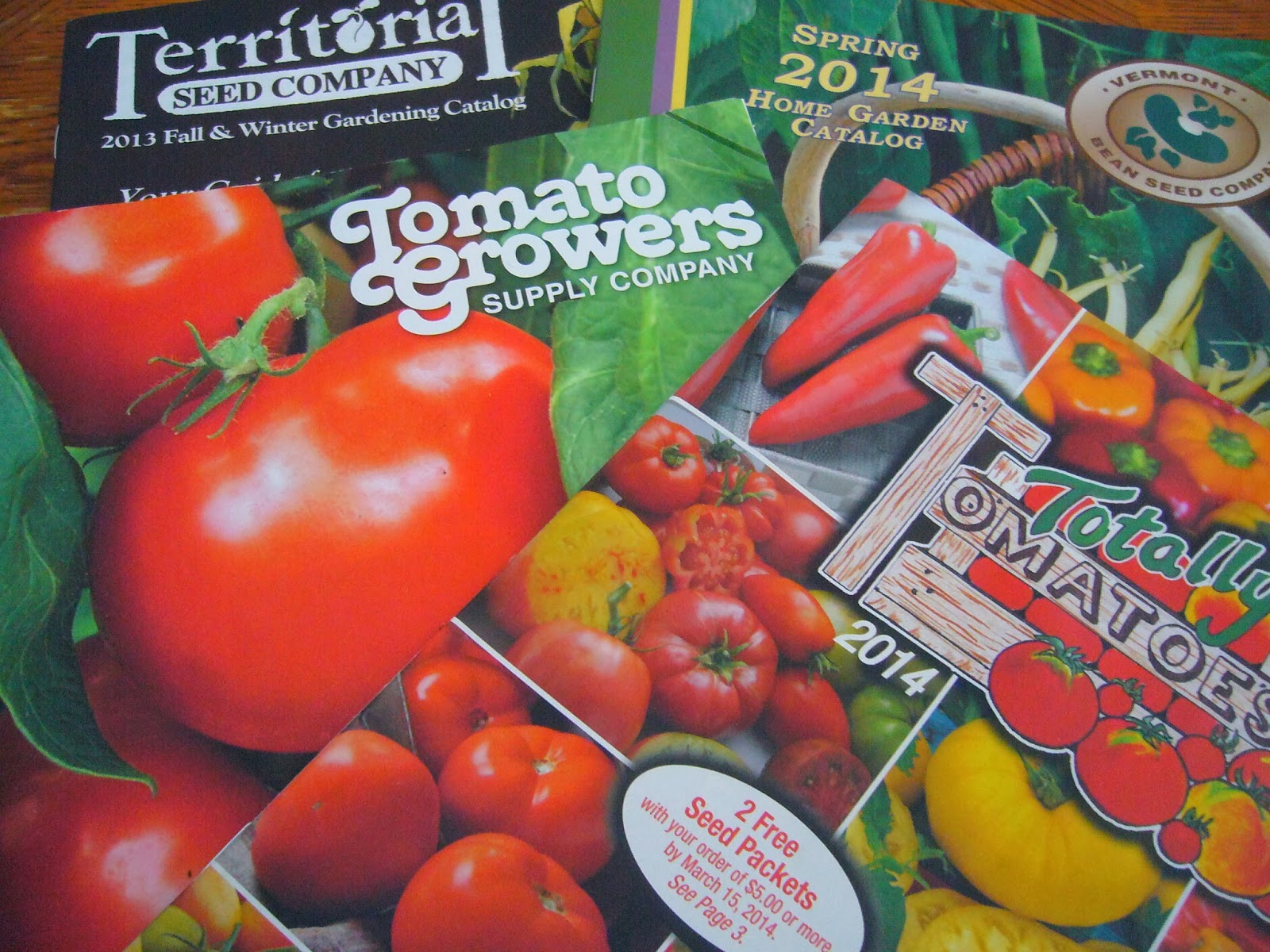
Uh oh. There's no hiding it now. As soon as I saw the back page of this year's Totally Tomatoes catalog, I got that sinking feeling in my gut. Tomato nerds like me know all too well what's on the back page of that catalog. Uh huh. That's right. Our little tomato secret is close to no longer being a secret. The Wild Boar series of striped tomatoes from Wild Boar Farms in Napa Valley just hit the mainstream big-time.

That's why I secretly placed my order this morning. Heh! Better get while the getting is good! There's no telling when they might run out of tomato seed for the lip-smacking Berkeley Pink Tie-Dye, or the absolutely LUSCIOUS Pork Chop. And yes, they do run out. The man behind the Wild Boar collection of fantastic tomatoes, Bradley Gates, is no longer a tomato grower's best kept secret.

Wild Boar Collection: Totally Tomatoes
Bradley doesn't just grow our favorite types of heirloom tomatoes, although he does offer a few. What he does offer, however, is somewhat better. These are his own creations: Solar Flare, Cascade Lava, Red Furry Boar, Lush Queen are all hand-crafted creations out of the Gates garden. What makes them so special is they are absolutely the best tasting tomatoes I've ever had the pleasure of tasting. And I've tasted my share, people. Trust me on this. Gates has hit on something big -- and the sky's the limit for his ever-expanding operation.

It's not just the taste of these tomatoes. Production figures into the equation just as well -- as does disease resistance. I took a chance last year and ordered four different varieties from Wild Boar Farms. Three of those selections: Lush Queen, Solar Flare and Pork Chop were among the biggest producers in last year's Bird Back 40 tomato garden. The wife that is Venus knows this all too well. Based upon last year's results? I'm doubling my order for 2014.

2013 Whole Tomato Canning Efforts (Partial)
It got to the point during last year's harvest season, where Venus could actually choose the kinds of colors she wanted in each one-quart jar of whole, canned tomatoes. Some jars were all red. Still others were all yellow. And yes, one or two or even three more went straight pink. That's because we literally had so much to choose from that we could "pick and choose" to our heart's delight.

This, by the way, has never happened during previous gardening years. In previous gardening years? Everything we harvested, no matter what the color, got added to those one-quart jars. But last year's gardening efforts produced such a payoff, that just one days worth of canning whole tomatoes provided enough jars to last us and one or two other families with enough tomatoes to last through the entire winter.

Call me: PRODUCTION
Know what that's called? That's called production, my friends. And it's why the Birds are handing out jars of salsa and special tomato sauce blends for Christmas this year. Because you haven't truly savored the flavor of tomato sauce, until you've prepared a meal with herbed sauce or a distinct Italian blend. In other words, why have a bland sauce with one type of basil, when you can spice it up with six blends of basil?

The tomato nerds over at all things tomatoes, a gathering spot called TomatoMania, have been whispering about Bradley's exploits and offerings for more than a few years. But I didn't get around to actually ordering anything from Wild Boar Farms until last winter. And it wouldn't be until late June or mid-July did I finally get to harvest some of these special offerings.

Solar Flare Tomato
I'll never forget that first taste of the very first, vine-ripened, Solar Flare. In a word? Scrumptious.

If you take the time to visit the Wild Boar Farms website, you'll find yourself in a world of striped tomatoes. There is no one, dominant color here. There's yellow streaked with white, red streaked with green and orange, orange streaked with yellow and just about every color found in a rainbow. The descriptions for each tomato are almost as entertaining as the colors. For instance? The Berkeley Tie-Dye carries the following warning: "High Acid Content May Cause Flashbacks."

It appears they have a sense of humor to go along with the ability to grow those great tasting tomatoes.

Garden Pornography
So, tomato lovers, as you gather your gardening porn together that recently arrived in the mail, and start to make those vegetable growing decisions for the 2014 garden, don't forget to pay Wild Boar Farms a visit. Because if there's room for a Brandywine or a Martha Washington in next year's tomato garden, you might also find a spot for the Pineapple Pig or the Golden Gates.

You have been warned.

Have Another Cold One!

Tuesday, December 10, 2013

Grapevines in Winter
It's about this time of year when Mother Nature begins to act like our favorite bartender. "Have Another Cold One," she screams as she delivers one whopper cold morning after another. It doesn't matter if you've already had enough of the frosty conditions that have blanketed the Sacramento area during the past weeks. Because Mother Nature is still in that giving mood: "Have Another Cold One!"

Notice -- I said Mother Nature begins to act like our FAVORITE bartender. This doesn't necessarily mean mean she's the MOST RESPONSIBLE barkeep. Them are two entirely different things.

Frosty Bird Back 40
As an amateur citrus grower, I've kind of come to regret the month of December in the Sacramento area. Oh sure -- the cold weather means great news for stone fruit crops like peaches, pluots and cherries because they get a nice, long winter slumber. And the longer they sleep? The happier they'll be in the morning come spring-time. But if you grow stone fruit AND citrus, this can get a little tricky.

You see -- citrus likes cold weather -- to a point. But that daily dose of "have another cold one" can get a little old. This is when cracks start to appear in the machine. All that newly emerged fall growth turns a none-too-pleasant shade of brown, which can only mean one thing. And it's not too much Brown Ale, either. It means it's time to hold a funeral for that promising growth that took place in October and November.

C-9 Christmas Lights Around Duke Avocado Tree
Responsible citrus growers, like Farmer Fred Hoffman for example, will take special precautions to protect those tender citrus babies. These responsible steps include heat-producing C-9 Christmas tree lights around the tree, an even bigger, warmer and brighter light, topped off with a special cloth covering. Isn't that nice?

By the way, this is nothing compared to the steps that the large scale citrus producers are taking. They battle the fierce cold weather with giant wind turbines, water and other measures to keep the freezing temps at bay. When a single, solitary acre of citrus plantings can produce a profit of $25K? This is nothing to laugh at, especially if you have 100-200 acres of citrus to protect. In other words, that's a lot of peel, if you get my snowdrift.

Cold Dancy Mandarin Tree
Other growers, like say yours truly, practice the hope and prayer method. This does involve stringing those warm C-9 Christmas bulbs around some citrus trees. But come on people! Covering one or two trees is one thing. When some fool decides to plant eight or nine citrus trees (me), there's just not enough C-9 lights or cloth covers to go around. Know what I'm saying?

That said, I must inform you that the time honored Bird ritual of the "hope and prayer" method isn't always 100 percent successful. And I have the blackened remains of old avocado trees and various mandarin branches to prove it. All because Mother Nature decided to announce: "Have Another Cold One!"

It gets colder than cold in the Bird Back 40. I know this to be a fact. The proof I have, as I mentioned before, are the blackened remains of four or five avocado trees that were once scattered about the yard. I also have highly sensitive thermometer equipment purchased some years back in a box of Cracker Jacks that confirms my micro-climate cold settings.

Loaded Meyer Lemon Bush
I thought it odd, however, that the equipment would yield a low of six degrees in the month of June. But if you can't trust the high quality temperature equipment yielded from a box of Cracker Jacks, what can you trust?

That said -- I must report these conditions from the Bird Back 40: So far, so good. Yes -- there's been some damage to some of the smaller mandarin trees that aren't producing citrus just yet. This includes the Clementine Mandarin and the Cara Cara orange tree. But I can also report that the Hangover citrus tree and the nearby Dancy Mandarin tree are doing just fine in this frigid "Have Another Cold One" snap.

Hangover Bearss Lime Tree
What's that you say? The Hangover Citrus Tree? Oh -- that would be the Bearss Lime tree. Which, by the way, produced a FINE crop of large and juicy limes this year. I call it the Hangover Citrus Tree for a very special reason. It's responsible for a number of weekend hangovers.

What's what you say? If I didn't mix so much tequila in that freshly squeezed lime juice, I wouldn't be suffering from hangovers? What are you? A communist? Or just my voice of reason, that I try to drown out with freshly squeezed Bearss Lime juice at every occasion possible?

There's nothing quite like freshly squeezed Bearss Lime juice. Trust me on this. I've had my share.

Murcott Mandarin
And so this holiday season, remember to follow the advice offered by Farmer Fred Hoffman. Don't follow the Bird "hope and prayer" method. For I fear that my favorite bartender is about to utter her time honored phrase: "HAVE ANOTHER COLD ONE!" And we'll get it, whether we like it or not.

Hot Fun in the Summertime

Monday, November 18, 2013

Melon Fruit Salad? Yes Please!
Yes -- I do understand. I get it. Our summer is as distant a memory as Sly and the Family Stone. Yet I am reminded of those "Summer Days" when I begin to clean up and clean out of the last of the summer garden. The last to go was the melon patch. It's so very hard to let go of something that was so good to us during those days in the country sun.

Actually, I'd be telling a bit of a fib to you if I proclaimed 2013 as the "perfect" melon year. It wasn't. In fact, for the second straight year, I'm sad to proclaim that my attempt to grow the Georgia Rattlesnake watermelon to be a big, fat failure. Instead of "fat melons" I got lots of melons that grew to a size of two to three inches, and then developed a dead blotch of skin at the end.

Georgia Rattlesnake Melon
It didn't take long for that dead spot at the end to cover the entire melon either. I can't tell you how many times I watched so many promising starts on the vine go haywire on us. Like avocado trees, I've got some sort of "complex" when it comes to the Georgia Rattlesnake. No matter how many times I've tried to grow this variety -- no matter how many different things I've tried -- each attempt has come up a big, fat zero.

Fortunately? Not all melons act in this matter.

The Sangria variety -- for example -- did quite well for me this year. Do you know what the really funny part of this equation is? I didn't plant any Sangria watermelon seeds. Nope -- the seeds that germinated in one corner of a raised gardening bed this year were left over from last year. It didn't matter much that I ran them over once or twice with the injustice of a Mantis Rototiller. They seemed to like it just fine. So -- while my watermelon desires may not have been satisfied with a Georgia Rattlesnake -- the Sangria made for an acceptable substitute.

Cantaloupe and Crenshaw Melon Combo
I find myself thinking about melons now because -- well -- because melon season is long gone. Like many fruit varieties to come out of the garden this year -- they all managed to ripen up for a two-week to 10-day period in late August. During this golden, luscious period in time, it was melons for breakfast, melons for lunch and melons for dinner.

As the picture top right shows -- it was a fruit salad bonanza. Grapes, melons, peaches, you name it. Everything gave a little or a lot. And guess what? Even after all that -- it still wasn't enough. Because Bill Bird finds himself craving a home-grown, vine-ripened melon here in the month of November.

Sangria Melon Right, Crenshaw Melon Left
Except -- you can't get vine-ripened melons in November. Not in this part of the country anyway. Therefore, I do the next best thing: Post pictures and dream till next year.

Once again -- the clear winner in this year's melon patch -- just as it was last year -- is the Crenshaw Melon. I'm beginning to believe that the Crenshaw is just so darn easy to grow that one would have to be named Bill Bird to possibly screw up something this simple. So far? I haven't managed to screw it up. Therefore, I must be doing something right.

What the bugs didn't get -- the wife that is Venus would squeeze into fresh Crenshaw melon juice. Unlike past years, we didn't allow one melon to go to waste this year. What we didn't consume fresh -- the wife cut into pieces and ran it through the juicer.

Sliced Crenshaw Melon
It's during melon season where I am reminded of the Kingsburg Watermelon Festival. Sponsored by the Kingsburg Lions Club chapter, the watermelon festival was a place where you could get your fill of vine-ripened watermelon. If one quarter-slice wasn't enough, here, have two! And while you're at it? Enjoy a third! Heck, there was enough there to bathe in.

Sadly, the Kingsburg Watermelon Festival is an event that can now only be found in local memories. I'm not sure why it went away, but like most good things it did. The radio station I worked for at the time in Fresno sent me south to cover the Kingsburg event every year it seemed. Why I kept on drawing repeat coverage duty, I'll never know. It wasn't one of those events that was very hard to report on. I suppose my report went a little like this:

"There are people here... They are consuming watermelon and lots of it... Reporting live from Kingsburg...."

My love for watermelon wasn't born there -- but it's one of those little events that will always stay with me. And it's one reason why the mighty melon will always have room in the Backyard of Bird...

Don't Say it's Over!

Friday, November 15, 2013

Pumpkin Harvest: Bird Back 40
But I'm not ready for it yet! Don't go there! Are you serious? My favorite time of the year known as summer gardening season is over? But it can't be! Seems like just yesterday that I planted those tomato bushes. It can't be gone this quickly, can it?

Welcome to my annual ritual: DENIAL. As you've heard it said before, probably on more than one occasion, it ain't just a river in Egypt.

Actually, if you checked ye olde calendar, which I'm loathe to do this time of year, one comes to find that summer gardening season ended more than a few weeks ago. It really ended with the onset of cool temperatures in the morning. That tends to play havoc with the sugar content in vine-ripened heirloom tomatoes. One can literally "taste" the end of summer.

Whoa! Time for a Haircut!
But when the brown, featherly leaves of downtown Sacramento begin to rain down and rest during my annual pilgramages to downtown Sacramento, I know the time has come. I'm just not ready to say goodbye just yet.

The end of summer gardening season also brings on a massive cleanup job in the Backyard of Bird. Every bush and every tree produces a little something during summer gardening and fresh fruit season. And, when the summer ends, it's time to clean up.

Unfortunately -- those tiny green waste cans do not do us much justice out here in the northern burbs. While I could really use a service like "The Claw" around my house during this time of the year -- the monster doesn't travel this far out in my direction. So -- the job of "disposing" of the summer garden usually results in stacked piles of garden rubbish around the backyard.

Common End of Summer Sight
Those piles will sit and wait for space to open up in the green waste can. Or, if I'm lucky, one of the neighbors will lend a hand with a half empty can. I've already learned one valuable lesson with my last green waste can, which busted into an unholy and warped cauldron that scared neighborhood children half to death.

We're not doing that again.

So -- piles here and there it is. I've also learned a bit of "patience" (aka "laziness") on the job. Rome wasn't built in a day. It wasn't also taken apart in a fortnight. Some projects can sit and wait until space opens up at the olde inn. Then and only then does it get scheduled for the "fall haircut."

The end of the summer gardening season also brings sadness. There are no more nightly visits to the Farmer's Market that we call our backyard. While some summer crops are still producing -- most are curled up and long gone. It's both sad and tough to reach for a jar of canned tomatoes that we prepped earlier in the year, rather than picking them fresh off the vine.

Test Bed: All Played Out
I'm just not ready to say goodbye!

Still -- the onset of Fall brings new challenges. What, for example, are we going to do with that line of pumpkins from this year's extraordinarily successful pumpkin patch pictured above? Share them with friends? Yes -- there's some of that. Carve pumpkins for Halloween? Absolutely!

But I also wouldn't be completely forthcoming if I didn't say that there's a little bit of a pumpkin pie in those pumpkins. We just might have plans for pumpkin bread. And then there's that recipe for pumpkin soup with barley that looked pretty darn good.

Short and sweet? You can lot more with pumpkins other than carve a scary face and roast some pumpkin seeds.

Summer Garden Pile: Scheduled for Removal
Fall is also a time to start thinking about other crops. There's garlic seed to stick in the ground for next year's garlic crop. And -- one just can't do without Tall Telephone Garden Peas, which are also planted now in anticipation of a fat spring harvest. Since you failed to remove every last potato from the ground last summer, the spuds you left behind have rewarded you with a nice fall crop.

So, no, the onset of Fall isn't a complete and total bummer. There's also time for a weekend nap in the schedule, where one can dream about next summer's heirloom tomato crop.

A Witch's Brew

Saturday, November 2, 2013

Tasty Home Brew
And now -- just in time for Halloween! Wait! Check that! And now -- just in time for Halloween 2014...

Hey, there's nothing wrong with being early, is there?

To your right is the latest project in the House of Bird. For the first time since I was 18 years old (long time ago kids), I'm "brewing" up something special. If you look below the rosemary and jalapeno peppers, you'll see something mighty tasty down in that brine.

That's right, kids. It's home brined, or home brewed, olives. And not just any olive, mind you. Nope, those are the large, queen sized, green olives -- also known as the Sevillano Olive. While I am also have some Mission olives undergoing a nice salt-water soak -- nothing beats the Sevillano Olive. These are the best of the best.

Henry Madden Library at CSUF
A lot of has changed since I was 18 and brewing my first batch of olives. First -- there was no such thing called "the internets." As for the personal computer, hell, only rich people had those. I was lucky enough to have an electric typewriter. Recipes for home-canned olives were not at your fingertips. They were in the local library. You paid a quarter to photocopy a page out of a book. This is after you'd spent the better part of two hours looking for the correct book at the Fresno State University Madden Library.

This was pure old school.

But, I'll tell you this much: A number of years have passed since I first brewed my own batch of olives. My life has taken many twists and turns that I was not expecting it to take. But I never forgot the incredible taste of home-brewed olives. They made for a tasty snack that a starving college student literally survived on. I stored my brew creation in old one-gallon, plastic milk bottles that I dug out of a dumpster. They sat for months in a dusty apartment kitchen pantry, waiting to be consumed.

Sevillano Olive Soak
Know what? They never went bad! When money was tight (money is always tight when you're a starving college student in Fresno), a bowl of olives made for a nice lunch or dinner.

Fast forward some thirty-plus years and you'll find that a lot has changed. Today, recipes for home-brew olives are literally at your fingertips. Not just one recipe for one type of olive -- but multiple recipes for multiple olives. I must also thank Honest Food blogger Hank Shaw for re-sparking my interest in home-brewed olives, as he wrote about his experiences last year.

A lot of time may have passed between this year's experiment and my brewing experience long ago, but the recipe remains largely the same. Although there are many ways to brine olives -- the standard involves something found in Drano. Yes kids -- as in something you would pour into a clogged kitchen sink. Lye is an essential ingredient for brewing only the best olives and it's still used today.

Good for Opening Drains and Making Olives
A side benefit of this exercise is the grimy sink in the garage used for dirty garden purposes gets mighty clean and mighty fast with one lye soak after another. The garage sink hasn't looked this good since the wife that is Venus and I moved into this North Natomas pad. It also drains like a champ now.

But, I digress. This isn't about sinks. It's about olives.

Although olive trees dot the landscape around many Sacramento and Placer County parks, I found these to be a major disappointment. Many of these trees just don't receive the irrigation they need to produce a good crop of olives. And if these trees are fortunate enough to receive an adequate supply of water, they have no protection from the bugs that drill into immature fruit and lay eggs that eventually become larvae.

Sevillano Olives After Lye Soak
Eating an olive infested with larvae (worms) doesn't sound too good, now does it? Blech!

I would also come to discover that home-brew olive addicts like myself head out to olive orchards in September and October and "steal" from the grower -- the rightful owner. Sorry kids -- but that's just not my style. I don't believe in helping myself to a crop grown by someone else and for a different purpose. Again, "the internets" would come to my rescue.

A grower of Sevillano Olives northwest of Sacramento in a ranch just outside the Woodland city limits had exactly what I was looking for. I could pick ripened olives to my heart's content -- five bucks for a five gallon bucket. Not only that, this was a grower who had properly irrigated and properly cared for his two acre spread of Sevillano trees. "SOLD," I thought at the time. This was the man I was looking for.

Sevillano Olive Harvest
I would spend the better part of a Saturday afternoon at this man's ranch, picking just enough to fill a five-gallon bucket and hauling my prized harvest back home. The lye soak started 30 minutes later. The lye solution accomplishes two major tasks. First, it softens a hard olive. Secondly, it removes the oleuropein compound that makes olives taste bitter. After a 12-24 hour soak, you've got a batch of soft olives that taste like soap.

Probably not a good idea to eat these olives. In fact, don't do it kids. It just results in a really bad tummy ache and perhaps a trip to the hospital to have your stomach pumped.

Time to Start the Brine Process
Once the lye soak has done its job, it's time to get the lye out of the olive. This is done through a series of fresh water rinses and soaks that can take anywhere from a week or two. I changed the water in this five gallon of bucket of olives -- religiously mind you -- every 12 hours. When the color of the water no longer turns brown, but a light shade of green, the lye has been removed.

Congratulations! You have a softened olive that tastes like, well, nothing. It doesn't taste bad. It doesn't taste good either. This is where the fun begins. It's time to put the taste into your softened olive collection. Although salt is a major ingredient of olive brine, don't stop there. Use your imagination!

Peppers and Lime Juice in Olives? Why Not!
In my particular case? My olives are soaking in a solution of sea salt and red wine vinegar. After the first week of this soak -- these olives tasted pretty darn good. But why stop at darn good when you can have jaw-dropping excellence? The second soak, which also included sea salt and vinegar, also contained fresh rosemary, basil and other herbs from the garden. Why not put those late season jalapeno peppers to work? Bay leaves? Sure!

Let your imagination run wild. The only problem you'll face is family members you've allowed in on your little home-brew "secret." They're already staking their claim...