Showing posts with label farmer fred hoffman. Show all posts

Super Bore Or Super Bell?

Sunday, February 10, 2019

Best Super Bowl Ad EVER!
With all due apologies to the fresh corn industry, I must admit, I thought the Bud Lite Corn Syrup commercial was the funniest thing I've seen on TV in quite some time. Don't get me wrong! I love me some corn. I personally believe corn grown in the Sloughhouse area of Sacramento County is, in fact, the best corn in the world. I wish no harm upon our fine corn farmers!

But that Bud Lite Corn Syrup ad that ran during last Sunday's Super Bore was absolutely hilarious. I am still busting up over the line of: "would you please smoke outside?" However, Bud Lite's pun and knock against all thing corn syrup will not stop me from purchasing Sloughhouse corn. Additionally, you will not find any Bud Lite in the Bird refrigerator. However, if you look hard enough, you just might find a bottle of the High Life. But, enough of that already. I've strayed much too far.

Cat Bowling Pins?
My friends, rather than watch the NFL bestow yet another title on Tom Brady last Sunday (BORING), my mind was positively fixated on the image that appears to your very left. Can you guess what those cups might represent? Bowling pins for the naughty Cat that is Lenny? That is a good guess, but NO. And although Lenny has already cast a rather envious glance at the cups placed on that bedroom window, I hope that cat knows better.

I hope.

Those cups placed against yonder windowsill represent the start of my summer 2019 vegetable garden. Would they represent the 13 varieties of heirloom tomatoes I will be growing this summer? Good guess, but also wrong. It's still a bit too early for that activity, though some have already started. No, the seeds placed in those cups all contain the same variety: The California Wonder Bell Pepper.

Peppers!
First introduced in 1928, the California Wonder is now a sweet staple in nearly every backyard garden. These are these big and blocky peppers that can be found in nearly every dish, ranging from salads, stir fry meals, fajitas or just brushed with olive oil and placed on a grill. You can also find them in home-canned items such as tomato sauces and SALSA. Roasted or fresh, the California Wonder represents one word: SUMMER.

Garden grown Bell Peppers are nearly as popular as home-grown tomatoes. According to the Masters of Horticulture Blog, "Bell peppers are the most commonly grown pepper in the United States.  According to the National Nursery survey, 46-percent of gardeners grow them every year.  Second, according to the same survey, bell peppers are the third most popular vegetable grown in American gardens.  Third, the bell pepper is the most consumed pepper in America.  According to the Agricultural Marketing Resource Center, Americans eat 9.8 pounds of them per year.  And finally, bell peppers are the only peppers in the genus that do not produce capsaicin.  Capsaicin is the compound that makes most members of the genus Capsicum hot."

Perfect for Seed Starting Efforts
The reaction from most of my pepper growing friends is going to be pretty typical, I think. People like Jake Seed and Dave Jesse are thinking along the lines of: "PFFFT! ROOKIE!" And you know what? They're right. To them? My pepper planting efforts are rather late.

You see, while the vast majority of us are thinking about  the Peppermint Wishes and Candy Cane Dreams of the Christmas Season, the pepper guys are thinking about peppers so hot they would melt Santa's tongue. There's a reason why Rudolph the Red Nosed Reindeer gives these homes a wide berth. These guys are serious. January 1st doesn't just signal the start of the new year. It means it's time to plant pepper seeds of all shapes and sizes for the upcoming summer gardening season.

Planting Seeds
Why start pepper seeds so early and why am I late? There's a good answer for that. Pepper seeds tend to grow much slowly than tomato seeds, which essentially sprout and grow like weeds until they are transplanted. As KFBK NewsTalk 1530 Gardening Show Host Farmer Fred Hoffman put it so eloquently to me once: "PEPPERS NEED HEAT!" Unfortunately, there's little heat to be found during the Northern California months of December, January and February. So, pepper growers get very inventive to creating the kind of heat they need to give seedlings the boost that they need.

I recall that one of these growers, and I won't mention names (Dave Jesse), placed his seeds in sealed starter cups and placed them under a woodstove. Where his cat promptly found them. Great fun ensued.

What's the payoff for my seed starting efforts? 13 large and healthy California Wonder Bell Pepper starter plants. Do I intend to plant all 13 in my summer garden? Are you nuts? Gardeners do not live on bell peppers alone. This means I will have plenty to share, or trade, once the transplant season begins (provided it stops raining at some point).

Danger Will Robinson! Danger!
Hopefully, the seedlings I have planted against my bedroom windowsill will sprout and start to grow (albeit slowly) in another day or two. Also, hopefully, the giant shade trees that dot this Citrus Heights neighborhood don't blot out the needed sunshine.

Finally, hopefully, here's hoping a certain Maine Coon cat can ignore the urge to start swatting what's been carefully placed on a windowsill that he can easily reach.

Hope springs eternal.

Take the Pain

Friday, August 1, 2014

Lemon Boy Tomatoes-Bird Back 40
The calendar says it's only been two weeks since I last put pen to paper. But to be honest -- it seems like eons ago. Three weeks ago life was grand. That pesky Achilles tendon that kept me out of the garden had finally healed up. The boot was off. Bill Bird was back in his element -- in the garden where he belongs -- blowing through one delayed project after another.

And then -- wouldn't you know it? I pushed that envelope yet a wee bit too much. Even though I promised myself that I would take it easy -- I knew those heirloom tomato plants that I'd just staked up three weekends ago would enjoy a nice long drink of liquid fertilizers.

I use a combination of liquid organic fertilizers in the garden. I've been hooked on a product called Maxicrop, for example, ever since Farmer Fred Hoffman was kind enough to share some with me many, many moons ago when the wife that is Venus and I first started this North Natomas garden assault. Combined with another organic fish fertilizer that I'd obtained from Peaceful Valley Farm Supply in Nevada City, the fertilizer solution has always resulted in out-of-this-world tomato production.

Miracle Tomato Producer
Sure it takes time to fertilize 28 tomato plants with this liquid fertilizer solution, but the eye-popping production was worth it.

It didn't really dawn on me that hauling five gallon buckets filled with water and fertilizer solution from the garage to the backyard would put much stress on the back. I was more concerned about the foot that had just come out of a walking boot to be brutally honest. I wasn't thinking about the back.

And what a terribly bad thing to not think about.

As a veteran of many back problems, plus at least one back surgery, I can tell you that once you hurt the sciatic nerve in the spine, you're done for. The pain, however, is not immediate. It starts as an annoyance a day or two after the injury. And, depending upon the severity of the injury, that tickling annoyance of pain slowly increases to a level of gut wrenching, soul-killing, pain that is hard to describe.

There is no relief from this pain. Lying down doesn't help. It only makes it worse. Sitting only serves to increase the jolts of pain that the injured sciatic nerve is sending into your legs, and yes, even testicles. It is a pain like no other. And it was all mine, mine, mine. I owned it. All of it. I did it to myself. Three or four days after pinching the sciatic nerve, I couldn't move from the only contorted spot I'd found that temporarily relieved the shockwaves of pain.

It was, at this point, where I allowed waves of negative thinking to take control of my mind. What had I done to myself? How could I possibly screw up this back again after going through $15K of highly successful back surgery nearly ten years ago? How can I live with this pain? What about my job? My career? I couldn't move from the spot I was anchored too, let alone throw on a suit and tie.

Narcotics offered some relief. Prescription pain killers like Percocet, Morphine, Flexeril and many others offered the only road to relief that I could find. And while this road is nice for awhile, it's also a trap. Narcotics don't solve the problem. They merely mask the pain. Narcotics also leave you unable to function, especially in a work setting. And forget about setting foot in a car!

I spent a solid week -- my vacation week for the year oddly enough -- in this narcotics fog. The recipe called for pills in the morning, pills in the afternoon and pills before heading off to bed. With each passing day, the fog grew deeper. What was today? Wednesday? Was tomorrow Friday? Where did I leave the Percocet?

I was in no shape to return to work when I finally did just that. The pain levels were still very high, but the narcotics continued to mask it. On that first day back, a co-worker remarked, "your face is as red as a stoplight!" Simple tasks, like answering a phone call, suddenly weren't so simple anymore. And why was my voice so high?

It was at this point where I realized that allowing myself to sink into a pit of pain-killing narcotics for a week really wasn't the best of ideas. Instead? I should have just taken the pain. And that's when I decided to dump the pills. And when I say dump? I mean, DUMP. There is really only one way to confront the abuse of narcotic pain-killers. It's called "Cold Turkey."

It was also about this time where I ran across one of my favorite epics dealing with the Vietnam War. Platoon not only related a fantastic story of what our fighting soldiers faced in Vietnam, the Academy Award Winner for Best Picture in 1986 also gave rise to a number of great young actors like Willem Dafoe, Tom Berenger, Charlie Sheen and many others.

But it's one line from that movie that stuck with me one night while I slowly dried out from the narcotics I'd used to mask my back pain. It's a battle scene where several soldiers are wounded and one even loses his life. It's a line where Berenger tells a screaming soldier to "take the pain." And suddenly, I knew what I had to do: Take the pain.

It's been five or six days since I made that decision. My back aches as I sit at this desk and type this prose. But I'm smiling because I know it's a pain that isn't half as bad as it was two weeks ago. It means surgery may not be needed. The falling levels of pain might indicate some future time in a garden setting. But -- don't worry kids -- I won't overdo it this time. That's a promise.

Fish + HH = AMF X Kitchen Sink = FAIL!

Sunday, May 25, 2014

And they're Off!
Follow closely now children -- because the title of this article is the mathematical equation we followed earlier this spring when planting the heirloom tomato crop now growing, and growing quickly I might add, in the Bird Back 40. Fresh off last year's season where each tomato plant got a fish head, two aspirins plus bone meal in each planting hole, we redoubled our efforts in 2014.

My friends, I'm here today to tell you this. Despite those lovely looking plants pictured above right, you can "love" your tomato starter plants just a little bit too much. You can go overboard on even the most organic of treatment -- and I know this from experience. Because it's taken time, patience and a bit of replanting to get our starter plants to look THIS good at this point in May.

Adding Fish Parts to Holes for Tomato Plants
Plus -- several people who ignored frost concerns and warnings and planted in March are WAY ahead of us. In the words of the immortal Tom Petty, "you got lucky, babe." Because planting in March can sometimes result in misery in April, especially if the weather turns cold again. This year, it didn't. Oh sure, it cooled down a bit here and there and actually rained a bit. But it wasn't enough to knock off March planting efforts. And for those people who rolled the dice and planted in March, they'll be harvesting a bundle of fresh tomatoes in June and laughing at the rest of us who waited until the first weekend of May.

Edit: We normally plant on or around the birthday of Farmer Fred Hoffman of "Get Growing with Farmer Fred" fame. That's usually the last weekend of April. But it was raining that weekend so we pulled a bundle of weeds instead. Anyone who gardens will tell you there's always a weed or one thousand to pull. It just comes with the territory.

But -- I digress.

Let the Planting Commence!
Fresh off a fantastically productive and surprising tomato year in 2013, we once again called on the Goddess of Love Apple Farms fame to help us with our tomato planting efforts in 2014. This time Sara and the wife that is Venus armed themselves with two buckets of smelly fish parts instead of just one, aspirin for the planting holes, organic bone meal and a few other "additives."

Here is what this year's brew contained:

1 can of water soluble Mycorrhizae and Bacteria
1 bottle (300 count) aspirin
Two boxes of Granulated Humic Acids
Two 5-gallon buckets of fish heads, tails, guts, and various parts
4 bags of Bone Meal

A Garden Party?
Holes for 24 heirloom tomato plants were dug to a depth of two feet each. Into the hole went a big helping of "fish stuff," one-half cup of Humic Acids, one-half cup of bone meal and two aspirin. Tomato plants were removed from starter cups and soaked in a Mycorrhizae bath before planting. We then proceeded to fill the holes with composted soil. The official count that first weekend in May looked like this:


24 heirloom tomato plants
16 Pepper plants
4 eggplants
2 Blueberry plants LOADED with blueberries (Sharp Blue and Misty)

Notice the Dog...
Can you guess the first thing that happened after we went through all that work to plant everything into the raised beds? If you guess that the garden dog named "DIGGER" immediately tried to dig up 24 tomato plants in a quest to munch on some smelly fish parts, you wouldn't be half wrong. If you also guessed that many of the tomato plants suddenly seized up and died, you'd also be right on the money.

Both actually happened. What the dog didn't dig up and kill in the process, died on its own. Why? Because we gave our starter plants a bit too much love. There is such a thing such as too much love. And if you follow the witch's brew I've outlined above, you too can KILL your share of tomato plants.

Janet's Jacinthe Jewel
Thank goodness the wife that is Venus and I decided to plant two cups of each tomato variety. Those replacement plants came in handy. Instead of giving them away to family and friends as we've done in the past, we were doing quite a bit of "replacement planting," while muttering the words: "NEVER AGAIN!"

However, we seem to be past the worst of it. And, I'll be honest, not every plant seized up and died on us, nor did DIGGER dig it up. For those that survived the harrowing plant-out process, I'll be honest, they look GOOD. Not just good, good, mind you. But, REAL GOOD! This includes a number of varieties from Wild Boar Farms, including a new offering this year called Janet's Jacinthe Jewel.

Pepper and Basil Starter Plants
Described as a large bright orange (jacinthe) striped beefsteak, this is a potato-leafed variety that is off to an eye-popping start and seems destined to deliver a boatload of tomatoes, many in the one pound range. And this is a bad thing? I think not!

The onset of hot weather in May has also given our tomato plantings a boost. Our once "leggy" starters now feature thick stems and are flowering heavy. We also decided to devote more room to our tomato plantings, because there can never be a thing such as "too many tomatoes." If you've read this blog for any amount of time, you know this to be true.

Baby, I've Got a Headache...
Although I was not able to take part in the final plant out due to this bum wheel that keeps me confined to a walking boot (complete with a developing, continent-sized, blister), Venus sprinkled liberal amounts of leftover tomato plants to the in-ground test bed and other spots here and there in the Bird Back 40 that offered a bit of planting space. The final count is 39 plants -- about ten to 12 more than we normally plant during the summer season.

I'm pleased to report that everything the green-thumbed wife planted is now popping out of the ground at an accelerated rate -- this includes various garden seeds that she planted here and there. That list includes five varieties of carrots, six varieties of basil, four varieties of slicing cucumbers, three varieties of pickling cucumbers green onions, bush beans, squash, pumpkins and probably five to ten other things that I've forgotten.

There comes a point in the season that when it's time to pay a trip to the Farmer's Market? We head straight for the Bird Back 40...

Have Another Cold One!

Tuesday, December 10, 2013

Grapevines in Winter
It's about this time of year when Mother Nature begins to act like our favorite bartender. "Have Another Cold One," she screams as she delivers one whopper cold morning after another. It doesn't matter if you've already had enough of the frosty conditions that have blanketed the Sacramento area during the past weeks. Because Mother Nature is still in that giving mood: "Have Another Cold One!"

Notice -- I said Mother Nature begins to act like our FAVORITE bartender. This doesn't necessarily mean mean she's the MOST RESPONSIBLE barkeep. Them are two entirely different things.

Frosty Bird Back 40
As an amateur citrus grower, I've kind of come to regret the month of December in the Sacramento area. Oh sure -- the cold weather means great news for stone fruit crops like peaches, pluots and cherries because they get a nice, long winter slumber. And the longer they sleep? The happier they'll be in the morning come spring-time. But if you grow stone fruit AND citrus, this can get a little tricky.

You see -- citrus likes cold weather -- to a point. But that daily dose of "have another cold one" can get a little old. This is when cracks start to appear in the machine. All that newly emerged fall growth turns a none-too-pleasant shade of brown, which can only mean one thing. And it's not too much Brown Ale, either. It means it's time to hold a funeral for that promising growth that took place in October and November.

C-9 Christmas Lights Around Duke Avocado Tree
Responsible citrus growers, like Farmer Fred Hoffman for example, will take special precautions to protect those tender citrus babies. These responsible steps include heat-producing C-9 Christmas tree lights around the tree, an even bigger, warmer and brighter light, topped off with a special cloth covering. Isn't that nice?

By the way, this is nothing compared to the steps that the large scale citrus producers are taking. They battle the fierce cold weather with giant wind turbines, water and other measures to keep the freezing temps at bay. When a single, solitary acre of citrus plantings can produce a profit of $25K? This is nothing to laugh at, especially if you have 100-200 acres of citrus to protect. In other words, that's a lot of peel, if you get my snowdrift.

Cold Dancy Mandarin Tree
Other growers, like say yours truly, practice the hope and prayer method. This does involve stringing those warm C-9 Christmas bulbs around some citrus trees. But come on people! Covering one or two trees is one thing. When some fool decides to plant eight or nine citrus trees (me), there's just not enough C-9 lights or cloth covers to go around. Know what I'm saying?

That said, I must inform you that the time honored Bird ritual of the "hope and prayer" method isn't always 100 percent successful. And I have the blackened remains of old avocado trees and various mandarin branches to prove it. All because Mother Nature decided to announce: "Have Another Cold One!"

It gets colder than cold in the Bird Back 40. I know this to be a fact. The proof I have, as I mentioned before, are the blackened remains of four or five avocado trees that were once scattered about the yard. I also have highly sensitive thermometer equipment purchased some years back in a box of Cracker Jacks that confirms my micro-climate cold settings.

Loaded Meyer Lemon Bush
I thought it odd, however, that the equipment would yield a low of six degrees in the month of June. But if you can't trust the high quality temperature equipment yielded from a box of Cracker Jacks, what can you trust?

That said -- I must report these conditions from the Bird Back 40: So far, so good. Yes -- there's been some damage to some of the smaller mandarin trees that aren't producing citrus just yet. This includes the Clementine Mandarin and the Cara Cara orange tree. But I can also report that the Hangover citrus tree and the nearby Dancy Mandarin tree are doing just fine in this frigid "Have Another Cold One" snap.

Hangover Bearss Lime Tree
What's that you say? The Hangover Citrus Tree? Oh -- that would be the Bearss Lime tree. Which, by the way, produced a FINE crop of large and juicy limes this year. I call it the Hangover Citrus Tree for a very special reason. It's responsible for a number of weekend hangovers.

What's what you say? If I didn't mix so much tequila in that freshly squeezed lime juice, I wouldn't be suffering from hangovers? What are you? A communist? Or just my voice of reason, that I try to drown out with freshly squeezed Bearss Lime juice at every occasion possible?

There's nothing quite like freshly squeezed Bearss Lime juice. Trust me on this. I've had my share.

Murcott Mandarin
And so this holiday season, remember to follow the advice offered by Farmer Fred Hoffman. Don't follow the Bird "hope and prayer" method. For I fear that my favorite bartender is about to utter her time honored phrase: "HAVE ANOTHER COLD ONE!" And we'll get it, whether we like it or not.

Down the Stretch They Come...

Saturday, February 23, 2013

Momotaro Tomatoes
Momotaro. That's the answer to the annual Bird Heirloom Tomato Contest of: Guess which variety of tomato seed germinates first? NeCole Brownwell Scott of Antelope, CA was on top of her game with her guess of Momotaro, which isn't all that surprising since she's a Tomato Maniac herself. For her brilliant perception and forecasting skills, NeCole wins her choice of two tomato plant starters from the Bird 2013 starter crop.

Yes indeed! It might be a bit chilly outside, but this is prime seed-starting season for backyard enthusiasts like the wife that is Venus and myself. Once again employing the seed-starting rack setup that we employed last year for the first time, Venus and I are growing many treasured favorites from the past plus quite a few new varieties this season.

Seed Starting Rack
One of those new varieties? Momotaro. While the variety certainly isn't new, it will be a new addition to the Bird Back 40 tomato crop later this spring. Momotaro, as you might have deduced, is a Japanese variety. It's one of the most popular varieties in Japan thanks to its legendary productive status. The fact that it's named after a legendary Japanese folk hero (it loosely translates into "Peach Boy" in English) also might help.

The story and legend of Momotaro was heavily promoted by the Imperial Japanese government during World War II. It should come as no surprise then that the "demons" that Momotaro was sent out to fight lived at a well-known United States naval base called Pearl Harbor.

Bingo Tomato: Impulse Purchase: Lockhart Seeds
I suppose this is one of the many reasons as to why I like growing as many varieties of heirloom tomatoes that I can get my greedy little hands on. Each one represents a little slice of international history. The story of Momotaro, the folk tale, and Momotaro the tomato, represents one of those interesting little discoveries.

How does the old saying go? Learn something new every day?

Venus and I set out on our planting adventure last Sunday, February 17th, just a day after this seed starting article appeared in the garden section of the Sacramento Bee. Some people start a week or two earlier than this. Still others start out a week or two later? Point is? The goal is to have starter plants ready to set out in the garden by May 1st, or Farmer Fred Hoffman's birthday if you will.

Germination after five days: Momotaro Tomato
Once again, we have outdone ourselves. 120 starter plants now sit under a collection six shop lights in a spare Bird bedroom. Believe it or not -- we have room for even more. We're not even using the bottom rack (yet), which would provide room for 40 more plants. And we haven't even considered using the top rack yet... Though I suppose that will come with time.

Point is? With a cheap metal rack and a few shop lights? You can do some serious garden damage. And that's just what we intend upon doing this year.

Of course -- not all of these are tomato plants. I WISH I had room for 120 tomato plants. I'd be in tomato heaven, as would every neighbor on the block. But our collection also includes a number of sweet and hot pepper varieties. These will come into use when it's time to can the legendary Roasted Garlic, Pepper and Heirloom Tomato Salsa. Venus also has about six different varieties of basil that have already germinated and are growing quite well.

Siam Queen Basil Seeds
Why have just one variety of basil when you can have all of them? Genovese Basil is a "must have" in any garden and one of the most popular starter plants you'll find at any garden store. But why limit yourself to Genovese -- when the hot variety of Siam Queen Thai purple basil beckons? Like a hint of lemon in your basil? There's always the popular Lemon Basil. Point is -- there's a basil for every dish.

Venus didn't just limit herself to vegetable garden selections with her seed starting efforts this year. Nope! With an excellent and hard-to-find selection of flower seeds purchased from Lockhart Seeds in Stockton, this year's indoor starting effort includes multiple flower offerings that you probably will not find at you local gardening store.

Love Lies Bleeding Seeds
Sure -- you can find your ordinary, run-of-the-mill, marigolds and petunias at your local Big Box Store. But if you've got your heart set on something called "Love Lies Bleeding," or "Oxford Blue Scabiosa," I hope you got it started early at home. The point is? We want our front and back flower beds to contain items that you just don't see in those everyday, mass planted gardens.

Seed starting is one of our favorite rituals. It's one of those "together" things that we both enjoy. The payoff is a fun afternoon and a summer's bounty of delicious tomatoes and flowers that bring a riot of color to the Bird Back 40. It's also a chance to share and trade with others who have been bitten with this gardening bug. One afternoon of seed planting brings out a season of beauty. Try and find a downfall to this. I've tried. I can't.

Afternoon of Fun
There is nothing quite like the joy and satisfaction that comes when the first seedling pops to the surface, or that first starter plant produces its first tomato, first pepper or first bite of fiery basil. I keep thinking of what the backyard flower gardens will look like when our Desert Bluebells or Penstamon Blue fire up into a riot of flower beauty.

Yes, I suppose this is a bug. Call it a twitch if you want. Disease works just as well. Just count me glad that I have it.

Bird 2013 Heirloom Tomato Garden


Agro 410
Arkansas Traveler
Beefsteak
Believe It Or Not
Berkeley Tie Dye
Big Zac
Bingo
Black Cherry
Chadwick Cherry
Cherokee Chocolate
Cherokee Purple
Costaluto Fiorentino
Dixie Golden Giant
Eva Purple Ball
Grushkova
Lemon Boy
Lush Queen
Magnus
Martha Washington (last year’s top garden performer)
Momotaro
Mr. Underwood’s Pink
Polish Giant
Pruden’s Purple
San Marzano
Schilling Giant
Siletz
Solar Fire
Sungold Cherry
Tangerine
Valencia
X-Large Spanish

The Garlic That Almost Wasn't

Thursday, November 8, 2012

2013 Bird Garlic Crop
The picture to your immediate right will indeed confirm that the 2013 garlic crop is indeed planted in the Bird Back 40! Not just planted -- but literally jumping out of raised beds that dot our crazy little cul-de-sac corner dedicated to all things vegetable and fruit. 

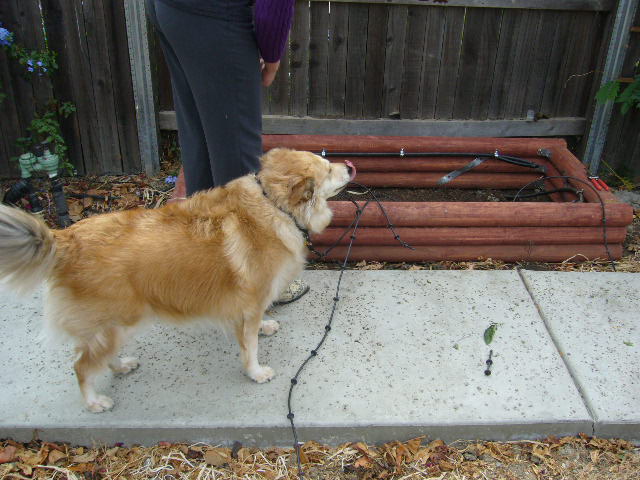
So what's the big deal? We grow garlic every year, right? Well, yes, that is true. Except that this year it nearly didn't happen. This year was nearly a complete bust thanks to election limits on my free time and the Ultimate Digging Machine known as Bandi the adorable mutt.

Damaged Planter Bed
As it turns out  -- the mutt is good at not just digging. Seems she can take apart a planter bed with one swift kick of a back leg. And she managed to do just that some weeks back -- destroying a planter bed that was destined to hold the Bird 2013 garlic crop.

I have always wondered how long these cheaply constructed gardening beds were going to last -- and now I know. Profiled here several years ago, it appears these "gardening beds on a budget" have a lifespan of five to six years. After that? It's time to repair, rebuild or in my case, start from square one.

Ultimate Digging Machine at Play
The first hint of trouble came when I spotted fresh dirt on the ground and knew that digging doggy had been up to no darn good. Bandi is clearly past her "puppy stage," but that playful and somewhat destructive side does surface every now and then. That's especially true if she spots a vole (field mouse) duck into one of the beds.

A vole? I must DIG! I must FIND! Do voles taste like BACON? I must find out!

Although the cats that grace the Bird Back 40 get their fair share of "vole treats," these thing reproduce so quickly and in such massive numbers that there's always one or two for Bandi to chase in a futile effort from gardening bed to gardening bed. Keep in mind, she never does catch one. She just leaves her tell-tale sign behind, which is usually a nice little hole in the ground or bed.

Yes Fred, I know. You warned me. You were right.

Gardening Bed Damaged Beyond Repair
When I first noticed that the Ultimate Digging Machine had partially destroyed part of one of my older planter beds, my thoughts first turned to "repair." A few well placed gold screws, I believed, would solve this problem. After all -- the bed had been screwed together once before. It certainly could be repaired in the same fashion, right?

Wrong.

I would come to discover that the Ultimate Digging Machine had finished what Mother Nature started a long time ago. Wood that once those golden screws so securely was now so brittle that it fell apart into tiny pieces at the slightest touch. It was done. It was finished. There would be no repair. There would be no 2013 garlic crop.

Or so I first thought.

Damaged Gardening Bed Logs
But the more I thought about it? I just couldn't let it go. This bed has been the source of so many mouthwatering crops and harvests that I just could not write it off. I grew champion Cherokee Purple tomatoes in this bed! Last summer's crop of green onions and several different types of basil was raided quite often I must say. Lettuce had grown here in the fall. The last harvest had been a fat onion crop.

Let it go? Write it off? Leave a big hole in the ground? Perish the thought. As Oscar Goldman of Six Million Dollar Man fame once intoned: "We Can Rebuild Him." It wouldn't be easy. This was bare, open ground when I built the first bed five years ago. There was nothing to get in the way. The rose bush to the left of the bed was added later. That honeysuckle vine covering up our second beehive was added later. And that nice little sidewalk framing the bed against the fence was added just this spring.

Gardening Bed and Drip Irrigation System Removed
In other words, I didn't have a lot of room to operate. And, to add insult to injury, the old bed would have to be removed piece by piece, along with the drip irrigation system, before I could proceed with new bed building efforts. Removing an old, wooden garden bed is quite the inconvenience to the Black Widow spiders and other creepy-crawlers that had since moved in and long ago called it home.

The first step involved removing numerous layers of gardening soil. It was removed the same way it was added -- with shovel and wheelbarrow. I would come to discover that those golden screws that had held the bed together so securely years ago had since disintegrated and would sometimes just break into two brittle pieces upon removal. Some of these "Lincoln logs" as I call them were so brittle they easily snapped into two or three pieces once they were removed. Years of gardening and usage, plus natural elements of rain, cold and heat can do a lot of damage.

We Can Rebuild Him
Yet -- up and out the old bed came -- piece by piece -- leaving surprised spiders and insects to bolt and scramble away. I was left with a bare spot in the ground and started over with the same system I had employed so many years ago: Assemble the new bed in layers, stack, align, screw and reinforce. The re-installation of the drip irrigation system allowed me to make several improvements that will serve to save precious water supplies, yet ensure that the irrigation reaches every last corner.

By the end of the day? The new bed, which looks a lot like the old bed (minus the black widow spiders), had been installed. Old, tired soil was mixed in with some new planter mix and compost, and what was once old and tired was new again. Venus planted the garlic varieties of Lokalen, Bogatyr and California Late White in short order. The cloves have since sprouted, and everything looks just dandy.

Goodbye Old Bed: Hello Potash!
As for the remains from the old bed? I have quite the growing pile of lumber scraps from previous bed building efforts and other "around-the-house" projects. I wasn't interested in growing the size of that scrap pile, which is why I was happy to have a handy-dandy fire pit installed this previous spring.

Old wood burns fast and hot and leaves behind a helpful gardening supplement: potash or potassium, which is an essential ingredient for any gardening project.

And, as for the Ultimate Digging Machine? She most definitely approves of the new addition. Here's hoping that next "urge" to dig strikes in places where I want to add additional fruit trees next spring.