Showing posts with label Lenny. Show all posts

The Ballad of Frick and Frack

Thursday, August 26, 2021

Frick and Frack
Warning! Cuteness Overload! And, perhaps a bit of sadness.

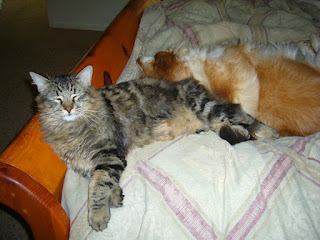
I write the following today to remember a great love and friendship before it has time to pass from my mind, as most things do as we move on in life. Pictured to the right are Frick and Frack. It really doesn't matter who "Frick" or "Frack" is. What is important is that tender, and rare, relationship between cat and dog who find each other at the right time.

Frick and Frack at rest. A rare moment.
We didn't do this by design. That would have been far too easy and somewhat impossible. This relationship was completely by chance. It just worked. Somehow, it just worked. The decade that followed was pure magic.

The dog, Bandana, a "Heinz 57" mix of herding breeds, was discovered on a working horse ranch in Southern Oregon. His owner, Tenaya Yager, made the painful decision to part with him during our 2010 visit. Lenny, the Maine Coon cat, was a gift from Mary Beth Barber. She discovered a litter of feral kittens in the sub-basment beneath her Sacramento home in 2011. She rescued them and bottle-fed and cared for each one before presenting Lenny as a gift.

The Kiss
The cats that my ex-wife, Venus, and I had at home never did care for Bandana after we brought her home. That is a kind way of describing it. Outright revolt, revulsion and disowning us as cat owners would be a more correct description. But all of that changed a year after adopting Bandana when we opened our home to Lenny. One lick from Bandana was all it took, and the legend of Frick and Frack was born. The two immediately fell in love with one another and were constant companions and partners in crime. They never left each other's side.

I thank the Good Lord that digital photography came into vogue by 2011. Otherwise, we would have enriched the makers of Kodak or Polaroid film by another million bucks or two. Frick and Frack would come to dominate photos and social media postings over the next decade. Who could possibly ignore that cuteness overload? The two would get into one adorable pose after another, usually around dinner or snack time. Or, if they wanted something we were eating at the dinner table. Which is usually what Frick and Frack did at dinner time 365 days a year. These two had discovered a couple of human SUCKERS, and took full advantage of it.

Frack on Frick
Here is a photo of Frick and Frack on the couch. Or a photo of Frick and Frack on the floor. Oh look! Frick and Frack are curled up on the bed together! Here are Frick and Frack outside, checking out the garden. "Is that dog lying on top of that cat???" This is a common question we received on Facebook, Twitter, Google or any other place we deposited multitudes of pet photos. "Why yes she is," came our response. "Pay no mind," we would respond. "They just want snacks." What we didn't say is that most of the time Frick and Frack were rewarded with any snack they wanted.

Did You Say Snacks?
If these two partners in pet crime weren't in one adorable pose or another, they were usually putting on one of their typical Battle Royale rumbles in the living or dining room. It would start when Frack would chomp on Frick's fuzzy tail and pull on it like a tug toy, which ultimately resulted in a massive, full-claw return swat from Frick. The battle was on. Or, sometimes it was Frick who put on his best Tiger Tank Surprise Attack from the rear, hitting Frack full-force when she wasn't looking or was peacefully sleeping. The battle, which never really ended between the two, was on again. The two proceeded to roll around on the floor for the next 5-10 minutes, usually knocking over whatever was in their path. Many chairs and even one Christmas tree met its demise when these two decided it was time for non-stop action.

Wandering the Garden
The battle took on a new form whenever we took Frack (the dog) for a walk. Frick would follow for awhile, but never lose sight of his home. It wasn't that he was scared, he just preferred to stay behind and plan his attack after Frack returned 30 minutes later. Frack always suspected that Frick would be up to something, waiting to unleash a surprise attack. Frick would never disappoint Frack, launching himself from underneath a bush, a parked car, from behind a pillar of bricks and, at least one time, with a flying leap from the roof. I have to admit, I was surprised with that mode of attack myself.

No matter how brutal the previous play session had been, Frick and Frack always made sure to position themselves into the most ridiculous and adorable pose possible after play time subsided and dinner time arrived. That's just who they were. They spent a lifetime irritating and loving one another. They were never apart. They were always by each other's side.

Chairs are for Frick and Frack
Did I mention how carefully they planned an assault on the vegetable garden AFTER Venus and I had carefully planted tomato plant starters on top of smelly fish heads? On the best garden advice available at the time? We came home the next day to find 16-tomato plants dug out of raised beds and a few paltry bits of those fish heads that we thought we had buried deeply enough to guard against theft. The culprits had dirty paws and full bellies. Frick and Frack had struck again. It was a team effort.

Stop here. Don't read any further. Because all good things do eventually come to a tragic end. I will keep this as short as I can.

Your bed? Not anymore!
As the years flew by, the play and antics subsided somewhat. Play time morphed into a lot of nap time for the both of them. But, they were still together. There came a point, however, where Bandana, the Frack, grew tired. A limp that developed after she had stumbled into a gopher hole worsened. Herding dogs like Border Collies, McNab Shepherds and Aussie Shepherds are very hyperactive as young adults. But when they begin to slide downhill, the end seems to take place very quickly. Bandana was no different. Frack passed in February of this year. I held her close as she took her last breath. I promised I would never forget the "Blonde Bombshell." The neighborhood children simply adored her.

Although I gave Frick all the love and attention I possibly could after losing his Frack, he followed a short time later. His last act was to crawl underneath my bed, where Frack had spent part of her final year. It's where he drew his last breath. That was yesterday. I'm a still a bit emotional at the moment, so please forgive me. I'm not going to bore you with all the visits to the veterinarian that took place and all the solutions that were prescribed over the last six months. Needless to say, none of them worked. It's tough to heal a broken heart.

Frick with his new Frack
I can only say that I tried my best to engage Frick. At one point I even adopted another Frack from the Bradshaw Animal Shelter in Sacramento County. It stopped Frick's slide. For a little while. But it wasn't enough. It wasn't the answer. I don't know if there was a solution. If there was one, I didn't find it.

We never forgot the kindness of both Tenaya and Mary Beth. They were reminded of the gifts they had bestowed every time a picture was posted on any social media account, which must have numbered in the hundreds through the years. We made sure that both saw each ridiculous Frick and Frack pose and moment.

"I talk about Bandana a lot," Tenaya admitted after calling to console me following Frack's passing last February. "The decision I made to give her to you was a validation of what I would become. I unite pets with people."

Marybeth also checked in to thank me for being a good cat "papa."

This relationship between dog and cat is not unique. Perhaps  you have been graced by a Frick and Frack in your lifetime. It is my sincere hope that you have. I have had no greather joy in life than to witness the love and joy that Frick and Frack demonstrated time and again. They are just memories now. Memories that I will never forget. I have to move on now. I will move on. But I will never forget.

Super Bore Or Super Bell?

Sunday, February 10, 2019

Best Super Bowl Ad EVER!
With all due apologies to the fresh corn industry, I must admit, I thought the Bud Lite Corn Syrup commercial was the funniest thing I've seen on TV in quite some time. Don't get me wrong! I love me some corn. I personally believe corn grown in the Sloughhouse area of Sacramento County is, in fact, the best corn in the world. I wish no harm upon our fine corn farmers!

But that Bud Lite Corn Syrup ad that ran during last Sunday's Super Bore was absolutely hilarious. I am still busting up over the line of: "would you please smoke outside?" However, Bud Lite's pun and knock against all thing corn syrup will not stop me from purchasing Sloughhouse corn. Additionally, you will not find any Bud Lite in the Bird refrigerator. However, if you look hard enough, you just might find a bottle of the High Life. But, enough of that already. I've strayed much too far.

Cat Bowling Pins?
My friends, rather than watch the NFL bestow yet another title on Tom Brady last Sunday (BORING), my mind was positively fixated on the image that appears to your very left. Can you guess what those cups might represent? Bowling pins for the naughty Cat that is Lenny? That is a good guess, but NO. And although Lenny has already cast a rather envious glance at the cups placed on that bedroom window, I hope that cat knows better.

I hope.

Those cups placed against yonder windowsill represent the start of my summer 2019 vegetable garden. Would they represent the 13 varieties of heirloom tomatoes I will be growing this summer? Good guess, but also wrong. It's still a bit too early for that activity, though some have already started. No, the seeds placed in those cups all contain the same variety: The California Wonder Bell Pepper.

Peppers!
First introduced in 1928, the California Wonder is now a sweet staple in nearly every backyard garden. These are these big and blocky peppers that can be found in nearly every dish, ranging from salads, stir fry meals, fajitas or just brushed with olive oil and placed on a grill. You can also find them in home-canned items such as tomato sauces and SALSA. Roasted or fresh, the California Wonder represents one word: SUMMER.

Garden grown Bell Peppers are nearly as popular as home-grown tomatoes. According to the Masters of Horticulture Blog, "Bell peppers are the most commonly grown pepper in the United States.  According to the National Nursery survey, 46-percent of gardeners grow them every year.  Second, according to the same survey, bell peppers are the third most popular vegetable grown in American gardens.  Third, the bell pepper is the most consumed pepper in America.  According to the Agricultural Marketing Resource Center, Americans eat 9.8 pounds of them per year.  And finally, bell peppers are the only peppers in the genus that do not produce capsaicin.  Capsaicin is the compound that makes most members of the genus Capsicum hot."

Perfect for Seed Starting Efforts
The reaction from most of my pepper growing friends is going to be pretty typical, I think. People like Jake Seed and Dave Jesse are thinking along the lines of: "PFFFT! ROOKIE!" And you know what? They're right. To them? My pepper planting efforts are rather late.

You see, while the vast majority of us are thinking about  the Peppermint Wishes and Candy Cane Dreams of the Christmas Season, the pepper guys are thinking about peppers so hot they would melt Santa's tongue. There's a reason why Rudolph the Red Nosed Reindeer gives these homes a wide berth. These guys are serious. January 1st doesn't just signal the start of the new year. It means it's time to plant pepper seeds of all shapes and sizes for the upcoming summer gardening season.

Planting Seeds
Why start pepper seeds so early and why am I late? There's a good answer for that. Pepper seeds tend to grow much slowly than tomato seeds, which essentially sprout and grow like weeds until they are transplanted. As KFBK NewsTalk 1530 Gardening Show Host Farmer Fred Hoffman put it so eloquently to me once: "PEPPERS NEED HEAT!" Unfortunately, there's little heat to be found during the Northern California months of December, January and February. So, pepper growers get very inventive to creating the kind of heat they need to give seedlings the boost that they need.

I recall that one of these growers, and I won't mention names (Dave Jesse), placed his seeds in sealed starter cups and placed them under a woodstove. Where his cat promptly found them. Great fun ensued.

What's the payoff for my seed starting efforts? 13 large and healthy California Wonder Bell Pepper starter plants. Do I intend to plant all 13 in my summer garden? Are you nuts? Gardeners do not live on bell peppers alone. This means I will have plenty to share, or trade, once the transplant season begins (provided it stops raining at some point).

Danger Will Robinson! Danger!
Hopefully, the seedlings I have planted against my bedroom windowsill will sprout and start to grow (albeit slowly) in another day or two. Also, hopefully, the giant shade trees that dot this Citrus Heights neighborhood don't blot out the needed sunshine.

Finally, hopefully, here's hoping a certain Maine Coon cat can ignore the urge to start swatting what's been carefully placed on a windowsill that he can easily reach.

Hope springs eternal.

Can't You Just Taste That???

Saturday, March 29, 2014

Table Grape Cluster-Thompson Vine
I know I can! Know what that is pictured to the right peeps? That, my friends, is a cluster. Not just any cluster mind you. And not the kind of cluster that Gunny Highway (Clint Eastwood) popularized in "Heartbreak Ridge." Nope! The picture to the right represents a big, fat CLUSTER of Thompson Table Grapes. And clusters just like this one are now emerging on every shoot emerging from the Thompson Table Grape vine.

Know what that means? It means a boatload of Thompson Table Grapes come this summer. And boatloads of table grapes are not a bad thing -- at least not in my book anyway.

Haircut Needed!
The table grape clusters now emerging by the hundreds it seems from the Venus, Fantasy, Black Monukka and Diamond Muscat vines, to name a few, follow on the heels of a haircut party held several weeks ago in the Bird Back 40. These vines, which emerged last year, managed to grow and cover the sidewalk you see pictured here and there. They also managed to grow right into the nearby pluot tree. Not only did they grow into it -- tendrils from these vines wrapped themselves around pluot tree branches and grew clear to the other side of the tree.

It wasn't all that unusual then -- to see a cluster of table grapes growing inside the pluot tree. And it did make for nice conversation.

Vines Before Pruning
Properly maintained? One single table grape vine will produce anywhere from 50 to 60 lbs. of table grapes. That's more than you and I can eat in any one sitting or two or three sittings for that matter. Now -- multiply that kind of production with nine table grape vines. There comes a point in the season where it's open season on table grape production, and I can't give them away or juice them fast enough.

The trick is to make sure the vines are properly maintained. The mass of vines you see pictured above looks like a really bad haircut, or someone just got up from a hard night's sleep. Most of these vines will not survive the pruning process that takes place when you're getting your mini-vineyard ready for spring and summer production. The wood that produced last years crop gets pruned away first -- along with any vines that emerged from that wood.

Vines After Pruning
The wood that you keep are the strongest vines or runners that emerged from the top of the vine, or the runners that emerged from the trunk itself. Those are the vines you keep -- and you won't keep all of them either. Some grape growers practice spur pruning -- keeping the strongest two vines that grew from the top or "cordon." Other growers practice the cane pruning method -- keeping the strongest vines that emerged from the trunks.

In my case? I practice both. Some varieties do better with spur pruning. Still others do better with cane pruning. Through the years I've discovered that the Thompson performs best with the spur pruning method, while the Black Monukka produces best through the method of cane pruning. And, as for the Fantasy vine, it really doesn't matter. The Fantasy is going to churn out ping-pong sized grapes no matter no matter what method of pruning that I use.

Piles of Discarded Vines
The vines that I choose to keep -- those that will be this year's fruit producers -- are then tied to the cattle pen fencing that we installed some years ago for our table grape vineyard efforts. It's been one of our better gardening investments. Cattle pen fencing can hold cows in place -- and can also support several hundred lbs. of table grape production.

It takes the better part of a weekend to properly prune and tie up nine table grape vines -- plus dispose of the piles of discarded vines piled nearby. That's a big investment of time and energy -- but well worth it when table grape season arrives -- which comes in late June for the Venus vine and continues right into July and August when most of the other varieties ripen up.

Cattle Pen Fencing
These vines will be sprayed to protect against mildew and other damage. Gibberellic acid, or GA-3, an organic growth hormone that promotes cell growth, will also be used at some point. Although there has been some previous research that suggests the use of GA-3 limits production on the Fantasy vine, I have not found this to be readily apparent in the Bird Back 40. And GA-3 results in large grapes that are packed with lip-smacking natural sugars. Fantasy grapes are not only the best eating -- they make the finest table grape juice.

The crop is ready when the mockingbirds who mock me begin to raid the vines with impunity. But it really doesn't matter all that much. These vines produce so much fruit now that I can share some with our fine-feathered friends. Besides -- they're taking a risk by coming in this close. Because somewhere in those vines -- hiding beneath the leaves -- is our garden patrol cat: Lenny. And when a 25 lb. Maine Coon snags a mockingbird? It's game over -- at least as far as the mockingbird is concerned.

As the wife that is Venus would say, "that's nature." Cats chase birds. It's the natural order of things. Yes -- and we can add one more rule to that list: Bill Bird likes table grapes.

The Show

Monday, May 28, 2012

Wonderful Pomegranate in Full Bloom
It's Memorial Day Monday at the Bird Ranch and the Show is on full display. It happens at this point every year it seems. Some years the show is a little better than others. This happens to be one of "them years." The Show is on.

I am, of course, referring to the show that our pomegranate tree is putting on. Largely hidden from the rest of the world, our four year old Wonderful Pomegranate is erupting with one of the most incredible and brilliant flower displays I've ever seen.

A Colorful Flower Show
Why did I stick this thing in a side yard? Why am I that dumb? While I knew that I wanted a pomegranate tree in the fruit salad Bird Back 40 collection, based upon my enjoyment of them as a child, I had forgotten the rather brilliant display this tree had given me as a child all those years ago in mid-1970's Modesto.

The tree that inspired me all those years ago is still alive and kicking, believe it or not. Located in front of a Norwegian Avenue home near what used to be an old-style A&W drive-in restaurant, it is well manicured and is as productive as ever. Hello old friend. It's good to see you again.

A Native California Pollinator
Given another chance? I would have stuck the Santa Rosa plum tree in the side yard and put the showy pomegranate out front.

This is going to be the heaviest year yet for pomegranate production thanks to some uber-pollination efforts that are currently taking place. A close examination of this tree yields the discovery of multiple pollinators. I spotted several of the Halictus species, aka sweat bees, just going to town on the coral red flowers and bright yellow stamens. The tree is very close to a mason bee home that I received as a gift several years ago, and they were out in abundance as well.

Hummingbird in Flight: Center Right
Honeybees also could not resist the lure and aroma of these tempting flowers, many of which have been transformed into small pomegranates. And just when I thought the show couldn't get any more diverse, in dropped a neighborhood hummingbird for a sweet drink of pomegranate flower nectar. He quickly zoomed away before I could get a proper closeup, but he's clearly visible in the one photo I managed to snap.

Short and sweet? I love the Show. This tree literally hums with life and production during the spring. Lenny, the Giant Maine Coon Kitten, enjoys the shade it provides below. It also serves as a base from where he can conduct a surprise charge and attack against the unsuspecting dog, aka, Ultimate Digging Machine.

Heavy Crop Now Forming
The pomegranates that are now forming will grow and add size and girth through the summer months. When they turn a glossy dark red in the fall, usually late October, it's time to harvest. I've learned, through experience, that harvest season is fairly quick. You can't allow pomegranates to hang on a tree like citrus. If they are not harvested quickly, they will split and spoil easily.

This means lots of gifts for family, friends and neighbors. It also means lots of pomegranate juice, which is a wonderful addition to freshly-squeezed lemonade. Pomegranates are also great for fresh eating, though they can be messy. Even after 40 years, nobody has quite discovered how to take the mess out of pomegranates. It's enough to make any mother of an eight year old pomegranate crazed boy cringe in terror.

It's pomegranate season. The show is on.