Showing posts with label steer manure compost. Show all posts

That Man Smells Like Manure!

Sunday, April 17, 2011

Does Someone Smell Cow?
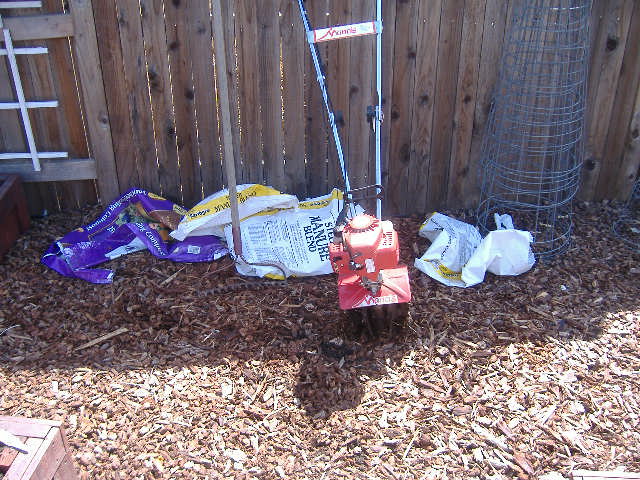
Step back ladies -- and please try to control yourselves. The Don Juan of bovine meadow muffins is in the house -- and as the photo to the right will clearly attest -- the "defcon of reekness" level stands at four.

Thanks to a weekend of warm weather and bright sunshine in North Natomas -- I'm pleased to announce that the 2011 summer garden season is now "on." Oh sure -- it's mid April. I'm not forgetting the calendar. But when two straight wam weekend days fall into your lap - a gentleman "takes advantage."

Think about it for a minute. In a lot of ways? Gardening is like sex. "How so Bill Bird," you inquire? Let's look at the facts, shall we? A day of gardening leaves you hot -- sweaty -- dirty -- tired -- spent and in desperate need of an ice-cold beer.

What other activity leaves you feeling in such the same manner?

I rest my case.

"Work It" With a Wheelbarrow!
If you're seriously insane -- I mean -- serious about gardening -- you just can't "plant seed" and forget about it. Oh no -- there's a lot that comes before that magic moment. First and foremost? You need to prepare for it. You need to "work it" so to speak -- as in work the garden beds before planting.

There are six main 4X8 gardening beds in the main part of the Backyard of Bird. There -- you will find the now infamous "V for Venus" beds. I'll be honest. After a long and frustrating winter -- a lot of the beds were covered in weeds. Call it our winter of neglect.

Fortunately? These are raised beds filled with loose soil planter mix. No matter how big the weeds get? They're fairly easy to pull out -- roots and all. And if you don't get it every last part of each root? The Mantis Rototiller will take care of the rest.

The Mantis needed yet another tune-up before I got started this weekend. Despite my efforts to drain out the old gasoline from last season and replace it with something new -- it wouldn't fire up the way I wanted it. It would run for a minute or two and then die when I gave it the gas. Know what that means? It means another trip to Bill Knight and the Lawn and Mower Repair shop in Elverta.

Bill knows his two-cycle engines.

Mantis Rototiller in Action!
After a standard $25 tuneup? Ye olde Mantis was running like a top again -- ready to tear into those beds with abandon. Each bed received three bags of top quality manure -- and I say that in jest -- because when is the last time you ever heard anyone use the line "top quality manure?"

It's cow-poop folks. Plain and simple. It comes from the back end of -- well -- you know.

After a less than satisfactory experiment with other forms of compost last year -- I switched back to the simple one-buck-a-bag variety found at your local Home Depot. Why fiddle with something that works wonders? Some of my best summer vegetable gardens have resulted from the use of the cheapest form of steer manure compost -- so why fiddle with something that works?

Sure -- I've tried better forms of compost. I've tried the organic variety. I've shelled out $20 for a bag of the Fox Farm product. Guess what? In my short experience? The buck-a-bag Home Depot stuff just works better. And there's nothing like the feeling of ripping into a bag of smelly steer manure compost -- only to find that it's rich with earthworms. That's like hitting the garden jackpot.

Amended bed before rototilling
I managed to till up four different beds this weekend -- which is a record for productive output. The main 4X8 beds each received three bags of steer manure compost -- which also comes with an ample supply of potash (potassium). I also experimented some additional nutrients for the beds in the form of organic bone meal -- which is high in phosphorus. If you're as insane as I am about heirloom tomatoes -- you'll find that they need equal amounts of three nutrients to do well: Nitrogen, potassium and phosphorus.

If your garden is lacking in any one of the three? It can affect production. You can also work in far too much of a good thing -- which I discovered last year when I experimented with chicken manure compost. However -- I am returning to a nutrient recipe that has served me well in the past. My "method of gardening madness" is to till up each bed with the Mantis -- add manure, bone meal and other pelleted nutrients -- and use the Mantis a second time to mix it in with the existing soil.

After splashing each bed with a fine spray of water (this keeps the wind from blowing half the soil away -- which is a real problem in the windy riverbottom) -- the end result is a dark -- rich soil that is ready for planting. And so -- this is when the magic moment comes. It's time to plant.

Amended "V for Venus" planter bed
I'll be honest with you -- I jumped the gun a tad. The heirloom tomato starters that I have been babying in a back room through most of the winter months are now in their permanent location. Yes -- I'm taking a gamble here. Yes -- there's still the chance for another cold storm or two. Yes -- most serious growers wait until the END of April before they dare plant anything.

In my case -- however -- it was time. The long and lanky heirloom starters were seriously rootbound. Worse yet? A normal spring day of warm weather was enough to dry them out completely. My only options were to transplant the starters into larger containers -- or plant out now. I chose the latter. It's a gamble -- yes it is. But the long range forecasts look promising.

Tomato plants can withstand a warm spring deluge. In fact -- I've found that they tend to enjoy it. I've seen plants knocked flat by warm spring downpours -- only to watch them spring back stronger than ever a few days later with nary a trace of disease. Warm spring rain doesn't bother me. A cold snap followed by cold rain and more cold weather? That's different. It should cause concern.

Raggedy heirloom tomato plant starters

If we're lucky? The wife that is Venus and I will be enjoying vine ripened tomatoes by the end of May or in early June. This is providing the weather cooperates. After experiencing a colder-than-normal summer last season -- I know that the weather rarely cooperates in these cases.

But -- every once in a great while -- a squirrel finds a nut. The heriloom tomatoes are in. The wife and I smell like we've been rolling around in meadow muffins all weekend long. There is no turning back now.

As for me? I need a beer -- and a shower.

Gardening Is . . .

Sunday, April 18, 2010


A. Hard Work
B. A Sense of Renewal
C. Causes You to Smell Like Fresh Steer Manure
D. Frustrating
E. Why My Back is Sore
F. All of the Above

THE 2010 POTATO CROP IS IN!

Slough WHO?

Sunday, August 2, 2009

It's early Sunday morning. I should be listening to Farmer Fred on his ye olde radio programme. Instead, both the wife and I are now planning a busy day of canning efforts BECAUSE we listened to Farmer Fred!

Gee, thanks Fred. I think.

I wanted to introduce you to a staple food item that has become a regular around the Bird household in the past two weeks. There's that wonderful item to your left -- and yes -- that sweet, lucious, golden corn was part of last night's dinner. Yet another heapin' helpin' of that summertime favorite called "corn-on-the-cob."

Who needs Slough House corn when you've got North Natomas?

This is our second year for corn-growing efforts in the quarter-acre backyard we call the "Back 40." But -- like many endeavours this year -- we have corn coming out of our EARS. Last year's corn patch was quickly overwhelmed by the sunflowers that Venus had planted as "companions."

Bad move. Sunflowers take over everything and destroy all.

This year? We kept the corn out of the raised beds -- away from the sunflowers -- and put it in the "test bed." And, I suppose you could call the "test bed" the "raving success bed" now because it's starting to produce right along with the raised beds. The corn -- tomatoes -- squash -- pumpkins -- baby corn and other produce is doing just fine. They seem to like this amended North Natomas junket soil. So be it. The test bed lives -- thanks to the Mantis Rototiller and a whole lot of steer manure compost.

This is probably the sixth or seventh meal where the wife that is Venus and I have enjoyed corn on the cob. There will probably be at least another five to six meals to enjoy -- and then the second crop of sweet white corn will be due in. And -- if that's not enough -- a mixed crop of yellow and white sweet corn will follow about a month later.

I love corn almost as much as I love heirloom tomatoes. Almost.

Not every ear is perfect mind you. That's the "thing" with home-grown corn. You're not going to get store-bought perfection. Even with most supermarkets -- you're going to encounter a bad ear or two. It just happens. And we've had our share of flops mind you.

Last night's corn for example? The first ear? Heaven on earth! Crunchy! Sweet! Every bite a joy! Bursting with nature's goodness. But the second ear? Not as crunchy. Not as sweet. You might even say it was a "tad gummy." I probably left that ear on the stalk for a little too long. Had I harvested it three days earlier, it probably would have been pretty darn good!

Corn on the cob anyone?

An Offer You Can't Refuse From The Man's Toy Store!

Saturday, June 20, 2009

I'll be honest. I often think of this place as "my second home." If it's the weekend and the sun is out, you'll probably find me milling around somewhere in the North Natomas Home Depot.

Heck, I'm there so much that most of the employees know me by name. Now that's bad.

Are you addicted to this place as much as I am? Do you find yourself going into the Home Depot with a suit and tie on during the work week just so you can get a jump start on that weekend project? Could you shop the drip irrigation section blindfolded? Do you know more about what they stock at your local Home Depot than the hired help?

If you answer yes to all three questions, there's no denying the truth: you're just as addicted to this place as I am.

The fine folks at the Home Depot want to reward you for your customer loyalty in the form of a $100 gift card. Could you spend $100 at Home Depot in five seconds? You've come to the right place, because the blog that is Sacramento Vegetable Gardening is presenting an offer that you can't refuse.

Are you ready to win?

Here's the catch: No money is required. However, you must do two things for me. First, you must click on this very special link HERE. Secondly, you must leave a comment at the bottom of this blog telling the fine folks at the Man's Toy Store why YOU deserve a $100 gift card. The link will take you to the Home Depot Garden Club, where you will find all sorts of useful ideas for the yard.

Am I shilling for Home Depot? You Betcha! Am I getting paid? NOPE! I love this store THAT much, even though the North Natomas branch will ANNOY me to no end by refusing to stock simple items like the Phillips Pan Head 10 X 1/2 metal screws in packages of 100 or more (I hope someone from the North Natomas store is reading this).

Those screws, you see, are essential for building planter boxes pictured to your immediate left. I have about ten of these in the yard now -- set against the fence line. Everything in this box, from the wood to the screws to the drip irrigation to the soil -- came directly from Home Depot. They even cut the wood for me! You can read more about these easy-to-build planter boxes here.

Home Depot is also one of the best places I've found to purchase soil amendments for raised planter boxes. I learned, from experience, last year that brand new planter mix for planter boxes isn't going to cut it. That soil might be brand new, but it still needs various amendments like a bag or three of steer manure compost purchased from the Home Depot for a buck a bag.

Venus and I amended each and every planter box in the backyard this spring, including a test bed in the side yard, using about 40 bags of steer manure compost. Yes, you can say that gardening "smells." It also results in whopper sized tomatoes, radishes and other good stuff from the garden.

So, if you think you're the one for that $100 Home Depot gift card, remember, click on this LINK. Then, leave a comment at the bottom of this blog. You must do both. And, by clicking on this LINK, you can also get valuable information about your region, gardening advice from pros and updates on local gardening events.

The wonderful wife that is Venus will draw the winner on Monday. Good luck!!!

Two Thumbs Up for the TEST BED!

Friday, May 22, 2009

This is a gardening experiment that -- quite frankly -- could have gone either way -- up or down.

I've tried growing vegetables in our Natomas Clay Muck before without much success. Artichokes did OK -- but just *OK.* The most outstanding results, of course, came in raised beds.

There's nothing wrong with this of course, because there are a lot of advantages to using raised beds. You can control what kind of soil goes inside, control drainage, they warm up faster -- the list of advantages goes on and on.

But, at the same time, raised beds take time to build. They can be expensive. They require room. You need walkways to reach all sides of a raised bed, which can be a waste of space. And, if you're limited on space....

You see, every inch in a normal North Natomas backyard counts. Some are no bigger than your average broom closet. I'm fortunate to have a large backyard, but I don't want an inch of it to go to waste.

And that's why I decided to put my handy-dandy Mantis Rototiller through a workout earlier this spring in an attempt to somehow, someway, improve the hard clay soil in our backyard. Growers in South Natomas, who moved in years before North Natomas was built, have done it.

And, if they've done it, so can I.

So far, it's working. With the exception of one tomato starter plant, everything planted in our "test bed" as I call it has either sprouted or is growing fairly well. As you can tell from the photo above -- the corn seems to like it. The squash seeds that the wife planted a couple of weeks ago have all sprouted. And, for the most part, the tomato starter plants are doing well.

They are not growing nearly as fast, mind you, as the tomato plants we have in raised beds. They're not nearly as lush. They're not nearly as productive -- yet. They still might be. One of the advantages of a raised bed is warmth -- it "warms up" faster than your average pile of dirt.

My hope is that by the time summer really hits -- and the temps warm up at night -- the test bed will get just as warm as the raised beds. My hope is that we can keep the slugs and other critters who can't reach the raised beds -- out of the test bed. My hope is the roots of these tender tomato plants don't curl up in horror when they reach 10-12 inches down and discover real Natomas clay soil.

That is my hope.

Cutting through the soil in the test bed was probably the hardest workout I have faced. The Mantis Rototiller has a lot of good things going for it, but it is not a heavy machine. When the tines of this tiller hit hard clay -- the tiller starts bouncing. It's hard to control. It takes a lot of muscle and a lot of pulling from behind to keep the tiller where it's supposed to be, and ensure that you're cutting as deep as possible.

I managed to do that over the space of an hour or two -- and then amended this concrete-like soild with as much compost as I could haul into the backyard. It swallowed every bit of it. Hopefully, the compost will stop the clay from turning into cement again.

That is my hope. Everything is working -- or seems to be working -- so far.

Then again -- it's only May. The garden season is just beginning.

March Update: Babies Move to a New Home

Monday, March 16, 2009

The heirloom tomato starter plants currently growing in the North Natomas home of Bill and Venus Bird are doing well. So well as a matter of fact that it was time to take the next step in the seed propogation effort.

Moving day had come.

I could tell because the plants that we started in this Jiffy starter tray were developing "root legs," and my fear was that if they didn't get a new home and soon, they just might walk away. Plus -- they were hitting the top of the grow lights, which is never a good sign. And those long stems that you see in abundance? That's not a good sign either.

There's a term for this -- and it's called "leggy." And this happens to a lot of indoor growers who do not have standard greenhouses. Starter plants tend to develop very weak stems when reaching for heat or a light source or both, and that's not good when you're growing tomato starter plants. Strong stems are needed for leaf growth and development. If the plant gets top heavy -- SNAP! You've just a lost a starter that you've spent a good month growing.

So, the "project" so to speak this weekend was to move the babies to a new home. This required a couple of different steps: A nice place to stretch out and work -- some new cups for the tomato and pepper starters and some good compost that the tomato and pepper plants will appreciate over the next month and a half.

Venus and I found the planter mix after a trip to the Big Box store that is Lowe's in West Sacramento, and the cups came courtesy of Farmer Fred Hoffman (Fred can just about find anything). After setting everything up in ye olde GarageMahal, including a tarp to cover the garage floor, Venus and I were ready to get to work.

In past years, we have used each Jiffy Peat Moss Pod to start three to four seeds -- or plants -- each. But separating the plants from the pod, without damaging the intertwined root systems, wasn't easy. And it was extremely messy. We usually wound up losing one or two starter plants from each pod anyway, so this year we tried something a little different:

One plant per pod.

And this made the process of transplanting pods into cups much easier. All you needed to do was scoop -- pack the dirt down -- drop in a pod with a plant -- cover with more composted soil -- label the plant and move on to the next pod.

The tomato starters, however, required a little more care than the peppers. Since the plants were so "leggy," we actually had to bury most of the stem in the compost, leaving only the top leaves exposed. This is actually a reccommended practice if you're going to start tomato plants from seed. Tomatoes are one of the few plants that will actually develop a second set of root systems resulting from a buried stem. And that, in time, will hopefully result in a stronger, thicker stem above.

As for the pepper plant starters, well, they didn't require this sort of "deep burial" treatment. All of the bell pepper plants had nicely developed stems, with good leaf structure. These were the easiest of plants to transplant into new cups.

This also happens to be the absolute worst year I've experience when it comes to actual germination rates. In previous years, tomato plants have always germinated faster -- and at better rates -- than the bell pepper counterparts. But, not this year. The bell pepper seeds gave us germination rates of nearly 100%

But the tomato seed? While some rows did better than others -- the total germination rate was probably 60%. In some cases, we had zero germination. We will not be enjoying Andrew Rahart's Jumbo Red this year, because none of the pods planted with seed germinated. The same holds true with another heirloom variety called Red Reif Heart.

But, don't feel sorry for us. We're not crying. We have more than enough started to plant five or six tomato and pepper gardens rather than just one. This includes a large variety of heirloom tomatoes and peppers. All of these plants are now sitting under a special contraption that I put together last week in the GarageMahal.

I can't take credit for inventing this PVC contraption. It sprang from the mind of an A-Type personality engineer who works for Intel and lives in the Rocklin area. But, while I could never invent something like this -- I am very good at looking at pictures or instructions and making a duplicate copy.

Which is exactly what I did!

All of these plants will remain indoors for about the next month (four weeks). By mid-April, if the weather has warmed sufficiently, I will take the next step in the "growing from seed" process and place the babies outside for what is called the "hardening off" process.

Details on that -- and more -- to come. But for now -- everthing is just dandy in North Natomas.

Re-Charging Raised Planter Beds

Tuesday, January 20, 2009


How the best plans can sometimes change....

I had intended to post up photos of heavily frost covered planter beds, with a "winter is here -- woe is me" blog message but Mothern Nature isn't cooperating.

A day after I took photos of my frost-covered beds, the weather changed, and changed rather dramatically. Those frost covered mornings? Gone. Replaced with bright sunshine, cool morning temperatures and real spring warmth in the afternoon.

Spring warmth? The high sixties? Low 70's? In JANUARY? Exsqueeze me? Did Old Man Winter take a break? Keel over? Last year at this time we were getting hit with rain and windstorms that blew fences down and cars off the road. And this year Mother Nature brings us April in January?

Weird

But, if there's one thing I've learned it's this: there's no arguing with Mother Nature. You just take what she gives you -- grin and bear it so to speak -- and if that grand old dame wants to give us a false spring, then so be it. Use your time wisely.

And that's just what I did this past weekend. The wife shoved a planting guide into my face, promptly produced thirty packets of seed, pointed to a nearby raised bed and ordered the now famous line: "get to work." That means, time to get digging.

Now myself, as a very romantic man, did inform the wife last Friday night that I had brought her a gift from the heart: three bags of composted steer manure. Not every man is this romantic, I'll give you that. But Bill Bird's heart just oozes with romance. And in some cases, romance smells.

Put these elements together: the weather is warm, I've got three bags of composted steer manure from Home Depot and the wife has thirty packets of various lettuce, swiss chard, spinach, bok choi, peas and other seeds. Plus, she's got the always reliable Farmer Fred Hoffman planting guide. And who can argue with that?

If there's one thing I've learned about raised beds, it's this? Yes, they are wonderful to garden in. The soil is surrounded by redwood, which conducts heat into the soil, warming it MUCH faster that ordinary dirt in ordinary ground. When you've got sunshine and highs in the sixties, you've got dirt with temps in the 70's.

Another thing I've learned is raised beds are USELESS unless they are "re-charged" so to speak with every season. The plants suck up all the good nutrients during the growing season. You might still have soft, loamy soil. But without a bag or four of compost, you've got a soil without nutrients. And without nutrients, you've got a garden that will not grow.

Since I have yet to inheirit a two-cycle, gas powered, Mantis Rototiller, I recharge my beds the old fashioned way. Yep. See that green-handled hoe in the bed? That's mine. And it digs pretty darn good if you're using two hands to dig up the dirt and mix in compost. With a raised bed, you must ensure that you pull ALL soil away from the redwood boards and ensure that old soil mixes in with the compost you're adding to the bed. Why? Because root systems grow towards HEAT. And those boards get pretty hot in the summer. I find that roots tend to grow right to the edges and, in some cases, stick right to them.

I also discovered that lots of little critters, such as BLACK WIDOWS, also enjoy raised beds. I manged to rudely intrude on a few of them. You would have thought that frosty cold days and nights would have done them in by now, but no such luck. By hiding in the soil, and near one of the redwood boards that retains warmth, just about any critter can withstand the onslaught of winter cold.

So, dig carefully and wear gloves!

The bed pictured here contains three bags of composted steer manure, worked into every corner. It also contains several cups of bone meal and other pelleted fertilzers that will ensure that vegetables will get the three important nutrients that ALL vegetables and fruit need: Nitrogen, Potassium (also called Potash) and Phosphorus.

It didn't take the wife long to start planting after I had finished -- perhaps thirty seconds or less. That entire 4X8 bed contains all sorts of good seed now, and if the weather holds, we'll see germination happen before the start of the weekend. If the cold weather sets in again, some seeds will germinate, while others will not.

It's still way, way, way, way too early to tell if spring has arrived two months early. Knowing our wacky weather, we could get another two months of wind, rain and more wind. But, when Mother Nature rewards you with a patch of spring in January, if you like to garden, you'd better take advantage of it.