The BOMB!

Wednesday, November 30, 2011

Lime Beef Bomb
As in LIME BEEF BOMB! Gentle readers -- I am about to share a cheap n' easy recipe that will even make Poor Girl Eats Well drool on her keyboard. And she's a pretty good cook! That recipe -- once finished -- results in what you see to your right. And it can be made with any type of vegetable (including broccoli), stir fried or steamed -- it's all up to you.

The best part is? Some of the key ingredients come straight from the Bird Backyard and citrus orchard, including the bell peppers pictured above? Did you think that growing peppers was a summertime deal only? So did I! Funny thing is -- fall came and they kept right on going. They've come through rainy weather, frosty conditions and lots of fog and are still putting out some mighty tasty produce.

Who am I to complain?

Fresh Bearss Limes
This recipe originally appeared in the Sacramento Bee section for food lovers -- which Bill & Venus Bird are. If I'm not mistaken, the source the Bee used for this article was Tuk-Tuk Restaurant in North Natomas, just a hop, skip and jump from the Bird Back 40. If memory serves me correctly, this was originally a recipe for a beef salad  (Lam Nuea?) seasoned with fresh limes, hot peppers and other Thai ingredients. If you want to use this as a salad recipe, with your favorite greens, you most certainly can. This can be modified in so many different ways, which is why we make it often (also because we kind of love it).

If there is one absolute KEY ingredient to this recipe it would have to be the fresh limes that are now coming ripe by the dozens in the Bird Back 40. I realize that not everyone has a lime tree in the backyard or even the front yard. But if you can find a source for fresh Bearss Limes, I highly encourage that you take advantage of said source. I have tried a number of different lime varieties with this dish, including the Key or Mexican lime, but I keep coming back to the Bearss. It has a sweetness factor that serves this dish well.

Beef soaking in fresh lime juice and Thai herbs
Fresh limes also have another big advantage over limes purchased in your local supermarket: They are far juicier. The dish that we doubled to serve two people last night was made with just three fresh limes. In the past? When we were without fresh limes and had to settle for whatever the produce aisle offered? It took six to seven limes to accomplish the needed task. The end result wasn't nearly as good either. I cannot stress this enough: the better quality of lime that you have means a much better tasting meal.

And this is one good tasting meal.

It means a pretty good trek in cold weather to reach the Bird pepper patch these days. Much of the yard is still not landscaped in the way I would like. These vast stretches of open dirt are fine in the summer, but turn into a muddy, sticky, clay SLOP at the first hint of rain, fog or cold weather. I don't know if you've noticed or not, but it's pretty darn sloppy right now. This means the donning of mud shoes, a flashlight to find my way in the dark and a bowl to carry the harvest back inside.

Fresh bell pepper harvest
And what a harvest it was! I'm not sure why the peppers are still churning out product at this point in the season. But I'm not going to complain about it. If life gives us green peppers? We make meals with peppers, including this Lime Beef Bomb dish, fajitas or just plain raw peppers sliced and seasoned with salt, pepper and a drizzle of red wine vinegar. One other thing I've noticed? While the peppers are still growing and producing at a rather eye-popping rate, they do not offer the heat factor that summer peppers bring. That's fine by us because the wife that is Venus likes her bell peppers to be sweet, fresh and crunchy. That is exactly what she gets.

We've been blessed with a lot of production from our three-year old Bearss Lime tree this fall. It also seems to like its location. While not huge, it has grown well since we planted it. We've allowed this citrus tree to produce since the first season, and while last season's production of a single, solitary lime was a bit of a downer, this year's production of about 50 limes has us smiling from ear to ear. Fresh limes go well in cooking. They also go well in Pacifico, which is something we're just a tad familiar with.

A tad...

Chopped peppers ready for steaming
The monthly fertilization schedule that we adopted some years back for all fruit and citrus offerings in the Bird Back 40 also seems to have played a positive role in production. It's not all that difficult to be honest. The instructions from City of Folsom Arborist Ken Menzer were to throw a handful of pelleted fertilizer beneath each tree every month. It appears to be good advice. If the fertilizer regimen resulted in production like this, I highly encourage it. It also doesn't hurt to have a beehive in the backyard, as honeybees LOVE citrus flowers. Bees, as we all know, are essential pollinators. I don't know if we would have this kind of production without them.

As for the vegetables, you can use your favorite. We sometimes go the stir fry route. I happen to prefer vegetables that are lightly steamed rather than stir fried. Lightly steamed vegetables retain their crunch factor and don't contain the oil content that results from a stir fry. We do always try to use fresh vegetables for this dish because anything that comes out of a bag (frozen veggies) gets somewhat limp during the reheating process.

As the wife would say: limp is bad.

Sliced beef cooking in fresh lime juice and seasonings
We've used many different cuts of beef for this dish. Since the key to this recipe is the lime and the soak process, any cut of beef will work. Venus and I generally follow the sales and stock up on beef when it's on sale. For instance? Last night's dish featured two Harris Ranch New York steaks that we cut into strips. But we've also used Tri-Tip for this meal as well as London Broil. In other words? It's "whatever you got." Ground turkey also works with this dish, but I must admit, beef is just so much better.

And now -- without further adieu -- the recipe for LIME BEEF BOMB. Remember this one piece of advice: the key to this recipe is the quality of the lime used, and the soak factor. The longer the beef soaks in the lime mixture, the better.

Happy eating!

LIME BEEF BOMB
(note, we usually double this recipe for two people)


1/4 cup freshly squeezed lime juice (about two limes)
1 tablespoon soy sauce
1 tablespoon sugar (substitute honey if you want)
1/2 teaspoon red pepper flakes
1 tablespoon Sesame Seed Oil (any oil can be used, but Sesame Oil adds taste)
1/2 lb steak (tri-tip is good, we used NY Steak last night)

Steamed peppers
Directions: Cut beef into long, thin strips and layer into a wide, raised bowl. Once the first layer is complete, spinkle liberally with salt and pepper and press into meat. Add a second layer of beef and again sprinkle liberally with salt and pepper and again press into meat. Keep repeating this process depending on how much of this you make.

Mix lime juice, soy sauce, sugar, red pepper flakes and oil together. Mix well. Pour half to three quarters of this mixture over beef . Let soak at least 30 minutes before stir frying or just frying in a regular pan. Cook until most of the lime mixture has evaporated,. OR -- if you enjoy a raw beef, reduce cooking time.

The absolute KEY to this meal is the LIME and the SOAK process. Add the cooked beef to an already prepared salad or steamed or stir fry vegetables and rice and enjoy it in another way.

We Wish You a Merry Citrus!

Saturday, November 26, 2011

Loaded Bearss Lime: Bird Back 40
We Wish You a Merry Citrus!
And a Happy New . . .Lime.

BOOOOOOOO!

This is the train wreck that happens when writer's literally write themselves into a corner. Didn't know writers could do that? If you've read any of my previous stuff, you'll know that's entirely possible. I start out with what I think is a fairly good idea -- and then it just all goes to Heck in a Handbasket. Steve Mallory might suggest that I've "Gilded the Lilly," but that would require a lilly to begin with.

With the summer vegetable garden a distant memory and fall crops like onions, garlic and spinach poking out of the soil (let's not forget the fall potato crop!) -- it's time to appreciate the other nice things about fall and the impending onset of winter.

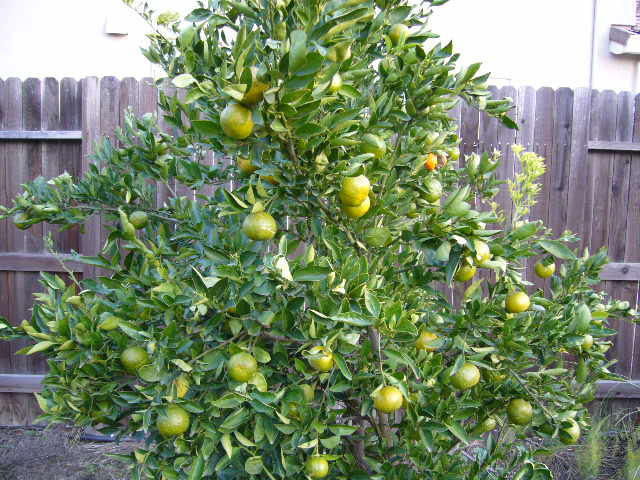
Bearss Lime Tree
The best part about this time of the season: It has to be the fresh citrus -- like the fresh Bearss Limes pictured above. This is the third year of production for the Bearss Lime that Venus and I planted into a barren side yard, and we're off to a nice little start. The lime appears to like where it's planted. It's growing quickly. And, after yielding a single, solitary lime last season, we've jumped ahead this year to about 30-40.

Not bad if I say so myself.

But the Bearss Lime isn't the only citrus tree offering in the North Natomas Ranch that's showing impressive color and production this year. Thanks to some mighty fine advice by a rather popular NewsTalk 1530, KFBK Garden Talk Show host -- the Birds are harvesting one of the sweetest, tartest pieces of citrus that I've ever tasted.

Ripe Owari Satsuma Mandarins
I wanted to plant the sweetest variety of citrus I could find. Venus, who is not a fan of the seeds found in the Dancy Tangerine, wanted something seedless. Farmer Fred Hoffman didn't think twice when he responded with the advice of "Owari Satsuma Mandarin."

I searched high and low for that Owari Satsuma Mandarin before I settled on a tree that had just been delivered to my local Home Depot. In most cases I get most of my fruit trees from local nurseries because they offer the Dave Wilson selections that I'm searching for, PLUS, the stock is better quality than what you'll find at your local Big Box Store. Plus, nurseries tend to stock those hard to find varieties that other places don't.

Owari Satsuma Mandarin: Year 1
But the story is different when it comes to citrus. Four Winds Growers, located in Winters, CA, is the primary supplier of citrus trees to all nurseries AND big box stores in Northern California. Nurseries tend to get better looking stock upon delivery, but if you camp out at your local big box store at just the right moment, you just might find yourself a steal of a deal.

That's where I discovered the Dancy Tangerine, loaded with bright orange tangerines I might add (a salivating sight to any lover of citrus), four short years ago. It's where I also picked up the Owari Satsuma just last year. It had just been unloaded from a delivery truck, but didn't last long in the Home Depot nursery aisle. It was the best looking one of the bunch delivered on that cold December day, and I must admit it looks pretty good in the backyard.

Dancy Tangerines
Although the vast majority of citrus ripens in the fall, not all varieties are ready for harvest at once. I was pleasantly surprised to discover that the Owari Satsuma started to ripen in October and is now delivering a sweet and tasty crop of mandarins. The Dancy Tangerine, meanwhile, is still green. Based upon harvests from the previous years, these won't start coming ripe until around Christmas. That's right about when the mandarins will begin to play out.

As for the Meyer Lemons? The news is both good and bad. We have a heavy crop on one tree -- and nary a lemon to be found on the other. I was also rather SHOCKED to discover that the larger of the two Meyer lemons was GROWING multiple shoots and branches in this cold fall weather, after not doing much of anything this spring.

Fall Growth on the Meyer Lemon
Good news? I suppose so. But if a cold frost should decide to hit in the next week or six (some winters are worse than others), those tender new shoots are toast. They will freeze. They will burn. They'll turn a none-too-pleasant shade of black. I'd rather the Meyer Lemon send out loads of new growth in the spring, but let's be honest: Meyer Lemons don't exactly cooperate with what the owner wants. I suppose I should be happy with the new growth spurt and leave it at that.

Despite the good news, we're not done yet. In fact, you could say we're just getting started. We manage to plant something new every year -- and this year is no different. South Natomas grower and citrus aficionado Nels Christensen gifted us with a Cara Cara Orange tree late last spring and it is still sitting in a pot, waiting for its permanent home. The process of grafting will soon yield other varieties of citrus. Short and sweet? There's a long way to go.

I could write all day about citrus -- but alas -- it's time for dinner. Tonight's offering? Turkey Pho, with leftover turkey, and pho broth generously sprinkled with fresh lime juice.

A Bite of a Vine-Ripened Tomato...

Remains of the Bird 2011 Heirloom Tomato Garden
It's a slice of heaven. It sure is. That taste. That texture. That wonderful, tangy surprise of a summer fruit is all but a distant memory now. This is the current state of the Bird tomato garden in late November. Fairly sad isn't it? They are still producing here and there, which is one reason why I haven't torn them out yet and moved on.

It's hard for me to admit that the season is over. What is coming off the vine now cannot compare, in any shape or form, to the tasty treats that the wife that is Venus and I enjoyed earlier this summer. But it's also loads better than the tomato shaped rocks you'll find in your local produce department these days.

At some point -- the 2011 summer garden will be removed and I will be forced to admit that it's all done.

I'm just not quite there yet. If you live for backyard gardening like I do, winter is a lonely time indeed. But, before this garden is indeed removed and plowed under, it's high time we look back to the summer favorites from 2011. There are some new entries on this list. As with any summer tomato garden, some varieties did well and others -- well -- better luck next year!

OUTSTANDING:

Eva Purple Ball Tomatoes
1. Eva Purple Ball: This was a new entry to the Bird Back 40 home for wayward heirloom tomatoes. I'd heard about this variety from other growers across the country, but again, what does well in New England or Arkansas doesn't necessarily translate into guaranteed success on the Left Coast. Growing heirloom tomatoes is a crap shoot anyway. Some do well, some not. Put this one in the "Did Very Well" category. A single bush yielded 50-80 gorgeous slightly pinkish, slightly purplish large tomatoes, some very close to the 1 lb. range. You'll find this tomato in our salsa, tomato sauce and whole tomato canning efforts from this summer.

2. Marianna's Peace: After a rather poor showing last season, MP bounced back in a rather eye-popping fashion this year. Our plant was susceptible to some early Blossom End Rot (BER) problems during the spring, but those vanished as the weather warmed. MP is one of the best tasting heirlooms I've ever tasted, and it wasn't unusual for this vigorous plant to set four new tomatoes at once. That's always a good sign.
3. Black Krim: One of the tastiest offerings in the field of black (or purple) tomatoes. When a single Black Krim bush delivers a bushel of 40-50 tomatoes? It's a good year.
Stupice Tomato
4. Stupice: If you can describe Stupice with one word? It would have to be WOW! Outstanding production from a variety that wins in backyard gardens from East to West and all points in between. Stupice sets tomatoes in large clusters, much like small cherry-sized tomatoes. They grow to about the size of a golf ball or larger. Not the best processing tomato due to size, but perfect for salads, snacking in the yard, or fresh salsa creations (fresh Rooster's Beak?). If you have room for just a few plants in your yard, I highly reccommend this productive variety.
5. Campbell's 1327: I don't know if I'll ever be able to thank the person who saved this variety from the brink of extinction, but they deserve some sort of recognition. Once the standard-bearer of processing tomatoes used in Campbell's Soups, it was tossed aside and abandoned for those hard-as-a-rock processing tomatoes that can withstand bruising on bumpy trips down long country roads from farm to processing plant. Campbell's 1327 is one of my "Reliable Reds," and produces bushel after bushel of round, red and ripe tomatoes that are blemish free and tart on the tastebuds.

GOOD:

1884 Tomato
1. 1884: Seeds for this variety were provided at the last moment by Sacramento gardener Nels Christensen. I can see why he's partial to it. 1884 delivers large, meaty red tomatoes that reveal a surprising orange-colored flesh once they've been sliced open in the kitchen. A wonderful processing tomato and perfect slicing tomato for those big barbequed turkey burgers that deserve a big slice of tomato on top. Originally discovered in 1884 by a Mr. Williamson in the debris after the big flood in Friendly, West Virginia, this variety will find home in the Bird Back 40 again.
2. Green Zebra: It's been a few years since I've been happy to report a large haul of green zebra tomatoes, and this was just one of those years. My former boss at the workplace, who is rather partial to this variety, received his fair share of the crop. It wasn't unusual to pick anywhere from 10-15 tomatoes during weekly harvests, which makes for a pretty darn good year.
Thessaloniki Tomato
3. Thessaloniki: It doesn't roll off the tongue easily, but this was one productive plant in the Bird Back 40. Thessaloniki is a rare Greek heirloom, introduced to the USA in the 1950's by Glecklers Seedsmen, Ohio. Nice production, nice size, outstanding old world tomato taste. The only reason this particular variety didn't make it to the outstanding list is that it is just a common red tomato.
4. Celebrity: It's the only non-heirloom that found it's way into the Bird tomato crop this year, and for good reason. You can depend upon a bushel of round, red, ripe and mostly disease free tomatoes from Celebrity. While other varieties susceptible to disease battled Blossom End Rot, Celebrity stepped up to the plate in a big way with some nice production.
5: Evil Seed: A big, beautiful black beefsteak type tomato that I will never the true origin of. The original plant was delivered to my desk several years ago with the name "Rainbow" attached to the side. The funny thing is, there is no Rainbow tomato that I know of -- especially a black tomato variety. The gentleman who produced this offering wound up doing some none too kind things to his wife and children, thus the wife stuck it with this unfortunate name. It's an unfortunate story for a great tasting tomato.

JUST PLAIN BAD:

No Brandywines in This Bunch!
1. Brandywine: It kills me to put this variety on my list because I absolutely LOVE Brandywine tomatoes. Although I was encouraged by some early season production, most developed BER and the plant just petered out on me by the time July rolled around. When the backyard garden produces one or two Brandywine tomatoes? It's generally not a good year. I hope for better luck next year.
2. Yellow Brandywine: Jeez -- what a Debbie Downer I am. Two varieties of Brandywine in the Bird Back 40 and I get squat. Yellow Brandywine was an absolute bust. Several seed sources do note that this variety can be "finicky to grow," and I can confirm as much. I will not attempt to grow this variety out again.
3. Mortgage Lifter: I either can't find a reliable seed supplier for this variety, or I'm just having the worst of luck. This marks my third year for growing this treasured heirloom, and while I do receive a few of them, it's not enough to warrant that much space in the Bird tomato garden.
4. Azoychka: This is one of my favorite Russian heirlooms, and after some rather encouraging early season production, Azoychka started to produce golf-ball sized tomatoes that were really nothing to write home about.
Processed Tomatoes Ready for Winter Storage
5. Bloody Butcher: I'm surprised this one landed on this list because Bloody Butcher is normally a wonderful, early-season producer. Not this year. It didn't produce early. It didn't produce late. It didn't produce much at all, and BER took most of them.

And there you have it. Although these 15 varieties represent half of what we grew in the Bird Back 40 this year -- these are the varieties that stood out the most in terms of production or disappointment. Other varieties that at least deserve an honorable mention include Caspian Pink, which grew well in the in-ground test bed and produced some very tasty tomatoes late in the season. Cherokee Purple is yet another treasured variety that did moderately well, as did Kelloggs Breakfast, Beefsteak, Druzba, Lemon Boy and Jubilee.

As 2011 begins that slow slide into 2012 -- all that's left are the memories of last year and the promise of what is to come.

A "Phenomenal" Pumpkin Year...

Monday, October 31, 2011

Ultimate Digging Machine Shows Off Pumpkin Haul
That's the lesson that you'll learn if you read today's posting from Debbie Arrington in the Local News Section of the Sacramento Bee. It's been a rather special year for pumpkin growers -- or so says a couple of local growers who specialize in growing out thousands of Jack O' Lanterns that will be glowing from near and far tonight.

And -- after getting to the last of the Bird 2011 harvest just yesterday -- who am I to disagree? The wife that is Venus and I have grown pumpkins before. But we've never grown them in quite this amount. I have pumpkin vines that cover a quarter of the Bird Back 40 and seem intent upon growing over the fence and into the neighbor's yard.

Lame Attempt at Pumpkin Carving
That's gardening! Some years are better than others. In some years -- some crops do extraordinarily well. And -- some don't. Call 2011 the "Year of the Jack O' Lantern." There are more than enough to go around.

What are Bill & Venus Bird doing with their cash crop of pumpkins this year? I thought strongly about a pumpkin toss or pumpkin catapult -- but both ideas were nixed by the wife. She just can't understand why grown men would want to see a perfectly round pumpkin get tossed into the air -- only to splatter into a zillion pieces and streams when they hit the ground.

Bill Bird says, "cool!"

Pumpkin Pie Anyone?
We are finding some traditional uses -- however -- for the 2011 crop. Venus and I grew three different varieties of pumpkins this year -- including the smaller and sweeter variety that will be used for all things pumpkin pie, pumpkin bread, pumpkin barley soup and, of course, who can possibly forget the pumpkin martini. I've found -- from experience -- that you can make martinis out of just about anything from the garden.

This is -- provided you have the all important added ingredient of fermented juniper berries -- of course.

The seeds from our carved pumpkins also went to good use I might add. There's nothing quite like roasted pumpkin seeds using a mixture of a little bit of butter (OK, a lotta bit of butter), worscetershire sauce, honey (from the Hello Kitty Hive) and seasoned salt. Mix it all up -- throw it in the oven -- and Voilà! Burned pumpkin seeds! Tasty too!

Some Gourds Not Quite Ready for Show
As for the pumpkin vines that I've nurtured through the summer -- they are starting to show some signs of wear and tear. The constant hum and din of honeybees that I noticed earlier in the summer has subsided quite a bit recently. That may be due to cold nights and cold mornings in the Sacramento riverbottom, and it can also be the fact that our colony has found a new source of pollen somewhere. Once the weather warms, it's not all that unusual to see them flying off over the fence in search of...something.

Perhaps they found some Juniper berries to pollinate? A man can dream, right?

HAPPY HALLOWEEN!!!

Bill Bird's Burned Pumpkin Seeds (A recipe)

This works well with seeds from just one pumpkin, or five. You may want to increase or decrease the amount of butter used, depending on the amount of seeds. The amounts listed below were used for seeds that had been collected from four different pumpkins

Seeded Pumpkins
1/2 stick of butter
2 tablespoons worcestershire sauce
2 tablespoons honey
1 tablespoon seasoned salt

Directions:

Clean seeds, removing as much pumpkin residue as possible. Soak seeds in water for at least 30-45 minutes. Drain, and pat dry with paper towels.

Melt butter in saucepan or microwave, add worcestershire sauce, honey and salt and heat slightly again if using a microwave. Mix well.

Add seeds and butter mixture to bowl and stir to coat well. Spread evenly on baking pan with raised edges and roast at 250-300 degrees for one hour (it may need more time if you have a lot of seeds). Stir every 15 minutes.

The end result will be sticky to the touch, until they are allowed to cool and dry.

Sacramento's Most Eligible Bachelor is a Real PEACH!!!

Friday, October 21, 2011

Loaded Elberta Peach Tree
Somewhere -- a peach tree lives. An Elberta Peach tree at that. Smack, smack, that's good eating folks. If all goes to plan, this Elberta tree will produce its first crop of peaches next year. There's nothing like a tree-ripened Elberta peach in mid-August. I didn't get nearly enough of them this year.

Take notes children. Because this just might be a question in Trivial Pursuit someday. Do people even play Trivial Pursuit anymore? Or is Bill Bird just showing his rather ancient age?

This is a nice story.

Sacramento's Most Eligible Bachelor Likes Babies (and peaches)
Sacramento's most eligible bachelor is this man to your left, ladies. His name is name is Eric Dietz, and he is, indeed, Sacramento's Most Eligible Bachelor, as proclaimed by "Girls on the Grid." Eric, who serves as Legislative Director for Assemblymember Allan Mansoor (R-Costa Mesa) grabbed the lofty title last February, beating out ten other deserving (or so I'm told) contestants.

This story stretches back to the month of March, so please bear with me. Some explanation is in order.

We do a lot of reading here at the State Capitol. The amount of written material astounded me a bit when I first arrived here and was given instructions to "read this." My first thought was, "will there be a test?" That answer would be a gigantic yes, but I really would learn the reason for the accelerated reading curve until much later.

It's not the kind of test that this former television and broadcast reporter turned public relations pro was expecting.

California State Capitol
If you're going to work in the halls of the State Legislature... No -- let me rephrase that: If you find yourself lucky enough to be afforded the wonderful opportunity to work inside one of the most historic buildings in all of California -- you had better be "informed." That is -- you need to know about a lot of different things. You don't need to be an expert on everything mind you -- but the worst crime that you can commit as a State Capitol staffer is to be caught "uninformed."

The State Legislature deals with every topic under the sun -- and 100 times more than that. Subjects range from Apples to Zebras (A-Z) and everything else in between. Not only are you REQUIRED to know about these subjects, it's also a good idea to understand the competing views that each subject offers. Not everything is "black and white" here under the dome. Some issues are several different shades of gray. And, as a State Capitol staffer, it's in your best interest to not only know about each and every issue -- but also know about and understand the competing views that each issue offers.

The worst, most possible, crime that a legislative staffer can commit is to answer a phone call from a constituent and utter the words: "I'm not aware of this." Why is this so bad? It sends a terrible message to a voter that a legislator THEY voted for has hired someone who is rather clueless about an issue that the voter is VERY concerned about. And, the thinking goes, if the staffer is uniformed, what about the legislator? That's not good people.

Read these-Test Later!
Committing a crime like this leads to a very bad day or week at work. Bill Bird knows this all too well from experience. Don't ever be caught off guard. The only way to stay on your toes is to read, read, read and then read just a little bit more. Read until your eyeballs literally turn red (and then read a little bit more). Read -- because you will be tested. You never know when the surprise "pop quiz hotshot" is coming -- but it will come. That much, you can depend upon.

In some cases -- the people who represent these different issues will bring them right to your front door in the form of visits to the State Capitol Office. Staffers in a State Capitol office will meet with a lot of different people. Sometimes? The issue can be a simple one. Group A visits in the morning to urge the legislator to consider a hike in taxes. Group B visits in the afternoon to urge the legislator to avoid a hike in taxes.

But it's not always that simple or cut and dried.

One group that will bring its issues to the front door is the California agriculture industry. This is a rather important industry as one might expect, and it covers ALL issues of agriculture, not just one. The industry will often hold what is billed as "Agriculture Week" (or Ag Day), where staffers are encouraged to visit ag related fairs and booths that have been erected on the grounds of the State Capitol.

It's not unusual then, for the fresh flower industry, to drop off a vase of flowers at every State Capitol office. One year I actually picked up an entire year's supply of radish and carrot seed packets that were offered by the thousands. California beekeepers also show off their wares, usually in the form of a demonstration hive. It's also a good place to pick up pens or pencils that are used on the job (I have a particular attachment to my VIAGRA pen -- but that's a different industry).

But this past year, the nursery outlet known as Green Acres took Ag Day one step further. In an effort to promote fresh fruit season -- and the end of bare root planting season -- Green Acres presented each legislative office with a bare root fruit tree (grown by Dave Wilson Nursery, of course). Not every office received the same variety of tree either. Some received apples, others got nectarines while still others received peaches.

Now, while I thought this to be a rather dandy and inventive idea, it also troubled me. Although the office that I work in received an O'Henry Peach tree -- I needed another peach tree like I needed another hole in my head. I have enough of them, thank you. Fortunately -- the tree did find a good home.

Bare Root Fruit Trees-Capital Nursery
But -- there are 120 legislative offices in the State Capitol. That's 40 offices in the State Senate, plus another 80 offices in the State Assembly. That makes for 120 bare root fruit trees. Although our tree found a good home -- I wasn't as positive about the others.

The State Legislature has changed somewhat from the day I first stepped through the front doors in 1999 as a wide-eyed, 36-year old, rookie. Before the era of term limits took over -- staffs and staffing levels didn't turn over that much. It wasn't unusual for a person to work 25-or-30 years for just one or two different legislative offices. There wasn't much turnover.

That abruptly changed when term limits took effect in 1990. By the time I arrived in 1999? Many established legislators had already departed. Some were still around, but not for long. The same rule of thumb also applied to legislative staff. People who had been working in the State Legislature for a very long time were moving on as well. The culture of change had taken hold.

The point I'm trying to make here is this: Many legislative offices are staffed with very young and very bright and talented people who haven't reached the age where they are thinking about home ownership just yet. Many legislators who serve here don't own homes in the Sacramento area, they choose to rent an apartment close by the State Capitol instead.

My fears -- which proved to be well-founded -- was that a lot of these bare root fruit trees would be abandoned and left to die somewhere in an office corner. That's an orchard worth of fruit trees gone to waste -- and as much as I love fresh fruit -- that bugged me a bit. So -- I decided to play the role of "adoption agency."

I crafted an advertisement for a publication called the Senate Daybook, and after borrowing a few choice lines from a famous statue located on Liberty Island in New York Harbor, the ad I placed looked a little like this:

"Give me your tired, your poor, Your huddled FRUIT TREES yearning to breathe free. If your office received a fruit tree delivery that hasn't found a good home, give it to me! I will make sure it finds the safety of a fruit orchard or backyard where it can live free."

Or something to that extent.

I was besieged, almost immediately, with a great many offers the moment this ad hit email inboxes. But they weren't quite the offers I was expecting. As it turns out? More people WANTED these trees than those who actually had them. One legislative staffer "gladly" offered to take fifty or sixty trees off my hand for an orchard she was planning.

Black Tartarian Bare Root Cherry Tree
There was just one eensy, teensy problem. I didn't have 50 or 60 trees. I didn't even have five. Getting just one of them was proving to be difficult. Perhaps my fears of trees left in an office to whither and die were misplaced?

As it turns out, not entirely. Slowly, one by one, the fruit trees rolled in. An unwanted Fuji apple here. A Black Tartarian cherry tree there. And I made sure -- as each one came in -- it went straight out to someone who promised to give it a good and proper home.

It was on one such hunt for forgotten trees that I entered the office of Assemblymember Allan Mansoor, where a young man handed me the gift of an Elberta Peach tree. As he smiled and turned away, his co-worker (a Sacramento Vegetable Gardening blog reader) pointed out: "That's Eric Dietz, Sacramento's most eligible bachelor."

And now you know why Sacramento's Most Eligible man is a real peach.

Sumthin Scary in the Bird Back 40...

Tuesday, October 4, 2011

Bird Back 40-Side Yard Test Bed
The photo to your immediate right is the state of just one part of the Bird Back 40. Scary, isn't it? When you see weeds THAT big? How did that little tiny weed reach a height of six feet? Why can't I see the back fence anymore? What is that traversing around and through the citrus trees?

That -- my good friends -- is a series of pumpkin vines that the Wife That Is Venus and I planted earlier this spring in the Back 40 "Test Bed." Keep in mind -- I've grown pumpkins before. But I've never experienced vines like this. They have extended 40-to-50 feet beyond where the seeds were originally planted and are intent upon growing right over the fence and into the neighbor's yard.

I hope the neighbor likes pumpkins.

Pumpkins here-Pumpkins There!
I know what you're thinking. What good are pumpkin vines if you don't have any pumpkins on them? That's a good question. Don't worry. Pumpkins I got. Way, way, way too many pumpkins. In fact, I'm not really sure how many I actually have. When the vines started to take off and grow Every Which Way but Loose during the summer, I sorta lost count.

At first? I thought it was kind of cute to have a pumpkin growing off a stalk of corn. What's that growing on the Caspian Pink Heirloom Tomato bush? A pumpkin! Pumpkins hanging from the Meyer Lemon tree? Grapes the size of pumpkins? Or just pumpkins? Short and sweet: The pumpkins are everywhere.

Note: This is what happens when you plant three different varieties of pumpkin seeds. You tend to get a LOT OF PUMPKINS.

Mass of Pumpkin Vines and PUMPKINS!
Mental note: Do not make the mistake of planting watermelon and cantaloupe seeds in the general vicinity of pumpkin seeds. Pumpkins will overtake them -- cover them  -- and essentially starve them of sunshine and nutrients. If you make the same mistake as I did -- and plant pumpkin seeds near melon seeds -- you will get lots of pumpkins.

And not much else.

Although it's probably now safe to tear out the vines and place the pumpkins in a pile in the Bird Back 40 -- I'm going to leave them in for as long as I can. We will get around to harvesting pumpkins for the all important holiday of Halloween -- and of course of pie and bread purposes (one of the varieties is a sugar-sweet pumpkin that is perfect for these types of creations). But I'm going to keep the vines going for as long as I can.

If this means I'm still growing pumpkins in December -- so be it.

Pumpkin Vines & Pumpkin Flowers
There is a method to my madness. The summer growing season is now coming to a close. All important sources of pollen that honeybees need to survive and thrive are starting to dry up. In response? Colonies are preparing for winter.

But if there's one thing I've learned? Flowers produced by pumpkin vines are like CRACK for worker bees. They are large producers of the pollen that bees need to survive and thrive. The pumpkin patch literally hums and buzzes with bee activity in the early morning and afternoons. There's not much left in terms of pollen producing plants, shrubs and trees. And I have pumpkin flowers coming out of my ears.

It would be shame to tear them out while they are still producing. So -- for now? The vines stay. This means the Hello Kitty Colony of bees will have a continuing source of pollen -- and won't suddenly turn defensive when the last pollen source vanishes. Defensive colonies are difficult to deal with. One wrong step invites a "kiss" (sting) from the hive.

Sugar Sweet Pumpkin
I'd rather avoid that if at all possible.

And so -- this is my very scary tale. Halloween is fast approaching. That means little ghosts, goblins and ghouls in the neighborhood and perhaps a Spiderman or two. If you happen to run across a home that is ablaze with lighted pumpkins, come on in and make yourself at home.

You've arrived at the Bird Back 40. The kegerator is located just inside the garage and to your right.