Down the Stretch They Come...

Saturday, February 23, 2013

Momotaro Tomatoes
Momotaro. That's the answer to the annual Bird Heirloom Tomato Contest of: Guess which variety of tomato seed germinates first? NeCole Brownwell Scott of Antelope, CA was on top of her game with her guess of Momotaro, which isn't all that surprising since she's a Tomato Maniac herself. For her brilliant perception and forecasting skills, NeCole wins her choice of two tomato plant starters from the Bird 2013 starter crop.

Yes indeed! It might be a bit chilly outside, but this is prime seed-starting season for backyard enthusiasts like the wife that is Venus and myself. Once again employing the seed-starting rack setup that we employed last year for the first time, Venus and I are growing many treasured favorites from the past plus quite a few new varieties this season.

Seed Starting Rack
One of those new varieties? Momotaro. While the variety certainly isn't new, it will be a new addition to the Bird Back 40 tomato crop later this spring. Momotaro, as you might have deduced, is a Japanese variety. It's one of the most popular varieties in Japan thanks to its legendary productive status. The fact that it's named after a legendary Japanese folk hero (it loosely translates into "Peach Boy" in English) also might help.

The story and legend of Momotaro was heavily promoted by the Imperial Japanese government during World War II. It should come as no surprise then that the "demons" that Momotaro was sent out to fight lived at a well-known United States naval base called Pearl Harbor.

Bingo Tomato: Impulse Purchase: Lockhart Seeds
I suppose this is one of the many reasons as to why I like growing as many varieties of heirloom tomatoes that I can get my greedy little hands on. Each one represents a little slice of international history. The story of Momotaro, the folk tale, and Momotaro the tomato, represents one of those interesting little discoveries.

How does the old saying go? Learn something new every day?

Venus and I set out on our planting adventure last Sunday, February 17th, just a day after this seed starting article appeared in the garden section of the Sacramento Bee. Some people start a week or two earlier than this. Still others start out a week or two later? Point is? The goal is to have starter plants ready to set out in the garden by May 1st, or Farmer Fred Hoffman's birthday if you will.

Germination after five days: Momotaro Tomato
Once again, we have outdone ourselves. 120 starter plants now sit under a collection six shop lights in a spare Bird bedroom. Believe it or not -- we have room for even more. We're not even using the bottom rack (yet), which would provide room for 40 more plants. And we haven't even considered using the top rack yet... Though I suppose that will come with time.

Point is? With a cheap metal rack and a few shop lights? You can do some serious garden damage. And that's just what we intend upon doing this year.

Of course -- not all of these are tomato plants. I WISH I had room for 120 tomato plants. I'd be in tomato heaven, as would every neighbor on the block. But our collection also includes a number of sweet and hot pepper varieties. These will come into use when it's time to can the legendary Roasted Garlic, Pepper and Heirloom Tomato Salsa. Venus also has about six different varieties of basil that have already germinated and are growing quite well.

Siam Queen Basil Seeds
Why have just one variety of basil when you can have all of them? Genovese Basil is a "must have" in any garden and one of the most popular starter plants you'll find at any garden store. But why limit yourself to Genovese -- when the hot variety of Siam Queen Thai purple basil beckons? Like a hint of lemon in your basil? There's always the popular Lemon Basil. Point is -- there's a basil for every dish.

Venus didn't just limit herself to vegetable garden selections with her seed starting efforts this year. Nope! With an excellent and hard-to-find selection of flower seeds purchased from Lockhart Seeds in Stockton, this year's indoor starting effort includes multiple flower offerings that you probably will not find at you local gardening store.

Love Lies Bleeding Seeds
Sure -- you can find your ordinary, run-of-the-mill, marigolds and petunias at your local Big Box Store. But if you've got your heart set on something called "Love Lies Bleeding," or "Oxford Blue Scabiosa," I hope you got it started early at home. The point is? We want our front and back flower beds to contain items that you just don't see in those everyday, mass planted gardens.

Seed starting is one of our favorite rituals. It's one of those "together" things that we both enjoy. The payoff is a fun afternoon and a summer's bounty of delicious tomatoes and flowers that bring a riot of color to the Bird Back 40. It's also a chance to share and trade with others who have been bitten with this gardening bug. One afternoon of seed planting brings out a season of beauty. Try and find a downfall to this. I've tried. I can't.

Afternoon of Fun
There is nothing quite like the joy and satisfaction that comes when the first seedling pops to the surface, or that first starter plant produces its first tomato, first pepper or first bite of fiery basil. I keep thinking of what the backyard flower gardens will look like when our Desert Bluebells or Penstamon Blue fire up into a riot of flower beauty.

Yes, I suppose this is a bug. Call it a twitch if you want. Disease works just as well. Just count me glad that I have it.

Bird 2013 Heirloom Tomato Garden


Agro 410
Arkansas Traveler
Beefsteak
Believe It Or Not
Berkeley Tie Dye
Big Zac
Bingo
Black Cherry
Chadwick Cherry
Cherokee Chocolate
Cherokee Purple
Costaluto Fiorentino
Dixie Golden Giant
Eva Purple Ball
Grushkova
Lemon Boy
Lush Queen
Magnus
Martha Washington (last year’s top garden performer)
Momotaro
Mr. Underwood’s Pink
Polish Giant
Pruden’s Purple
San Marzano
Schilling Giant
Siletz
Solar Fire
Sungold Cherry
Tangerine
Valencia
X-Large Spanish
The Samad Method

Sunday, February 10, 2013

Open! Open! Open!
I can feel it. Can you? I shouldn't be inside typing. I should be outside, digging in the dirt. The weather is warming. Do you feel that sunshine on your back? Does the sun look just a tad brighter than the normal winter blah? Look closely. Is that daffodil about to pop open?

Spring is on its way. I should be outside amending the raised beds in anticipation of the onion starters that will arrive next week from Dixondale Farms. After last year's grand experiment produced some whopper and good tasting onions, the wife that is Venus and I doubled up on the order this year. We ordered one bunch each of red, yellow and white. One bunch equals about sixty onion starter plants. That's 180 onions. Think that's enough?

Bing Cherry Graft to Royal Rainier Cherry Tree
The onset of this February blast of spring-like conditions also tells me something else: I'd better get moving and finish off the projects on the grafting front. With the stone fruit trees in dormant stage, Bill Bird has been playing the role of "Johnny Appleseed" in one Frankensteinish grafting effort after another. Why be stuck with two or three peach varieties when you can have 20?

I documented last year's amateurish grafting efforts here. Using my handy-dandy 3T EZ grafting tool, I set about the yard grafting scion branch after scion branch to one fruit tree after another. The result? Amazing success on the pluot and plum trees! But I struck out on the peach, cherry and nectarine grafting efforts. Not a single branch took. So what went wrong?

3T EZ Grafting Tool
Nothing, really. I'm still learning at this craft. Greater success comes with experience. The more you graft? The better you'll get at it. Your success rate will go up. So, when you look at it from that angle? I did pretty good. But I can do better. This year I am employing a new method learned at the hands of an Iranian-born Sacramento resident who taught me a grafting technique I'd never seen performed before.

His name is Samad (or Sam) Jaufeshan. And his Sacramento backyard is loaded with testament after testament to his grafting skills. When you come across a grower that has 42 different varieties of table grapes that have been grafted to less than ten grapevine stumps, it might be a good idea to stop, look and listen. I first met Sam during my miserable and failed attempts to graft Duke avocado tree scions to avocado root stock.

Standard Grafts Using the 3T EZ Tool
The 3T EZ grafting tool I had employed that first year is a good tool for beginners and it's a tool I will continue to use. But this type of grafting does have it's drawbacks. The V-Graft, for example, requires you to find a branch on a tree that is about the same size of the scion itself, which isn't always easy to do via the naked eye. Secondly, both the V and Omega grafts require you to pick a branch that is the farthest away from the fruit tree trunk. As you get closer to the trunk, the fruit bearing branches get to be very large -- an inch or more in diameter.

I do not recommend hacking off a large branch to perform a graft like this. It's likely to fail and leave you with a gaping hole in the tree itself. This is not a good idea.

Samad Method: Skin Grafting
But the "Samad Method" as I've come to call it now (also known as t-budding) does not rely upon grafting one branch to another. It doesn't require you to "search out" and find the "perfect fit." It allows you to graft on any branch, or even the trunk of the fruit tree itself. The "Samad Method" is simple, yet successful. I say this because I have three grafted Duke avocado trees to prove it. At least one of them will find a home in the Bird Back 40 this spring.

Let me back up a moment and say the Samad Method "seems" to be simple when you see it performed. However, like any grafting attempt, experience counts. My first few grafts using this method were, in a word, bad. But practice makes perfect. The last few grafting attempts have been right on the money.

Common Box Cutter Turned Skin Grafting Tool
Another plus? This grafting technique does not require the grafter to hack off fruit bearing branches. It also allows the grafter to make ten grafts instead of one or two. Every inch of the fruit tree in question is open to this method. You're not limited to one small branch that is at the furthest point from the tree trunk itself.

The "Samad Method" involves taking skin from one fruit tree scion branch and grafting that bit of skin to the skin of a fruit tree. Rather than "branch to branch," it's the skin of one bud cut from the donor branch to the skin of the recipient tree. This requires a couple of things: a bit of practice and razor sharp grafting tool. There are some grafters who employ actual surgical tools for this type of procedure, so caution is a must.

T-Cut Into Cherry Tree Branch
Each scion branch contains anywhere from five to ten buds. This means one donor branch can provide five to ten grafting opportunities rather than the ONE that is offered with the V or Omega grafts. This is why Venus' Royal Rainier Cherry tree holds eight Bing Cherry grafts instead of one or two. I don't need all eight to be successful, although that would be a riot, wouldn't it? No -- as long as one survives and grows -- I will have accomplished the task at hand.

This grafting technique allowed me to graft four Loring Peach buds onto the trunk of my O'Henry fruit tree. It allowed me to place four Suncrest Peach buds on the strongest branches of the June Pride Peach tree. Four of the strong, fruit bearing, branches on the Fuji Apple tree hold Braeburn Apple grafts. There's more to list here, but I'm sure you get the idea.

Bud Inserted Into T-Cut
And now the $64 question: Will this method work? I've seen it work in another backyard, but Sam has a 40 year head start on my growing and grafting efforts. As with any gardening experiment? Only time and patience will tell. When the first buds of spring emerge I'll either have a large smile on my face, or it's "more practice needed."

Heaven Comes in a Seed Packet

Monday, February 4, 2013

Seed Haul: Lockhart Seeds
Now that is a beautiful sight indeed isn't it? That little bundle of seed picture to your right comes from the "Best Little Seed House in California!" I am, of course, referring to Lockhart Seeds, located in the most romantic city in the world: Stockton, CA. Trust me on this: "Date Day" at Lockhart Seeds with the wife that is Venus is an event for the ages.

Sadly, we haven't had a chance to visit much. And the fine folks at Lockhart Seeds don't make it easy on us weekend warrior type garden punks (sorry, Katie). They're not open on weekends. They're closed on most major holidays as well, as we would rather unfortunately discover during a President's Day holiday two years ago. The doors were locked as tight as a drum.

The Most Romantic Spot in Stockton
If you happen to work full-time like the both of us -- there are only two options. One, duck out early at work. Two, take a vacation day. We opted for Choice #2. We figured that we could follow up a 49ers blowout victory in the Super Bowl with a celebratory trip to Lockhart Seeds the every next day!

Yeah, uh, unfortunately the 49ers didn't cooperate. But that's a story for another day. There's always next year.

As I've mentioned before in a previous post about Lockhart Seeds, this place hasn't changed much since the day it opened. This is as old as a storefront as you're going to find still standing anywhere in the San Joaquin Valley. It's a throwback to the day when major department stores were still located in old downtown buildings. Shopping malls? Never heard of em'!

Still in the same spot! Check!
From the heavy wood door that requires some effort to push open to wood floors that creak, you get the impression that generations of small farmers and gardeners have walked these aisles before you. And you just might be right. It's been quite some time since tomato seeds were sold in containers resembling V-8 juice cans. But you'll find them stashed in a corner here and there with gardening implements that are nearly as ancient. I've come to discover that Lockhart Seeds is half store and half museum.

If you're a nutcase gardener like me and the wife? You could spend hours in this place and never get tired. Store employees might get tired of you as you walk up each aisle again and again and again, but the Lockhart Seeds experience is one to be savored. This is truly one of Stockton's tiny treasures. Most seed stores in California up and vanished eons ago. But Lockhart Seeds not only survived the onslaught of the big box retailers, they've thrived in a niche market catering to nutcase gardeners and small farmers.

Lockhart Seed Bank
In a frantic pursuit for peppers? Fishing for some fennel? Hunting for Honey Dew melon? You get the idea. You're going to find it against this wall or in that row. A world of discovery awaits. Don't for a moment think, "you can't grow that here." Because, if they sell it at Lockhart Seeds? You can "grow that here."

Lockhart Seeds is also one of the few places that didn't rush headlong into the heirloom vegetable craze that's sweeping the country. It got its start with heirloom tomatoes, but has now branched out into heirloom melons, heirloom asparagus, heirloom radishes and, yes, even heirloom peach trees (See: Hale Peach). What Lockhart Seeds does offer is even more valuable: tried and true varieties that produce and produce well in our hot summer climates.

Franchi Sementi Spinacio (Spinach)
You'll also run into seed providers not often found anywhere in California, such as Franchi Sementi (Sementi is the Italian word for seeds). I've heard of this seed company, but never saw any of their offerings until I walked into the front door of Lockhart Seeds. Franchi is a rather big name in the seed business. Seems they've been around for a spell. How long you ask? Well, I'm glad you asked!

From the website: "In 1783 (the year the American Revolution ended) Giovanni Franchi started selling seeds around the market squares of Parma from his horse-drawn cart. The company is still in the same family 229 years later, with Giampiero Franchi at the helm and modern facilities in Bergamo, near Milan."

One of each please!
Remember! You asked!

Lockhart Seeds also offers another advantage not found in your local big box stores. Sometimes? It's more economical to "buy in bulk." Costco shoppers will understand this. Why purchase a small packet of cilantro seeds for $2.69 when a quarter-pound of the good stuff can be had for just thirty cents more?

It's safe to say that Venus and I departed Lockhart Seeds with enough vegetable seed to plant our spring and summer garden, plus the entire neighborhood's spring and summer gardens. Does 15 packets of green onion seed sound like a little too much?

Come to Papa...
Bill Bird loves his green onions more than anything else (other than a fat, vine-ripened tomato of course). So, to Bill Bird? 15 packets of green onion seed sounds just about right...

Lockhart Seeds is located on 3 North Wilson Way in Stockton. We always make sure to call ahead at (209) 446-4401 to make sure they're open. The company started building a website years ago, but never finished and I sometimes wonder if they ever will.

Instant Gratification and Gardening

Friday, February 1, 2013

Feed Your Citrus Trees! Feed Them!
Instant gratification and gardening do not mix. The words instant gratification and gardening, when used in the same sentence would represent an oxymoron. There are no quick results when it comes to digging in the dirt. There are only successes and failures.

If I had to compare gardening with anything, it would probably be a turn at a Las Vegas craps table. Sometimes you hit it big -- real big -- know what I mean? And then, at other times, you're informing the wife that is Venus that she'll be making the house payment this month. And perhaps the next...

Owari Satsuma Mandarin-Bird Back 40
I bring this up because even an experienced gardening screwup like Bill Bird can still make some fairly basic mistakes by expecting to see too much in too little of a time. Case in point? Growth on the citrus and stone fruit plantings that currently dot the Bird Back 40.

I harken back at this point to some wonderful advice provided to us by Ken Menzer, the arborist employed by the City of Folsom. Ken is known to provide classes from time to time on various subjects that include fruit tree trimming and other tips and advice.

Long Gone Blueberry Planting-Bird Back 40
Yes, it is Ken Menzer who told the wife that is Venus and I to plant blueberry bushes beneath our fruit tree collections. Sadly, that experiment failed. I would later come to discover that both have different pH requirements and a couple of Southern Highbush plants would go on to kick the proverbial bucket.

But -- I must say that Ken's advice about planting strawberry plants beneath fruit tree groupings was spot on the money. His other advice that I took to heart and would later abandon? Fertilize fruit and citrus trees once a month -- every month -- without fail. "It doesn't take much," I recall him telling us. "Just a handful here and there every month."

Apple Trees and Strawberry Plants in Winter
At first? At first I followed his advice to the letter. I dutifully purchased bags of fertilizer for my many citrus and fruit tree plantings scattered across our North Natomas backyard. Every month -- without fail -- eight table grape vines got a little something. The same with those peach trees over there -- and the nectarines in the front yard -- they got the same treatment. Nobody got the cold shoulder.

But at some point in this journey -- I can't place exactly when -- I sort of fell out of this practice. I'm not sure why. Perhaps I got a little disappointed when the fruit trees failed to "take off" after six months of loving care? Perhaps it's when Capital Nursery went out of business, taking that supply of fruit tree fertilizer I loved so much.

Dancy Mandarins! Yum!
I can't remember when I did it. Point is? I did it. I stopped when I should have continued. Why? Because last year those fruit trees that I'd lovingly cared for suddenly sprang to life. One peach and one pluot tree doubled in size over the course of a summer. The three nectarine trees started acting like they had ingested some of Jack's "magic beans." The Dancy Mandarin delivered a whopper of a harvest this year -- the largest ever.

The same can pretty much be said for most fruit and citrus tree offerings scattered in and throughout the Bird Back 40. I had one of my best production years ever. I ate table grapes until I was sick of table grapes. Sick of table grapes? That's a crime!

Fruit Tree Fertilizer (now gone)
Even after one whopper harvest or growth spurt after another, I still failed to put two and two together. I never have been the best at math, I will admit. But this equation is fairly basic. As the Scotts Fertilizer pitchman once begged: "Feed Your Lawn! Feed it!"

It wasn't until just recently -- fairly recently I'm ashamed to admit -- did that proverbial light suddenly snap on in the rather darkened spot between my ears. This wasn't some mistake. Last summer's growth spurt and good harvest was probably due to Ken Menzer's good advice. And, unfortunately for me, I'd stopped following it at some point.

Improved Meyer Lemon After Frost Damage
I'm happy to report that I'm "back on the wagon" again. I'd committed the gardening sin of expecting instant gratification from my garden. Worse yet, I'd abandoned a practice that had served up some mighty fine peach cobbler desserts over the course of a summer.

The $64 question is -- did I wait too long to resume what had served me so well? I can tell you this much: I won't go expecting instant results...

Because Three Apple Trees Are Not Enough! That's Why!

Thursday, January 17, 2013

Wild about Walnuts? Nutty over Nectarines? Does the thought of apricots make you anxious? If you find yourself in a panic over plums, then this weekend was made for you and every other fruit fanatic in the Sacramento area. Because it is -- this weekend -- where you can satisfy that compulsion for Plumcots.

A WHAT? Plumcot you say? Do those actually exist? Thanks to the freaky and Frankensteinish efforts of Modesto-area biologist Floyd Zaiger, by golly, you betcha they do.

Scion Exchange-2012
The Sacramento Chapter of the California Rare Fruit Growers (CRFG) holds its annual scion exchange this weekend. More precisely, the give and take will take place on Sunday, January 20th at the Cooperative Extension Offices located at 4145 Branch Center Road in Sacramento. The fun starts at 10:00 AM and lasts until 1:00 PM, which will put you home just in time for some 49er playoff football!

But if you want my advice? My advice is get there closer to 10:00 AM rather than 1:00 PM. If this event is anything like last year's shindig? My friends, it will be packed to the gills with fresh fruit lovers from all over the territory.

Apple Pie! Oh My!
What are scions? They are branches, small branches, from fruit tree varieties that are simply too numerous to mention. The scion exchange features thousands of varieties from hundreds of different trees -- and I'm guessing that you probably haven't heard of a great many of them. I simply didn't know THAT many plum varieties existed -- until I found row after row after row of perfectly labeled scions at last year's gathering.

In other words? If you've come for just one? You've come to the wrong place. Why take one when you can have five? Better yet, be a glutton and take ten! Why have one plum variety when you can have so much more?

A Festival of Fruit Opportunities
If you're really not sure -- or sold for that matter -- on the concept of grafting, the fine folks at the CRFG have that taken care of as well. Not only will you find scions at this year's exchange, you'll also see demonstrations of HOW to graft, WHERE to graft and WHEN.

The event is "free" for all CRFG members and a small donation is requested of non-members. You can even sign up for the club. There's room for lots more crazy people -- I mean -- people who are crazy about fresh fruit.

See you there!

In the Dead of Winter...

Monday, January 14, 2013

Something Green This Way Comes
Gardening does not take a holiday in the dead of winter. Your body might feel like taking a holiday. Those playoff games inside a warm home and a soft couch sure are a lot more tempting than that frozen piece of mud doubling as your half-landscaped backyard. Not much is moving out there, except for the occasional dive of a humming bird.

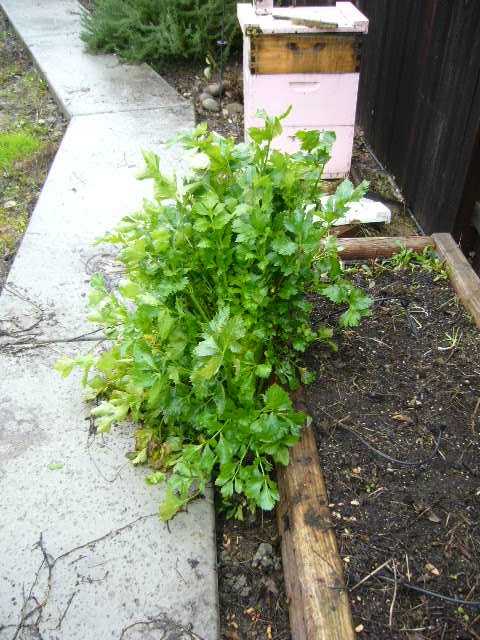
But plants are growing. I give you "Exhibit A" to your upper right. Exhibit A made for a tasty snack during the 49er playoff win against Green Bay. Exhibit A is growing like a weed in the Bird Back 40. Exhibit A shouldn't be growing in this particular spot because a one Bill Bird did everything in his power to kill it last summer.

Gardening Exhibit A
But Exhibit A knows far more and is far tougher than a gardening screwup like myself. It is proof positive that "you can grow this," even if you do everything within your power to "not grow this here or now."

By now, you may have recognized that green plant with the parsley-looking top growing in a very brown and frozen over area of the Bird Back 40 is, in fact, celery. It's not just one celery plant -- it's several. And it's some of the tastiest, most tender I might add, celery that we've been lucky enough to enjoy.

You may begin to ask, "what celery is this that grows so well?" Well, you may ask. My answer would be something akin to a shrug. You see, I'm really not too sure what kind of celery this is. So, we'll just call it celery and be done with it. You may also notice from the photo above that this particular patch of celery is growing OUTSIDE of -- and in FRONT of -- a raised bed.

Home Grown Celery: A Crunchy Treat
To add insult to injury, it's also got a piece of concrete covering the top of it. No matter I suppose. The celery known as "Exhibit A" is doing just fine and dandy without the benefit of a raised bed, regular irrigation or anything closely resembling good soil. There's a two-or-three inch spot between the sidewalk and that raised bed. Exhibit A has found that to be a nice home indeed.

Blame the wife that is Venus for this celery that grows so prolifically. She decided to plant celery seeds in this bed one fall several years back, and it did grow. Everything the wife plants grows. But, to be honest? We didn't like it. The celery that sprouted looked nothing like the celery you can purchase for fifty cents to a buck in your local supermarket. It was thin. Worse yet? It was tough and stringy. We ate some and let the rest of it grow until it was time to tear it out and move onto "Crop B."

You have no business here!
But the stringy celery had other plans I guess.

At some point the celery either went to seed, or one of the cats dug out a starter plant -- who knows -- maybe both happened. But, at some point, celery plants started to grow OUTSIDE the raised bed rather than inside (gardening is tough to contain). I didn't think much of it. I would cut it back with the weeds that would spring up outside the bed. A year later? I hired some guys to pour concrete on it so I could have a walkway in front of the bed. "End of Celery" I thought at the time.

The celery had other plans.

It was while I was removing a prolific number of pole beans from this raised bed last September when I suddenly realized this patch of celery that I'd abused through the years was really getting in my way. Worse yet? There were bugs on it. Last year was a particularly buggy year in my gardening world, and not just for celery. Bugs got into everything -- from pole beans to grapes and flowering bushes like roses. I don't really like spraying what I eat with insecticides anymore, even if they are deemed "safe for the garden." So I let the bugs have their share and got what was left.

Hey! This is GOOD!
But Mother Nature has her way of dealing with bugs that infest the garden. It's called cold weather. And while I was dealing with gall bladder issues during November and December, Mother Nature was delivering one frosty blow after another to the Bird Back 40.

End result? Crisp, clean, bug-free celery for our lazy football weekends. It's celery so good, that we can add it to our dinnertime soups at night, or we can just munch on it raw during game time. Does it taste better with onion dip? Of course! Everything tastes better with onion dip! That's a rule, isn't it?

But it's just another reminder that "you can grow that here." No need to buy celery, or carrots, for that matter in the local grocery store. We can dig that up outside, even in the worst of weather.

Chopped Celery for soups and side dishes
Dead of winter? It might be a tad brown outdoors at the moment. But it's not quite dead.

NOTE: The wife that is Venus claims full naming rights for the Sacramento Vegetable Gardening title of "Dead of Winter." She wanted you to know that.

The $70 Chicken

Friday, January 4, 2013

Pastured Chicken: Chaffin Family Orchards
I don't often make New Year's Resolutions. However, I am quite good at breaking them. Which is probably why I don't make a lot of New Year's Resolutions. But if there's one thing that I resolve to do in 2013 -- it's this: Invest in more $70 chickens.

What's that you say? A $70 chicken? Is this a chicken made out of gold, perchance? I know what you're thinking. The last time you visited your local supermarket, you didn't see any of them $70 chickens. Nor would you buy such a thing. Chickens are cheap! Especially if you watch the sales and buy in bulk like we do thanks to a handy-dandy floor freezer.

Foster Farms Chicken!
The wife that is Venus and I do happen to "shop the sales." I must admit -- I am a tad partial to my Foster Farms chicken. I grew up less than a stone's throw from an old Foster Farms processing facility on McHenry Avenue in Modesto (it's a fire station now), which is Foster Farms "home territory." It's also the home of one of the last "Chicken Barns," but we'll save that story for another day.

If Venus and I spot a store ad for Foster Farms whole chickens selling at a price of 79-cents or 89-cents per pound? Count us "there" and attempting to corner the market. We have a million and one different recipes for chicken dishes, ranging from beer can chicken, honey-barbequed chicken, fried chicken, baked chicken... You get the story. Chicken is a fabulous meal.

The $70 Chicken: Cut Up and Ready for BBQ
But the $70 chicken? The $70 chicken is special. The $70 chicken is never on sale. The $70 chicken is available only for a few weeks every year. If there's one thing I've learned, it's this: Foster Farms cannot compete with the $70 chicken.

What am I? "Made of gold," you ask? Not hardly. But I've discovered something quite good and I'm not letting go of it.

The Logo Says It All
During my months of research on the Duke Avocado, it's storied beginnings in Butte County and it's legendary ability to withstand frosty cold conditions I began to gain awareness of a 2,000 acre family farm located just north of Oroville. Five generations of the Chaffin family have farmed this land, and according to the words printed on their own family website: "have had a deep respect for the environment, preservation of open space, promoting wildlife and producing food for the local community."

I would come to learn that more than just Duke Avocados came from the Chaffin operation. The family presses their own olive oil from old growth Mission Olive trees. I was shocked to receive a recent email from the ranch operation, informing me that one can purchase "shares" in the upcoming olive harvest and olive oil production. SHARES? In olive oil? I'd heard of purchasing stock in companies or precious minerals, but OLIVE OIL? I remember chuckling at the thought.

Shares? In Olive Oil? You Kidding?
As it turns out, the joke was on me. By the time I seriously got around to thinking about purchasing a share or two, none was to be had. I suffered the same disappointment when I waited to place orders for an upcoming grass fed beef sale. I balked at the price. By the time I finally ginned up the courage to buy? There was nothing left to buy, not so much as a soup bone.

I couldn't begin to understand, yet, why these products would vanish so quickly. It's not like grass-fed beef is hard to find. It's more expensive than conventionally produced beef, but it's easy to find if you know where to look. But never had a I run across a situation like this: Wait, and you'll be SORR-EE.

Chaffin Broilers on Pasture
I vowed that I would not make the same mistake when I was alerted to sales of Chaffin's pastured chickens. They are sold only twice a year, in the spring and fall,  and like the grass-fed beef, if you wait too long to place that order...

And -- so -- I placed that order.

It wasn't until I traveled to the Nevada City Farmer's Market that sunny October morning did I truly realize just what I had done. First: Nevada City is a LONG way off the beaten path from the Bird Back 40 when it comes to purchasing chicken. Let's just say the neighborhood market is just a tad closer. Secondly, I wasn't expecting a price tag of -- GULP -- $70 for three chickens.

OMG! Have I Lost It Completely?
It was at that crucial point where I read the fine print. Pastured chickens cost $4.95. Not per chicken mind you. That's $4.95 PER POUND. With each chicken weighing anywhere from 4-5 lbs., I could just see the reaction from the wife that is Venus. I would soon be sleeping in the backyard with the cats...

What's so special about pastured chicken? Again, from the Chaffin Family website: "Because about a third of a truly pasture raised chicken's diet actually comes from forage of grass and bugs in the pasture, they have more healthy fats like Omega 3's and CLA (Conjulated Linoleic Acid) in the meat. They are allowed to be happy and joyful chickens, which adds to the quality of the meat."

BBQ Chaffin Chicken: Heaven on Earth
Yeah, OK, but here's the $64 question: Are they really worth $70?

That is a question that I will leave to you, faithful blog explorer. What I can tell you, however, is this much: There is a world of taste difference between those chickens that sell for $5 or $6 in the store, and those that have been raised on pasture grass and bugs. You'll notice it in the first juicy bite of one of those very special chickens.

I've never tasted chicken like this before. I'm not sure how to describe it to you in simple terms, but I can tell you that only one of the original three chickens is left in the freezer and the wife is saving it for one very special event. A special event deserves a special chicken. The taste of any meal prepared with a Chaffin pastured chicken is incredible.

And now the final question? Will I gin up the courage to buy more next spring? But of course! I'm beginning to like spending nights in the backyard with the cats...

Visit the Chaffin Family Orchards website here.