Fish + HH = AMF X Kitchen Sink = FAIL!

Sunday, May 25, 2014

And they're Off!
Follow closely now children -- because the title of this article is the mathematical equation we followed earlier this spring when planting the heirloom tomato crop now growing, and growing quickly I might add, in the Bird Back 40. Fresh off last year's season where each tomato plant got a fish head, two aspirins plus bone meal in each planting hole, we redoubled our efforts in 2014.

My friends, I'm here today to tell you this. Despite those lovely looking plants pictured above right, you can "love" your tomato starter plants just a little bit too much. You can go overboard on even the most organic of treatment -- and I know this from experience. Because it's taken time, patience and a bit of replanting to get our starter plants to look THIS good at this point in May.

Adding Fish Parts to Holes for Tomato Plants
Plus -- several people who ignored frost concerns and warnings and planted in March are WAY ahead of us. In the words of the immortal Tom Petty, "you got lucky, babe." Because planting in March can sometimes result in misery in April, especially if the weather turns cold again. This year, it didn't. Oh sure, it cooled down a bit here and there and actually rained a bit. But it wasn't enough to knock off March planting efforts. And for those people who rolled the dice and planted in March, they'll be harvesting a bundle of fresh tomatoes in June and laughing at the rest of us who waited until the first weekend of May.

Edit: We normally plant on or around the birthday of Farmer Fred Hoffman of "Get Growing with Farmer Fred" fame. That's usually the last weekend of April. But it was raining that weekend so we pulled a bundle of weeds instead. Anyone who gardens will tell you there's always a weed or one thousand to pull. It just comes with the territory.

But -- I digress.

Let the Planting Commence!
Fresh off a fantastically productive and surprising tomato year in 2013, we once again called on the Goddess of Love Apple Farms fame to help us with our tomato planting efforts in 2014. This time Sara and the wife that is Venus armed themselves with two buckets of smelly fish parts instead of just one, aspirin for the planting holes, organic bone meal and a few other "additives."

Here is what this year's brew contained:

1 can of water soluble Mycorrhizae and Bacteria
1 bottle (300 count) aspirin
Two boxes of Granulated Humic Acids
Two 5-gallon buckets of fish heads, tails, guts, and various parts
4 bags of Bone Meal

A Garden Party?
Holes for 24 heirloom tomato plants were dug to a depth of two feet each. Into the hole went a big helping of "fish stuff," one-half cup of Humic Acids, one-half cup of bone meal and two aspirin. Tomato plants were removed from starter cups and soaked in a Mycorrhizae bath before planting. We then proceeded to fill the holes with composted soil. The official count that first weekend in May looked like this:


24 heirloom tomato plants
16 Pepper plants
4 eggplants
2 Blueberry plants LOADED with blueberries (Sharp Blue and Misty)

Notice the Dog...
Can you guess the first thing that happened after we went through all that work to plant everything into the raised beds? If you guess that the garden dog named "DIGGER" immediately tried to dig up 24 tomato plants in a quest to munch on some smelly fish parts, you wouldn't be half wrong. If you also guessed that many of the tomato plants suddenly seized up and died, you'd also be right on the money.

Both actually happened. What the dog didn't dig up and kill in the process, died on its own. Why? Because we gave our starter plants a bit too much love. There is such a thing such as too much love. And if you follow the witch's brew I've outlined above, you too can KILL your share of tomato plants.

Janet's Jacinthe Jewel
Thank goodness the wife that is Venus and I decided to plant two cups of each tomato variety. Those replacement plants came in handy. Instead of giving them away to family and friends as we've done in the past, we were doing quite a bit of "replacement planting," while muttering the words: "NEVER AGAIN!"

However, we seem to be past the worst of it. And, I'll be honest, not every plant seized up and died on us, nor did DIGGER dig it up. For those that survived the harrowing plant-out process, I'll be honest, they look GOOD. Not just good, good, mind you. But, REAL GOOD! This includes a number of varieties from Wild Boar Farms, including a new offering this year called Janet's Jacinthe Jewel.

Pepper and Basil Starter Plants
Described as a large bright orange (jacinthe) striped beefsteak, this is a potato-leafed variety that is off to an eye-popping start and seems destined to deliver a boatload of tomatoes, many in the one pound range. And this is a bad thing? I think not!

The onset of hot weather in May has also given our tomato plantings a boost. Our once "leggy" starters now feature thick stems and are flowering heavy. We also decided to devote more room to our tomato plantings, because there can never be a thing such as "too many tomatoes." If you've read this blog for any amount of time, you know this to be true.

Baby, I've Got a Headache...
Although I was not able to take part in the final plant out due to this bum wheel that keeps me confined to a walking boot (complete with a developing, continent-sized, blister), Venus sprinkled liberal amounts of leftover tomato plants to the in-ground test bed and other spots here and there in the Bird Back 40 that offered a bit of planting space. The final count is 39 plants -- about ten to 12 more than we normally plant during the summer season.

I'm pleased to report that everything the green-thumbed wife planted is now popping out of the ground at an accelerated rate -- this includes various garden seeds that she planted here and there. That list includes five varieties of carrots, six varieties of basil, four varieties of slicing cucumbers, three varieties of pickling cucumbers green onions, bush beans, squash, pumpkins and probably five to ten other things that I've forgotten.

There comes a point in the season that when it's time to pay a trip to the Farmer's Market? We head straight for the Bird Back 40...

The Show

Saturday, May 17, 2014

Wonderful Pomegranate Tree-Bird Back 40
Hello old friend. It's nice to see you again. It's been far too long since you last visited and I'm overjoyed to see that you're feeling well again. I was so worried last year when you came down with some strange sickness and just didn't seem to be your same old self. I'm glad to see that you've fought off the bad bug, whatever it was, and you're putting on a right fine show this spring. It's nice to see.

An experienced gardening eye will tell you that the picture above right is that of a pomegranate tree. Not just any pomegranate tree mind you, but the old standby that produces only the best, sweetest and tartest of ripe, red fruit. It's called, simply enough, Wonderful. And it's a good name. Because it fits like a glove. The Wonderful Pomegranate provides the most delectable and wonderful pomegranates on the planet. And it's putting on quite the colorful show in the Bird Back 40 side yard this gardening season.

Pomegranate Buds Preparing to Bloom
I must admit, I'm breathing a big sigh of relief while watching the tree do its thing this year. Because it wasn't doing this last year. Well -- let me explain. Half of the tree put on a nice show. The other half looked pretty darn terrible. And, for the life of me, I cannot figure out why. But, count me concerned. And I had a reason to be.

It was about two years ago when a frustrated young lady contacted me via email out of the blue to ask, "where have all the pomegranates gone?" She went onto explain that all of the trees in her neighborhood that fed her pomegranate desires were barren, looked somewhat diseased and did I know of any trees around the City of Davis where she might help herself to her favorite fruit? This request caught me by surprise. Two years ago the Wonderful Pomegranate tree in the Bird Back 40 was covered with one of the largest crops it has ever produced.

A Color Show Like No Other
I remember telling this young lady that I didn't know of any diseases that were hitting backyard orchard pomegranate trees, and gave her a couple of locations to check out. I never did hear back from her, but clearly remembered her concerns last year when half of my once-healthy tree suddenly wilted during the spring bloom season, dropped quite a few leaves and didn't flower. That's right, not ONE single flower.

Color me very concerned. What was wrong with my Wonderful Pom? Had it been hit with some sort of funky disease or virus? A quick check of some online resources that I depend upon (UC Davis Fruit and Nut Information) yielded some answers -- but not the kind of problem I was experiencing. Further complicating matters were a few recent newspaper and industry reports detailing some strange disease that had struck without warning in commercial pomegranate fields. Nobody was quite sure what it was.

Emerging Pomegranates
Last year's harvest was one of the smallest I had ever encountered. Not only were the numbers curtailed, the size of the fruit was also affected. While the seeds inside the fruit that did mature were fine, the overall condition of the tree bothered me a great deal. Had I over-fertilized? Over-watered? Got a little too frisky with winter pruning efforts?

This year I adopted a "hands off" approach. While most fruit trees and vines get a small monthly allocation of fertilizer, the Wonderful Pom got nothing. The tree still received twice-weekly irrigation supplies from drip sprinklers at the base of the tree -- but not much else. I wanted to see the results of this "hands off" approach.

Honeybee At Work
Whatever was bothering the Wonderful Pom last year has, thankfully, moved on. Either that, or the tree fought it off. It is once again growing with a healthy vigor and this year's show of blooms is simply unrivaled. Although not all blooms turn into pomegranates, many of them are. And the tree continues to produce bloom buds at a surprising rate. I thought it would have eased up by now. Nope. It's showtime in the side yard and the Wonderful Pom is the star.

This is happy news, of course, to the legions of honeybees that have a home in the Bird Back 40 and elsewhere. It's not all that unusual to hear this tree buzz with excited honeybee activity. Although it's impossible to count them all, I wouldn't be surprised if that count amounted to the hundreds. Pomegranate pollen must be a prized commodity, given the honeybee activity that I've noticed day in and day out.

Wonderful Pomegranate Bloom
A heavy load of pomegranates means Bill and the wife that is Venus will be firing up a commercial brand juicer that can be found in many upscale (and some dive) bars -- especially those bars that specialize in serving drinks concocted from fresh fruits and vegetables. Pomegranates aren't easy to squeeze, but the reward is a fresh juice that is unlike any other. And from that simple juice, there are so many possibilities.

Pomegranate jelly anyone? Pomegranate punch? It's simply Wonderful. Here's looking at a healthy harvest come this fall and a healthy tree to boot.

Snap! Crackle! Pop!

Friday, May 16, 2014

Snap, Crackle and Pop Here to See You
I know what you're thinking. I really do. You saw the title of this latest blog posting and your heart sank. "Bill Bird has gone commercial," you thought. "He's traded in his heirloom tomatoes for some kid's cereal!"

The shame, the shame of it all.

But that's the furthest thing from the truth. You see, this blog posting could be named many things. It could be called "Gardening Hurts." It could also be called "Gardening Season is Over," because both titles would represent the truth. Gardening does sometimes hurt. And gardening season, although it's just now getting underway for some folks, has come to a rather abrupt end in the Bird Back 40.

Nice toes! NOT!
At least -- that's the story for crazy blog writer Bill Bird. As for the wife that is Venus? She may carry on with her seed planting ways. Her faithful husband will watch her efforts from the patio with a beer in one hand and a sad smile. For the first time in years, I cannot join her. I can only sit and watch.

You've probably guessed by now that I'm not schlepping for some kid's cereal. That "Snap, Crackle, Pop" sound I heard last weekend was all too real. Unfortunately, I didn't hear it while pouring milk onto a kid's cereal (although I wish now that I had). I heard that sound while stepping off the sidewalk in the Bird Back 40 while moving a heavy wheelbarrow load of compost to the in-ground test gardening bed. Unfortunately again, the sound came from my right foot.

That wasn't right. Did I step on something perchance? No? Is that blood? Where did that blood come from?  From me? Those are the thoughts that first crossed my mind when I suddenly dropped that wheelbarrow load of gardening product and looked down. The bottom of my ankle began to ache. Which really isn't all that strange because at my age, after a weekend full of gardening, my feet not only REEK to high heaven they are also quite sore.

Life in a BOOT that Never Comes Off
But this was a different kind of sore. And the soreness grew into a pain that had me limping back to the garage and settling into the nearest chair. Something wasn't right. It wasn't until I tried to get back up some 30 minutes later (to attempt to resume gardening no less) did my ankle let me know that things were "not OK."

The hours following my little "garden accident" are still somewhat of a blur. I blame that on the numerous emergency room doctors and nurses that I visited that evening. For each one came armed with a horse-shaped pill, a glass of water and the instructions of: "Here, take this."

Percocet Fog
Since those pills made me feel somewhat better -- I had no problem with repeating the line of: "What? Another Percocet? For me? Sure!"

I would learn later that Percocet makes you somewhat happy and somewhat groggy. I don't really remember a lot of detail from those emergency room visits and followups with the Podiatrist, except that a partially torn Achilles Tendon and an aggravated bone spur in the heel are going to keep me out of action and in a lot of pain for quite some time.

I swore off the Percocet a few days back. I'll live with the pain instead. How people get addicted to prescription pain killers I'll never know. They just make me feel groggy and play all sorts of negative havoc with my digestive system. Plus, to be honest, I don't remember the pain ever really going away. I suppose it made the pain manageable, but given a choice, I'll opt for a clear mind and a painful foot any day of the week.

Off Limits! Verbotten! Do Not Pass Go!
And so -- that's it kids. The 2014 gardening season is finished for me. My number one love of life, other than the wife that is Venus, is off limits. There will be no digging in the dirt. There will be no weeding. There will be no fertilizing, no planting of seeds, no drip irrigation repair. Zip, nada, nothing.

There will only be this damn boot on my leg, a damn sore right heel bone and a cranky gardener who can only watch while others do.

I'll be honest with you. There's not much fun in that.

The Drought is Over!

Thursday, May 8, 2014

The Wife That is Venus-Bird Back 40
You heard right -- the drought is over! It's done! Finished! Kaput! Good riddance! Don't let the door hit you in the keester on the way out! Your company was never wanted to begin with! So, get a clue, MaGoo and SCRAM. And If I don't see you next year -- it won't be too soon!

As you might be able to tell, I don't like droughts. As a matter of fact, I kind of detest them.

Friends and frenemies -- I'm not talking about the kind of drought that means a lack of water. We're still in that. Big time. That hasn't ended. It's here. It's going to stick around for the next couple of months. While we can hope and pray for big bucket of rain from the sky next winter season -- that's still a long ways off. There are hot summer days still to come.

Apricots in May? Yes Please!
Nope -- the drought I'm referring too -- the drought that has now officially ended -- is the drought on fresh fruit production in the Bird Back 40. It's over. It's gone. It started with a smattering of strawberries from the Albion plants situated beneath the Backyard Orchard Culture (BOC) Apple Orchard, but that wasn't nearly enough to satisfy and satiate our fresh fruit desires. But this latest little treat comes as a big surprise. I wasn't expecting this tree-ripened fruit, this early in the fruit growing season.

The proof of our fresh fruit extravaganza is pictured above right in that dazzling photo of sheer beauty. That is the wife that is Venus -- and she is smiling for good reason. No -- she did not win the lottery. No -- the Pope did not grant special dispensation so she could file for divorce. She's smiling because her favorite tree-ripened fruit ripened a lot earlier than we ever expected.

Royal Rosa Apricot
That's the five-in-one Apricot Fruit Cocktail tree to the right of the vision that is Venus. A Dave Wilson Nursery multi-budded special, we stuck this tree in the ground during the 2013 bare root season. We allowed it to produce a little bit of fruit last year -- just a taste mind you. We're allowing it to produce a lot more this year.

Are all the apricots on that tree ripe for the picking? Of course not! That's the beauty behind a five-in-one Fruit Cocktail tree. The five different varieties all ripen at different times of the spring and summer. In fact -- not all of the varieties on that Fruit Cocktail tree are actually apricots. Nope! One branch contains the Aprium.

Royal Rosa Apricots with Tomcots in the Background
Exsqueeze me? A what? "Maw! He's using them strange words again!" What in the world is an Aprium? Is it an apricot? Is it a plum? The answer to both questions is, "yes." Mind blowing isn't it? According to our fine friends at DWN, "The Aprium is a is a complex interspecific hybrid, predominantly of apricot and plum. Additionally, the sugar content of interspecifics is much higher than in standard plums or apricots, yielding fruit of incomparable sweetness."

Ain't that just terrible news?

But, I digress, because the fruit from this tree that is bringing us the most joy at the moment happens to be the branch that holds the Royal Rosa Apricot. Although it's not supposed to fully ripen until the third week of May -- the third week of May came a tad bit early this year -- here in the first week. Not all of them are ripe, of course. Some might even make that third week date. But just enough are soft for the picking and at optimum sweetness.

Young Annie Lennox
Is the Royal Rosa Apricot good? Is the Pope Catholic? Do tomato plants grow in Sacramento? Did Annie Lennox dump The Tourists? OK -- so it's a little obscure music knowledge on Bill Bird's part. But, the point is the answer to all three questions is a definite "yes." The Royal Rosa, Katy, Blenheim, Tomcot and Flavor Delight Aprium have all found a deserved home in the Bird Back 40.

It's been far too long since Bill or Venus sampled fresh fruit from the Bird Back 40. The drought is over. The onset of fresh fruit season is as right as rain.

If only we could get a little more of it.

And Now for Something Completely Ugly

Saturday, April 19, 2014

BOC Apple Orchard-Bird Back 40
Mother Nature can be viciously cruel at times, especially for those of us who yearn to dig in the dirt and plant good things to eat. Pictured to your right, my friends, is the Bird Back 40 Apple Orchard. It consists of three trees: Granny Smith, Fuji and Honey Crisp. I know this photo doesn't necessarily look all that ugly, but a closer inspection reveals the kinds of troubles that drive backyard growers crazy.

Short and sweet? Although those trees look healthy, they're not. In fact, the wife that is Venus and I will be lucky if we get a single apple this year. That's right! Three trees! One apple -- and we'll be lucky to get it. Worse yet -- there will no Honeycrisp Apple harvest this fall. That's worse than bad. It's tragic. The Honey Crisp is the best dang apple on the planet -- offering a taste explosion that cannot be missed.

Granny Smith Apple Tree-Bird Back 40
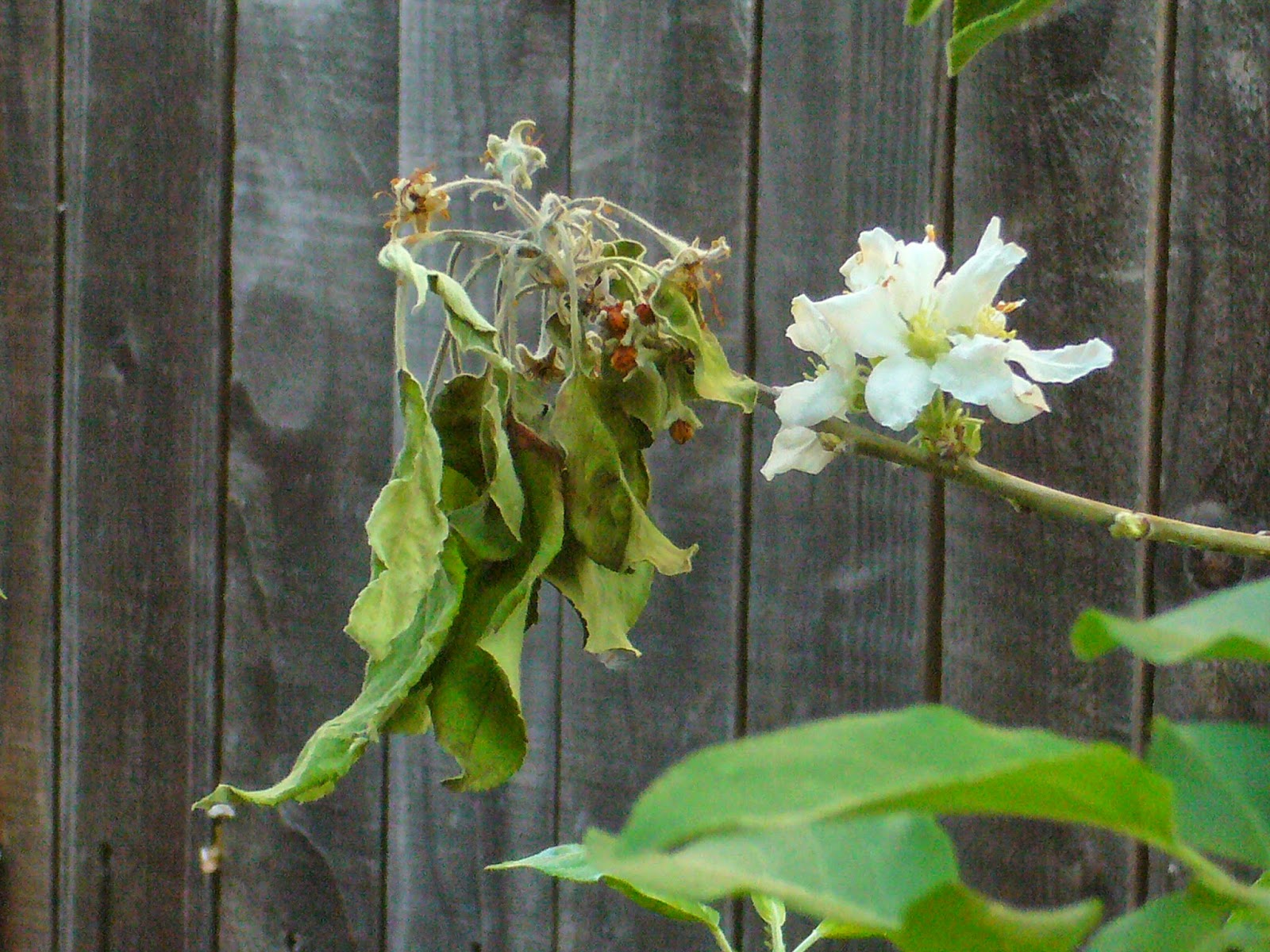
Yet -- I will miss it this year. And the photo to your left explains why. Those drooping leaves coming out at the end of one branch of the Granny Smith spell big time trouble. I first noticed this problem last week. It has since spread, slowly, to other parts of the Granny Smith and to the Honey Crisp.

This trouble is called Fire Blight. It's the first time its reared its ugly head in the Bird Back 40. I had this mistaken belief, perhaps call it a prayer, that backyard growers like myself would be spared from this scourge. Hah! Fat chance kid! The Blight is here and it's here to stay. Fire Blight means big trouble. Not only do the apple trees have it -- but the pear orchard I installed earlier this year has it as well.

Bartlett Pear-Bitten by Blight
I know what you're thinking. Why didn't you spray your trees to protect them from this bad boy over the winter? Oh, but I did. You see -- although Fire Blight has been around for a very long time -- there's still no active control for it. There is no spray, no dust, no treatment, organic or otherwise, that fights the dreaded blight. There is only one, proven method of control. And that method can result in a total crop loss, which is exactly what I'm facing.

This disease is called Fire Blight because it looks like leaves and fruit have been hit with a blow torch. The first sign of a problem is wilt. The leaves then turn a none-too-pleasant shade of brown, before fading to black. Fire Blight also spreads like wildfire.

Blackened Leaves-Granny Smith Apple Tree
I bet that you didn't know that, at one time in our not so distant past, pears and apples were kind of a big deal in Sacramento, Placer and the surrounding counties. Long before Sacramento adopted the nickname of SackofTomatoes, this was prime pear country. It still is in the southern part of Sacramento County, near the Sacramento River, but at one time tens of thousands of pear trees covered Sacramento fields from one of the county to the other.

And then, one day without warning, Fire Blight showed up. The damage was minimal at first -- but it spread like an out-of-control wildfire. Numerous controls were attempted. They all failed. Entire orchards were snuffed out in the space of a year or three. The main crop that powered the economic engine of Sacramento and the surrounding counties was dying a slow death, and nobody knew how it got here, how it spread from tree to tree and worse yet, how to stop it.

Dying Honey Crisp Apple-Bird Back 40
The answer of how the disease spread would come from horticulturists sent from UC Berkeley. It was believed that field workers were spreading the disease as they used pruning tools again and again as they moved from tree to tree, without washing them first. Today, that thinking has changed somewhat, at least in the opinion of some horticulturists who I contacted regarding my little problem. While the cleaning of pruning tools is still recommended, the belief is pollinators are spreading the pathogen as they move from tree to tree and flower to flower.

That's right -- the ordinary bee. This is where the infection starts -- when pear or apple tree bursts into bloom after a long winter's nap.

Fire Blight Strikes the Granny Smith Apple Tree
The good news? If there is any good news out of this, the "window of infection" is a short one. Once spring moves into summer, it's done. If there is any fruit on the tree that didn't get infected during the "window of infection," it's safe. But as for the branches, apples and pears that are infected? There is only one answer. That answer is pruning the infected branch back to a point where the dreaded blight can spread no further. It means the trees I've dutifully tended to a height of seven feet are about to get a rather severe haircut.

But that is my only option. Do nothing in the face of this scourge and the blight will show up again next year, stronger than the first year and left uncontrolled, will spread into the root system, killing the tree.

Honey Crisp Apple Blight Damage
I can't let that happen. I don't care how severe the cutting will have to be -- it's my only option. Do it, and I might save the tree. Do nothing, and that prized Honey Crisp will never deliver another tasty apple.

And so, those dreams I had over the winter of apple crisps, apple pie, apple juice and applesauce using our own home-grown apples will remain just that -- a dream. For this year -- Bill and the wife that is Venus are singing the farmer's lament: "There's Always Next Year."

Are They Tuff Enuff?

Sunday, April 6, 2014


Vegetable Plant Starters-Bird Back 40
Texas-based Blues Rock and Rockabilly band The FabulousThunderbirds posed this question to the rest of America with their first and only Top 40 hit, and it's the same question the Birds are now posing to our 2014 summer vegetable crop. At this moment these tender, leggy veggie starters have been moved from the safety and warmth of their office-converted-greenhouse, to a shady spot in the Bird Back 40.

To throw these babies into full sunshine would be cruel and unusual punishment as well as foolhardy. Do that and the starters we've been nursing since mid-February would perish in a day. Nope -- wheeling our crop outside to a shady spot is just the first step in a gardening dance called "Hardening Off." It's a Texas-style two-step that we've come to learn quite well through the years (and a number of dead or shocked starter plants in the process).

Three rows of a Summer Garden
One wrong move in this process and we're heading off to a nursery later this month to purchase our summer starter plants.

So what are the Birds tending this summer? Just the most delectable of summer garden selections found in any Sacramento area backyard. There's a selection of new varieties -- a selection of old-time favorites -- big tomatoes -- small tomatoes -- hot peppers -- warm peppers -- sweet peppers -- you name it and we probably have it stuck in that rack somewhere.

By our count that's 34 varieties of tomato plant starters (two of each variety), 14 sweet, hot and warm peppers and six varieties of basil. Because what's a summer garden without at least six varieties of basil? That's right! BORING! Oh -- and did I mention the eggplants? Throw four or five varieties of eggplant starters into the mix as well.

Blue Beauty Starter Plant
This month represents one of the most crucial months in the "grow your own" summer vegetable garden movement. Should a sudden snowstorm or freeze strike the Bird Back 40 this month -- it means big trouble. Because, as of right now, these starter plants are not "Tuff Enuff." They will be by the end of the month, that much I can promise you. But as for right now? The first day and first week in Sacramento's natural elements? There's a whole HOST of things that can go wrong.

And they have before.

Starter plants grown sans a true greenhouse are leggy, weak and not ready for prime time. But the goal -- over the course of this next month -- is to toughen up those leggy stems. The goal is to prepare those leaves for the shock of true sunlight and the UV rays that come with it. The goal is to produce a starter plant that is tuff enuff to not only withstand everything that Mother Nature can throw at it -- but thrive in these conditions.

Pepper Plant Starters
The wife that is Venus and I will keep the plants in the safety of shade and away from the winds that can tear those tender stalks into so much kindling. At some point, the metal rack holding our starter plants will be covered with a a plastic sheeting that is used by painters and sold in any Big Box hardware store. After five or six days under the plastic cover in full sunshine? The once- weak and leggy starter plants are completely hardened off and feature thicker stems to boot.

The suggestion to use plastic sheeting -- I must admit -- was not a Bill Bird invention. Nope -- like most good ideas I STOLE IT from someone else. In this case? I stole it from a retired engineer turned gardener who lives in upstate New York. I love retired engineer-turned-gardener types. They have a solution for just about every problem -- and in this case? The advice was right on the money. After five or six days under the cover of 4 ml translucent sheeting purchased from my nearby Home Depot? The once-tender starters were indeed "tuff enough" for the 2013 summer gardening season.

Heirloom Tomato Starter Plant Forest
And 2013 was one of our best years ever, I might add.

And so my friends, while I could write more, I'm afraid that weed-pulling project in the vegetable garden deserves not only my time but attention as well. Because -- after a warm spring day like this one -- the weeds that await are certainly "tuff enuff."


Starring in the Bird Back 40 This Season:

Tomatoes:
  1. Azoychka
  2. Black and Brown Boar
  3. Black Sea Man
  4. Blue Beauty
  5. Blueberries
  6. Brad’s Black Heart
  7. Brandywine OTV
  8. Campbell’s 1327
  9. Cascade Lava
  10. Copia
  11. Costaluto Fiorentino
  12. Fireworks
  13. German Johnson
  14. German Queen
  15. Giant Belgium
  16. Green Zebra
  17. Grushkova
  18. Indian Stripe
  19. Janet’s Jacinthe Jewel
  20. Lemon Boy
  21. Limmony
  22. Lush Queen
  23. Lynn’s Mahogany Garnet
  24. Martha Washington
  25. Paul Robeson
  26. Pineapple
  27. Pineapple Tomatillo
  28. Pink Berkeley Tie Dye
  29. Pork Chop
  30. Porter’s Pride
  31. Purple Bumble Bee
  32. Royal Hillbilly
  33. Sioux
  34. Solar Flare
PEPPERS:
  1. Alma Paprika
  2. Anaheim Pepper
  3. Bhut Jolokia (Ghost Pepper)
  4. Big Bertha Bell Pepper
  5. California Wonder Bell Pepper
  6. Chinese Giant Bell Pepper
  7. Early Jalapeno
  8. Early Sunsation Bell Pepper
  9. Merlot Bell Pepper
  10. Mucho Nacho Jalapeno
  11. Pasilla Bajo
  12. Purple Jalapeno
  13. Sunbrite Bell Pepper
  14. Sweet Red Bell Pepper
BASIL:
  1. Corsican
  2. Dark Opalka
  3. Genovese
  4. Lemon
  5. Lime
  6. Siam Queen

Strawberries for the Soul

Sunday, March 30, 2014

Emerging Strawberries-Bird Back 40
And you thought Chicken soup was the only good thing for the soul? Guess again. Strawberries -- especially home grown berries -- are pretty darn good for the soul as well. I should know -- since fresh berry patches grace the Bird Back 40 -- providing us with a bounty of fresh berries from mid-spring through June.

Why plant strawberries? The most obvious answer is "why not?" Strawberries are a wonderful addition to any backyard -- and you can grow a lot of berry with a small bit of room. In this particular case? A raised bed holding fruit trees is also doing double-duty as a strawberry patch. As it turns out -- fruit trees and strawberries work quite well with one another.

Strawberry Plants in the Apple Patch
This is a tip that the wife that is Venus and I learned one adventurous Saturday afternoon during a class taught by Folsom City Arborist Ken Menzer. A lot of great ideas came out of that class -- some of which worked and others (blueberries) did not. But his advice to plant strawberries at the base of fruit tree plantings was spot on. Leaves of these trees help shelter tender berry plants from blazing afternoon sunshine, while the berries open up cracks in the soil allowing water and other nutrients to reach fruit tree roots.

The pairing just works. Another advantage to this tandem is strawberry plants choke out all weeds. I haven't been required to weed the berry bed for years.

Emerging Strawberries in the Pear Patch
It's done just fine for the apple trees we planted four years ago in a side yard of the Bird Back 40. This apple "patch" as I call it also holds the tastiest apple on the planet -- bar none: The Honeycrisp. The raised bed that the trees are planted in is dotted with a collection of Albion and Chandler strawberry plants.

Although they look productive -- this was yet another gardening mistake on my part. If you Google the terms of "popular strawberries to plant in California," up jumps a number of lists of strawberry plant recommendations. At the top of those lists? The number one plant for California gardens? The recommendation is the "Albion" strawberry.

Shuksan Strawberries
And so -- four years ago -- Bill Bird sat at his computer as he is now -- and made yet another gardening blunder. I ordered a set of ten Albion plants and ten Chandler plants from Sakuma Brothers Farms in Washington. Why was this an error on my part? Because I jumped before reading the fine print. As it turns out -- Albion is a GREAT strawberry for California -- but only for certain areas. Albion berries grow and produce best in gardening zones 3-8. The Bird Back 40 is located in Zone 9A.

Bummers. No wonder the strawberry plants weren't as productive as I hoped. Although they've set a nice crop here in Year 4 -- at some point I will pull them out and replace them with a strawberry plant that loves Zone 9A. There are plenty of varieties that do quite well in the Sacramento area. I just have to choose the right one.

Shuksan Strawberry Plant (bare root)
For this year's berry planting effort? I decided to read the fine print on the Sakuma Brothers website. In other words -- I found the berry for our backyard. It's called the Shuksan Strawberry -- and the bundle of 20 plants that arrived in the mail earlier this week have been planted here and there in the raised bed holding three pear trees.

Shuksan strawberries grow best in Zones 4-10 -- and are often found at those roadside strawberry stands that dot the Sacramento countryside during fresh strawberry season. They are good for fresh eating. They are good for jams and jellies. They are good for just about everything.

The Shuksan plants will grow through the spring and summer, sending out shoots and will take over every last inch of space in the raised bed holding our pear patch. Combine that with other strawberry patches dotting the Bird Back 40 -- and that's a lot of pie.

This is a bad thing?

I think not!