The Kids Are Alright...

Tuesday, April 13, 2010

For those of you who are as "Mathematically Challenged" (Dumb as Rocks) as I am -- please answer the following question:

When do three flats containing 72 tomato and pepper starter plants suddenly equal nine flats and 216 tomato and pepper starter plants?

If you answered "second planting," WRONG!

But if you guessed that the wonderful wife that is Venus and I got a little *ahem* "generous" with our seed distribution efforts in those first three flats? DING! You're ready for Alex Trebek.

What do you win if you answered the math question correctly? Let me check my supply of used cat hair -- and I'll get back to you on that. Vanna White -- I'm not.

I thought that Venus and I would be a tad late with our tomato and pepper plant starters this year (we started our seeds on the weekend after the Super Bowl) -- but our local weather has been more than highly unpredictable. It's been downright pathetic.

At this point last year? Venus and I had already received our starter plants courtesy of Farmer Fred Hoffman and half had already been planted. Why did someone as famous as Fred Hoffman "volunteer" to grow starter plants for our North Natomas farm? Does a hearty contribution to the Hoffman Foundation of Fine Scotch begin to answer that question?

But this year -- contribution or no -- the decision was made to strike out on our own. My decision? Oh -- HECK NO! I begged and pleaded on bended knee for another starter plant offering from the Hoffman estate. I even entertained the thought of enlisting the support of the Sacramento branch of Al Qaeda to change Fred's line of thinking -- but alas -- we were on our own.

See? This is what happens. The happy North Natomas gardeners start with three simple trays containing 24 cells each. Two months later? I'm seriously considering knocking out one of the bedroom walls in an attempt to gain more growing space. Heirloom tomatoes make you crazy. Not wives -- tomatoes.

But -- so far -- everything is working. In fact -- I'm more than a little surprised by the results of our plant separation efforts. We didn't do anything fancy mind you. When the time finally came to separate plants -- Venus and I literally tore them out of each cell and then re-planted into new trays. End result? Take a good look. The trays containing the transplants are actually doing BETTER than the trays that contain the original plantings.

How is this happening? Why is this happening? I'm not sure. The jury-rigged -- excuse me -- professional light system setup we're using is just extensive enough to cover three trays. The problem is -- we have nine. Those that are closest to the light source should be doing better.

But they're not. The transplants furthest from the light source have actually grown at a faster rate and look healthier than the starter plants that were not rudely ripped from their homes and transplanted into another tray.

We didn't change our methods much during the transplant process -- a job that we undertook in stages. We used the same "Black Gold" seed starter mix that we used for the first three trays. I continue to fertilize my seedlings with a weak mixture of a liquid organic fertilizer called Omega 2000

So what gives? I'm not sure. For those of you who are visiting the blog for the first time expecting expert advice -- I'm really sorry to tell you that not only are you going to be sorely disappointed -- but you've come to the wrong place. Despite what you may have read recently in your local newspaper -- about the only expertise I have is in the consumption of fine gin that comes from a plastic bottle.

What I can tell you is this: There are 216 tomato, pepper and eggplant starters that are growing in a spare bedroom. Instead of just two varieties of each heirloom tomato starter -- I suddenly find myself with four or five. Instead of one or two varieties of peppers (sweet, hot and VOLCANIC) -- there are six.

I suppose I could plant all 216 starter plants in my backyard. But -- at last check -- I still hadn't gotten around to building raised beds on the roof of our home. Therefore -- yes it's true -- Venus and I will be parting with a great many of our plants when the time comes.

This is provided -- of course -- that I don't kill them all off during the hardening process. What's that? Can that possibly happen? Does gin come in a plastic bottle???

Hey Buddy, Can You Spare a Cranberry Red?

Saturday, April 10, 2010

Our fifteen minutes of fame now over -- it's time to move on to bigger and better gardening delights. This is gardening season my friends. Yeah -- I know -- it may not look like it outside -- but the month of April is pretty darn crucial in terms of getting work done. If only Mother Nature would cooperate.

Venus and I are actually behind on the gardening front. At this point last year? Venus had filled up an entire 4X8 bed with two varieties of seed potatoes. By early April? The first sprouts were poking above the soil. We were on our way to a monster potato harvest that year -- and the wife's goal of a Red, White and Blue Potato Salad for the 4th of July holiday was FULFILLED.

This year? Sorry Venus. It appears were out of luck. A range of factors -- some that were out of my control -- will probably prevent an early July harvest this year.

The biggest error -- however -- appears to be all on me. I made the wrong move in assuming that I would find a bountiful supply of seed potatoes when I visited Peaceful Valley Farm Supply in the foothill community of Grass Valley two weeks ago.

Bad assumption.

Oh -- they had -- and still have a good selection of seed potatoes alright. These two bags of "All Blue" and "Colorado Rose" potatoes are evidence of that. At some point -- Venus will be chopping these up and planting them into one of our raised beds.

But -- I was too late to find our personal favorite: Cranberry Red. This is a wonderful variety. Much like "All Blue," the Cranberry Red variety doesn't lose that light red streaky color, even after cooking. Not only was Peaceful Valley out of this particular variety -- I would soon find out that EVERY nursery I contacted either didn't stock it -- or sold the last Cranberry Red spud eons before I called.

What does this mean? It probably means that Cranberry Red won't be a part of our potato plantings this spring -- OR -- it will be planted far too late to produce in time for a "Red, White and Blue" Potato Salad creation for the 4th of July. Don't be fooled. The wife creates a mean potato salad. Add in the colorful display? Suddenly -- you're the envy of every other wife at the big bash block party.

The second key factor in all of this is the weather is just not cooperating this year like it did last season. Don't get me wrong. The weather in April of last year wasn't perfect. We got very lucky when a bed of tomato plants survived a late, warm, April rain. But it was a lot nicer -- and warmer -- in April of last year than it is this year. And next week's weather forecasts are enough to make a grown gardener cry.

But that's Mother Nature for you. I can still remember my mother singing the familiar tune of "April Showers Bring May Flowers" while I wistfully sat inside during the April weekends of my youth -- missing yet another youth baseball game opportunity (I played the position of Left Out).

And -- who knows? Maybe our April lament will turn into a mid-July surprise when we hopefully harvest a bountiful crop of Colorado Rose Red Potatoes? No -- it doesn't retain that "All Red" color (even after cooking) -- but the reviews look pretty darn tasty. The website "Maine Potato Lady" gives Colorado Red a solid thumbs up:

"With Cherry Red as one of its parents, Colorado Rose was bred for high yield and early bulking. Attractive oval red tubers with white flesh are great for those early summer salads or roasting. Resistant to hollow heart, second growth, and bruising. Medium semi-erect plant with purple flowers."

If there's one thing that I've learned about gardening -- it's this: Never be afraid to try something new. At one point in my life -- not all that long ago -- I believed that a potato was a potato and nothing more. They all tasted the same.

Then I grew my own and learned the real truth. Potatoes can be a lot like heirloom tomatoes in terms of color -- taste and texture. All you need is some seed spuds and the urge to create your own, personal, Frankenstein monster in your backyard garden.

Closing Note: Thanks to some fine hunting by Farmer Fred Hoffman -- you can still order Cranberry Red Seed Potatoes through Territorial Seed. Peaceful Valley Farm Supply should also receive a new shipment of Cranberry Red seed stock by mid-April (you may want to call ahead and check first).

Shameless, Shameless Self-Promotion!!!

Sacramento Bee Garden Writer/Blogger/Newswoman Extraordinaire Debbie Arrington paid a visit to the Bird compound in North Natomas earlier this week.

What appeared in today's Home and Garden section was totally unexpected! She was too nice! She needs to learn a thing or three from Farmer Fred Hoffman.

Debbie will be on Fred's gardening show tomorrow by the way -- on both NewsTalk 1530 KFBK and later Talk 650 KSTE.

If the conversation turns to us? It's a sign that the show is getting SLOW...

Hands Off My S-Curve -- You Ingrates!!!

Wednesday, April 7, 2010

Sorry -- but I'm just a WEE bit cranky at the moment. Spring has sprung -- which means summer isn't all that far off -- and that means it's time to plan out the summer flowerbeds.

What on earth does a flower garden have to do with vegetable gardening? Easy! Flowers attract beneficials like butterlies and BEES -- and Bill &Venus need BEES to pollinate those wonderful melon vines and citrus trees.

Otherwise -- no summer martini for you!

But -- I digress. Summer flowerbeds are the BOMB. The best and most vibrant colors come from a summer flower garden. One of my personal favorites is a design called the "Rainbow of Colors."

It's tough to find this exact design online -- but here's a picture of what it looked like in the front yard of our first home in North Natomas. I can't remember exactly who sent me this design -- except that it came with a packet of other flower garden designs that I received in the mail shortly after purchasing my first home in Madera, CA in 1993.

Yes -- I lived in Madera. So what? Why are you snickering?

There's nothing better -- in my humble opinion -- than the Rainbow of Color Flower design. I've tried several -- but I keep on coming back to this one. There's just something about the color show -- and it puts on quite a show during those hot summer months of July and August.

The most famous part of the Rainbow of Color design? Again, in my humble opinion, it's got to be the all important S-CURVE. The curve is made up of one of my personal favorites in the flower garden: the Victoria Blue Salvia. The latin name for this old-time favorite is Salvia farinacea. A more common name that some gardeners might recognize is Mealy-cup sage.

There was a day -- a time -- an age -- where you could find Victoria Blue Salvia in just about any nursery. Heck -- the Big Box Stores like Home Depot carried this stuff by the flats. You could walk out with enough Victoria Blue to create your own -- personal -- 100 yard Rainbow of Color patch.

Sadly my friends -- those days are long gone. It seems that our common friend -- our mealy-cup sage -- has become the newest and latest target of the young and the dumb. That's right -- the kids are after MY S-CURVE. Not because the young and the dumb are suddenly into creating a Rainbow of Color Flower Garden.

Nope -- they're smoking it.

Say again? Did you say what I thought you said? Smoking it?

Yes -- it's true. They're not only smoking it. They're chewing on the leaves. You laugh? I would join you -- except it's TRUE.

Our little Victoria Blue is under assault. And the thing is -- the kids aren't even getting it right! They're confused! Then again -- if they're dumb enough to light up some Salvia farinacea -- they're probably too far gone to understand that they're lighting up with or chewing on the wrong weed.

Victoria Blue salvia is a member of the mint family, which is characterized by square stems and an aromatic fragrance. The salvia genus is a large group within this family that includes more than 900 species of shrubs, herbs, herbaceous perennials and annuals. Salvia comes from salveo, which means "save," referring to the medicinal value associated with this genus.

Unfortunately, it has also been confused with another species called Salvia divinorum. Also known as Diviner's Sage, Salvia divinorum and Salvia farinacea are two completely different plants altogether. However -- they do share a common trait.

Unless you have a practiced eye, you can't tell them apart.

What is Salvia divinorum? It's a is a psychoactive plant which can induce intense feelings of joy -- sadness -- fits of laughter and other altered states. It's certainly nothing new in terms of a drug. It's been around for awhile.

But it's suddenly become the "designer" drug to have among the young and dumb. You can witness these kids posting up on the subject in various chat rooms -- and most have absolutely NO CLUE of what they are doing. But most often -- they write something dumb like "I've got to have some." And suddenly -- there's a big chunk missing out of MY S-CURVE at home!

What does this mean? It means the young and dumb are targeting MY S-CURVE! Even though -- it's the wrong thing ENTIRELY! Who says kids read labels anyway? My S-Curve is to be "admired" from the street. It's not meant to be dried -- rolled -- chewed -- stuffed into a pipe or smoked. How do I know these terms? From exp -- NEVERMIND!

I know what this means. Suddenly -- Victoria Blue Salvia is going to be HARD to find this year. Once a flat or two gets put out for sale -- a bunch of kids show up and it's suddenly GONE LIKE THE WIND.

I would grow it at home -- like I do with my tomato and pepper plant starters -- but that just screams for a surprise daytime visit by some uninvited guests. No -- I'll have to do what I do every year -- which is call around various nurseries -- looking for an available six-pack or two.

And if I'm lucky enough to find that -- it means I'm standing guard doing shotgun duty for the rest of the summer.

Stupid kids...

I'm Just PICKLED Pink!

Saturday, April 3, 2010

Bleah! Sorry folks -- but it's the only word I can think of after waking up this morning with the "Mother of all Hangovers" (thank you Saddam Hussein!). This one is a DOOZY.

It's safe to say that Venus and I spent most of our Good Friday being VERY BAD indeed. After trying and failing miserably to get our taxes done (our accountant decided to take the day off -- and didn't tell us) -- we embarked on our annual "Pacific Adventure!"

Oops -- slight typo there. There should be an *O* at the end of "Pacific." As in -- Pacifico. What is the "Pacifico Adventure?" Find the nearest Hole-in-the-Wall Mexican-themed restaurant -- order up some Pacifico beer -- dip a tortilla chip into salsa and eat -- sip (well, gulp actually) on the Pacifico.

We repeated this very process throughout our one hour lunch -- and didn't stop once the chips ran out. Foolish behavior? Yes indeed! But -- your Honor -- Pacifico is one FINE beer. That's my only defense.

Therefore -- I thought it highly appropriate to bring you today's posting: PICKLES! Why not? I'm pickled, right? I is -- therefore -- I am. Or something like that.

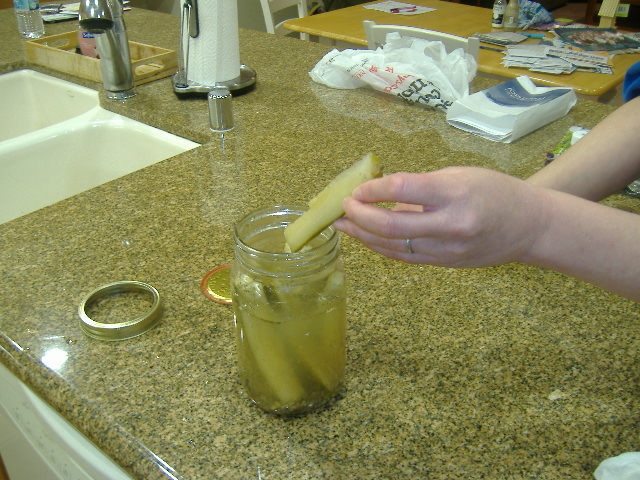
Actually -- I've been intending to write about this subject for quite some time now -- ever since we sampled the 2009 crop that has been brining away in some one-quart canning jars in the pantry of our kitchen. Although I did serve these pickles at our annual Super Bowl party -- I never did get around to sampling them. By the time I reached the dish -- they were gone!

I should have known then.

There are those days -- and men know this all to well -- where you've just got to have a pickle. I'm not sure how and where the mood strikes -- but it does -- and you'd better have some pickles on hand otherwise you're going to be severely disappointed.

Sure enough -- that urge came just the other day -- and I'm pleased to report that the Bird family was well-prepared for the "L'assaut du Cornichon!" (Attack of the Pickle). About 25-to-30 jars of our special and well marinated Dill Pickle creation were on hand -- so you can guess what happened next.

Lovely! It's just about the best word that I can think of when describing the first test of what Venus and I carefully and meticulously canned last summer in our North Natomas kitchen. The basic Dill Pickle recipe comes courtesy of All Recipes. But Venus and I have expanded upon this in recent years with various herbs and spices.

It also helps that all of the spices in question came straight from the backyard -- right down to the dill flowers and the Inchelium Red garlic. About the only thing that didn't come from the backyard garden is the pickling salt. Don't worry though -- we're getting there.

Some of the canned jars also included whole Thai Red Peppers -- which is more than enough to give the pickles a little bit of a spicy jolt! Once you open a jar of these pickles -- said jar doesn't last long. You can't stop at "just one."

Score an assist to Sacramento-area gardener/blogger Carri Stokes for this pefect pickle creation. She came through with some rather interesting cucumber seeds last spring after I'd failed to pick up a starter plant or plant an Armenian cucumber vine from seed. Although Armenian cucumbers aren't listed as pickling cukes -- they should be. Why? They're tough. That crunchy taste doesn't bend to six months in a canning jar filled with vinegar, water, salts and spices. Every pickle that comes out of that jar CRUNCHES like a pickle should.

But -- as it turns out -- the seeds that Carri provided were something special. What came out of those seeds looked like an Armenian cucumber vine -- but the cucumbers were some of the strangest creations I've ever seen come out of a cucumber patch. Armenian cucumbers are normally light green in color and ribbed. As you can plainly tell from this photo -- what we got was something that was sized like your average Armenian cucumber -- but it was a dark green with less ribbing.

What gives? It turns out that Carri had planted her Armenian cucumber next to another variety called a Suyo Long -- a Chinese variety that produces long -- slender cukes that are dark green and quite bumpy. I knew these cukes weren't Suyo Longs. They weren't the standard Armenian either. What were they then? It appears the two plants cross-pollinated at some point -- and that cross-pollination continued with the next generation. I had a cross.

I must admit -- I was a tad worried last summer. But not anymore. The cross produced the best of both varieties -- and resulted in the best darn pickle I have ever tasted in my life -- bar none. These are truly incredible -- and will be in high demand later this summer during the last week of Legislative Session at the State Capitol in Sacramento.

This is also known as Legislative Hell Week or "The Crush" in some circles. It's a time when lobbyists of all shapes and sizes prowl the hallways in hopes of getting a bill passed -- or even defeated in some cases. The particular Senate Office that I serve in is also the office for the Vice-Chair of the Senate Rules Committee. And it's a long-held Capitol tradition that this office is opened to lobbyists during the final week -- so they can have a place to sit down and relax for a minute -- while helping themselves to coffee, soft-drinks and assorted snacks that are provided.

Last year -- as sort of a lark -- I brought in a jar of our home-canned pickles to provide an alternative to the pre-packaged snacks of pretzels or peanuts. They sat there for a few hours -- bypassed by many -- until a transplanted Upstate New Yorker turned California lobbyist found them. After that? The pickles vanished in the space of minutes. The next day? I brought in another jar. Same result: Gone in Sixty Seconds.

I would soon come to find out that the pickles reminded this particular lobbyist of a corner deli back home. But he also assured me that mine were much better -- and his attention to those jars (here, try this!) created somewhat of a feeding frenzy. I made a promise to the many new fans of our home-canning efforts that day. If I was still in the same office next year? The pickles would return.

I supose I also owe Carri a jar or two. Perhaps she'll part with some Limoncello? Fat Chance!

A Lizard's Ball Sack

Monday, March 29, 2010

Hmm...

Let's just roll that one around in the back of ye olde cranium for a second or two -- shall we?

During my eons of professional radio broadcasting education at Fresno State University -- the all-knowing professors instructed us to write flowery prose that created an image in the listener's mind. Instead of the line; "it rained real hard here today," we came up with image provoking lines of; "there's a small lake forming at the intersection of Shaw and Cedar Avenues..."

Imagine the image that comes to mind when you think of the phrase: "A Lizard's Ball Sack."

On second thought -- don't.

Yet -- that is how the "significant other" of a well-known Sacramento gardener describes the "look" of an artichoke that is slowly emerging from the center of an artichoke plant. After hearing that line -- suddenly my excitement vanished. My taste for all things "artichoke" went south (probably to Fresno). All I could think of was: Look at Bold Line Above.

First -- I really don't know what a lizard's private parts look like. Secondly -- I really don't want to know. Yes -- we do have small lizards that scamper about here in the wilds of North Natomas. No -- I am not inspecting the private parts of said lizard. And -- in case you were wondering -- no -- I'm not about to "go there."

I don't think the lizard would appreciate the inspection either -- but that's just a guess on my part. I haven't questioned a lizard lately. Have you?

Image provoking comments aside -- I don't think I'm going to surprise anyone with the statement of: Spring Has Sprung. It's fairly obvious. Vast fields of yellow mustard are blooming like mad in North Natomas. The daffodils popped early in February and now the tulips have shown up. The shower of blossoms that emerged from the Santa Rosa plum has come and gone -- and now? We have artichokes.

What's the big deal? Well -- number one -- I think this is the first time I've seen them pop this early. Usually? The first buds on an artichoke plant don't emerge until early to mid April. By the time May and June rolls around? It's fresh artichoke season in the Sacramento Valley. It does coincide somewhat with the start of artichoke harvesting efforts on the coast -- which means the grocery store headlines of "Artichokes: Five for $5" isn't all that far off.

But -- again -- I'm partial to what comes straight out of my backyard. I grew them. I know exactly what I put into them. I know exactly what I'm getting. And what I'm getting is some of the best artichokes you'll find anywhere. My guess is Venus and I will be harvesting the largest 'chokes in another week or two. It sort of depends upon the weather.

Speaking of the weather -- the series of rainstorms that is supposed to hit the Sacramento area this week is coming at an opportune time for backyard artichoke enthusiasts such as myself. I've discovered through experimentation that a heavy dose of water and fertilizer through the prime growing months results in large harvests of not only large artichokes -- but 'chokes that are just as tender.

Yes -- you'll still get artichokes without the increased attention to water and fertilization. The first harvest will still be pretty good. But the second, third and dare I say fourth, harvests will result in artichokes that are smaller in size -- and worse yet -- tough to chew on. How tough? How much do you like chewing on leather?

The wonderful wife that is Venus and I are sharing fertilization duties this year. The lady has hit upon a super-secret (so secret that she won't even tell me) mix of liquid organic fertilizers and I have been spreading nitrogen-rich -- time-release fertilizers such as Osmocote and other pelleted plant foods.

Is there such a thing as too much love for artichokes? If there is -- we haven't found it yet. Lord knows -- we're trying various experiments from year to year. It just doesn't seem to matter much. The more love that you show artichokes? The more love that they will show you in terms of a prolonged harvest.

How long will the harvest be? That depends upon Mother Nature. If the Grand Dame provides us with pleasant spring-time temperatures in the mid 70's to lower 80's -- you can stretch an artichoke harvest for three months. BUT -- the moment the mercury rises above 90? Kiss the season goodbye. The large plants don't like the heat much.

At that point -- they shut down -- die back -- and wait for the cooler breezes of fall. That's when the life cycle begins anew.

As for varieties? That's a good question. Venus and I know we have different varieties of artichokes that are growing out of the same bed. They're easy to spot. But the names were lost years ago. The artichokes that you see in these pictures started from four starter plants that were purchased from an Elk Grove area nursery in the spring of 2003.

They have survived year after year after year of abuse. They have even survived a transplant from one backyard to another. Just like the old Timex watch -- "they take a licking and keep on ticking."

Strangely -- that line brings back the image of a lizard's ball sack.

Pinkston -- clearly -- wants to change the subject.

The World's BEST radish!

Monday, March 22, 2010

Okay -- perhaps I'm showing a little "Homer Instinct" here. It might not be the "World's Best Radish." It might not even be the 2nd best. It might not even be selected for "runner-up" in the "Best Mutt" contest where the prize is two weeks in Bakersfield (1st place is one week in Bakersfield).

But I'm of the belief that the best produce in the world comes straight from your backyard garden. And -- thanks to a solid ten days of GORGEOUS weather in Northern California -- our North Natomas garden is "putting out."

Case in point? These lovely little radishes came straight from the raised gardening beds and went straight into last night's salad -- as did some various salad greens -- green onions -- garlic chives -- various fresh herbs and spices and whatever Mother Nature was good enough to bring us on Sunday.

Of course -- it does also help quite a bit that the wife that is Venus has discovered the magic of Omega 2000 and other liquid organic fertilizers that really pack a punch in the garden. That little lady will spend hours fertilizing every little last spot in the garden. And this is the result after a month of once-a-week treatment.

It's not just the radishes either. The fruit trees are popping. The peach trees are loaded - as is the Santa Rosa plum. The cherry trees are flowering like nobody's business. The hybrid tea roses -- tree roses and Floribunda roses are getting ready to pop open. The new plantings of nectarines -- pluots and table grapes are also showing decent signs of life.

This is what I like to call our "salad spring." Unfortunately, it doesn't last as long as Venus and I would like. But -- during this time of year -- you can literally harvest a salad a night from the backyard (minus the fresh tomatoes, of course).

The best part? In my opinion? Well -- I've always been a fan of radishes. I think it may have been the first thing that I planted in a garden as a small boy (radishes are easy). But -- in my humble opinion -- there's just something special about radishes that come straight from the backyard and onto your plate.

There's a bite there -- on the tastebuds -- that you just don't get from the store-bought varieties. Or -- perhaps you do -- but it's just not quite as strong. Plus -- you're not getting the "standard red radish" from the backyard. Oh no -- you're getting a taste of the Watermelon Radish -- or perhaps the French Breakfast. There's nothing wrong with the wild colors of the Easter Egg radish and the giant white April Cross makes for interesting dinner conversation.

Crunch, crunch people. It's fresh radish season! And -- if you're thinking that "I've missed the boat" -- think again! Plant seeds now to enjoy bumper harvests through mid-June. At some point the weather will turn just a tad too warm for radish growing endeavours -- but there's plenty of time left in fresh radish season.

"Adventures in" -- Check That -- "Errors in Gardening!"

Tuesday, March 16, 2010

The sun is shining! The ground is drying out! It's time to get out there and DIG to my heart's content!

Not so fast, Needlemeyer.

Unfortunately -- I came up with a perfect time to get infected with a disease known simply as "The Crud." You know what this is. Chances are -- you've already had it. You know? The symptoms include hacking cough, congested chest, the chills? Just when you think you're coming out of it -- it suddenly gets worse? Or -- when you think that it can't possibly get any worse -- it does?

Yeah -- that's "The Crud." And I have it. Lucky me. Just in time for Spring!

What is a gardener to do then? Unfortunately -- not much. I got this case of "The Crud" from the wonderful wife that is Venus -- who did battle with it all last week. This "stuff" has been making the rounds at work -- knocking people out and off the job for anywhere from a week to ten days. It's just downright nasty. In response -- I had been consuming two oranges -- or an orange and an apple -- every morning for months on end -- hoping I could fight this off.

You know the old saying? An Apple a Day Keeps The Crud Away? No, Needlemeyer, it don't.

There would be no post-hole digging this past weekend. Besides -- the Friday rain had pretty much washed away all possibilities of installing the second and final half of my table grape arbor. I mean -- it's tough to sink posts when the two foot post-holes you dug the previous weekend are filled with two feet of rainwater.

What's that? Bale them out you say? With what? A soup ladle? Be my guest. Besides -- I tried that. The ground was so saturated with rainfall that whatever water got taken out was immediately replaced. No -- there would be no sinking of the posts this weekend.

So -- what is a sick and frustrated gardener to do then? Just WASTE AWAY the first sunny and nice weekend of 2010? Stay inside and watch TV? Take a long afternoon nap? HEY -- THE SUN IS SHINING!

Well -- there was one project that I could do that wouldn't take much physical effort. See that nice little section of bare clay soil to the right? That's a small patch of ground against the back side of the house that desperately screamed for beautification. This patch of ground has frustrated me for quite some time. At first -- I had planted a camelia bush back there -- thinking that the shade of the house would protect it.

Bad idea. Oh -- the camelia got protection alright. But it was protected from the morning sun. By the time the clock hit High Noon -- that camelia got a full-on blast of summer heat and summer sunshine. It wilted against the heat. Leaves would burn and fall off. Nope -- as the wife pointed out last spring -- it wasn't going work. So I dug that camelia up -- moved it to another shady location (where it's very happy I might add and finally bloomed for the first time this year) -- and replaced that camelia with two tree roses.

While the roses did well -- as you can tell -- that area needed "more." That hard clay soil just looks ugly -- plus the weeds get to be problematic. The retired-rocket-scientist father-in-law who also serves as my landscaping inspiration suggested filling the area in with bark -- which wasn't a bad idea -- but I wanted more.

I do have a growing pile or collection of scrap wood from earlier box building efforts. Why not use that to build a small flower box the retired-rocket-scientist father-in-law suggested? I must admit -- it wasn't a bad idea. I did have four, two-foot long sections of 4X4 posts that I had shaved off from the posts I had purchased earlier for arbor-building efforts. Why not "recycle and re-use?"

It was about that point where the retired-rocket-scientist father-in-law asked the simple question of: Why did you purchase four, eight-foot long, 4X4 posts and cut two feet off?

My answer: "Because I needed six-foot posts for the arbor, Gale."

His response: "Why didn't you buy two, 12-foot long, 4X4 posts and just cut them in half?

I hate engineers. They're just so smug. And they're so right. As I stood there -- soaking in his simple advice -- I realized he was right. It was right about that time that I started to feel like -- and resemble -- a Jack ***. DOH! "Error in Gardening" Mistake #1.

It was also about that time that I realized that I didn't have quite enough of those two-foot sections to make the flower bed that I wanted. What I wanted was to be four feet long and two feet wide. That would require six, two-foot long sections of leftover 4X4 posts. I only had four.

Know what this means?

Back to Home Depot! Because -- Bill Bird just can't make ONE gardening error. There's got to be SEVERAL. Sooooo -- back I went -- fervently hoping the entire time that Home Depot did not stock the 12 foot sections of 4X4 posts that the retired-rocket-scientist father-in-law had suggested. Guess what? They did. DOH! "Error in Gardening" Mistake #2.

But I needed those two-foot sections that are the result of buying eight-foot-long, 4X4 posts and cutting two feet off. And so -- that's what I did. I bought four more eight-foot-long, 4X4 posts -- had our handy-dandy Home Depot associate cut two feet off each -- loaded everything into the car and headed home. It wasn't a terrible waste you understand. The six foot sections of 4X4 posts will be used for the second arbor. And I finally had the missing two-foot sections I would need to complete the flower bed project.

To the engineers who are reading this post (Garry) -- you have probably guessed by now what "Error in Gardening" Mistake #3 will be. I needed two, two-foot sections of 4X4 posts to complete the flower bed project. But -- instead of coming home with just two -- I came home with four. DOH! Suddenly -- the size of the flower bed in question expanded to six feet in length.

As I began to assemble this bed with my handy-dandy Makita drill and gold screws -- it suddenly dawned on me that I didn't have the necessary number of metal straps and reinforcements this "flower bed" in question would need. These pressure-treated posts are much heavier than the "Lincoln Logs" I had used earlier for other box building efforts. What I had at home just wasn't going to suffice. The bed in question to your right would need more -- otherwise it would just fall apart.

Back to Home Depot, Needlemeyer! I needed tin straps. I needed metal straps. Fortunately -- this was a short trip. There would be no "Error in Gardening" Mistake #4 (unless you want to call this entire endeavour one huge mistake). Putting together a box like this is quite easy -- and moves quickly -- when you finally have the parts that you need. Although I was tiring quickly from "The Crud," work progressed smoothly from that point forward.

But -- building the box is only half of the project. It's also the easiest part of the project. Moving the bed into the correct space -- centering the bed -- and finally -- leveling the bed isn't easy. The hard clay soil isn't level. Plus -- the box needed to be even with the surrounding concrete -- which it wasn't. And -- you can't forget about irrigation. Installation of drip irrigation must be done before the first cup of planter mix is placed inside the bed -- otherwise -- you've got problems.

Hard work? You bet! But at some point -- you do begin to see the payoff. Venus and I have spent years installing different gardening beds for different purposes. Some hold our famous heirloom tomatoes. Still others hold potatoes, peppers, onions, garlic, cucumbers, okra, lettuce and other greens.

We've dug multiple holes and built other boxes for fruit trees and fruit bushes like blueberries, thornless blackberries and thornless boysenberries. While we still have room to add a few other things (I never did get around to planting an Owari Satsuma Mandarin) -- the last part of our landscaping effort involves "beautification." It's the last step in any landscaping process. You get the essentials in first -- and beautify later. You don't want to dig up a lawn later -- or rake away bark or landscaping rock -- because you forgot something important.

And so -- this is how this one small area looks now. It's the one section of the yard that I can point too with all honesty and say "job well done." It's a small section to be sure -- maybe four feet wide and ten feet long -- but it's done now. Soon -- this is how the rest of the yard will look. We're not "there" yet. It's going to take another year or three before we can say "we're done here."

But we're getting there, Needlemeyer. We're getting there.

Of Artichokes N' Blooms

Thursday, March 11, 2010

Excitement Level = HIGH!

We're getting close to Bill & Venus Bird's favorite part of the year. More so me than the lovely wife -- but Spring is getting ready to Sprung in ye olde North Natomas Back 40.

The wife loves this time of year too -- don't get me wrong. But she can hardly wait for the 100-degree nights (sans Delta Breeze of course), Johnny Miller calling the play-by-play on KNBR, cats chasing after insect ghosts in the dark backyard night and a refreshing drink containing high-class gin that comes from a plastic bottle.

Now that children -- is a good time for all. I happen to like it too.

Winter is a bit of a bummer for us backyard enthusiasts. Yeah -- you receive reams of catalogs to go through. Seeds must be ordered. Gardens must be planned. But that's all INDOOR work. Meanwhile -- for those of us who would rather be outside in the garden -- all we can do is look out the window at the downpour.

But the first hint of spring for us? That's when the daffodils burst open. We got quite the show this year. Next up? The Santa Rosa plum tree turned bright white with a thousand blossoms.

And now -- finally? The artichoke plants are beginning to perk up and look like artichoke plants again. In another month or two -- the first artichokes will begin to emerge from the nine or ten artichoke plants in this bed. By mid-May? Artichokes will be on the menu just about every night for supper.

There's nothing quite like a meal of a big, meaty artichoke, some melted butter, garlic salt and fresh herbs from the garden. It is Heaven on Earth.

I was a tad worried though -- earlier this year. The freeze that hit in December really walloped the artichoke plants that had emerged last fall. Usually -- artichoke plants emerge in the fall and grow right through the winter months. They are usually quite gargantuan by March and April. But something strange happened this year.

I'm not sure if it was the December freeze or perhaps a neighbor got a tad too generous with some Roundup -- as our plants started to die back in January. Some of the damage -- as the photo to the left illustrates -- is still with us. There was a time when every plant looked exactly like that one leaf. I'd never seen it before.

But -- thinking this could also be freeze damage -- I followed the advice of other well known gardeners who advised "leave it alone." It's true that artichokes do love cold, foggy conditions. But they draw the line when the mercury drops too far -- as it's been known to do in Sacramento. Give them a coastal climate and they'll shower you with love and artichokes.

Most of the time -- we have that. But there are those "exceptions..."

I'm not only happy to see them bouncing back -- but the return of my natural bug hunters brought a big smile to my face. I'm not exactly sure why ladybugs are so wild about my backyard -- but I have them in abundance. They are the best control that I have against the aphids and other pests that will begin munching on the artichokes and artichoke plants later this spring.

Eventually -- the aphids and the heat will always win out the day. But the ladybugs do their part in keeping the bad characters away. Now -- don't get me wrong here. You can't just cut -- steam and eat on home-grown chokes -- unless you really like getting a mouthful of yard critters. They love hiding ON and INSIDE the artichoke.

The best defense then? A good salt water bath is a must once you've brought them inside to prepare for that evening's meal. A good 30 minute soak in a salty brine will remove most of the bad actors -- and you'll be surprised to find out just how INFESTED these things can get.

Bill Bird -- and an overabundance of bugs -- love artichokes.

If you desire artichokes as big as your hand for dinner -- the time to start preparing for that experience is now. I fertilize my artichoke plants regularly -- with both organic and non-organic materials. The plants get a least a gallon of water mixed with Omega 2000 and Maxicrop every week and I also distribute several cups of Osmocote brand fertilizer in the bed during the month of March.

As the weather warms and the plants begin to produce? Normal watering schedules go by the wayside. The bed is soaked thoroughly with a hose on a low stream of water at least twice a week.

This method usually results in a first crop of artichokes that will be large -- meaty and very tender. Successive crops will result in smaller artichokes. And -- as the weather really begins to warm in mid-June -- artichokes take on the consistency of leather. They're still good mind you -- but tough on the teeth!

Perhaps more experimentation is needed? We will be expanding our artichoke planting efforts into a second bed later this spring. The bed is built -- but isn't irrigated yet nor do I have the required planter mix. Put that on the list of "projects to be completed later this spring."

I never do get to all of them.

Oh -- I promised BLOOMS! And here you go! This is another reason to get excited about the approaching change in seasons that is spring. The two peach trees in the backyard are flowering like nobody's business.

Although there are some growers who reccommend that you don't allow a peach tree to produce ANY fruit for the first three years -- well -- I couldn't wait. This O'Henry Peach tree produced a few peaches during the first year. Last year? An avalanche of peaches. The tree had to be culled regularly to keep branches from bending and breaking under the weight of loaded peaches.

As for Year 3? While I really should pull each and every peach from the tree and allow root systems to develop -- you should know me by now. There's peach pie to be had later this summer!

Blogging: Easier Than Digging Post Holes

Sunday, March 7, 2010

File that one in the "No Duh, Sherlock" department.

I just hurt all over. No -- not from the project pictured to the right. I hurt because of the project that I tackled AFTER creating that little rose and flower garden. Digging post holes is no darn fun. Digging post holes in muddy clay soil is REALLY no fun.

And I still have one more to go....

But -- I digress. Although my thoughts remain with a very ill gardening friend -- life goes on. It must. Flowers will flower. Roses will bloom. Peaches will grow. Heirloom tomatoes will ripen. Life happens. Katie would have wanted it that way.

But -- to honor our friend and beautify the yard at the same time -- Venus and I completed a project over the weekend that we call "Katie's Spot." Katie will like it because soon -- this spot will be full of flowers -- which matches her flowering personality. Perhaps -- if I'm lucky -- I can get Katie to weed it later this summer (fat chance!).

I've been meaning to tackle this project for quite some time -- but there were always other "pressing duties" that needed to be taken care of first. This hybrid tea rosebush -- Blue Girl -- was transplanted from our old home (now a rental) to the new backyard three years ago. I put it in a side yard -- hooked up some irrigation -- and there it sat.

Sure -- it looked pretty. But it was all alone. Hybrid tea rosebushes need company -- they really do. No -- they don't get lonely. No -- they don't have "isolation issues." The plain fact is that hybridizers have put so much work into the top of the rose -- where it flowers -- that they've kind of ignored the bottom.

This is how it looked earlier this year when I pruned back a lot of last year's growth. Compare the photo to your left to the one above. Quite a big difference eh? Now imagine that soil filled with a mix of perennials. It should put on quite the show.

Another point to consider is that the bottoms of hybrid tea rosebushes can get kind of ugly as the summer wears on. The first leaves to emerge on a hybrid tea rosebush are at the bottom. Those are usually the first to catch some sort of disease or be eaten away by some bug. They drop -- and sometimes the bottom of a pretty hybrid tea rosebush can look bare and ugly.

So why not beautify the area with some "Rocklin Rocks," a little bit of bark, some Coreopsis, Butterfly Flowers, English Daisies and other selected perennials? The flowers serve a double purpose. Not only will they look pretty and draw attention to the showpiece at the top (the actual roses) -- they also serve to hide that bare spot that invariably develops at the bottom of the rosebush.

And the rocks? We call them Rocklin Rocks for a reason. Why? Cause we got them in Rocklin -- that's why. A few years ago -- when developers couldn't build homes fast enough -- giant bulldozers turned over acres of soil for new housing subdivisions and new commercial shopping centers.

Have you ever tried to dig a hole in a Rocklin backyard? They call the place "Rocklin" for a reason. Chances are -- you're going to hit big boulders the moment the shovel hits the soil line. Venus and I would find piles and piles of these rocks during commercial building efforts -- and just help ourselves.

They make for an attractive border, no? And the best part is -- they're FREE. That's a good selling point for frugal folks like us (you can also substitute the word "cheap" in for "frugal").

I have a feeling that Katie will like the arrangement because:

1. Flowers match her flowering personality
2. Roses smell good
3. It's not a lawn (Katie doesn't like lawns)

Next week's project? Installing my acre-sized lawn!